
Reformist Prison Theology: God The Slave, God The Prisoner
George Walters-Sleyon
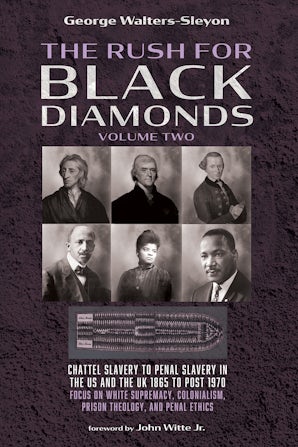
This essay is an adapted excerpt from the twelve chapter of George Walters-Sleyon’s book,The Rush for Black Diamonds, Volume Two: Chattel Slavery to Penal Slavery in the US and the UK, 1865 to Post-1970 Realities (Cascade Books, 2025). You can view an excerpt from Volume One: From John Locke to Thomas Jefferson—The Transatlantic Slave Trade to Chattel Slavery in the UK and the US here. Used by permission of Wipf and Stock Publishers.
This chapter argues for the necessity of a prison theology referred to as a Reformist Prison theology (RPT). The superpowers of the transatlantic slave trade and chattel slavery including the United States, England and Wales, and Scotland have flourished at the expense of trading in Black humanity as the rush for black diamonds. However, the historic continuation of trading in human beings as economic units has only mutated. The post-1970 form of this mutation in human trading is the phenomenon of mass incarceration. Mass incarceration is the post-1970 continuation of the rush for black diamonds.
The cumulative, existential, social, psychological and economic impacts of this mutation from the transatlantic slave trade to chattel slavery to colonialism and eventually to penal slavery as mass incarceration include the emphasis on profit-making, the reduction of human beings to thinghood, and the disregard for human dignity. Reformist prison theology is thus a negation, critique, and alternative analysis to the normalization of this modern mutation of the rush for black diamonds, considering its tolls of prisoner deaths, prisoners as economic units, and industrialization of punishment. It contends that the intersections, influences, and mutations of the transatlantic slave trade, the institution of chattel slavery, colonialism, and penal slavery into the twenty-first century necessitate a theological analysis considering the high rates of prisoner deaths in the US and the UK penal systems. Reformist prison theology provides a theological analysis that reflects on the historical and existential continuity of patterns of death, use of people as economic units, racist disrespect for human dignity, and the consistent mutations of human trafficking as prisoners. Similarly, central to the claims of reformist prison theology are critiques of the following: the cult of White supremacy, the abuses of the Ku Klux Klan, mass Black incarceration during the convict-lease system, mob lynching of Black people, and the present penal phenomenon of mass incarceration of Blacks, poor Whites, and Hispanics in the United States; and Blacks, Asians, and Minority Ethnic groups in England, Wales, and Scotland.
Reformist prison theology grounds its theological formulation in history, human experience, Scripture, and the quest for liberation. It begins with the premise that God is a slave and God is a prisoner. Exploring and analyzing the various dynamics of the transatlantic slave trade, the institution of chattel slavery, and their mutation into the post-1970 penal systems. It reflects on the involvement of John Locke, secretary of the British slave trade and slave trader; Thomas Jefferson, the third president of the United States and a slave master and slave trader; and Immanuel Kant, a prominent Enlightenment pioneer and one of the originators of the theoretical cult of White supremacy as the immediate interlocutors. Reformist prison theology argues that any formulation of a prison theology cannot be separated from what it refers to as Lockean Slavery, Jeffersonian Slavery, and the Kantian cult of White supremacy. As discussed in chapter 1 of this volume, Kant, an Enlightenment pioneer, made some very racially charged statements about people of African descent. While some have come to his defense with the assertions that Kant changed his views to become a champion of cosmopolitanism, Kant’s racial claims about Black people remain a fundamental paradigm in the racial claims of what I refer to as the cult of White supremacy. About Africans, Kant claims:
That their temperament has not become entirely adequate to any climate can also be inferred from the fact that it is hard to find any other reason why this race, which is too weak for hard labour and too indifferent for industrious work, and which is incapable of any culture even though there are enough examples and encouragement in the vicinity [namely, the example set by the European colonial settlers], stands far below even the Negro, who occupies the lowest of all other levels which we have mentioned as racial differences.
This research maintains the view that like Locke, Jefferson, and Kant’s views on Black people have been historically influential on subsequent German intellectuals. This includes Hegel’s view on Black Africans and in Western academics, policy makers, the White religious communities and individuals, and White nationalist groups, including the KKK.
Reformist prison theology provides a theological critique of the post-1970 penal developments, especially their historical normalization of mass incarceration of the poor and racially marginalized in the United Kingdom and the United States. With no respect for the sanctity of human life and dignity, the modern penal developments of the US and the UK are grounded in gross forms of capitalistic interests and racial stratifications.
Reformist prison theology advances the need to reimagine a penal system based on fairness, judicial equilibrium, and human flourishing. This kind of theological discourse is constructed with the awareness that the high rates of prisoner deaths—convicted and not convicted—in the United States, Scotland, and England and Wales necessitate a reevaluation of the post-1970 concepts of punishment.
Ideologies and practices of the modern penal systems of these nations represent the structures of historical bondage and the persistent “cultural production of evil.” The Black community in the United States and the United Kingdom defines mass incarceration through the horrors of the industrial slave trade, the institution of chattel slavery, Jim Crow, the Black Codes, the convict-leasing system, and finally, the horrific experience of Black lynching. As prophets of Western intellectual and political histories, Locke, Jefferson, Kant, Hume, Hegel, and French philosophers including Voltaire vehemently denied and argued against Africans receiving the European civility of justice, fairness, respect for human dignity, and equity, to justify chattel slavery and the cult of White supremacy.
Reformist prison theology negates the historical practice of penal industrialization. There are no justice and no fairness in penal industrialization and penal slavery. The post-1970 penal systems of the United States and the United Kingdom produce structural and systemic bondage for the poor and racially marginalized and are often responsible for “concentrated forms of generational impoverishment.”
In Locke’s empiricism, experience alone serves as the foundation for knowledge. Locke rejects any reference to innateness or revelation as a credible source of knowledge. His theory of knowledge is natural and material. Knowledge must be derived from the five senses. As an empiricist, Locke emphasizes reason over faith, intuition, or revelation. Experience is also fundamental to the formulation of the reformist prison theology. It provides an immediate context for the theological investigations of human suffering. However, experience is not the only ground for knowledge. Experience plays an essential role in analyzing the post-1970 penal developments from the perspective of those who have been historically imprisoned. Notwithstanding, unlike for Locke, experience is not the sole means of knowledge. Reform prison theology is divine theology and liberation theology. It seeks the liberation of the poor and historically racially exploited by the nations of the United Kingdom, the United States, and the rest of the superpowers of the transatlantic slave trade and chattel slavery.
Considering the various phases of transition in human suffering in the United States and the United Kingdom, reformist prison theology provides an analysis that reflects on the plight of prisoners as a theological concern. In the twenty-first century, the penal targets have increased with Blacks, Asians, and Minority Ethnic groups in the United Kingdom, and Blacks and poor Whites in the United States. However, the identity of the Black person in the West has never been that of a complete human being—accepted, accommodated, and allowed to fully participate with-out racial inhibitions in the West’s sociocultural, political, economic, and even religious institutions and worldviews. After the sixteenth century in the West, the Black person has been perceived and treated as a slave. The economic utility of Black people emerged into an eclectic social consciousness that mutates from the slave trade to chattel slavery to colonial slavery to penal slavery and, presently, the post-1970 phenomenon of mass incarceration. With the end of slavery in the nineteenth century, the Black person became a penal target with the identity of a criminal.
According to the Thirteenth Amendment, punishment in the United States criminal justice system is legal slavery. An essential argument of reformist prison theology is that God is a slave, God is a prisoner, and God is a deliverer who comes to set the captive free from the bondage of Lockean slavery, Jeffersonian slavery, and penal slavery in the United States and the United Kingdom. God is a slave with the enslaved people in the transatlantic slave trade and chattel slavery, and the mutation of that practice and experience into the post-1970 penal phenomenon of mass incarceration. God is a prisoner who remains imprisoned with the prisoners of the post-emancipation penal practices and experiences of the Black Codes, the convict-lease system, and the existence of the “slavery as punishment” clause of the Thirteenth Amendment in the twenty-first century. God is a deliverer in the post-1970 prisons, jails, and remands of the US and the UK. Imprisonment is suffering and death associated with longer-term and indeterminate sentences in the US, England and Wales, and Scotland. The angst of this form of imprisonment is reflected in the increasing rates of aging, terminal illness, dying, suicide, death, and the economic use of prisoners. Thus, the necessity of a reformist prison theology. ♦

George Walters-Sleyon is an Author, Professor, Speaker and Consultant with an interdisciplinary and broad international academic background. He has served as a keynote speaker, presenter, and panelist at conferences in the US, the UK and Africa. He has published several articles and books: Locked Up and Locked Down: Multitude Lingers in Limbo Revised Edition; Nuggets from the Night: An Anthology of Poetic Expressions; Prison Chaplains on the Beat in US and UK Prison Caring for Aging, Dying, and Dead Prisoners; and God in the Name of Jesus Christ.
Recommended Citation
Walters-Sleyon, George. “Reformist Prison Theology: God The Slave, God The Prisoner.” Canopy Forum, January 28, 2026. https://canopyforum.org/2026/01/28/reformist-prison-theology-god-the-slave-god-the-prisoner/
Recent Posts