“Drakeman’s Faint-hearted Originalism” by Andrew Koppelman

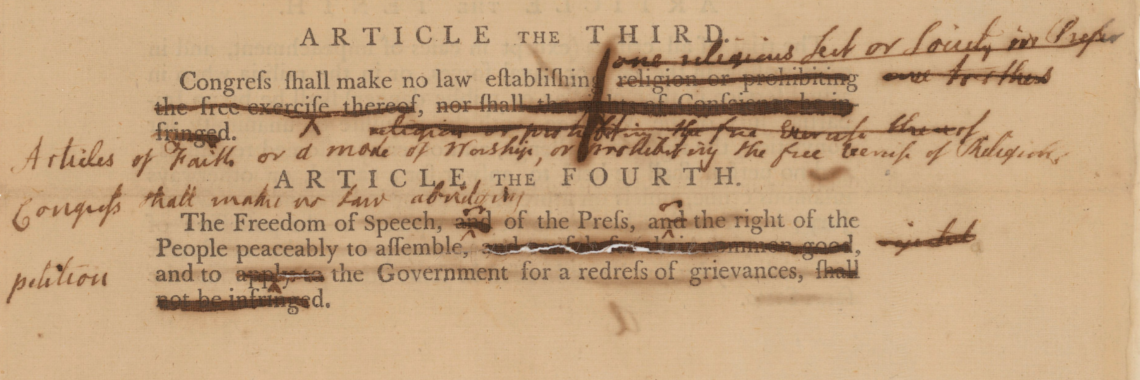
Senate Revisions to House Proposed Amendments to the U.S. Constitution, National Archives (US-PD) On October 15, Canopy Forum, hosted by the Center for the Study of Law and Religion, will be organizing an online book symposium regarding Donald L. Drakeman’s upcoming book, to be published November 2026, titled The Free Exercise Clause and the Rights of Conscience (Harvard University Press,…

“The Global Legacy Of American Exceptionalism: The Sound of Liberty” by Luca Pietro Vanoni

Page from original working manuscript of Democracy in America by Alexis de Tocqueville, held by Yale University (US-PD) This article is part of a forthcoming series on the 250th Anniversary of the Declaration of Independence. In political and legal discourse, American exceptionalism denotes the idea that the United States is a distinctive political community, both…

“How Modern is the U.S. Constitutional Order?” by Jeffery Pojanowski

The U.S. Constitution on display at the National Archives of the United States by APK (CC-BY-SA 4.0) This article is part of a forthcoming series on the 250th Anniversary of the Declaration of Independence. This contribution addresses two questions of legal and political theory in connection to constitutionalism in general, and in the United States…

The Free Exercise Clause and the Rights of Conscience, Review by John Witte, Jr.

Senate Revisions to House Proposed Amendments to the U.S. Constitution, National Archives (US-PD) On October 15, Canopy Forum, hosted by the Center for the Study of Law and Religion, will be organizing an online book symposium regarding Donald L. Drakeman’s upcoming book, to be published November 2026, titled The Free Exercise Clause and the Rights of Conscience (Harvard…

“Scandal as a Concept in Anglican Canon Law” by Samuel L. Bray

Chapel dedication at Porter-Gaud School. Courtesy of Porter-Gaud School, used with permission. Recently, a private school in Charleston, South Carolina, dedicated its new chapel. The school has long had an Anglican/Episcopal connection, and its board of directors includes both the bishop of the Episcopal Diocese of South Carolina and the bishop of the Anglican Diocese…

“Gods, Judges, and Presidents: Trifunctional Archetypes in American Law and Government” by Charles Lincoln

Gods, Judges, and Presidents and the Sacred Grammar of Constitutional Authorityby Charles Edward Andrew Lincoln IV The following is an introductory essay to Charles Lincoln’s recently published book, Gods, Judges, and Presidents: Trifunctional Archetypes in American Law and Government (Bloomsbury Press, 2026). The American Constitution is usually introduced as a diagram. Congress legislates, the President executes, and…

“De-Mystifying the Sino-Vatican Agreement: What Post-Vatican II  Agreements Reveal About Law, Papal Diplomacy, and China” by Thomas Ching Wei Tu (凃京威)

The St. Ignatius Cathedral in Shanghai in Shanghai, China (National Cathedral Church of China) by 钉钉 (CC-BY-SA4.0) In September 2018, the Holy See and the People’s Republic of China signed a historic,  but largely secret Provisional Agreement on the appointment of Catholic bishops in China. Provisional treaties made by the Holy See are signed, but…

“What distinguishes humans from AI robots? An Islamic perspective” by Mariam al-Attar

ChatGPT Rendering of AI via Wikimedia Commons (US-PD). In recent decades, philosophers have intensely debated the meaning of personhood and what it means to be human. Some have sought to blur the lines between human beings and non-human animals, while others challenge the distinction between humans and machines. The rise of “enhanced humans” and AI…

“Going Dutch with the American Founders” by John Witte, Jr.

Last page of the Union of Utrecht, 1579, Nationaal Archief (US-PD) This article is part of a forthcoming series on the 250th Anniversary of the Declaration of Independence. In his Pulitzer Prize-winning volume on The Ideological Origins of the American Revolution (1967), Harvard historian Bernard Bailyn pointed to five major sources that helped drive the American revolutionaries…

“Traces of Ancient Rome in the Declaration of Independence” by Umberto Vincenti

“Gallery of Views of Ancient Rome” by Giovanni Paolo Pannini, 1758 (US-PD-Art). This article is part of a forthcoming series on the 250th Anniversary of the Declaration of Independence. The issue of the cultural foundations of the Founding Fathers and of American constitutionalism in general is, perhaps, more apparent than real and, in any case,…