Obligations of the Sacred and the State: When Walking Away Is the Dharmic Act
Sai Santosh Kumar Kolluru
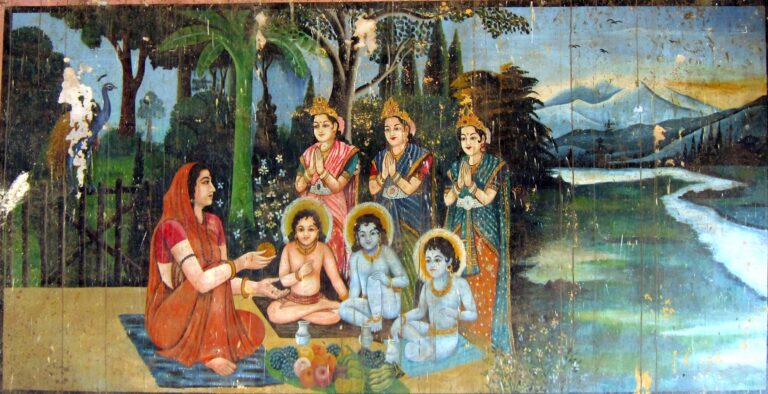
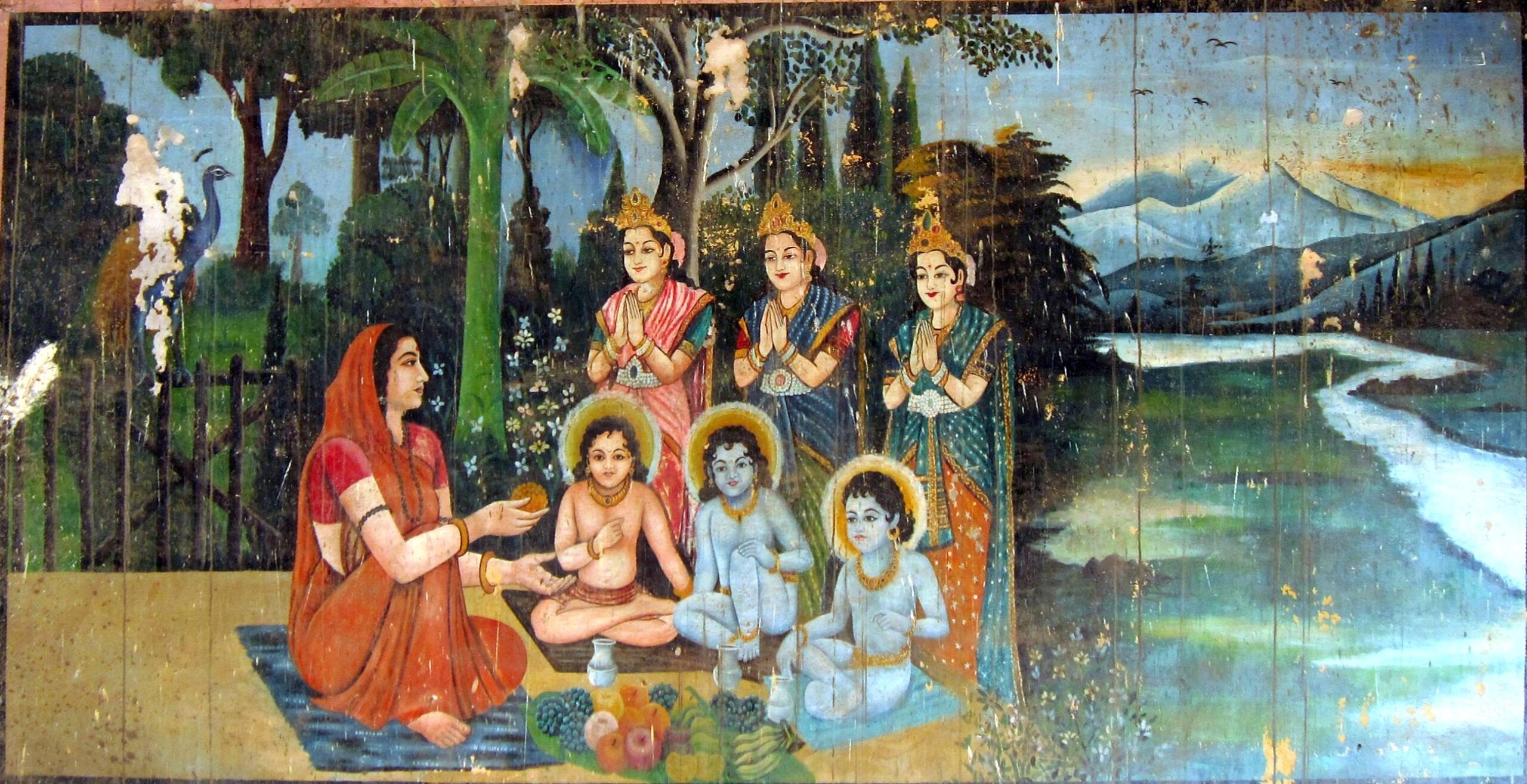
Anasuya Feeding the Hindu Trinity, painting on the wall of the Krishna-Sudama Temple of Porbandar (CC0 1.0).
In The Illusion of the Repugnant Client: Hindu Ethics in American Legal Practice, I argued that the concept of an inherently repugnant client is incoherent from a dharmic perspective, that the Hindu-American lawyer’s svadharma demands zealous representation of a client’s rights and liberties, not a moral verdict on their person. Karma yoga, the path of selfless action, transforms the practice of law into sacred service. The Advaitic recognition of the divine spark in all beings dissolves the very ground on which repugnance stands. Dharma finds its truest expression not by circumventing the crucible of the courthouse, but by passing directly through it. But what happens when the institution itself forfeits its claim on the government lawyer’s dharma?
A mentor of mine, one of the most dedicated executive branch government lawyers I have had the privilege of knowing, recently left public service. For her, it was never merely a profession. It was a calling. What breaks a covenant like that? What makes a guardian of the rule of law conclude that her dharma lies elsewhere? What does Hindu ethics have to say about that moment of departure?
This essay attempts to answer these questions and concludes that when the moment of departure arrives, the government lawyer does not walk away from dharma, but toward it.
The Dharma of the Government Lawyer: A Sacred Covenant
To understand when walking away is justified, or required, we must first understand what draws certain people to government lawyering and why, for them, it is never merely a job. The private lawyer’s commitment is to her client. She measures success by outcomes secured, deals closed, verdicts won. The government lawyer’s north star is not a client in any ordinary sense—it is the constitutional dharmic order, the public trust. The lawyers drawn to that work tend to understand, from the beginning, that they are not maximizing anyone’s private interests. That distinction, between winning and preserving, is what makes government lawyering a vocation rather than a profession, and what makes its betrayal, when it comes, feel like something closer to apostasy than resignation.
Hindu thought distinguishes between two broad categories of dharma. One is sāmanya dharma, the universal duties: they include satya (truthfulness), ahimsa (non-harm), asteya (non-corruption in the broadest sense), shaucha (integrity), and dama (self-restraint). These apply to all human beings regardless of station. The other is vishesha dharma, the particular duty tied to one’s specific role, position, or stage of life. Within vishesha dharma, svadharma is the most personal formulation: the duty that arises from one’s own nature, one’s particular constitution of qualities (guna), one’s place in the web of relationships and obligations at a given moment in time.
The Bhagavad-Gītā’s teaching is that one cannot outsource her dharma to someone else’s framework. As Krishna insists to Arjuna: “Better is one’s own dharma, though imperfectly performed, than the dharma of another well performed” (BG 3.35). Svadharma is rooted in svabhava, one’s deeper nature, and in the actual conditions one finds oneself in. This is where Hindu thought becomes subtle. Svadharma can be misidentified as role-loyalty when it is actually something deeper. A military lawyer’s svadharma is not unconditional obedience to command; a civilian lawyer’s svadharma is not unconditional defense of the superior, client, or institution employing them.
Sāmanya dharma is the ground from which all particular dharmas derive their legitimacy; svadharma is only dharma at all because it is in service of sāmanya dharma. When a specific role begins to require the systematic violation of these universal principles, demanding that you defend what you know to be unjust, that you remain silent about what you know to be harmful, that you subordinate truth to institutional interest, then the role has ceased to be an expression of dharma.
For a government lawyer, the svadharma attached to that role carries a particular tension. Colin Black’s Renewing Our Vows: The Lawyer’s Oath and Our Pledge to Democracy explores this unique position at the intersection of legal advocacy and public accountability. He writes, government lawyers are “responsible not only for representing the government in legal matters but for ensuring that the actions of government officials comply with the law” (23) and that their legal opinions and interpretations shape policy direction and public perception of government legitimacy often without the check of judicial review. Indeed, in this specific arena, government lawyer’s unique capacities and moral sensibilities find their fullest expression; they must be prepared to refuse to defend actions they believe are unconstitutional, even at the risk of political or professional repercussions, weighing the public interest and the integrity of the legal system over the interests of individual officials.
When these layers fracture, svadharma calls for examination.
The Svadharma of a Government Lawyer
More precisely, understanding why departure can be a dharmic act requires first understanding what the government lawyer’s svadharma actually demands.
Written in the aftermath of the Bush Administration’s post-9/11 legal controversies, the OLC torture memoranda, warrantless surveillance, and the politicized firing of U.S. Attorneys, a Note from the Harvard Law Review, Government Counsel and Their Obligations, examines the government lawyer’s client and the role of those lawyers. The Note “argues for a definition of the client on three levels: the President, the presidency, and ultimately, the public through their representatives in Congress. Under this hierarchy, the attorney primarily has a duty to advance the aims of the current President, but in cases of conflict, the duty to serve the public interest predominates” (1411).
The Note’s central argument is that the government lawyer’s role is that of a constitutional gatekeeper, not merely a skilled advisor to the official who directs her work, but a guardian of the rule of law itself who must: (1) tell the client to change course; (2) refuse “to assist in the client’s course of action if the client is not dissuaded from proceeding” (1419); or (3) alert others, using the information gleaned from his or her role to involve outside authorities or to warn third parties. Her highest obligation runs not just to her supervisors, not to her agency or institution, but to the constitutional order those supervisors and that agency or institution are supposed to serve.
Additionally, the Note conceives the svadharma of a government lawyer as one that extends beyond the organizational client to innocent third parties, and that imposes an obligation to report violations within the institutional hierarchy and, if necessary, outside of it. The Note’s proposed reforms presuppose a system in which the lawyer has a defined gatekeeping position with clear authority.
In dharmic terms, the constitutional gatekeeper role is the specific form that sāmanya dharma takes within the svadharma of the government lawyer. The universal commitments to satya, ahimsa, and asteya are not abstractions floating above the lawyer’s professional life. They are embedded in the institutional role itself, in the oath, in the professional responsibility not to make arguments the lawyer believes to be false. The svadharma of the government lawyer and the sāmanya dharmas of the Hindu tradition are not in tension at this level. They are the same obligation. The gatekeeper model is the ideal. Here is what happens when the institution makes that ideal impossible.
When the Institution Cannot Be Gated
The gatekeeper framework carries an obligation beyond zealous service to the executive: it includes a dharmic obligation to withdraw or dissent rather than enable unlawful conduct. This works when the institution also retains sufficient functional integrity to be gated, when reporting up or across is received, when honest legal analysis is permitted to constrain policy, and when the lawyer’s professional judgment is treated as a genuine check. But the framework breaks down when the institution systematically refuses to be gated, and the system that presupposes the defined gatekeeping role is fragile.
Daphne Renan’s The Law Presidents Make identifies two dominant models of executive branch legalism that illuminate precisely why the gatekeeper role is fragile regardless of which model prevails. The first is formalist legalism: the quasi-judicial Office of Legal Counsel (OLC) model features centralized authority, formal written opinions, and legal judgment insulated from political pressure. The second is porous legalism, an informal, diffuse model where legal and policy reasoning are intermingled, interpretive authority is shared across multiple actors, and the process is iterative rather than adjudicatory. Renan’s framework illuminates precisely why the gatekeeper role is fragile regardless of which model prevails. In my view, both models fail in the same way: the gatekeeper’s function is overridden, either openly or invisibly, and the constitutional check the role was designed to provide is lost.
The formalist model’s failure is at least legible. Under the Carter Administration, OLC’s neutral arbiter role provided genuine structural insulation, legal judgment was rendered independently, and policy actors understood themselves to be operating within its constraints (809). But that architecture proved entirely dependent on the institutional culture of the administration inhabiting it. Under the Bush Administration, the same formal structure, centralized OLC authority, written opinions were turned to precisely the opposite purpose (832). The torture memos were not produced despite the formalist model; they were produced through it. The OLC’s authority matured into an extreme formalist model based on ideological alignment with the president who appointed its heads (834). Jack Goldsmith ultimately concluded the memos were so deeply flawed they could not stand, withdrew them, and ultimately resigned rather than allow compromised legal analysis to accumulate as precedent.
The porous model’s failure is that it leaves no record to contest. When the Obama Administration confronted the question of whether the Libya military action constituted hostilities triggering the War Powers Resolution’s sixty-day clock, it did not seek a formal OLC opinion. Renan writes that it was reported that the acting head of OLC, Caroline Krass, “indicated to Bauer [White House Counsel] that OLC could not support such an interpretation of the statute, though OLC was never asked for a legal opinion” (840). Instead, the Lawyers Group, a consensus-based body drawing on legal advisors from across the national security apparatus, was convened, and when that Group could not reach consensus supporting the Administration’s preferred conclusion, the opinion of State Department Legal Adviser Harold Koh was adopted in its place (839-840). A single voice, selected because it reached the desired result, substituted for the institutional gatekeeping process the formalist model would have required. Under porous legalism, the gatekeeper’s disagreement is not overruled, it is simply diffused out of existence. The dissenting lawyer has no opinion to withdraw, no formal record to contest, no institutional moment at which the gate was visibly breached. The gate is removed entirely.
From Carter’s genuine neutrality through Bush’s weaponized formalism to Obama’s consensual diffusion, the pattern is consistent: in each configuration, the conditions under which a government lawyer can meaningfully fulfill the gatekeeper function are narrower than the institutional structure suggests, and the moment at which that function becomes untenable arrives faster than any of its occupants anticipate.
Across every model and every administration, the pattern resolves to the same point: the moment the institutional architecture can no longer absorb the lawyer’s dissent, the gatekeeper stands alone. When a government lawyer’s name appears on an opinion she does not believe, or a motion she knows to be improper, she has not fulfilled her svadharma. She has become the instrument through which the constitutional gatekeeping is turned against itself. No reporting mechanism, no model of executive legalism, no institutional hierarchy reaches her there. There is only viveka, the discriminative wisdom to see clearly what the moment requires, and the willingness to bear the cost of acting on it.
Viveka and the Moment of Departure
The Sanskrit term viveka is the capacity to distinguish the dharmic from the merely expedient. In the Advaitic tradition, it is the foundational intellectual virtue. Adi Shankaracharya placed viveka first among the four qualifications (sādhana catuṣṭaya) necessary for the spiritual path. Without the capacity to see clearly, stripped of the projections that self-interest, institutional loyalty, and fear of loss cast over reality, no other virtue can function properly. Moha is, at its root, a failure of viveka. For the government lawyer facing a directive she believes to be unlawful, viveka is the operative faculty. Viveka is not a feeling. It is not the discomfort of distasteful work, the frustration of policy disagreement, or the general sense that one’s agency has changed direction. These experiences may point toward something important, but they are not viveka. They are dvesha, aversion, which the Yoga Sūtras identify as itself a kleśa, an unreliable guide to dharmic action.
Viveka operates through careful analysis tested against something more stable than feeling. In the legal context, its analog is the lawyer’s professional judgment: the reasoned, documented, good-faith conclusion, formed with the rigor the profession demands, that a particular directive is inconsistent with law. When that determination, that the proposed actions are fundamentally adharmic, or go against the constitutional order, is reached and confirmed, the lawyer has achieved what the tradition means by viveka: a seeing-through of institutional maya, or illusion, to the underlying dharmic reality.
The center of all Hindu thought is the divine spark that is immortal in all beings, described in another way, Sakshi, the inner witness, the observing undifferentiated consciousness that watches the mind’s activity without being captured by it. Before concluding that departure is a dharmic act, the tradition asks: Have you watched your own reasoning with the same dispassion you would bring to a brief written for the other side? Have you genuinely considered that your client may have legal reasoning or factual context you lack? Sakshi embodies satyam, the highest truth and honesty with oneself. When this Sakshi shines clearly, you have seen clearly. The threshold has been crossed. Dharma requires departure.
Goldsmith’s withdrawal of the torture memos was not a policy disagreement or an expression of personal discomfort. It was a professional determination, documented and reasoned, that the legal analysis was indefensible on its own terms and reached conclusions law could not support. Krass similarly could not support Koh’s legal interpretation that “hostilities” would permit military activities to continue beyond the 60-day clock.
This is the threshold the tradition is describing when it speaks of viveka cutting through maya. The government lawyer has crossed it not when she dislikes the direction, but when she can no longer construct a good-faith legal defense of what she is being asked to sign. In my mentor’s case, the reckoning did not arrive with the sudden, undeniable clarity of a single encounter like Goldsmith; it accumulated in small assignments, in arguments made, in a slow recognition that the institution’s direction had become incompatible with the oath that justified her years of service. That process of discernment, gradual, agonizing, deeply personal, is precisely the process viveka describes.
Three Figures at the Gate
Vibhishana, in the ancient Indian epic Ramayana, is Ravana‘s own brother, a minister of Lanka, and a trusted insider. When Ravana abducts Sita, Vibhishana recognizes the act immediately as adharmic and counsels Ravana publicly to return her. Ravana refuses and expels him. Vibhishana walks away from institutional service and toward Rama, the epitome of dharma, at enormous personal cost, knowing he will be called a traitor. The Ramayana frames his departure not as disloyalty but as its highest expression. It is Vibhishana’s departure that the tradition most honors. Walking away from an adharmic institution is not a betrayal of dharma. It is one of its recognized paths.
Bharata offers a variant — the refusal to benefit from adharma even when the benefit is freely given — but the government lawyer facing an unlawful directive is not offered a regency; she is asked to sign the opinion.
Bhishma, a central figure in the Hindu epic Mahabharata, stands as the necessary counter-example. He is the figure who did not walk away. Bhishma sits in silence when Draupadi is humiliated in open court. He knows it is wrong. He says so afterward. But his institutional identity holds him in place. He fights on Duryodhana’s side in a war he privately believes is unjust. Bhishma’s silence and his continued service to a court he knows to be adharmic represents the brilliant, honorable public servant whose attachment to institutional identity or blind loyalty cost infinitely more than his departure ever could have.
Hindu ethics warns against this moha, the delusion that keeps one attached to service that has been conscripted into adharma. Arjuna’s paralysis at Kurukshetra illustrates the same failure: he mistakes the appearance of duty, loyalty to family on the wrong side of the war, for duty itself (BG 1.28-1.31). Krishna’s teaching is a dismantling of that identification. The government lawyer who cannot distinguish between serving her supervising official and serving the Constitution has been influenced through the subtler failure of moha: the inability to see the institutional role clearly because she is too deeply inside it.
The epics do not resolve the anguish of these moments. They dignify it. What they offer is not a formula but a recognition: that the choice to depart, made with clear eyes and at real cost, belongs to a long human tradition of refusing to let institutional belonging become the final word on what dharma requires. My mentor knew nothing of Vibhishana when she made her decision; she did not need to. The tradition was describing something that transcends its own vocabulary.
The Dharma of the Empty Desk
When I learned of my mentor’s departure, my first instinct was grief, for her, for the institution, for the public that would no longer benefit from her counsel, particularly the privacy and civil liberties she had guarded as senior privacy counsel. I have not stopped feeling that grief. She was not a political appointee, not a headline name. She was the kind of lawyer institutions depend on and rarely thank, and the public has little idea of her expertise and commitment to the rule of law. But this essay has taught me to read her departure differently.
Her departure is what the tradition calls nishkama karma in practice. Viveka has spoken and Sakshi has confirmed, staying has become a betrayal of the oath that made the service sacred. The departure itself is the act of worship. The empty desk is the offering.
When a government lawyer concludes that continued service requires compromising sāmanya dharma, her departure is not an abandonment of dharma through weakness. It is a recognition that the svadharma of the government lawyer was never the ultimate category — it was a specific expression of something deeper. Moving toward sāmanya dharma in that moment requires relinquishing security, institutional identity, the instinctive clinging to one’s known self (abhiniveśa) and often the social recognition that comes with a powerful role. It requires bearing the cost of non-attachment, which is itself one of the Gītā’s central teachings (BG 2.47).
Departure does not extinguish obligation. It transforms it. What remains is the duty of witness, not vengeance, not performance of grievance, but honest testimony about what was seen, offered when and where it can be useful, without attachment to whether it changes anything. This is nishkama karma applied to the aftermath. The lawyer who departs and then speaks truthfully, whether in legal proceedings, in public writing or teaching, in quiet counsel to those still inside or in private practice, is completing the arc the tradition describes. What she does next is the beginning of her sadhana.
Hindu ethics does not promise that dharmic action produces dharmic outcomes. It promises only that the practitioner who acts from viveka, without attachment to result, in fidelity to the deepest obligation of her svadharma, has done what can be done. The rest belongs to Brahman, the underlying order that the tradition insists, even in the darkest institutional moments, has not ceased to operate.
To those who have left: the tradition sees what you have done, and honors it.
You did not walk away from dharma. You walked toward it. ♦
The views expressed in this article are the author’s alone and do not necessarily represent the views of the United States.
Sai Santosh Kumar Kolluru is an Emory Law graduate ’18L, and a former member of the Journal of Law and Religion. He is a practicing attorney in Washington, D.C., and a student of Yoga and Vedanta.
Recommended Citation
Kolluru, Sai Santosh Kumar. “Obligations of the Sacred and the State: When Walking Away Is the Dharmic Act.” Canopy Forum, Month 6, 2026. https://canopyforum.org/2026/03/06/obligations-of-the-sacred-and-the-state-when-walking-away-is-the-dharmic-act/.
Recent Posts