
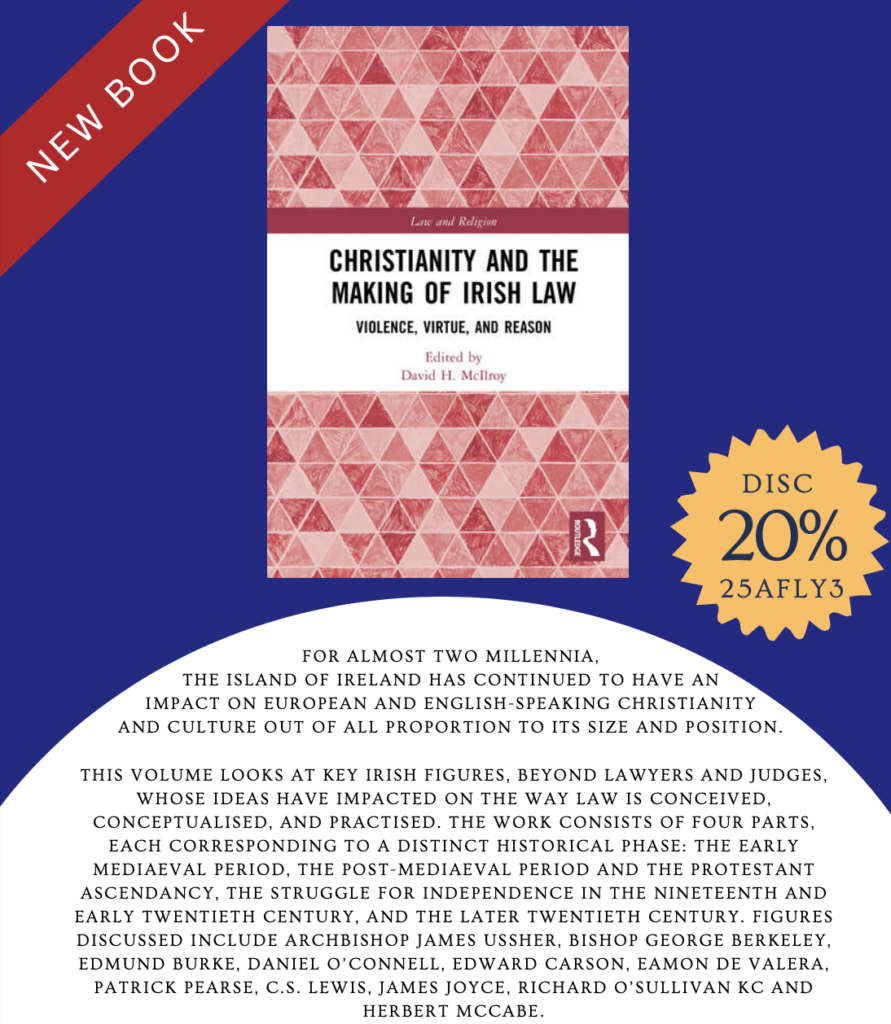
Christianity and the Making of Irish Law: Violence, Virtue and Reason
David H. McIlroy (ed.)
The following essay introduces the new book, Christianity and the Making of Irish Law, Violence, Virtue, and Reason (Routledge, 2026) by the volume’s editor, David H. McIlroy. The volume is now available for purchase via Routledge.
Ireland, “the Isle of Saints”, cannot be understood without knowing how Christianity, and conflicts about Christianity, are central to its history. What may be less immediately obvious is that Irish Christians have thought deeply and innovatively about law, and that their ideas have been influential throughout both the English-speaking world and continental Europe. The new book that I summarize in this essay explores these ideas through the work of 17 thinkers, from different centuries and across the theological spectrum. They include monks (from Adomnán and Sedulius Scottus in the first Christian millennium to Herbert McCabe in the twentieth century), philosopher bishops (James Ussher, George Berkeley, John Henry Newman, Charles McQuaid), famous politicians (Edmund Burke, Daniel O’Connell and Éamon de Valera, though Burke and O’Connell both trained as lawyers first), major literary figures (James Joyce and C.S. Lewis) as well as those who held legal office in Ireland or who practised as lawyers (John Davies, Thomas Ryves, Edward Carson and Richard O’Sullivan).
Three themes recur in Irish contextual political theology. First, Irish Christian reflections on law have often been consciously framed by violence and the threat of violence. That violence could be the violence of internecine disputes, of colonialising power, or of armed resistance. Second, the experience of Irish customs as different from English customs forced consideration of the relationship between reason and law and between natural law and man-made law in a way that was not required in the common law’s homeland of England. Third, the consequent sense of law as necessary to control violence but of law’s instability inspired Irish Christian writers to look beyond law to the role of the virtues in human flourishing.
Adomnán’s Law of the Innocents, written in Ancient Irish, looked at the question of how non-combatants were to be treated in warfare. Whereas later mediaeval Christian writers reflected on what conditions would justify the decision to go to war (ius ad bellum), Adomnán’s concern was how one side in a war ought to treat those caught up in or captured in conflict (ius in bello). Sadly, the importance of the principles Adomnán enunciates remains vitally relevant today.
Sedulius Scottus traveled from Ireland to the Carolingian court. There he initiated a new genre of Latin literature, the mirror of princes. Sedulius taught rulers to govern themselves first so that they would then act wisely when imposing punishment to correct lawbreakers. Virtue was the essential foundation for good and godly government. The mirror of princes genre became a prominent feature of the Middle Ages, as Christian thinkers (including Thomas Aquinas and Giles of Rome) urged emperors, kings, and other rulers to govern with temperance, justice, and mercy, in accordance with natural law, and for the common good.
Henry II established the common law system in England, and it was during his reign that the Anglo-Norman conquest of Ireland occurred. The Anglo-Norman conquest did not stem the importance of Ireland as a test ground for legal theories, particularly those relating to colonialisation, the extent of royal authority, and the justification for rebellion. Those the Crown regarded as rebels and outlaws were ripe for dispossession when sufficient force of arms could be deployed, and the precedents thus set were ready for adaptation to the British conquest of the New World.
After the Reformation, the divide between Britain and Ireland now took on additional, intersecting dimensions, especially with the arrival of English and Scotland Protestant settlers, particularly in Northern Ireland. The Crown was more successful, and more committed to, imposing English common law on Ireland than it was in enforcing Anglicanism on either the Catholic Irish or the Presbyterian Scots-Irish. Nonetheless, in Ireland, the triangle of natural law, common law, and local custom was an equation there was difficulty in squaring.
John Davies was an apologist for the imposition of English common law throughout Ireland. As the conquering power, the Crown had the right to require its conquered subjects to hold their land provided they swore allegiance or to redistribute land away from rebels. For the purposes of this argument and others, Davies had to claim that Ireland had never been fully conquered before and to assert that the Irish had been hitherto deprived of living under the rational, English, common law. In presenting his case, Davies was faced with the awkward fact that insofar as the English common law claimed to be connatural to the English people and reflective of their customs, Irish brehon law could make the same claims. Davies’ arguments on behalf of the colonising powers and the colonists were not novel to him, and show how many of Locke’s later ideas applied in the American colonies had already been widely used in the Irish context.
Thomas Ryves addressed both the legal practicalities and the theology of seeking to embed the Protestant ascendancy. David Rothe, the Catholic bishop of Ossory, argued that Irish Catholics could and would recognise King James I as their secular ruler but that because the king’s power was purely secular, he had no right to claim ecclesiastical supremacy or to force Catholics to change their faith. It would take more than 200 years before either an Irish or a British Parliament would accept that Catholics could live on equal terms with Anglicans. Sidestepping entirely Rothes’ arguments for religious toleration and demurring Rothes’ distinction between civil and ecclesiastical powers, Ryves insisted that a subject’s primary duty is to obey their ruler .
James Ussher was both a major historical figure and an intellectual giant. Ussher’s reflections of matters relating to Church and State and ecclesiastical polity centered on three key ideas. The first is a commitment to absolute monarchy. Ussher saw the king as literally “a law unto himself”. On such a theological account of absolutism, the virtue of the king is essential. The second is the idea of reduced episcopacy, a form of conciliar church governmentwhich offered a via media between the Catholic conception of the authority of bishops and the Presbyterian alternative. The third was his insistence that each national church should have its own distinct canons. What united Ussher’s three ideas was his commitment to originalism.
George Berkeley, Ireland’s most famous philosopher, continued to defend royal absolutism in the eighteenth century, and to do so on the grounds of natural law. Berkeley’s firm commitment to hierarchy and obedience, as requirements of natural law, are connected to his involvement with slavery and colonialism. However, Berkeley held that subjects could withhold active obedience when faced with a ruler’s command or law which contradicted divine law. Their duty, in such circumstances, was to render passive obedience, patiently accepting any punishment the ruler might impose. In this way, Berkeley offers a conceptual framework for non-violent resistance against tyranny, based on natural law arguments.
For Edmund Burke, tyranny might be justly opposed through not only lawful means but also force of arms if necessary. The natural law and the law of reason which showed where the limits of lawful authority were and how discernment could be made between which regimes were to be approved, which were to be reformed, and which were to be resisted. In his prosecution of Warren Hastings for the misgovernment of India, Burke argued that “there is but one law for all, namely that law which governs all law, the law of our Creator, the law of humanity, justice, equity – the law of nature.”
The East India Company’s rule in India was abhorrent because it was lawless. The policies of George III towards the American colonists were tyrannous because they did not acknowledge the natural and ancient liberties of those subjects of the British Crown. The French Revolution was abhorrent because the revolutionaries were making a category error. Natural law was the law of reason, but it was the application of reason to specific places and circumstances. As such, it was always an exercise of practical reason requiring prudence and discernment of what practical measures will best promote the common good rather than the simple deduction of universal conclusions derived from speculative reason.
The immediate catalyst for the Roman Catholic Relief Act 1829 was the election of Daniel O’Connell to the British Parliament. O’Connell, the lawyer who became the Liberator, provided a rallying point for Irish Catholicism as a political force. O’Connell emphasized moral force over physical violence, and was able to work within the law to bring about change without resorting to armed conflict. Although he believed in the power of the law, he was also prepared to challenge, by non-violent means, laws which he believed were illegally imposed on the Irish people, or in violation of a higher moral order.
John Henry Newman shared the concerns of Burke about the relationship between reason and tradition. Newman was opposed to too much centralisation of authority, either in politics or in the Church. Newman saw constitutionalism as a means of restraining a ruler’s power so that it was exercised in accordance with the traditions of the people.
The reasons for, rights of, and even duties of violent resistance were to dominate politics in at least parts of Ireland for the twentieth century. Though religion was by no means the sole factor in the partitioning of Ireland between the Irish Free State and the formation of Northern Ireland, it became a key rallying point. In this powder keg, two men fanned the flames by arguing that violence was the virtuous response to perceived injustice. Edward Carson defended the right of Ulster, where there was a Protestant and Unionist majority, to take up arms to resist home rule, the return of a separate Irish Parliament. Carson was the orator who equated Protestant and Unionist identities, but who ended his political career in Northern Ireland with a plea that the Protestant minority demonstrate that the Catholic minority had nothing to fear.
On the other side of the political and religious divide, Patrick Pearse, a romantic, Catholic, nationalist was the architect of the Easter Rising of 1916. His determination to ignite revolution in the hope that popular opinion would, sooner or in retrospect, validate it. Pearse set a template to which republican splinter groups would forever be able to appeal and which loyalist terror groups would mirror. Pearse’s ideas of the importance of Catholic Christianity to Ireland’s history, of the Gaelic language as integral to Irish identity, and of the sovereignty of the Irish people all find expression in the Irish Constitution of 1937 which provides the settled framework for the Republic of Ireland.
If Pearse was the inspiration for the Irish Republic, Éamon de Valera was its undisputed architect, dominating Irish politics for forty years from 1932. In the context of rising fascism in the 1930s, De Valera’s commitment to constitutional government and natural law as indelible principles in the Irish Constitution of 1937 is an example of Ireland once again holding up a light in a darkening age. De Valera drew from the Thomist tradition a view of political authority as ordered to the common good. The Constitution gives effect to this through locating sovereignty in the people and including within its provisions rights to referenda and other mechanisms whereby the people decide “in full appeal” questions of national policy according to the requirements of the common good. Natural law reasoning and common law wisdom were thus given a uniquely Irish inflection.
The question of the relationship between the natural law and man-made laws occupied many Irish minds in the twentieth century. John Charles McQuaid, a Catholic prelate, had a vision of a Catholic Ireland, rooted in the fundamentals of the Counter-Reformation and rejecting not only Protestantism but also secular liberalism. For McQuaid, virtue was emphatically Catholic virtue, which was to be supported and promoted through the natural law and the law of reason as understood by the Catholic tradition. McQuaid’s vision provides a striking counterpoint to both the continental Catholic movements which aligned themselves to fascism and to the modernising views which were ultimately triumphant at the Second Vatican Council.
Richard O’Sullivan, an Irish barrister who received his legal education in England, became a champion of a reading of the English common law as an instantiation and application of natural law to local conditions in England achieved by the Church and in the intellectual atmosphere which the medieval Church fostered. O’Sullivan’s bold thesis was that the common law was “the only great system of temporal law that came out of the Christian centuries”. Against an anti-clerical, Protestant reading in which the common was the product of the reasoning of lay judges, he emphasised the role of clerics in everything from Magna Carta, to its earliest textbooks, and in sitting as judges establishing a Christian set of values which reflected natural law.
In his apologetic work, Mere Christianity, C.S. Lewis attempted to remind the different Christian churches what they had in common. Less celebrated is Lewis’s concern for natural law. C.S. Lewis saw natural law as a product of reason. Because reason aims at objective truth, and because good and evil are more than the expression of our personal likes and dislikes, there must be objective morality. Without objective morality, there is no such thing as inherent value, no limits on the powers of rulers, no standard for gauging proportionate punishment, and no defence against tyranny.
Joyce’s writings, Ulysses and Finnegan’s Wake, show us the maladroitness of laws, their tendency to harden and to stifle, and their inadequacy to address our simultaneous yearnings for justice and mercy. In Ulysses, we are told the story of an Everyman, whereas in Finnegan’s Wake, the myriad of fractal pictures tell the stories of Everybody. Finnegan’s Wake leaves us with the question: is history cyclical, without resolution or coherence? Ulysses asks us whether we would condemn or forgive Leopold Bloom? Joyce reminds us of the limits of law, that it cannot be avoided, but that we need to look beyond it.
Herbert McCabe was troubled by the limits of law. Like Burke, he dismissed a conception of natural law as a set of premises from which detailed prescriptions of universal application could be drawn. McCabe sought to contrast legalism with development of the virtues. How do we learn to live well and what part do laws play in human flourishing? For McCabe, in order to play a game like football well, we need a rulebook to tell us what the rules of the game are, a technique manual to give us a guide to how to play the game well, and then we need to practise what we learn in those two books.
The experience of how Christianity and law have interacted in Ireland’s history offers a distinctive window through which to consider questions about the relationship between natural law, reason, and the common law. For almost two millennia, the island of Ireland has continued to have an impact on European and English-speaking Christianity and culture out of all proportion to its size and position as an island jutting out into the Atlantic Ocean.At a time when the abuses committed and hatred generated under cover of religion dominate many people’s impressions of Christianity in Ireland, this book seeks to provide a modest reminder of the ways in which Irish Christians have been a humanising force both for the island itself and for the wider world.♦

David McIlroy is Professor of Law at the University of Notre Dame (USA) in England and Visiting Professor of Law at Queen Mary, University of London. He is a practising barrister admitted to practise at the Bars of England & Wales and of Ireland. His other publications include The End of Law: How Law’s Claims Relate to Law’s Aims. He curates the website www.theologyoflaw.org.
Recommended Citation
McIlroy, David H. “Christianity and the Making of Irish Law: Violence, Virtue and Reason.” Canopy Forum, January 21, 2026. https://canopyforum.org/2026/01/21/christianity-and-the-making-of-irish-law-violence-virtue-and-reason-by-david-h-mcilroy/.
Recent Posts