Evaluating the Mediation System in Pakistan
Muhammad Bakhsh Meskanzai
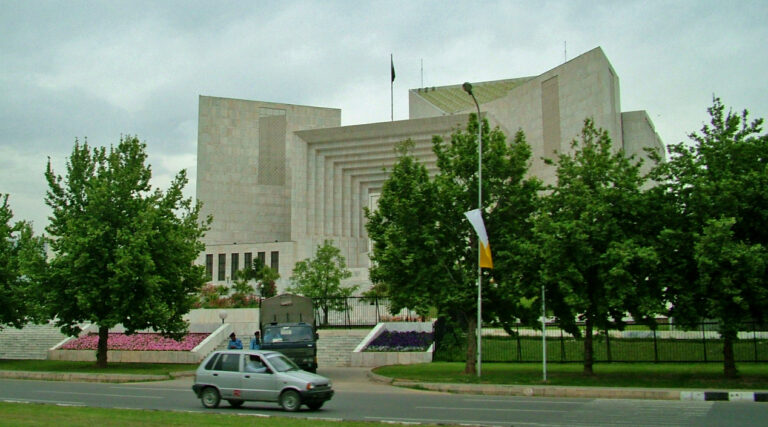
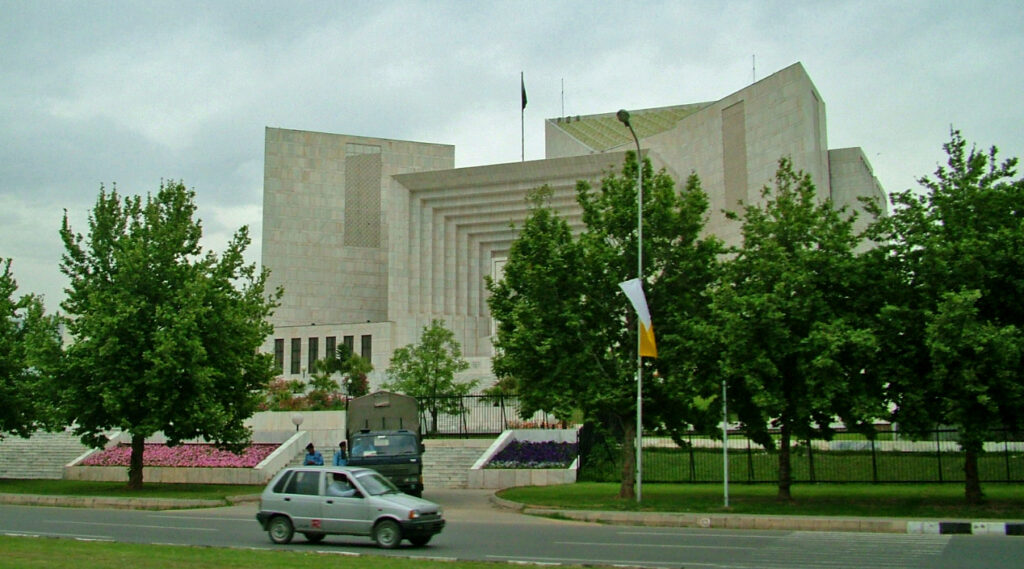
Supreme Court of Pakistan by Guilhem Vellut (CC BY 2.0).
The pursuit of justice is often described as a journey toward truth, yet in the context of Pakistan’s legal landscape, that journey is frequently stalled by the heavy burdens of delay, exorbitant costs, and procedural complexity. As the backlog of cases in the superior and subordinate judiciary continues to swell into the millions, the search for alternative pathways to justice has transitioned from a theoretical preference to an institutional necessity. Pakistan’s justice system, long characterized by chronic adversarial rigidity and a scarcity of judicial resources, has increasingly turned toward mediation as a remedial mechanism.
What was considered a marginal and unofficial process, embedded in a cultural tradition, mediation has now developed into a salient phenomenon that characterizes the formal dispute resolution environment. The courts are actively promoting it, and a process of experimentation with its use is underway in formal institutions. The mediation process has also been recognized for its possible role by policy-makers and has now been identified as a key area for reform. Nevertheless, it remains true that despite all this, a weak and fragmented mediation process is in place and this is unevenly implemented in different provinces. Any serious critical assessment of this process will require going beyond the euphoria for its supposed imperatives and examining it for the presence of for itself on solid foundations.
Any discussion of the state of mediation must first begin by defining mediation’s role as a non-adversarial dispute resolution process. When ideal, the process of mediation requires the intervention of a third-party neutral who will allow the disputing parties to communicate with each other constructively so that the parties can reach a self-determined agreement to meet the needs of each one. Mediation is quite the opposite of adjudication since the latter is basically a win/loss game whose culmination is the win/loss decision. When viewed on the global platform, the benefits of mediation lie in the fact that the process has shown its usefulness given the real savings on litigation costs, the retention of business or personal relationships, as well as the administration of justice occurring much faster than can be imagined in courts.
A similar practice finds great resonance in the Pakistani setup. Ways of resolving disputes in this region were in practice long before the colonial-era laws were imposed. These include community elders, jirga, and panchayats, which are all part of the region’s customs. These customs are proof that consensual dispute resolution is not something that is unknown in Pakistani culture. It is, therefore, imperative that there be an important distinction made between customary practices and mediation. This is geared towards the fact that mediation, as a profession, is underpinned by neutrality, voluntariness of outcome, procedural justice, and, importantly, enforceability.
The superior judiciary has remained the main driving force instrumental in the spread of the mediation movement in Pakistan. The judiciary has realized that the conventional trial process is like a “black hole” that consumes time, money, and energy; hence, it is advisable that litigation must be the last resort, not the first.
There have been important judicial declarations that determine mediation to be a means for the promotion of the intrinsic right to justice. In regard to the said approach, it can be observed that there has been an understanding that the adversarial litigation procedure tends to enhance conflict, especially with regard to cases relating to the private and public sectors, wherein the parties are obliged to continue their interactions despite the conflict that has been concluded within the legal proceedings. Consequently, there has been the birth of “judicial induced mediation,” wherein courts do not, as usual, propose settlement but rather make it mandatory as a procedural matter. In numerous jurisdictions, courts order the parties to go to mediation prior to the proceedings on substantive matters.
The constitutional validity of mediation within Pakistan is well established on the basis of Article 37(d) of the Constitution itself, which states the State’s duty to ensure the free and expensive resolution of disputes. This is not just a matter of policy; rather, this is made a constitutional imperative where efficiency and accessibility become the primary focus of the entire judicial delivery system. Additionally, Article 189 of the Constitution makes the orders of the Supreme Court binding upon all subordinate courts, and thus the validity of mediation is further reinforced. Indeed, if the Supreme Court makes mediation its preferred approach to dispute resolution, there can be little doubt that this particular approach to dispute resolution becomes itself a constitutional imperative.
Despite all this, there have been somecritics and challenges involved in this transition to mandatory mediation. Though there is experience all over the world that mandatory mediation is effective enough in reducing the burden on courts, Pakistan’s experience, being somewhat experimental on this sort of model, is quite inconsistent. Without any sort of nationally applicable legislation, mandatory mediation is largely subject to the personal judgments of judges. Some regard it as a tough precursor, whereas it is regarded as an unnecessary ritual, which has to be ticked prior to trials. This sort of inconsistency makes it a bit difficult to make judgments predictable. This might transmit the perception concerning mediation as having a “postal” role, as everybody will indeed just tick it off as an unnecessary task concerning any sort of genuine quest for conciliation. Further, mandatory mediation might transmit signals toward the attenuation concerning voluntariness. In other words, it might transmit signals toward being swayed or coerced into settlements, either as a mean-stakes sort of delay tactic or as being coerced by the daunting presence of differing trials, as prior mentioned, spread out over a decade.
The legislative void constitutes the single greatest challenge that the forum has to overcome. The judiciary has been supportive of mediation, but the lack of a single, comprehensive and coherent legal framework for mediation in Pakistan is a barrier to its development. Currently, mediation is supported through various provisions in present law, including the Code of Civil Procedure,Family Courts Act, different provincial ordinances, and other laws; therefore, there are no common standards for all provinces regarding mediated settlements. For instance, some of the provinces (e.g., Punjab, Sindh or Balochistan) have established court-annexed mediation centres, while others have not. Because there is no one uniform national mediation act regulating mediation, there is not a standardised manner of accrediting mediators, so no uniform code of ethics for mediators, nor does a common policy regarding confidentiality exist among the provinces. Mediation relies heavily upon confidentiality; if parties have no statutory assurance that their statements during mediation cannot be used against them in court at a later date, there is little likelihood that they will speak freely and openly during the mediation sessions. Additionally, the lack of clear rules establishing the enforceability of mediated agreements creates a “settlement trap,” whereby the parties may ultimately have to go back and litigate the agreement reached during mediation, should the mediated agreement be unable to be easily converted into a court decree.
The legitimacy of mediation centers’ institutional capacity also requires examination. For example, although establishing physical mediation centers located on courthouse grounds is a positive development in itself, many of these centers are poorly funded and lack qualified personnel to manage them. To be viewed as a genuine alternative to litigation, mediation generally should include an effective operational framework of highly trained professionals who possess knowledge of negotiating strategies and understand the psychological aspects of conflict resolution. Currently, most mediators have either retired from being judges or have been senior members of the legal profession, and even with their extensive legal training, they are often encumbered by a predominantly adversarial way of thinking. To shift one’s perspective from an “arbitration” mentality, which focuses on determining who is “right,” to a “mediation” mentality—facilitating the development of win-win agreements among parties involved—requires unique and specific training that is not currently offered uniformly throughout the country.
The international arena calls for an immediate need for reform, and the Singapore Convention on Mediation has provided a global infrastructure to enforce internationally mediated settlement agreements, thereby providing mediation’s primary role in commercial dispute resolution. The existence of a trustworthy Alternative Dispute Resolution (ADR) mechanism will serve as an important marker of legal and economic stability to a developing country like Pakistan, trying to attract foreign direct investment. Generally speaking, foreign investors are hesitant to utilise the local judicial system because of perceived inefficiencies, delays, and local biases. By establishing an advanced mediation process meeting international standards, Pakistan will be able to provide international investors with a “safe haven” for the resolution of commercial disputes, increasing investor confidence and facilitating cross-border trade.
The cultural compatibility of mediation is clearly the single greatest opportunity that remains to be fully realised. Mediation’s emphasis on dialogue and compromise, and the restoration of harmony, fits perfectly within the collective traditions of Pakistani Society. Mediation allows parties to voice their frustrations in their own language and through their own terms, which is in contradiction with the alienation created by traditional courtrooms. As a result, mediation has the ability to re-humanize the judicial system, changing the perception of the court from a cold and impersonal battlefield to a problem-solving organization. However, there must be a balance of cultural attachment with current human rights standards when establishing the practice of mediation as a legitimate process for people to resolve their disputes. All parties using mediation must also be protected by established legislative protection and anti-discrimination laws, ensuring that we will not create a mediation process which allows for “informal justice” and supplants the protections of women, minorities, and the economically disadvantaged. An equal opportunity for all people to use mediation as a method of dispute resolution through the establishment of strong legislative protections will assure that mediation remains a process that is both fair and takes power imbalances into account rather than one that continues to establish and reinforce such imbalances.
To provide an avenue ahead that enables a move away from judicial activism and towards a legislative institution, there is an urgent need for a National Mediation Act. This type of legislation must define the boundaries of mediation that have to occur, provide a national organisation for the training and regulating of mediators, and incorporate a fast track method of enforcing settlement agreements. In addition to the legislative and regulatory aspects of mediation, a National Mediation Act must also provide a range of incentives for participants to use mediation, including the reimbursement of court costs where a case is settled through ADR. To further facilitate a degree of transition in both how litigants and lawyers operate, the culture within the legal profession needs to change. Law schools and bar associations need to include mediation in both their academic curriculum and continuing education programs, to help change the belief that a lawyer is only successful if they win a case in court.
All in all, the results of evaluating Pakistan’s mediation system show that while there is much potential for reform, the system has a number of shortcomings due to a lack of both legislative and structural framework. Mediation has the potential to be used beyond just a means of clearing the backlog of cases; it has potential for being a major tool for achieving both commercial stability as well as social justice. At present, the use of mediation through over-reliance on court support or judicial enthusiasm without any statutory support will not ultimately sustain it. To become truly institutionalized, mediation will need a credible and consistent framework from the state to be able to protect and ensure the rights of all participants. Therefore, the future of justice in Pakistan does not rest solely on increasing the number of court facilities/buildings or hiring additional judges; it rests in how Pakistan will evolve the current dispute resolution process. If Pakistan adopts a framework of mediation based upon statutory law and a commitment by the government to an ethical process, Pakistan will ultimately move toward developing a justice system that is efficient, cost effective, humane, inclusive, and sustainable in the long run. Mediation will serve as the basis for creating a new, evolutionary justice system for the future of Pakistan—not just another option when resolving disputes. ♦

Muhammad Bakhsh Meskanzai is an Advocate of the High Court and a member of the Balochistan Bar Council, Pakistan. He is a legal researcher and award-winning writer whose work focuses on judicial reform, constitutional development, mediation, and access to justice in Pakistan.
Recommended Citation
Bakhsh Meskanzai, Muhammad. “Evaluating the Mediation System in Pakistan.” Canopy Forum, February 13, 2026. https://canopyforum.org/2026/02/13/evaluating-the-mediation-system-in-pakistan/.
Recent Posts