National Religious Broadcasters v. Werfel: The Court Should Uphold the Johnson Amendment to Protect Voters’ Right to Know Who Is Spending to Influence Them
Kevin Hancock
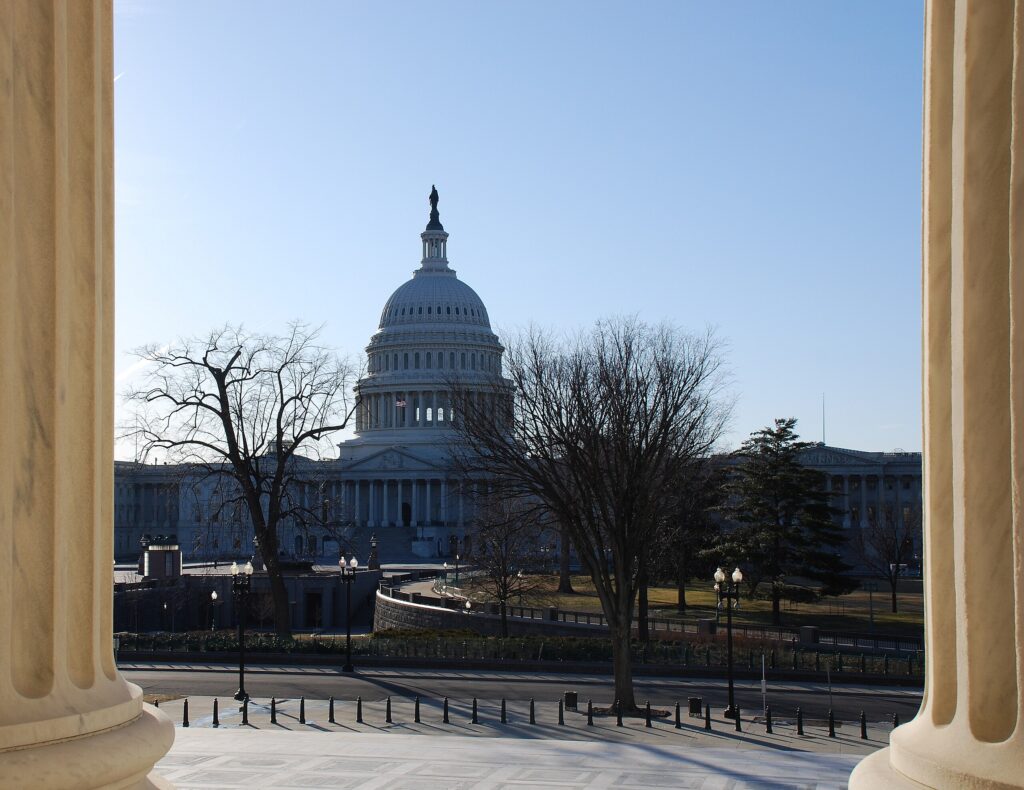
United States Capitol in Washington D.C., by Jarek Tuszyński (CC-BY-SA-3.0 & GDFL).
This article is part of our series on Law, Religion, and The Johnson Amendment. If you’d like to explore other articles in this series, click here.
Few provisions are more vital to preserving both the integrity of religious organizations and democratic transparency than the Johnson Amendment. Adopted in 1954, this safeguard prevents tax-exempt charitable and religious organizations from intervening in political campaigns—a necessary barrier to ensure that taxpayer dollars intended to promote the public good do not subsidize partisan electioneering or turn houses of worship into campaign platforms. Yet, a federal court case currently pending in Texas, National Religious Broadcasters v. Werfel, threatens to dismantle this longstanding protection.
In that case, four religious section 501(c)(3) organizations sued the Internal Revenue Service (“IRS”) claiming that the Johnson Amendment is illegal as applied to their activities. Two plaintiffs are churches, which claim their religious beliefs compel them to take a position on electoral politics and that the Johnson Amendment burdens their ability to do so in violation of the First Amendment’s protections for freedom of speech and religion. A proposed, court-ordered settlement agreement (called a “consent decree”) between the churches and the IRS would allow the churches to endorse or oppose candidates during worship services and through their “customary channels of communication,” which today include livestreamed and archived sermons on YouTube and other digital platforms.
Several public interest organizations, including Campaign Legal Center, Public Citizen, and Common Cause, have appeared in the case through an amicus brief to urge the court not to adopt the parties’ proposed settlement. At stake in this lawsuit is not whether two churches may speak about politics from the pulpit, but whether American elections will be opened to a new form of anonymous, tax-deductible election spending—an expansion of “dark money” unprecedented in scope or secrecy.
Anonymous Election Spending Harms Voters and Democratic Self Government
Democratic self-government depends on transparency. Since the early twentieth century, Congress has required that those who spend money to influence federal elections disclose their donors and expenditures. The Supreme Court has repeatedly endorsed this principle. As it has emphasized, enlightened self-government depends on voters knowing who is speaking about a candidate before an election, so that they may make informed choices in the political marketplace. Disclosure requirements not only equip voters with the information necessary to evaluate political messages but also serve to deter corruption and its appearance by exposing electoral spending to the light of publicity. Congress has also recognized that transparency is essential to the enforcement of its substantive limits on campaign contributions—including restrictions on donations from foreign nationals, federal contractors, corporations, and unions.
Yet the nation’s disclosure system has eroded. Political actors increasingly use nonprofit corporations—especially those organized under section 501(c)(4) as “social welfare” organizations—to finance electioneering while concealing the sources of their funds. The IRS allows these entities to engage in substantial political activity so long as such efforts are not their “primary purpose.” Because they are not formally “political committees,” they escape the detailed reporting obligations of campaign finance law. In practice, the combination of IRS permissiveness and dysfunction at the Federal Election Commission has allowed billions of dollars in anonymous campaign spending to flow through these nonprofits.
The emergence of this “dark money” system has already weakened public confidence in the integrity of elections. According to the Brennan Center for Justice, nearly two billion dollars in undisclosed funds were spent to influence the 2024 races alone. Donors whose identities would normally be revealed—corporations, unions, even foreign nationals—can now route money through opaque entities that never file meaningful public reports. The public’s ability to trace political influence and to understand who supports which candidates and why, is rapidly diminishing.
If religious organizations were exempted from the Johnson Amendment, this problem would intensify dramatically. Unlike 501(c)(4) groups, 501(c)(3)s enjoy the dual privileges of tax exemption and the ability to receive tax-deductible contributions. Donations to them function as government-subsidized gifts: they reduce a donor’s tax liability and therefore operate much like a cash grant. To allow such organizations to channel deductible donations into electoral campaigns would be to invite taxpayer-financed partisan politics conducted in secrecy.
The Purpose of the Johnson Amendment
When then-Senator Lyndon B. Johnson proposed the amendment in 1954, Congress acted with little controversy. The measure was a pragmatic safeguard, intended to prevent tax-exempt entities—whether religious, educational, or charitable—from using public subsidies to influence electoral outcomes. It was rooted in a longstanding bipartisan consensus that the privilege of tax exemption should be reserved for organizations serving genuinely public, nonpartisan purposes.
The IRS and the courts have consistently interpreted the amendment to prohibit not only direct financial contributions to candidates but also the publication or distribution of statements favoring or opposing them. Courts have upheld revocation of tax-exempt status for churches that purchased newspaper ads urging parishioners not to vote for particular candidates, and for nonprofits that rated or endorsed political figures. The rule does not silence moral or policy advocacy around issues of public policy. Rather, it addresses only the use of tax-subsidized funds for explicit electoral intervention.
This line serves two crucial functions. First, it protects the public purse from subsidizing electoral activity. The exemption is, in effect, a public grant conditioned on neutrality in campaign matters. Second, the Johnson Amendment also preserves the integrity and public trust of the nonprofit and religious sectors. Congress recognized that exempt entities receive tax benefits only because they contribute to the public good—through charity, education, or faith-based service—rather than partisan politics. If the Johnson Amendment were weakened or repealed, those core interests would be jeopardized. Politics and money would inevitably be injected into religious 501(c)(3)s in ways that harm both faith and public confidence. Wealthy donors could demand that churches endorse their favored candidates or withdraw contributions unless the congregation took a partisan stance. Clergy and lay leaders would face pressure to align their ministries with political agendas, alienating members who disagree and fracturing congregations along party lines. The amendment’s restriction was designed precisely to prevent such corrosive dynamics—to keep the pulpit from becoming a platform for political power.
The Consent Decree’s Threat: the Creation of Religious “Super Dark Money” Groups
If adopted, the proposed consent decree in National Religious Broadcasters v. Werfel would undermine the Johnson Amendment. The decree asserts that when a church addresses with its congregation “through its customary channels of communication on matters of faith” that intersect with politics, such speech should not be considered campaign intervention. Superficially, this language might appear to shield only sermons and internal communications. But in the digital age, a church’s “customary channels” can and do include public broadcasting and online platforms accessible to millions.
The plaintiff churches themselves have acknowledged that, absent the Johnson Amendment, they would urge congregants to vote in accordance with certain principles, and even host candidates in services. In practical terms, these activities amount to using tax-exempt donations to endorse or oppose candidates in public forums.
Although the decree nominally would apply only to two congregations, its implications would extend nationwide. Once the IRS accepted an interpretation exempting the plaintiffs from the Johnson Amendment, it would be exceedingly unlikely to enforce the rule against other houses of worship. The result would be a de facto repeal of the amendment, achieved not by Congress but by the IRS. As tax scholar Ellen Aprill has observed, “Many churches would undoubtedly see such language in a final order as permission to ignore the Johnson Amendment in a variety of settings.”
Exempting religious organizations from the Johnson Amendment would create what might be called “religious super dark money” entities—organizations able to combine the secrecy of 501(c)(4)s with the additional power of tax-deductible fundraising. The potential for abuse is vast.
First, the charitable deduction disproportionately benefits high-income taxpayers. Wealthy individuals could thus channel large sums into political campaigns while simultaneously reducing their tax liabilities. The incentive to transform churches into political vehicles would be immense.
Second, churches already occupy a uniquely opaque regulatory space. Unlike most nonprofits, they are not required to file annual Form 990 informational returns disclosing revenues and expenditures. They also are not required to apply formally for tax-exempt status, and they are shielded by special statutory procedures that limit IRS audits. If these organizations were allowed to engage in campaign activity, the financing of that activity would be almost entirely invisible to both the government and the public.
Third, the effect would be a massive taxpayer subsidy for partisan activity. Both the exemption and the deduction are, in substance, public expenditures. The Supreme Court has repeatedly recognized that government may decline to fund expressive activities without violating the First Amendment; the public need not subsidize private speech. To dismantle the Johnson Amendment would reverse this logic, effectively transforming the Treasury into a financing mechanism for campaign speech in the form of religious expression.
The immense scale of potential spending is not hypothetical. The United States has hundreds of thousands of religious 501(c)(3)s, some with annual budgets in the tens of millions or more. If significant numbers redirected funds toward political communication, the sums involved could rival or surpass existing dark-money spending. And because the amendment’s bright-line rule would vanish, donors and political operatives would quickly adapt, exploiting churches as conduits for campaign funds precisely because they offer both secrecy and deductibility.
The Johnson Amendment Does Not Burden Free Speech
Supporters of repeal often frame the Johnson Amendment as a restriction on free speech, especially on the speech of pastors and religious congregations. But this characterization misunderstands both the nature of the amendment and the structure of constitutional protection. The amendment does not prohibit speech; it conditions eligibility for a tax subsidy on a commitment to refrain from using tax-preferred funds for certain forms of campaign intervention. Organizations are free to reject those conditions and spend as they wish—they simply cannot do so at taxpayer expense.
The Supreme Court has long upheld such conditions. In a 1959 case, Cammarano v. United States, the Court approved Treasury regulations that denied deductions for lobbying expenses, reasoning that businesses “are simply required to pay for those activities out of their own pockets.” In 1983, in Regan v. Taxation With Representation of Washington, the Court reaffirmed that denying a tax subsidy is not the same as suppressing speech. Congress may choose to subsidize some forms of expression—such as charitable work—without subsidizing others.
Equally important, the Johnson Amendment does not discriminate against the viewpoints of the organizations to which it applies. It bars all 501(c)(3) organizations—religious and secular alike—from spending tax-deductible donations to intervene in campaigns, whether in favor of or against any candidate. Courts have consistently recognized this viewpoint neutrality. The U.S. Court of Appeals for the D.C. Circuit, for example, upheld the revocation of a church’s exemption for running ads opposing Bill Clinton’s candidacy in 1992, noting that the rule “prohibits intervention in favor of all candidates for public office by all tax-exempt organizations, regardless of candidate, party, or viewpoint.”
Claims of selective enforcement occasionally surface, often alleging that liberal or progressive nonprofits have escaped scrutiny or faced special scrutiny. But such assertions, even if true in isolated cases, have arisen from administrative inconsistency within the IRS, not because the Johnson Amendment itself discriminates against any particular points of view.
The Johnson Amendment Serves Compelling Public Interests
Even if one accepted the premise that the Johnson Amendment imposes some burden on speech, it would still withstand constitutional scrutiny. The government interests supporting the Johnson Amendment are compelling and deeply rooted in the structure of the tax and electoral systems.
First, the federal government has an undeniable interest in preventing charitable tax deductions from subsidizing nonprofit political campaign spending. The amendment ensures that charitable deductions serve their intended purpose—to support public welfare, education, and faith communities—not to subsidize electioneering.
Second, the government has an equally compelling interest in preserving the integrity and public trust of the nonprofit and religious sectors. Charitable exemptions rest on the assumption that such organizations confer public benefit independent of partisan goals. As the Supreme Court explained in Bob Jones University v. United States, the tax exemption is justified because the exempt entity contributes to the public good. Allowing churches and charities to become campaign vehicles would erode that justification.
These interests are not abstract. In an era when citizens already question the fairness of the political system, transforming churches into tax-deductible political committees would further polarize both politics and religion. Congregations would face pressure from donors and candidates to take sides. And voters would suffer from the resulting lack of transparency.
Conclusion
If the proposed consent decree in National Religious Broadcasters v. Werfel were approved, it would open a vast new channel for anonymous, taxpayer-subsidized political spending. Churches and other religious nonprofits could become vehicles for untraceable donations, further eroding voters’ right to know who seeks to influence their choices. Nothing in the Constitution compels such a result. Maintaining the line that the Johnson Amendment draws is not an act of hostility toward religion—it keeps houses of worship places for religion rather than campaign strategy, and 501(c)(3) a tool to promote the common good rather than a loophole for political influence. ♦

Kevin Hancock is a litigator who specializes in campaign-finance issues and structural election reforms. Before joining CLC, Kevin served for nearly a decade as an attorney at the Federal Election Commission, including as senior counsel to FEC Commissioner Ellen L. Weintraub. Kevin also represented the executive branch as a trial attorney in the Federal Programs Branch of the U.S. Department of Justice. He has also taught constitutional law as an adjunct professor at American University Washington College of Law and Georgetown Law.
Recommended Citation
Hancock, Kevin. “National Religious Broadcasters v. Werfel: The Court Should Uphold the Johnson Amendment to Protect Voters’ Right to Know Who Is Spending to Influence Them.” Canopy Forum, December 18, 2025. https://canopyforum.org/2025/12/18/national-religious-broadcasters-v-werfel-the-court-should-uphold-the-johnson-amendment-to-protect-voters-right-to-know-who-is-spending-to-influence-them-by-kevin-hancock/.
Recent Posts