
The Making of National Ecclesiastical Law in the Eighteenth-Century Kingdom of Naples
Matteo Carmine Fiocca
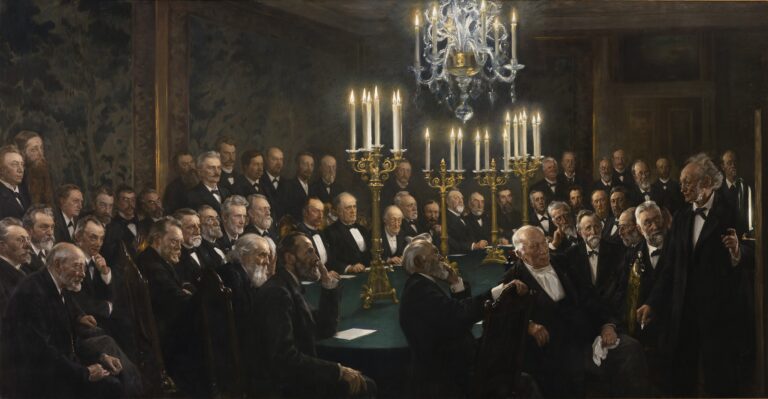
Carlo III di Borbone visiting the Pope Benedetto XIV in the coffee-house of the Quirinale, Rome (US-PD).
As the eighteenth century unfolded, theories aimed at limiting the Roman Catholic Church’s authority, shaped over the previous centuries and influenced by humanist and natural law thinking, started to really take hold in the religious policies of some Catholic countries in Europe. Building on these ideas, rulers began pushing for more control over religious affairs, even making laws in areas that had traditionally been under the Church’s authority. Over the course of the century, the Roman Church gradually lost influence compared to the national churches. One of the clearest examples of this shift is the Kingdom of Naples, where a strong jurisdictionalist culture led to the creation of a complex and far-reaching set of rules on ecclesiastical matters. This context is the focus of this essay.
Jurisdictionalism in Early Modern Naples
Scholars have convincingly argued that jurisdictionalism wasn’t just one of many contributing factors, but actually a key part of how the modern state came to be. By asserting its independence from the Church, the state started to clearly draw the line between temporal and spiritual powers.
Within the Neapolitan kingdom, this process unfolded with particular intensity especially in the eighteenth century, with the Bourbon dynasty coming to power. In 1734, Charles of Bourbon became king of Naples and Sicily, putting an end to the long period of Spanish and then Austrian rule through viceroys. Aiming to strengthen the Crown’s power, Charles launched a series of reforms in different areas: institutions, the legal system, and the economy (8-21). Most of these reforms proved only partially successful – or even failed altogether – except those concerning ecclesiastical matters, which actually turned out to be a major success.
Throughout the eighteenth century, the Kingdom witnessed a wave of secular legislation dealing with Church matters, all influenced by royalist and jurisdictionalist ideas. These measures – covering things like church benefices, clerical privileges, and the relationship between ecclesiastical and secular courts – not only limited the Church’s independence, but also ended up creating a distinct body of “Neapolitan” ecclesiastical law: a separate and self-contained legal system, different from traditional canon law.
In King Charles’s Naples, the creation of a national ecclesiastical law was mainly built on a strong tradition of jurisdictionalist thinking that had taken root in the city since the late 1600s, thanks to the work of major Neapolitan jurists and intellectuals like Serafino Biscardi, Gaetano Argento, Pietro Giannone, and Niccolò Fraggianni. But just as important were the specific administrative bodies in the Kingdom that handled religious affairs and relations with the Roman Curia, like the Segreteria di Stato per gli affari ecclesiastici (Secretariat of Ecclesiastical Affairs), a sort of Neapolitan Ministry for Ecclesiastical Matters set up when Charles of Bourbon came to the throne. In the Kingdom, there were also older institutions, like the Cappellano Maggiore (Chief Chaplain) and the Delegato per la Real Giurisdizione (Delegate for Royal Jurisdiction), which already had key roles in religious governance and were strengthened under Bourbon rule. These bodies didn’t just offer advice: they also had legislative, regulatory, and judicial powers, and fully acted as tools of state sovereignty in church matters.
Concordat of 1741 and Neopolitan Relations with the Church
The key legal basis for managing the relationship between the Kingdom of Naples and the Roman Church in the mid-1700s was the important Concordat of 1741, signed by King Charles of Bourbon and Pope Benedict XIV. It covered a range of issues – like church benefices, personal and institutional immunities, and jurisdictional boundaries – but it clearly favored the king over the Church. Still, the main legislative tool behind this ecclesiastical policy was the dispacci reali (royal decrees), official orders issued directly by the king through his ministers. When it came to religious matters, these decrees allowed the Bourbon government to maintain tight and ongoing control over religious life.
Throughout the eighteenth century, the Secretariat of Ecclesiastical Affairs, issued a huge number of ecclesiastical decrees: so many that Diego Gatta, when collecting them, in his compilation of royal dispatches ended up filling five hefty volumes. These legal measures covered a wide range of topics: from church benefices to clerical immunities, from burial practices to holiday celebrations. Virtually anything not strictly spiritual or doctrinal could fall under state regulation. The Secretariat, working closely with the Chief Chaplain and the Delegate for Royal Jurisdiction, operated in a highly systematic way, issuing measures that, even indirectly, could affect spiritual and liturgical matters too.
A few examples suffice to illustrate the extent of these measures. One royal dispatch banned bishops from publishing the diocesan liturgical calendar without the king’s prior approval (134-135). Another, dated May 3, 1738, forbade them from denying the sacraments for personal or political reasons (135-137). Then there’s the dispatch from November 2, 1751, which prevented the Church from refusing burial to women suspected of prostitution (182-183), and others from 1752 and 1754 guaranteed people the right to choose where their funeral would take place (296-297). On July 19, 1738, a decree stated that only the king could authorize the celebration of religious feasts (261-263). Even the administration of the sacraments was affected: a 1763 dispatch prohibited parish priests from charging fees for sacraments (237-238), except for issuing official certificates.
Examples like the restriction on bishops printing liturgical calendars or the ban on priests asking for payment for sacraments show just how deeply the secular power wanted to get involved in spiritual matters. This body of legislation didn’t just define jurisdictional boundaries between Church and State: they actively shaped daily religious life, regulating, even if indirectly, rituals, practices, and the behavior of both clergy and laypeople. This regulatory framework shows that the state’s involvement went far beyond its relationship with the Church: it reached deep into the fabric of everyday religious life in the Kingdom.
Polizia ecclesiastica and Regulation of Religious Affairs
In Southern Italy’s legal language between the eighteenth and nineteenth centuries, this large and wide-ranging body of royal laws on ecclesiastical matters came to be known as Polizia ecclesiastica (Ecclesiastical police). Of course, “polizia” here doesn’t mean what it does today. It referred to the older meaning of the word: regulation, governance, or normative discipline, in this case, over religious affairs (1-4).
The term Polizia ecclesiastica, which had already been used in late sixteenthth-century France, became more common in Italy starting in the eighteenth century (8-18, 20, 62). In Naples, the jurist and intellectual Pietro Giannone used it frequently in his Istoria civile del Regno di Napoli(1723), and it later appeared in other works too, like Vito Giliberti’s collection of ecclesiastical laws, which was explicitly titled Polizia ecclesiastica.
Neapolitan jurists were fully aware that ecclesiastical matters in the Kingdom were based on a coherent and well-organized set of national laws. This is clear from the various collections and systematizations of ecclesiastical legislation, published towards the end of the century. A prime example is Diego Gatta’s monumental compilation of royal decrees, which includes an entire section dedicated specifically to ecclesiastical decrees. Alongside this, there were other important legal collections focused solely on ecclesiastical law, like Gius Sagro esposto colle pure leggi del Regno (1793) by Filippo Ammirati and the previously mentioned Polizia ecclesiastica by Vito Giliberti.
Such awareness is also reflected in the Elementa iuris canonici (Elements of Canon Law) published in Naples in the second half of the eighteenth century. These were short, systematic manuals that reinterpreted canon law in light of royal laws, showing a clear jurisdictionalist influence and a strong intent to subordinate church regulations to state law. Among these works are Elementa iuris ecclesiastici (1770) by Oronzo Fighera and Elementa Iuris canonici by Carmine Fimiani (1777-1778) and Domenico Cavallari (1769). Also worth mentioning are Institutionum iuris canonici communis et neapolitani in four volumes (1756-1763) by Carlo Gagliardi.
Considering all these elements, we can say that by the late eighteenth century, the Kingdom of Naples had its own national ecclesiastical law: a legal system that, while dealing with religious matters, was really an expression of the State, not the Church. It was a secular law created within a defined political space, with its own legal sources, interpreters, and operating structures.
In conclusion, we can say that this law developed within the state’s territorial boundaries through basically three main elements, if we can call them that: first, the Neapolitan jurisdictionalist tradition – especially the one inspired by Pietro Giannone’s ideas in the early part of the century – which laid the doctrinal and theoretical foundations for this law; second, the legislative aspect, which starting with the 1741 Concordat regulated church matters through a rich and varied body of national laws; and third, the institutional side, with various dedicated bodies that had specific roles and powers over church affairs, ensuring close management and control of religious life in the Kingdom.
I would argue that the experience of the Kingdom of Naples in the late eighteenth century offers a prime example of how jurisdictionalist theories could translate into deeply innovative forms of government practices. Through a wide range of laws, the work of specialized administrative bodies, and a legal doctrine focused on reasserting state supremacy, a national ecclesiastical law emerged that didn’t just limit the Church’s powers but actually redefined them within a completely secular legal framework. In this sense, Neapolitan ecclesiastical law was one of the clearest expressions of the building of the modern state: a state that established itself as the sole holder of sovereignty, able to regulate every part of social life – including religion – based on public utility, order, and control. The Neapolitan experience thus anticipates some key features of institutional secularism that would characterize the modern era, while still obviously carrying a clear imprint of the Old Regime’s legal heritage in its concepts and regulations. ♦

Matteo Carmine Fiocca is currently Contract Professor of Medieval and Modern Legal History at Universitas Mercatorum of Rome. He earned a PhD in Law (Philosophy of Law and History of Legal Culture) from the University of Genoa in 2021 and subsequently served as a Research Fellow in Medieval and Modern Legal History at Sapienza University of Rome. His research focuses primarily on the history of legal sources, the historical-legal aspects of southern Italian brigandage, and the history of medieval canon law.
Recommended Citation
Fiocca, Matteo Carmine. “The Making of National Ecclesiastical Law in the Eighteenth-Century Kingdom of Naples.” Canopy Forum, Jan 8, 2025. https://canopyforum.org/2026/01/08/the-making-of-national-ecclesiastical-law-in-the-eighteenth-century-kingdom-of-naples/.
Recent Posts