Saint Death v. Church and State: The Political Economy of Santa Muerte in Mexico
R. Andrew Chesnut
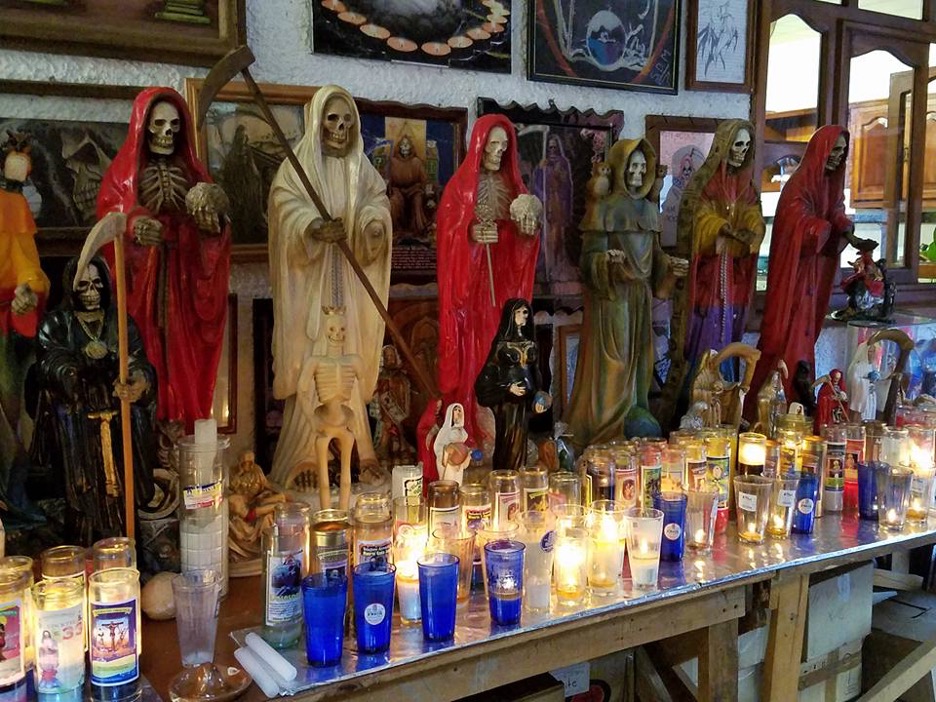
Photo of Santa Muerte iconography. Photo taken by author.
In March 2009, Mexican soldiers razed more than forty public shrines to Santa Muerte in Nuevo Laredo and Tijuana, pulverizing cement and plaster images of La Huesuda under the treads of military bulldozers. The spectacular demolitions—repeated in subsequent years, including in Coahuila under President Enrique Peña Nieto—condensed the state’s anxieties about a devotion that had spilled from clandestine domestic altars into highly visible urban landscapes. The shrines’ publicness marked a fault line: zones where sovereignty is fragmented, moral authority contested, and citizens hedge existential risk through supernatural means. As one devotee quipped after the bulldozers departed, “They can destroy her house, but they cannot evict her from this place.”
This article theorizes Santa Muerte as a religious formation of Mexico’s necro-state, a regime in which the power to expose populations to premature death—through militarized drug war, cartel control, femicide, or health-system collapse—organizes social life. While Mexican nationalism has long played with the symbolism of death, the intensification of lethal risk and impunity since 2006, when President Felipe Calderon (2006-12) ramped up the war against the drug cartels, has transformed that symbolism into everyday governance. In this context, Santa Muerte expands as a vernacular apparatus of protection, justice, and healing for those who perceive themselves as abandoned or misrecognized by formal institutions. Rather than a deviant fringe, the devotion discloses how citizens craft parallel infrastructures of meaning and security amid violent pluralism.
Methodologically, the argument synthesizes historical reconstruction of the devotion’s emergence, ethnographic insight from fieldwork since 2009, and analysis of state, media, and ecclesial responses. The aim is not to adjudicate theology but to explain how a skeleton saint became central to the political economy of late-neoliberal Mexico.
From Cryptic Cult to Public Saint
Although popular narration often anchors Santa Muerte in pre-Hispanic underworld deities, archival traces indicate a more complex genealogy. In late colonial records, “Santa Muerte” appears within Indigenous-mestizo healing and love rites, embedded in hybrid zones beyond full ecclesial control. Through the nineteenth and twentieth centuries, devotion endured as a clandestine practice—domestic, informally transmitted, and associated with stigmatized labor.
While Santa Muerte has ancient roots in Mexico’s syncretic religious history, her contemporary manifestation represents a distinctly modern phenomenon. Santa Muerte was primarily a clandestine folk devotion until the early 2000s, practiced largely by marginalized urban populations in Mexico City neighborhoods such as Tepito.The first public shrine to Santa Muerte was established in 2001 by Enriqueta Romero (aka Doña Queta) in the rough and tumble barrio of Tepito, marking a watershed moment in the devotion’s transition from the private to the public sphere. Monthly rosary services dedicated to the Skeleton Saint swelled to thousands, translating a hidden cult into an urban public devotion.
The timing was not incidental: Mexico had just experienced democratic alternation after seventy-one years of authoritarian PRI rule; market liberalization deepened; and the U.S.-backed drug war escalated toward militarization. Mexico entered a period of violent democracy where elections coexist with routinized coercion and impunity. Santa Muerte’s publicness was both an effect and critique of the shifting political economy.
The Mexican Necro-State
Necropolitics reframes sovereignty as the power to dictate who may live and who must die. In Mexico, state and para-state actors alike wield lethal force with partial overlap and pervasive ambiguity. Calderón’s offensive precipitated a staggering death toll and normalized exceptional measures. But necropolitics is not only spectacular killing. It involves the routine exposure of populations to slow violence—healthcare deterioration, labor precarity, environmental harms— through policy and selective provision.
In this milieu, Santa Muerte functions as spiritual securitization, an informal apparatus of protection, justice, and healing–all of which may seem rational under conditions of insecurity. Devotees place her in the same problem-solving repertoire as neighborhood self-governance, private security, and kinship networks. She is revered precisely because she “judges no one,” offering impartial protection where law is partial and mercy scarce.
Mapping the Bone Mother
In Mexico City, the landmark Tepito shrine exemplifies how Santa Muerte marks spaces of fragmented sovereignty. Monthly rosaries instantiate a temporary autonomous zone of collective agency and mutual aid. Street-side altars materialize counter-claims to urban space, operating as counter-monuments to state and ecclesial monopoly and signaling that residents will organize the sacred on their own terms.
On the U.S.-Mexico bordering cities like Tijuana and Nuevo Laredo—liminal spaces of migration, maquila economies, and tightened enforcement—public shrines proliferated as crossings grew deadlier and economies more volatile. Santa Muerte frames risk management for migrants, smugglers, and ordinary residents alike, offering protection for journeys the state cannot secure and the market cannot insure.
In the cartel strongholds of Michoacán, Guerrero, Tamaulipas, and Sinaloa, devotion adapts to political ecologies of power. Where a dominant organization governs, shrines can be elaborate and public, signaling authorized transgression. In contested zones, altars become portable and discreet, tracking mobile sovereignty and the need to evade both rivals and security forces. Devotional density shadows zones of state abandonment and regions of rapid market transformation, such as tourism corridors in Quintana Roo where resort development produces new precarity. Moments of collective crisis amplify devotion: after the 2017 earthquakes and during COVID-19, health-associated votives surged as vulnerable populations sought non-bureaucratic care and protection. The saint’s cartography is a living map of exposure and improvisation.
Criminalization and Ritual Warfare
The Mexican state’s antagonistic stance toward Santa Muerte reveals much about the political stakes of this new religious movement (NRM). Beginning with President Calderón’s administration (2006–2012), government officials systematically attempted to delegitimize the folk saint by associating her exclusively with criminality. The destruction of shrines, often accompanied by military displays of force, represented spiritual warfare as counterinsurgency—an attempt to reassert state moral authority in contested territories. This criminalization occurred through several mechanisms. First, media spectacles showcasing Santa Muerte altars discovered in cartel safe houses implicitly linked all devotees to organized crime. Second, military and police forces targeted public shrines for destruction, usually without legal warrants. Third, government officials made statements condemning the NRM, echoing the Church’s rebuke of “a cult of narco-satanists.”
The Catholic Church joined this effort, with bishops denouncing Santa Muerte as satanic and performing exorcisms in areas with strong devotion. As Perdigón Castañeda argues, “The alliance between church and state in opposing Santa Muerte reveals their shared interest in maintaining a monopoly over the sacred.” Indeed, both institutions faced legitimacy crises in contemporary Mexico—the state for its inability to provide security and the Church for clerical abuse scandals and perceived alignment with elite interests. The criminalization campaign reveals the political threat Santa Muerte poses to state authority. Unlike official saints, she operates outside institutional control, offering spiritual services without moral judgment or bureaucratic mediation. By bypassing both state and ecclesiastical authorities, Santa Muerte devotees implicitly reject the legitimacy of these institutions to determine acceptable religious practice. The saint of death threatens not merely by association with criminality, but by demonstrating the possibility of autonomous religious practice beyond state and clerical control.
The state’s physical destruction of Santa Muerte shrines constitutes what Menjivar and Rodríguez call “spiritual warfare”—state violence performed as a public spectacle to communicate symbolic messages about power and legitimacy. These demolitions follow consistent patterns that reveal their ritual nature: they typically involve military rather than civilian authorities; they are conducted in daylight with media invited to document the process; they include the deliberate desecration of sacred objects; and they often feature religious counter-rituals such as prayer or blessing of the “purified” space. The ritual aspects of shrine destruction become particularly evident when compared to other state actions against criminality. Whereas drug seizures are conducted behind closed doors, money-laundering investigations advance through files and forms, and arrests tend to be discreet, the destruction of Santa Muerte shrines is consistently staged in public view. This publicity serves specific political purposes: demonstrating state power in contested territories, associating devotion with criminality through visual juxtaposition of religious items with seized weapons or drugs, and symbolically reconsecrating space under state authority.
Devotees recognize these symbolic dimensions and respond with counter-rituals of their own. After the 2009 shrine demolitions in Nuevo Laredo, devotees conducted clandestine ceremonies at the rubble sites, collecting fragments of destroyed statues as relics. In several cases, miniature altars appeared within days at the exact locations where larger shrines had been demolished. This pattern of destruction and reconstruction represents a ritual engagement between state power and folk religious practice—a dialogue conducted through symbolic action rather than words. The state’s focus on shrine destruction rather than other aspects of devotion reveals an implicit recognition of the political significance of sacred space. Santa Muerte shrines in public spaces operate as material manifestations of alternative territorial claims, contesting state authority while signaling the existence of distinct moral and spiritual economies. By physically removing these markers, the state attempts to reassert its monopoly not merely on legitimate violence, but on the organization of public space itself.
Catholic Crusade
Catholic denunciations, both nationally and in the U.S. borderlands, have been theologically consistent and pastorally counterproductive. Bishops insist that death, as a state of separation, cannot be a person to whom petitions are licitly addressed; therefore, Santa Muerte is an idol incompatible with Christian faith. High-profile interventions, from the Mexican Episcopal Conference’s Holy Week statements to Pope Francis’s 2016 rebuke of “macabre symbols” in Ecatepec, have signaled clear institutional boundaries.
Yet the majority of devotees identify as Catholic, engaging in plural practice that combines Mass, Marian devotion, and Santa Muerte rosaries. Campaigns to destroy altars or deploy exorcistic discourse often reinforce the saint’s countercultural appeal while highlighting gaps between elite doctrine and vernacular cosmovisions. The struggle is about theology and authority: who interprets suffering and who dispenses protection. For many devotees, the saint’s nonjudgmental assistance contrasts sharply with ecclesial and political gatekeeping–they insist she treats rich and poor, righteous and unrighteous alike.
Amoral Protection and Subaltern Theodicy
Santa Muerte’s “amoral” economy of grace—protection without moral vetting—has generated the caricature of a narco-saint. In reality, her constituency is far broader and includes market vendors, sex workers, migrants, the unemployed, police, soldiers, and yes, traffickers. What unites them is not criminal identity but exposure to violence and precarity. In a society of democratized danger, impartial protection is a scarce good.
Devotion offers a subaltern theodicy. Rather than asking sufferers to accept injustice as providential or to wait for distant salvation, the saint equips them with practical means—amulets, baths, candles, petitions—to navigate risk, pursue healing, and secure livelihood. Where the law rarely arrives except as a menacing spectacle, devotees recognize in the saint a protector who is available on demand, whose rituals are legible and affordable, and whose economy of favor does not depend on moral reputation or political connections.
Fettered Freedom of Worship
Mexico’s constitutional guarantees of religious liberty and the 1992 Religious Associations Law promise pluralism, yet recognition has been selective and stratified. The Mexico-U.S. Templo Santa Muerte Internacional briefly obtained legal status before the Interior Ministry revoked it, a decision widely read as capitulation to ecclesial pressure. Subsequent petitions met theological gatekeeping: if death is not a living being, officials reasoned, devotion cannot constitute a religion. Such arguments betray a state willing to adjudicate doctrine when it comes to popular religiosity.
The result is unequal pluralism. Middle-class spiritualities marketed through wellness and New Age circuits enjoy tacit tolerance and even tax advantages, while the devotions of the poor are criminalized or pathologized. In response, devotees have reframed their struggle in constitutional language, marching with Article 24 placards and insisting they are believers, not criminals. The arena of recognition becomes a testing ground for Mexico’s secular compact and its willingness to extend religious freedom beyond respectable precincts.
Devotional Gray Market
Santa Muerte’s rise is inseparable from Mexico’s insertion into global neoliberalism after the 1980s debt crisis and NAFTA. Privatization, social retrenchment, and labor informalization widened inequality while hollowing out welfare and public security. Devotees’ petitions mirror this economy. Alongside love and health, finances dominate—including work, business success, protection from destitution. The saint is as present at market stalls and trucking depots as at street-corner shrines.
Devotion sustains a sizable gray market. Statues, candles, oils, baths, limpias, and consultations circulate through mercados, botanicas, and home-based enterprises. Women are prominent ritual specialists and vendors, converting spiritual knowledge and reputational capital into income and status. The devotional economy blurs lines of licit and illicit; some inputs are regulated or stigmatized, and sales often occur where oversight is negotiated rather than total. Santa Muerte is both a response to and generator of economic opportunity at the margins, offering gendered entrepreneurship and alternative routes to recognition where formal qualifications and secure employment remain out of reach.
Not Just a Narco-Saint
State narratives cast the saint as a narco icon. Ethnography suggests a more complex field. Traffickers and enforcers seek her protection given short life expectancies; so do police and soldiers tasked with confronting them. The common denominator is not criminal identity but occupational risk. Moreover, the drug war itself has been sacralized through Catholic imagery and moral binaries, with presidents positioning the state as a righteous avenger against evil. Santa Muerte destabilizes this script by refusing state monopoly on moral adjudication. Her willingness to receive all petitioners exposes the thinness of official hierarchies in a context where institutions routinely fail to protect the innocent or punish the powerful.
From Repression to Détente?
The López Obrador administration (2018-2024) and the early current Sheinbaum presidency mark a softening in state posture: fewer shrine demolitions, a more explicit rhetorical commitment to religious liberty, and greater distance from episcopal campaigns. Church leaders have criticized public uses of Santa Muerte imagery, but the federal register of enforcement has not resembled Calderón’s era. This relative tolerance reflects both normative commitments to pluralism and pragmatic recognition of the devotion’s mass base among the urban poor and working classes. Without endorsing the devotion, the state has stepped back from performative criminalization—a shift that de-escalates ritual warfare even as structural violence persists. Whether such détente proves durable will depend less on doctrinal pronouncements than on the political economy of security and livelihoods in the years ahead.
Reading the Necro-State Through the Skeleton Saint
If Mexican nationalism once domesticated death as a playful symbol, the past two decades have rendered death a structuring condition of citizenship. Santa Muerte’s rise is a vernacular re-politicization of the sacred under those conditions. For scholars of religion and politics, she demands analytical frames capacious enough to grasp how doctrine, economy, affect, and sovereignty interpenetrate in everyday life. For policymakers and ecclesial leaders, she counsels humility. Attempts to eradicate popular devotions often produce their proliferation, however, addressing the devotion’s causes would require transforming the necropolitical order that makes Santa Muerte necessary. Until those conditions change, the Bone Mother’s rosary will continue to sound in barrios, borderlands, and beyond—marking both the failure of formal institutions and the resilient creativity of those who must live, and seek protection, within the necro-state.

Dr. R. Andrew Chesnut is Bishop Walter F. Sullivan Chair in Catholic Studies and Professor of Religious Studies at Virginia Commonwealth University. He is the author of the first academic book in English on the fastest growing New Religious Movement in the Americas – Devoted to Death: Santa Muerte, the Skeleton Saint (OUP, 2012, 2017 & 2025), with translations in Spanish, Polish, Portuguese, French, Italian, and Turkish), Competitive Spirits: Latin America’s New Religious Economy (OUP, 2003) and Born Again in Brazil: The Pentecostal Boom and the Pathogens of Poverty (Rutgers University Press, 1997) as well as numerous book chapters, journal articles, and scores of media interviews.
Recommended Citation
Chesnut, R. Andrew. “Saint Death v. Church and State: The Political Economy of Santa Muerte in Mexico.” Canopy Forum, February 6, 2025. https://canopyforum.org/2026/02/06/saint-death-v-church-and-state-the-political-economy-of-santa-muerte-in-mexico/.
Recent Posts