Sisters and State Building: The Sisters of the Good Shepherd and Carceral Infrastructure in 19th Century Colorado
Hennessey Star
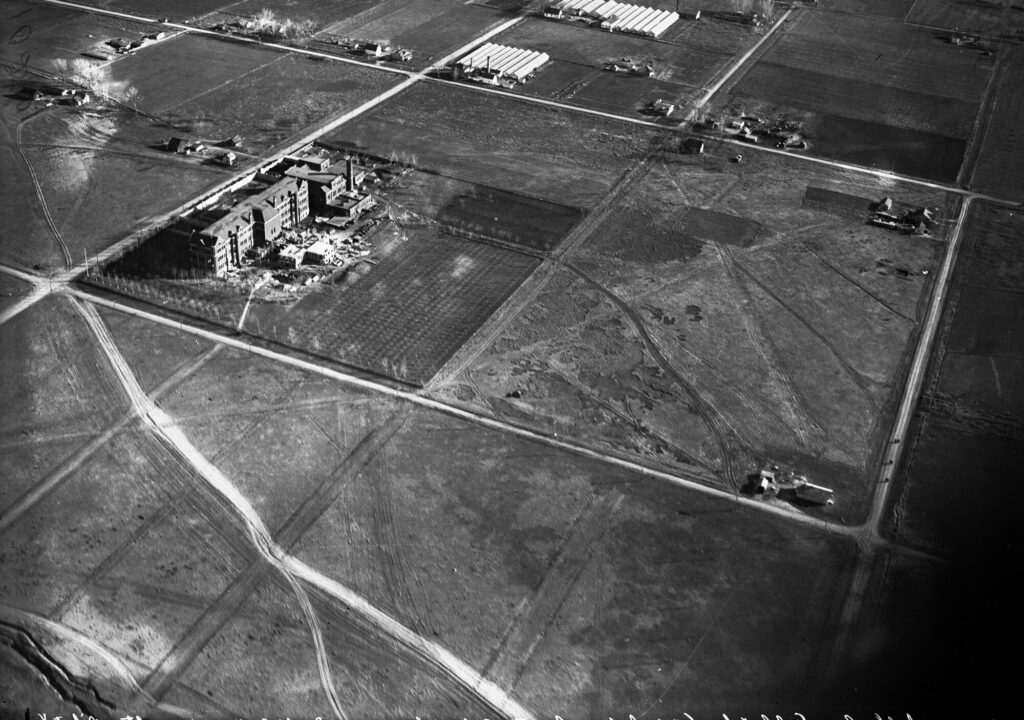
Aerial view of the House of the Good Shepherd via Denver Public Library (Public Domain).
When the Indiana Women’s Prison History Project endeavored to study the “oldest” women’s prison in the United States they pointed not only to the Indiana Reformatory Institute for Women and Girls—the oldest state penitentiary built exclusively for women—but the Home of the Good Shepherd in Louisville, Kentucky. The Home of the Good Shepherd, run by the Catholic Sisters of Our Lady of Charity of the Good Shepherd, reformed and incarcerated ‘fallen’ women and girls in the U.S. as early as 1843. This makes them, as Michelle Jones et al. argue, the first institution in the U.S. to incarcerate women. Over the next few decades, the Sisters of the Good Shepherd, largely made up of Irish nuns who had run the now infamous Magdalene Laundries in Ireland, would expand on the East Coast and throughout the Midwest to cities like Chicago, New York, and New Orleans. The Good Shepherd Sisters didn’t venture, however, into what we now consider the Western United States until 1883, when they established a Home of the Good Shepherd in Denver, Colorado.
Preceding the construction of the Colorado State School for Girls in 1896, all incarcerated girls in the state were sent to the Home of the Good Shepherd. The collaboration of church and state, although tenuous, was normalized and even supported by Protestant reformers for the purpose of incarcerating wayward women and girls. Because of this, fallen girls and women became wards of both the state and the sisters. More importantly, perhaps, Colorado State’s carceral institutions for girls were built in relation to and with the Good Shepherds, constructed from the bedrock already built by the sisters. Ultimately, the history of the Denver Sisters of the Good Shepherd highlights how the construction of girls’ carceral institutions in the West arose from the precarious collaboration of the Catholic church and of state governments.
At a time when many states were passing “Little Blaine Amendments” to prohibit the state funding of sectarian educational institutions, the Denver Sisters of the Good Shepherd organization exposes the collaboration between the Catholic church and state governments, as well as the federal government. During this time, the Denver Sisters of the Good Shepherd were not only receiving state funding for the purposes of incarcerating girls convicted of crimes but were also contracted by the federal government as a Native boarding school from 1885 to 1891. The Sisters of the Good Shepherd offer a way to understand the complex landscape of church and state relationships—one that was essential to state-building in the Western United States and centered around the mission of incarcerating children.
Gendered Containment
The Sisters of the Good Shepherd arrived in Denver in 1883, invited by Elizabeth Byers, a Protestant, founding mother of Colorado welfare institutions. At the moment of the sisters’ arrival, the state had little public infrastructure, including reformatories. The Sisters of the Good Shepherd effectively functioned as the state carceral institution for girls in Colorado from 1885 to 1895. A Colorado Session Law passed in 1887 formalized its status and allowed for counties to send girls convicted of crimes to the Sisters of the Good Shepherd for 25 cents per day for girls under thirteen years and 50 cents per day for those over the age of thirteen, while the state constructed its own institution without haste.1 “Incorrigible Girls,” Rocky Mountain News (Denver, Colorado), July 28, 1895.
Many of the girls incarcerated at Home of the Good Shepherd were not immoral or criminal themselves but were charged with being in danger of becoming immoral due to their surroundings like Myrtle M., who was imprisoned at Home of the Good Shepherd in 1894. Police officers brought Myrtle to court because she lived with her sister who “had a bad reputation.”2 “Myrtle Moore to the Home of the Good Shepherd,” Weekly Gazette (Colorado Springs, Colorado), Dec 6, 1894. As the Larimer Counter Independent claims, “there was really very little evidence showing that the child had done anything but quantity of it that her surroundings were such that she would soon be ruined.”3 “Myrtle Moore.” Whether or not she was guilty of committing a crime or even of sexual immorality, Myrtle was wayward.
The people of Denver, whether Protestant or Catholic, saw the capture and incarceration of fallen, erring, and wayward girls like Myrtle M. as an important and necessary public service. This became particularly evident in 1894 when multiple counties began to fault on their payments and accrued large debts to the Sisters of the Good Shepherd, even as they still continued to imprison girls from said counties. The counties claimed that to pay the sisters would be in violation of the Colorado State constitution, which was written to contain its own version of a Little Blaine Amendment that prohibits the state funding of institutions for religious instruction. Arapaho County, who led the charge against the Sisters of the Good Shepherd owed $4,296.50 in 1897, worth approximately $167,000 today.4 “Sisters of the Good Shepherd Sue the County for Money Due,” Rocky Mountain News (Denver, Colorado), Aug 1, 1897. However, despite recognizing that the reliance on the Good Shepherds for carceral infrastructure violated the Colorado constitution, the governor continued to encourage counties to send girls convicted of crimes at the county level to the Sisters of the Good Shepherd and to pay their debts even after the opening of the State Industrial School for Girls in 1895.5 “Sisters of the Good Shepherd Sue.”
Newspapers, largely owned by Protestants, published articles unequivocally supporting the Sisters of the Good Shepherd throughout this controversy. The Larimer County Independent wrote that counties’ refusals to pay the Sisters of the Good Shepherd “looks like dishonesty.”6 “To an outsider,” Larimer County Independent (Fort Collins, Colorado), Aug 5, 1897. Rocky Mountain News, owned by Elizabeth Byer’s husband, posted multiple advertisements for fundraising fairs organized by Protestant reformers to benefit the “worthy” sisters.7 “They Work Quietly Now,” Rocky Mountain News (Denver, Colorado), Nov 29, 1896. They believed it was due to “evil influences” that the sisters had not received their funds.8 “Girls In State Home,” Rocky Mountain News (Denver, Colorado), Oct 2, 1895. Likewise, all the local businessmen and Denver corporations signed a petition in 1894 that was sent to the state legislature requesting that counties pay their debts to the sisters, pointing to the necessity of the sisters’ work.9 “The Petitions Won’t Go,” Daily News (Denver Colorado), May 2, 1894.
It is, however, an article in The Weekly Gazette, as seen here, that clearly outlines the role of the Sisters of the Good Shepherd in Colorado State, stating:
The State has no reform school for girls. The Roman Church maintains one called the House of the Good Shepherd. We see nothing unconstitutional—whatever other objections there may be—in making use of this institution temporarily for State purpose, and granting money to it in so far as it does work which the State ought to do. In both these cases, the money is granted, or the exemption from taxation made, not at all because these are religious institutions, or for the support and maintenance of the form of religion preferred by the founders of the institutions, but simply because these are used temporarily as State institutions, doing state work, and therefore entitled to State aid. It would be a deal better for the state to have it one reform School for girls…but so long as they do not, those must be used which are in existence.10 “Churches and Taxes,” Weekly Gazette (Colorado Springs, Colorado), Feb 7, 1895.
The sisters were doing the work of the state, work that this article stressed was as important as the lifesaving work of hospitals. This is in contrast to the movements across the West to exclude Catholic run educational institutions from state funding, which was likely the motivation behind the wording of the Colorado constitution. It was the sisters’ location at the intersection of prison and school, however, along with their effectiveness in incarcerating wayward girls, that allowed them to garner such widespread support in Denver.
Instead of creating networks of medical care, as The Weekly Gazette likens the Home of the Good Shepherd to, the sisters established what James Smith refers to as an architecture of containment. In his work on the Magdalene Laundries in Ireland, Smith demands that we understand the work of the Sisters of the Good Shepherd as one of containment and capture of so-called promiscuous girls and women. Importantly, Smith stresses that the architecture of containment was a religious frame that operated in service of a colonial government. The architecture of containment created by the Denver Good Shepherd became the foundation upon which the State of Colorado could construct their own system of containment. In the ten years that it took the state to build their own institution, the sisters offered a solution to the wayward ‘girl problem’ plaguing America in the late nineteenth and early twentieth centuries. Moreover, they provided a model of containment and discipline that was taken up by the state. The idea that Catholic welfare institutions influenced the creation of Protestant and secular, state institutions is not new. As Maureen Fitzgerald demonstrated in her book Habits of Compassion, many state and Protestant welfare institutions were created in response to the strength of Irish Catholic welfare in New York City. What the Sisters of the Good Shepherd in Denver demonstrate is that secular and Protestant institutions were not built solely in opposition to Catholic work but were built in relation to and with Catholic institutions. The sisters were contracted to design the state’s architecture of containment; they could and would do the work of the state before it was able to sustain itself. They were effectively not just architects of containment but architects of public infrastructure in Colorado State.
Indigenous Containment
The architecture of containment provided by the Sisters of the Good Shepherd in Denver was not limited to the incarceration of girls—to gendered containment—but expanded to include the containment of Native children. In 1885, the home entered into a contract with the federal government to function as a Native boarding school and imprisoned Chippewa, Ute, Lakota/Dakota, and Shoshone children.11 Colorado, Good Shepherd Industrial School, 1885. Box 14, Folder 4 (1885), Bureau of Catholic Indian Missions Correspondence, Marquette University. There may have been children from other tribes. However, these are the only ones that I have found mention of at this point in my research.
The Denver sisters were only one of two Homes of the Good Shepherd in the United States to operate as boarding schools, with the other located in Milwaukee.12 Milwaukee was the only other Home of the Good Shepherd to act as a Native boarding school. Commissioner of Indian Affairs, Annual report of the Commissioner of Indian Affairs to the Secretary of the Interior, for the year 1885 (Washington, DC, 1885), 220. Sarah Whitt, a Critical Indigenous Studies scholar, has noted the alignment of the mission of the Irish Magdalene Laundries and US boarding schools as forces of containment under colonial governments, writing “the global history of women’s forced confinement in Magdalene laundries…is also Indigenous history.”13 Sarah A. Whitt, “Wash Away Your Sins: Indigenous and Irish Women in Magdalene Laundries and the Poetics of Errant Histories,” American Indian Culture and Research Journal 46, no. 3 (2023), 18. Moreover, in Whitt’s recently published book, Bad medicine: Settler Colonialism and the Institutionalization of American Indians, she discovered the function of the Sisters of the Good Shepherd in Reading as dumping ground in which difficult Native girls imprisoned at the Carlisle Indian School in Pennsylvania were sent to be “disappeared.” What the Denver Home of the Good Shepherd makes clear, however, is that the sisters were not only linked to Native genocide, but active participants in the separation of Indigenous children from their family and communities, and their internment at boarding schools.
Rather than a departure from its mission, the Sisters of the Good Shepherd likely saw this as an extension of their work. Correspondence from Reverend Mother of the Angel Guardian, the Mother Superior of the Denver Home of the Good Shepherd, explains that at first the sisters had trouble finding Native children to fill their school, wishing Native communities “could be forced to give the children up.”14 Colorado, Good Shepherd Industrial School, 1885. Finally, they had succeeded in finding 83 Indian girls who are bright intelligent girls from five years to fourteen writing that they “hope to make them good useful women.”15 Colorado, Good Shepherd Industrial School, 1885. In other words, these are girls capable of reform and the sisters’ intentions were to make them into proper, American women and girls. This was, after all, their mission—to reform wayward girls.
The Denver Sisters of the Good Shepherd were perpetrators of this violence, along with many other sectarian institutions. A recent study shows that 34% of known boarding schools were Catholic run. The justification at a national level for the US collaboration with Catholic orders is demonstrated by a statement from Daniel Dorchester, a Methodist minister and the superintendent of American Indian schools in the early 1890s. He wrote in 1891 that “[The] hope of the Indian’s regeneration, therefore, lies not in education alone, nor in civilization alone, but in Christianity united with these great forces.”16 Commissioner of Indian Affairs, Annual report of the Commissioner of Indian Affairs to the Secretary of the Interior, for the year 1891 (Washington, DC: 1891). The federal government, thus, depended on the work of religion—of the Catholic church—in its settler colonial mission of land theft, assimilation, and genocide.
The landscape of Native boarding schools reveals the contested relationship of church and state in the late 19th and early 20th century. The passing of the 1896 Indian Appropriation Act, which prohibited the federal funding of religious institutions for the purpose of Native “education” at boarding schools demonstrates the desire to maintain the separation of church and state. Quick Bear v Leuppin (1908), however, ruled that the prohibition against the federal funding of sectarian schools did not apply to Native treaty or trust funds, which could be used to fund Native boarding schools. This decision shows a recognition of the dependence of the US government on religious institutions for the purpose of Native genocide, despite reservations about this relationship and desires to maintain stark barriers between church and state.
Conclusion
In a moment of contested relationships between religious run institutions, state governments, and federal governments, the Denver Sisters of the Good Shepherd reveal a willingness at both the state and federal level to depend on Catholic sisters for the purposes of incarcerating children. As architects of containment, they worked in the service of genocidal federal projects through the capture, imprisonment and assimilation of Indigenous children and to incarcerate Coloradan girls that violated gender and sexual norms. The sisters’ work of imprisoning girls in Colorado didn’t just aid the state but was state work at a time when the new state was unable to sustain it themselves. In doing so, Catholic sisters created the blueprint for Colorado’s subsequent girls’ carceral institutions.
The Sisters of the Good Shepherd’s location at the intersection of state and federal funding in the 1880s and 1890s underscores the centrality of containment (both Native and gendered) to Western civic expansion. The state and federal governments’ reluctance to fund sectarian institutions—revealed by the writing of a “Little Blaine Amendment” inspired section into the Colorado State constitution and the passing of the Indian Appropriation Act of 1896—but ultimate dependency on said institutions speaks to the foundational “state work” accomplished by Catholic sisters in the West at both the state and national level. The sisters functioned to solidify both federal and state power through the containment of children, effectively supporting civic expansion in the Western US at the end of the 19th century. ♦

Hennessey Star is a PhD student in the American Studies department at the University of New Mexico, where she teaches courses on social justice movements and the intersection of Christianity and power in film. Her research is focused on the history of girls’ incarceration in the Southwest U.S. as a site of gender enforcement and control, with a particular interest in the role of the Catholic Church in this history.
Recommended Citation
Star, Hennessey. “Sisters and State Building: The Sisters of the Good Shepherd and Carceral Infrastructure in 19th Century Colorado.” Canopy Forum, February 27, 2026. https://canopyforum.org/2026/02/27/sisters-and-state-building-the-sisters-of-the-good-shepherd-and-carceral-infrastructure-in-19th-century-colorado.
Recent Posts