On Choosing Our Partners Wisely: Faith, Community, and Duty in Health Care Sharing Ministries
Andrew Van Horn
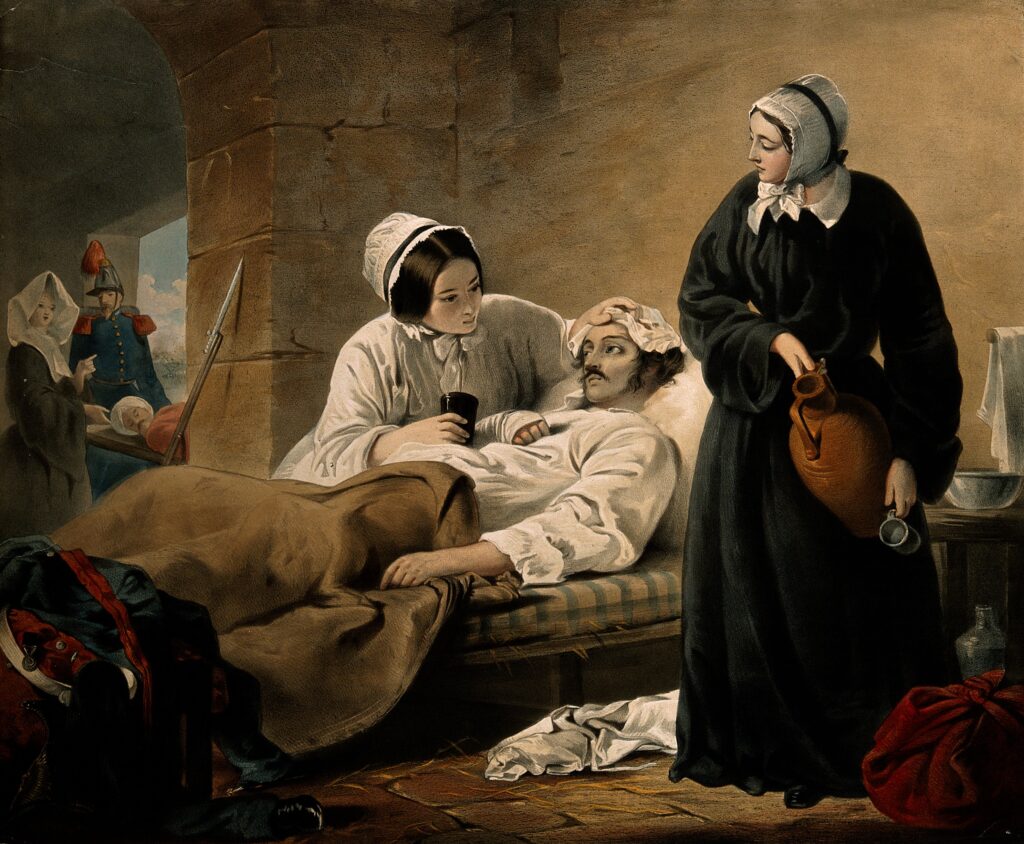
Florence Nightingale. Coloured lithograph. Source: Wellcome Collection (Public Domain Mark).
When we think of the story of human evolution, we often focus on the dramatic, “sexy” storylines: battles for physical or social dominance, hunting large game, and finding mates. But a significant subplot in our shared human story is cooperation. Our ability to cooperate toward a common goal has aided our survival for millennia. Early human foraging bands likely practiced “central place food-sharing” wherein everyone who is able goes out to hunt or gather, and the (sometimes literal) fruits of their labor are combined at the end of the day and divvied up without regard to what each individual found or caught. The custom was so effective that contemporary foraging societies still follow it. Pastoral and agricultural communities often establish formal networks of mutual aid whereby individuals can receive help without incurring a debt through what we call “need-based transfers” (in contrast to debt-based transfers)—helping someone does not create a direct obligation for them to pay you back. These sharing networks and behaviors are referred to as “risk-pools.” The group takes on the risk of the individual.
As my colleagues anthropologist Lee Cronk and psychologist Athena Aktipis have discovered, successful risk pools share a number of common design features. Chief among them is the use of need-based transfers. But this unique giving arrangement creates an obvious opportunity to cheat. A participant could receive help and never “pay it forward,” so-to-speak. Fortunately, several of the other design features address this free-rider problem. Participants agree on what constitutes “need.” This prevents individuals from using pool resources to enrich themselves. Perhaps most importantly, participants must be allowed to choose their partners, people they believe will respect the risk pool and who won’t take more than they need or refuse to help when they are capable of doing so. Among foragers and other traditional societies, partner selection is based on kinship, reputation, and individual experience. In larger, contemporary societies, however, these filters are more difficult to apply.
Something else must serve the function of sorting trustworthy cooperators from potential free-riders. Religion provides one of the oldest solutions to this ancient problem. Research across diverse fields supports the notion that religion facilitates cooperation. Religiously grounded communes in 19th-century America outlasted their secular counterparts, and members of religious kibbutzim in Israel proved more cooperative in economic experiments than members of secular ones, for example. These studies show that religion provides a screening mechanism by which individuals can ensure the integrity of their fellow risk-poolers. Religious communities demand that members continually signal their commitment by attending services, following dietary laws, adhering to codes of conduct, abstaining from certain behaviors, and so on. These behaviors require time and effort and are sometimes quite costly. A person unwilling to do the work or incur the costs signals that they may not be a reliable partner. As such, religion and shared religious identity may be another of the common design principles among successful risk pools.
The function of shared religious identity as a practical tool for partner selection brings it into direct contact with health care policy in contemporary America. Risk pools have long featured in health care. Food-sharing and need-based transfer networks have allowed the sick or injured to survive while recuperating for millennia. More recently, in the United States, fraternal organizations and industrial sickness funds functioned as a kind of health insurance during what we would consider the dawn of modern medicine in the late 19th and early 20th centuries. With therise of individual health insurance and the creation of Medicare and Medicaid, however, these services were no longer needed.
Since the Affordable Care Act (ACA), sometimes referred to as “Obamacare,” was signed into law in early 2010, the health care risk pool has started to see something of a Renaissance. In particular, health care sharing ministries (HCSMs) have expanded substantially both in number and membership. Members of HCSMs were specifically exempted from the Requirement to Maintain Minimum Essential Coverage under the ACA. As a result, people looking to avoid that requirement and willing to join a faith-based group flocked to HCSMs. Nearly a million people are served by over 100 such ministries in the U.S., the vast majority of which are Christian.
HCSMs do not function like traditional health insurance. In fact, HCSMs are required by law to inform prospective members that they do not provide insurance, that payments are not guaranteed, and that there is no legal transfer of risk. Rather than premiums, members make monthly contributions, called “shares,” to their ministries. Ministries may use escrow accounts or other ministry-managed accounts to send money to members in need of assistance, or they may instruct members to send their shares directly to those members. Ministries typically do not cover preventative or routine medical care, such as physicals or doctor visits for minor ailments. Coverage is typically for significant unforeseen expenses, which is in line with another of the design features common to successful risk-pools). Unlike conventional insurers, HCSMs may decline to cover preexisting conditions, though many create channels through which members can appeal.
The ACA exemption is commonly discussed in terms of religious liberty, particularly the freedom of believers not to participate in a system that funds procedures or behaviors their faith condemns, such as abortion or certain forms of contraception. Indeed, most ministries explicitly exclude coverage for elective abortions and for medical expenses arising from behaviors like drunk driving. Participants may be required to agree to a set of behavioral commitments: regular worship, abstinence from tobacco and illegal drugs, moderate alcohol consumption, and general adherence to a healthy lifestyle. While this may be an important factor in members’ choice to join an HCSM, it is not the only factor. Cost may play a role. Monthly shares range from roughly $100 to $400, depending on the number of individuals covered. HCSM members pay out-of-pocket for care, which generally reduces costs by up to 50%. Ministries may also negotiate with care providers on members’ behalf to reduce costs.
My colleagues and I wanted to understand what actually motivates HCSM members to join their ministries and whether religion genuinely plays the predicted role as a screening agent. We conducted initial interviews with five HCSM members and then administered an online survey to 213 U.S. residents (112 current or former HCSM members and 101 people who had never joined one).
Predictably, members were far more religious than nonmembers, and they reported a greater desire not to pay for health issues they saw as arising from immoral behavior. Other important themes emerged, however, in our interviews and later in the survey, particularly self-reliance and community. Members who were surveyed placed greater import on being self-reliant and reported appreciating the sense of community they felt with other ministry members. One interviewee tied these two seemingly contradictory characteristics together, telling us essentially that one must be self-reliant in order to be part of the community. This mirrors yet another design principle: participants must not be required to give until they have taken care of themselves. Thrift was an important motivation, as well, but with a crucial caveat. Members did not score higher than non-members on most general measures of frugality. They did, however, significantly outscore their counterparts on a scale that measures “sanctified thrift,” or the belief that thriftiness is a sacred or moral duty.
Based on this evidence, we believe that what HCSMs accomplish is something that conventional insurance–and likely government health care coverage–simply cannot. Ultimately, ministries make health care-related behaviors sacred. Clemens Cavallin describes ritualization as the process of “raising action to the level of meaning.” For HCSM members, the most mundane aspects of health care become ritualized: paying bills, taking care of yourself, even sending get well cards. One of our interviewees had suffered life-threatening injuries in an accident a few years before speaking with us. He described receiving dozens of prayer cards from fellow members he had never met, all of which he
kept. His fellow members were not simply wishing him well; they were performing a sacred duty. The monthly shares that funded his care were not simply premiums, but offerings.
This “sacralization” process addresses the free-rider problem at its root. When paying your share is an act of religious faithfulness, the psychological cost of skipping it rises sharply. When your fellow members are co-religionists whose spiritual integrity you respect, the social cost of cheating rises further still.
What makes HCSMs work as risk pools is the sense of shared identity and moral obligation that binds members together. This moral binding need not be specifically Christian. Some ministries serve members of other specific faiths (United Refuah, for instance, is Jewish) and many are non-denominational, broadly “Judeo-Christian,” or accept members of all faiths. It may not need to be explicitly religious at all. CrowdHealth, which gained national attention just as our research was concluding [link to time], offers a model stripped of explicit religious affiliation but built on many of the same cooperative principles.
The HCSM carve-out in the ACA was built around religious freedom. But freedom of religion is not simply freedom of conscience. It includes the freedom to build cooperative institutions with people who share our commitments. As policymakers, legal scholars, and communities grapple with the future of health care coverage in America, risk pools may offer an alternative to both traditional insurance and government-subsidized options for precisely this reason. The right to choose your cooperative partners is ancient and essential. It allows us to build moral communities that make bearing risk together feel meaningful. ♦

Andrew Van Horn is a Ross-Lynn Postdoctoral Fellow in the Department of Anthropology at Purdue University. He is an evolutionary anthropologist and data scientist interested in how culture evolves and how people cooperate to create art.
Recommended Citation
Van Horn, Andrew. “On Choosing Our Partners Wisely: Faith, Community, and Duty in Health Care Sharing Ministries.” Canopy Forum, April 18, 2026. https://canopyforum.org/2026/04/18/on-choosing-our-partners-wisely-faith-community-and-duty-in-health-care-sharing-ministries/.
Recent Posts