Andrea Pin and the Roles of Dignity Jurisprudence
James R. May
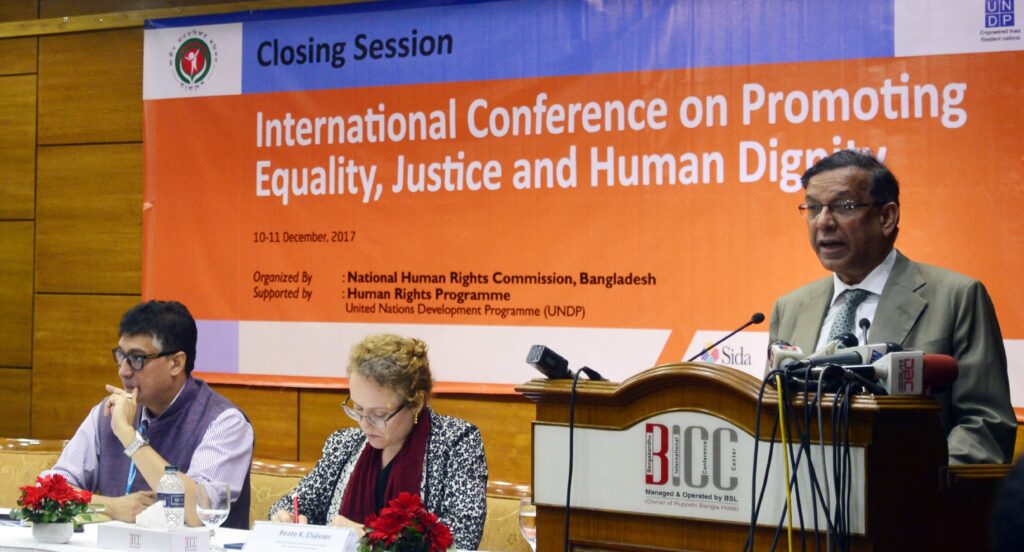
Keynote address at International Conference on Promoting Equality Justice and Human Dignity by Press Information Department (PD)
This article is part of our Book Review Roundtable on Andrea Pin’s book, Dignity in Judgement: Constitutional Adjudication in Comparative Perspective (2025).
If you’d like to check out other reviews in this series, click here.
Human dignity is an elemental value that presupposes that every human being has equal worth. It emphasizes the fundamental value and equality of all members of society – humans not only are endowed with dignity, but each is endowed with an equal quantum of dignity. In the words of the UN’s Universal Declaration of Human Rights (“UDHR”), “All human beings are born free and equal in dignity and rights.” Similar language has since found its way into myriad international human rights accords, including both the International Covenant of Civil and Political Rights and the International Covenant of Economic, Social, and Cultural Rights. The majority of countries on the planet have taken the next step of constitutionalizing the concept of human dignity. Over the last 50 years, dignity has become entrenched in constitutional systems throughout the world. More than 160 nations recognize human dignity in some form in their constitutional texts and hardly a new constitution is adopted or amended without it.
There is a robust global jurisprudence of dignity. In “Dignity in Judgment: Constitutional Adjudication in Comparative Perspective,” Andrea Pin captures the role of human dignity in jurisprudence and the rule of law like it’s a molecule of oxygen consisting of two atoms essential to human life. In this refreshing take on a well-worn subject, Pin offers a rich and careful examination of how five different constitutional systems deploy the concept of human dignity, and what that usage reveals about the ongoing negotiation between law, religion, and secular public reason, as not only a legal tape measure:
“The concept of human dignity has become a staple in legal studies, political philosophy, and political and moral theology. It is now a powerful term in constitutional and statutory texts, judicial decisions, academic scholarship, and even political rhetoric. It serves several roles: it may galvanize political and legal sensitiveness to a certain topic or agenda, express the importance of human rights or the gravest concern for their violation, capture the quintessence of a legal system, flesh out a meta-theory of how legal systems should operate, and guide interpretation of legal rules. … Actually, dignity … often embodies the quest for the universal in human rights adjudication and has become a yardstick to measure the progress of legal civilization.”
Detailing dignity’s role in law and society is a delicate dance, one Pin manages with aplomb. The book does not try to provide a single philosophical definition of dignity or a doctrinal manual for one jurisdiction; instead, it undertakes a sustained comparative inquiry into the apex courts of Canada, Colombia, Egypt, the Court of Justice of the European Union, and Israel, asking how each treats dignity within its constitutional framework.
As Pin explains, each selection bears the imprint of an Abrahamic religious heritage, each has undergone its own pattern of secularization, and each relies heavily on judicial review to manage deep social and moral pluralism. This design allows Pin to avoid treating dignity as an abstract moral slogan. He presents it instead as a working legal concept that courts employ when navigating conflicts about religion, rights, and contested visions of collective life. Importantly, Pin is careful to describe the concept of dignity dispassionately and with restraint, rather than with an enthusiast’s cudgel:
“In writing this book, I had different goals from those of most of the scholarship that exists in the field. I do not claim to identify the exact contours of the notion of dignity, nor do I set out the find common denominators across jurisdictions. I am neither sanguine about the usage of dignity in constitutional narratives, nor do I suggest that the notion of dignity is simply a fig lead for juridical and political discretion. In contrast … I assume that different constitutional settings may understand dignity differently for specific reasons, which depend on the cultural and legal makeup of each body politic. I even suggest that dignity often changes meaning and direction because, and after, the cultural outlook in which a court operates has shifted”(xxi).
Running through the book is a recurring descriptive argument about how courts talk about dignity over time. Pin suggests that, in the jurisdictions he studies, judges initially treat a dignity violation as a dual affront: it harms the individual directly and simultaneously reflects on the kind of political community that tolerates such treatment. As his case studies unfold, he argues that this more relational understanding increasingly gives way to a conception of dignity that is closely tied to personal autonomy and self-definition. On his account, then, the prevailing trend in constitutional jurisprudence is toward a thinner, more individualized dignity, one that often sidelines thicker ideas about community and shared moral responsibility. That diagnosis has obvious implications for current controversies over reproductive decision-making, end-of-life choices, and gender identity, where courts must navigate between autonomy-oriented claims and competing visions of collective identity. Here, Pin seeks to find dignity’s utilitarian heart:
“In mapping out how dignity has been employed in these different legal texts, I offer insight on the proper role of dignity, especially in times of deep ideological disagreement between and among jurisdictions and of strained international relations … I have tried to respond to the sustained critique against dignity’s apparent vagueness or emptiness” (xxxi).

The opening chapter lays out the conceptual groundwork. Pin identifies the several distinct roles that dignity plays in contemporary legal argument: it lends rhetorical force to political claims, marks the seriousness of rights violations, serves as shorthand for core constitutional values, and guides judges in interpreting and applying rights guarantees. He also traces how a relatively narrow philosophical inheritance, especially autonomy‑centered ideas associated with Kant, Dworkin and Barak, has traveled into different legal settings through judicial reasoning. As Pin makes clear, one of the book’s contributions is to make this intellectual genealogy visible across systems that, on the surface, look dramatically unlike one another.
Two features of the analysis give the study a particular bite. First, Pin shows that judicial appeals to dignity, despite their variety, often draw on a shared liberal vocabulary. Dignity operates as a channel through which ideas about the person as a free and equal agent enter constitutional law even where formal texts invoke religious authority or other non‑liberal sources. In this respect, the book helps explain why dignity language surfaces both in European decisions on data protection and in post‑Arab Spring constitutional debates in North Africa, where citizens appealed to “karama” or dignity against authoritarian repression. Second, by insisting that dignity has both an individual and a political dimension, Pin offers a helpful frame for understanding change over time. When dignity is conceived in binary terms, an affront to one person’s dignity simultaneously raises a question about the kind of community that allows such treatment. As courts shift toward an atomistic understanding, dignity is increasingly cast as a guarantee of the individual’s protected space for self‑authorship, and the emphasis on what the community owes itself recedes into the background.
The main body of the book is helpfully organized around five jurisdiction‑specific chapters. Each reconstructs the legal and historical context, examines key dignity decisions, and draws out dominant patterns in judicial reasoning. For example, in Canada, Pin traces the Supreme Court’s early efforts to anchor equality jurisprudence in dignity, and explains the evolution of the Court away from this thicker, socially embedded understanding and toward a more explicitly autonomy‑focused conception, in which dignity is tied to personal choice and respect for self‑determination.
The chapter on Colombia situates dignity within the Constitutional Court’s ambitious project of transformative constitutionalism. There, dignity sustains decisions on social and economic rights, transitional justice, and the recognition of historically marginalized groups, including Indigenous peoples. Pin’s account helps show how a single concept can support a dynamic that echoes current Latin American debates over using dignity to justify far‑reaching social rights and transitional justice measures.
The nuanced discussion of Egypt examines how dignity is invoked in a system that explicitly references Islam while also engaging with international human rights standards. Here Pin shows that Egyptian courts have used dignity as a bridge between these normative worlds. On the one hand, dignity resonates with ideas of honor, modesty, and public morality rooted in Islamic tradition. On the other, it is gradually filled with more universal, rights‑oriented content. Unlike in some Western systems, the move toward an atomistic dignity is less abrupt; judges retain elements of the communal and religiously inflected understanding to avoid a direct break with constitutional provisions on Islamic law, even as they shift portions of their reasoning into the language of individual human rights. This “Westernized” reconstruction is especially useful for interpreting the post‑Arab Spring constitutional moment, where claims to dignity have been central both in protests against authoritarianism and in debates about the place of Islamic norms in public law.
Pin’s chapter on the Court of Justice of the European Union portrays the EU as a laboratory for “new dignities.” He traces how the CJEU deploys dignity in fields such as data protection, biotechnology, and market regulation, often to mark limits beyond which people may not be treated merely as objects, data sets, or economic units. In doing so, Pin explores how the Court underscores individual autonomy while also articulating a sense of “European values” that legitimates the Union’s expanding authority. This analysis connects neatly to current controversies over Europe’s role in shaping global norms on online speech and digital privacy, where EU bodies explicitly invoke the “dignity” of users and citizens to justify stricter regulation of platforms and data processing.
The Israeli chapter, described as an “experiment,” explores dignity in a state that understands itself as both Jewish and democratic. Early jurisprudence intertwines “Jewish dignity” and “universal dignity,” reflecting the dual ambition to affirm a particular religious identity while aligning with international human rights norms. The case law reveals a continuing effort to hold these commitments together. Over time, a more secular vocabulary of dignity gains ground, but without formally displacing the Jewish element embedded in the Basic Laws. Rather than resolving the tension, Pin explains how courts in Israel manage it, using dignity as a shared idiom within which both universal and particular claims can be expressed.
The book concludes with an epilogue where Pin notes that dignity has become ubiquitous in constitutional argument yet remains conceptually fragile. Simply, Pin doesn’t seem convinced of its singularity. As judges invoke it in an ever wider range of disputes, from migration and border policy to biomedical regulation, there is a risk that it will lose the distinctive connotation that once made it compelling. By reconstructing the historical paths that led to the present autonomy‑heavy usage, the book undercuts the idea that current understandings of dignity are either inevitable or neutral. This has clear relevance to ongoing global conversations about the “dignity” of migrants and refugees, where states invoke their own constitutional identities and social cohesion while international actors frame dignity primarily in terms of the rights and agency of individuals on the move.
One of the study’s most attractive features is its methodological discipline. Pin does not try to settle the philosophical question of what dignity ultimately is, nor does he impose a single template on the diverse systems he examines. Instead, he tracks how courts actually use the term, identifies recurring patterns and tensions, and draws careful inferences from what he finds. Readers seeking a prescriptive theory of how judges ought to use dignity, or strong guidance on when relational appeals should prevail over autonomy‑oriented ones, will not find that here. The work thus marks, rather than erases, the line between descriptive and normative projects.
The choice of jurisdictions is similarly double‑edged. Focusing on five Abrahamic‑influenced, rights‑active systems produces a coherent and illuminating comparison, particularly regarding the interplay of religious heritage and secular evolution. At the same time, the study does not extend its analysis to other major sites of dignity jurisprudence, such as India, South Africa, constitutional courts in East Asia and Latin America beyond Colombia, or even the United States, especially subnationally. In practice, this makes the book more of a platform than a survey: it equips readers with a conceptual vocabulary and comparative pattern that can be applied and examined elsewhere.
One shortcoming is that the book does not engage current events that would seem to put dignity in law to the test. This seems particulary trenchant given events in the Middle East, especially considering – as the book illustrates – dignity’s featured role under the Israeli constitution and legal system. Yet neither the chapter on dignity within the Israeli legal system (Chapter 5), the Epilogue (Chapter 6) nor elsewhere much engage the dignity implications of of conflict in that region, not to mention other dignity-implicating conditions, including immigration, climate change, Russia’s invasion of Ukraine, the threat of nuclear war, etc. The book nonetheless informs some current challenges, for example the renewed emphasis international bodies have placed on “human dignity” in regulating digital surveillance and AI, where the concern is whether new technologies are reducing people to mere data points or tools, erasing personal autonomy.
For readers working in constitutional theory, law and religion, or human rights, “Dignity in Judgment” offers a thoughtful and well‑crafted study of a concept that is both central and notoriously hard to pin down. As explained by the book’s promotional material, it might be best suited to those with some familiarity with constitutional adjudication and comparative methods, and it would fit naturally into advanced seminars or research projects that aim to understand how legal concepts travel across systems. Practitioners may find it valuable less for doctrinal guidance than for the way it sharpens one’s ear to what judges are doing when they invoke dignity, particularly in contemporary disputes. To be sure, Pin finishes the book with a lament of sorts that is more apt and fitting than anything I can muster for concluding this review:
“Dignity may not serve to decide several concrete cases when disagreements about its meaning are insuperable; but this is not a failure of dignity—rather it is a testimony to the variety of views that the concept of dignity now hosts. … If this book has reminded academics and judges that some parts of the history of dignity should not be omitted just because they do not fit a certain academic or judicial approach, it will have done its job.” ♦

James R. May is the Richard S. Righter Distinguished Professor of Law, Washburn University; Emeritus Distinguished Professor of Law at Widener University. He is the author or co-author of numerous works in Dignity Rights and Law, including ‘On the Human Right to Dignity in America: Influences, Recognition, and Outcomes’ (2024) 18 Vienna Journal on International Constitutional Law (ICL Journal) 123; _Dignity Under Law: A Global Handbook for Jurists_48 (Dignity Rights International 2021); Advanced Introduction to Human Dignity and Law (Edward Elgar, 2020); Dignity Law: Global Recognition, Cases and Perspectives (W.S. Hein 2020); Why Dignity Rights Matter, 19 European Human Rights L. Rev. 129 (2019), A Primer for Dignity Rights, 3 Juriste Internationale 21 (2018).
Recommended Citation
May, James R. “Andrea Pin and the Roles of Dignity Jurisprudence.” Canopy Forum, April 17, 2026. https://canopyforum.org/2026/04/17/andrea-pin-and-the-roles-of-dignity-jurisprudence/.
Recent Posts