For the Word of God is Posted and Passive
Christopher D. Hampson
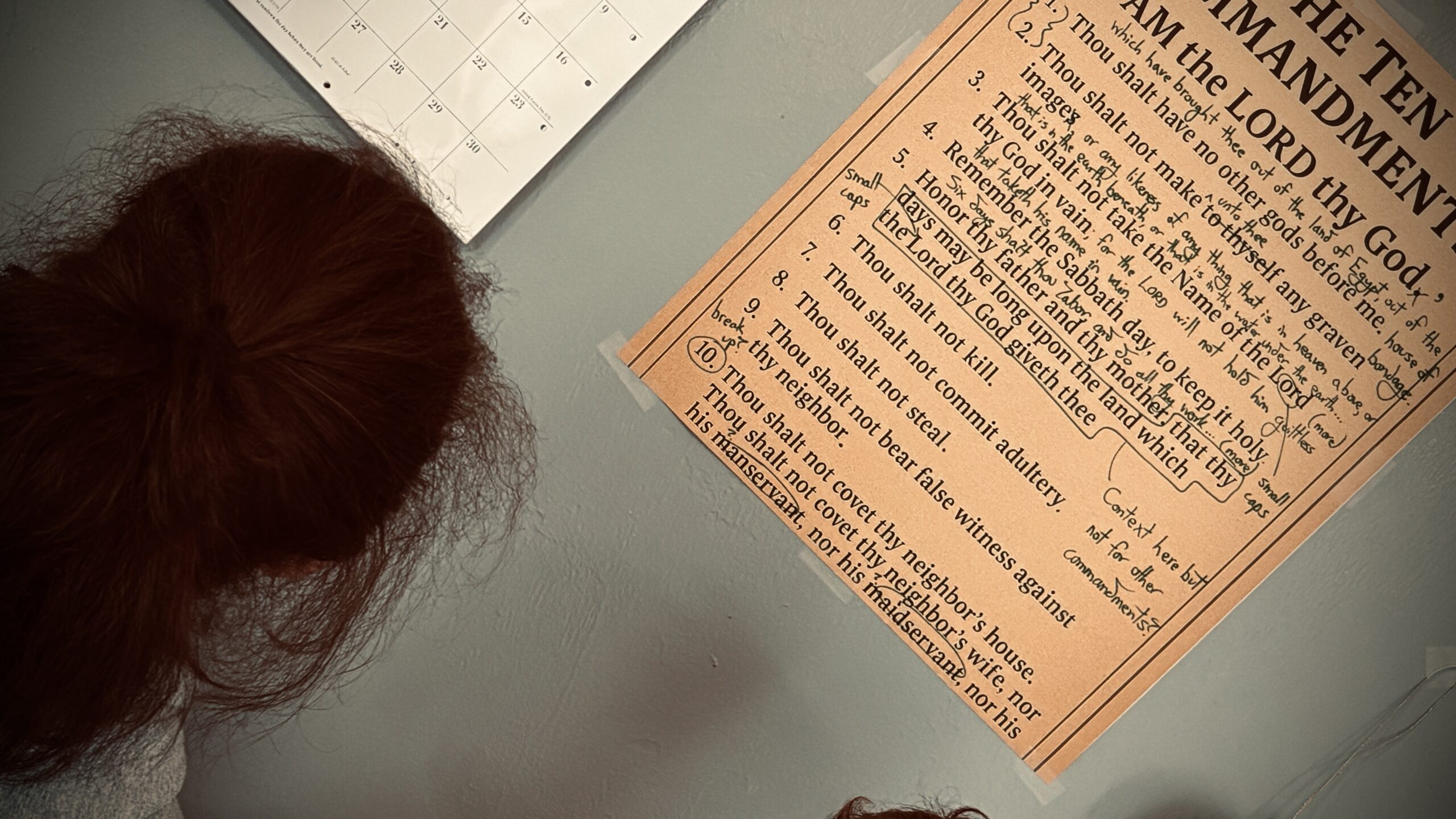
An SB 10 compliant Poster. Photo by author.
The Ten Commandments are almost certainly headed back to the Supreme Court. Over the past couple of years, Louisiana, Arkansas, and Texas have all passed statutes requiring the Decalogue to be posted in public school classrooms, and the federal courts are reassessing whether such a display is consistent with the Establishment Clause of the U.S. Constitution. The Fifth Circuit (a federal appellate court that reviews cases from Louisiana, Mississippi, and Texas) recently held in Nathan v. Alamo Heights Independent School District that the display of the Decalogue on a schoolroom poster is not what the framers would have recognized as an “establishment” of religion, and so the display is constitutionally permissible.
In Stone v. Graham, in 1980, the Supreme Court decided that posting the Ten Commandments in a public school classroom violates the Establishment Clause. In reaching the opposite conclusion, the Fifth Circuit has anticipated that Stone is no longer good law, due to intervening shifts in the Supreme Court’s First Amendment jurisprudence. Whether the Fifth Circuit is right or wrong about the status of Stone, the Supremes like to overrule their own precedents themselves, and so the case seems destined to reach the High Court.
A new defense of the posters argues that they are “passive displays” and therefore do not violate the Constitution. Professor Nathan Chapman has made a strong case that this argument is wrong: the state compels school attendance, assigns students to classrooms, and plasters the classroom walls with texts that the students are meant to memorize and internalize.
Whatever the courts make of the “passive displays” argument, it should baffle theologians, religious scholars, and people of faith. In the Christian faith, God’s Word is not usually thought of as passive, but as “living and active.” This essay lays out the implications of this surprising turn in the defense of the posters.
An Old Battleground for Establishment Doctrine
As lawyers would anticipate, the controversy has attracted a range of views on the meaning of the Establishment Clause. The originalist school of constitutional interpretation points to the features of religious establishment that were prevalent in colonial America as the touchstone for the analysis, while other schools of interpretation focus on the subtle, coercive effect that religious texts can have in public schools.
The Supreme Court’s First Amendment caselaw has long held that the government cannot coerce citizens in matters of religion, and it has focused on subtle forms of coercion in the public school environment. In Engel v. Vitale and School District of Abington v. Schempp, the Supreme Court held that mandatory school prayer and Bible readings violated the Establishment Clause. In Lee v. Weisman, the Court held that a public school could not hold religious prayer led by clergy during a graduation. And in West Virginia State Board of Education v. Barnette, a free speech case, the Supreme Court held that a Jehovah’s Witness could not be compelled to recite the Pledge of Allegiance. The Supreme Court is unlikely to bless religious coercion, even as it replaces the messy, multi-pronged Lemon v. Kurtzman test with an originalist “history and tradition” analysis. As Judge Leslie H. Southwick put it in Nathan v. Alamo Heights, “Faith cannot flourish when it is forced.”
And so, some defenders of the laws have quickly begun to defend the Decalogue posters as “passive.” This camp includes a range of sophisticated thinkers, from Fifth Circuit Judge James C. Ho to law professors Mark David Hall and Lael Weinberger, and attorney and author Andrea Picciotti-Bayer. “[T]here is a long history and tradition of including religious images and language in public spaces,” say Hall and Picciotti-Bayer in a new article, and “passive displays of the Ten Commandments in public schools are constitutional.” Judge Ho, in his concurring opinion in the Louisiana appeal, repeatedly referred to a Decalogue poster as a “passive display” and called it “even less coercive than being forced to listen every morning to the monotheistic and anti-atheist Pledge of Allegiance.” “No one is required to have any particular response to those Ten Commandments,” writes Weinberger. “Students could look at them, ignore them, scoff at them, learn from them, be annoyed by them, wish that the school had better art on the walls, or any of a thousand other possible responses.”
Along the way, numerous commentators have pointed out that there is no single, agreed-upon text of the Ten Commandments. As I wrote in a recent essay, the proposed text is both “unbiblical” and “sanitized,” stripping the narrative setting of slavery, Exodus, and Jubilee from the text. “God’s self-revelation as the God who brought the Hebrews out of slavery is trimmed,” I pointed out, to read, simply, “I am the Lord thy God.”
These are not minor redactions. The revelation of God as abolitionist played a significant role in American political history, and the story of the Exodus of the Hebrews resonated with generations of enslaved persons, abolitionists, and radical reconstructionists. “The Jubilee,” I argued, “is arguably of equal or greater significance in American legal history than the Decalogue,” a significance that I demonstrate in a long-form essay called The Spirit of Jubilee.
In my view, posting a redacted Decalogue does a disservice both to the Bible and to American history. The temptation to seek political power has resulted in the posterization of a sacred text. The concern that entanglement with worldly politics would corrupt and distract the church is exactly why Roger Williams—a Baptist preacher and a founder of Rhode Island—endorsed a “wall of separation” between church and state in his public debates with John Cotton of Massachusetts Bay.
These days, many people seem to feel cornered into taking a “pro-religion” or an “anti-religion” view on the First Amendment’s religion clauses. A “pro-religion” person supports a broad scope for free exercise and a narrow definition of establishment: religious imagery washes over the public square and into the halls of power—and state money floods back. An “anti-religion” person supports a narrow scope for free exercise and a broad definition of establishment: religious people cannot become a “law unto themselves” and the state stays imperiously above the fray. Fewer people take Williams’s approach: broad free exercise and broad non-establishment, all in the name of good governance and a flourishing church. But Roger Williams was on to something. A degree of separation between church and state might be valuable not to protect the state from the influence of religious communities, but to protect those communities from the corrupting influence of worldly power.
The new battle over the Ten Commandments is an excellent example of this temptation. What if the campaign to “get God back into public schools” is squeezing Christians into endorsing a view of Scripture that does not actually align with their faith?
The Sacred and the Poster
The passivity argument runs into the Supreme Court’s observation in Stone that Ten Commandments posters in public schools, if they “are to have any effect at all, it will be to induce the schoolchildren to read, meditate upon, perhaps to venerate and obey, the Commandments.” But it also runs into traditional Christian beliefs about the Word of God. Leave a federal courtroom and step into any Christian church, and you are likely to hear a different view of the Word. The author of Hebrews wrote that God’s Word was “living” and “active” and “sharper than any two-edged sword, even penetrating as far as the division of soul and spirit, of both joints and marrow, and able to judge the thoughts and intentions of the heart” (Hebrews 4:12, NASB). God’s Word is described as having intent and purpose: “It will not return to Me empty,” says God in Isaiah 55:11, “Without accomplishing what I desire / And without succeeding in the purpose for which I sent it” (NASB).
The Christian faith underscores that the activeness of God’s Word pervades every letter of the text. “All Scripture is God-breathed and is useful for teaching, rebuking, correcting and training in righteousness,” says Paul in 2 Timothy 3:16–17, “so that the servant of God may be thoroughly equipped for every good work” (NIV). The faithful must not add to, or subtract from, God’s commands (Deuteronomy 4:2) or God’s prophecies (Revelation 22:18–19).
This is especially true of the law, which the New Testament holds out as central to its message of death and rebirth into God’s beloved community. The Apostle Paul teaches in Romans 7 that God’s law brings death by making us aware of how far short we fall of God’s commands. “I was once alive apart from the Law,” says Paul,” but when the commandment came, sin came to life, and I died” (Romans 7:9). “Do not think that I have come to abolish the Law or the Prophets,” says Jesus in Matthew’s Gospel, “I have not come to abolish them but to fulfill them. For truly I tell you, until heaven and earth disappear, not the smallest letter, not the least stroke of a pen, will by any means disappear from the Law until everything is accomplished” (Matthew 5:17–19, NIV). And John’s Gospel identifies the Word (Greek: logos) as Jesus Himself (John 1:1–14). For the Apostle Paul, the process of salvation begins and ends with hearing the Word: death by hearing the law and new life by hearing the good news of salvation (Romans 10:13–14).
The testimony of numerous Christians through the centuries turns upon confrontational encounters with God’s Word. Augustine of Hippo in his Confessions described his turn to faith when he heard a young child repeating the phrase “tolle, lege” or “take up and read.” He grabbed Paul’s Letter to the Romans and opened it to Chapter 13, finding therein what a modern Evangelical Christian might call his “life verse.” Indeed, many coming-to-faith stories from the Christian tradition rely on someone coming across a fragment of the Word. Like a seed, even a small amount of the Word is enough to germinate spiritual growth, especially in countries where a complete Bible is hard to come by.
An honest assessment of the Ten Commandments in the Christian tradition, whether in the Good Book or on a poster, would not describe the text as “passive.” To the contrary, God’s Word is living, active, piercing, judging, purposeful, and God-breathed: it even brings spiritual death and resurrection to the reader and points him or her to Jesus Christ. But none of the attorneys for the states have told the courts that many Christians believe the Ten Commandments are meant to bring spiritual death to public schoolchildren (for obvious reasons). And yet, that is a longstanding Christian view of the function of divine law.
When Judges Cannot Avoid Doing Theology
The Fifth Circuit’s majority opinion in Nathan v. Alamo Heights dodged the question of whether the Decalogue is passive. Arguing that “matters of theology and scriptural interpretation lie beyond our ken,” the majority opinion claimed theological ignorance to avoid addressing whether Texas’s version of the Ten Commandments privileges one religious denomination over another. That approach is unworkable, of course, because it leaves all the theological questions to the legislature—and most lawmakers are not theologians, either. It also borders on false humility, since the majority did enough theology, albeit implicitly, to satisfy themselves that texts on a wall do not coerce.
Similarly, in a shocking failure of constitutional imagination, the majority did not analyze whether other religious texts or artefacts would be “passive” enough to pass constitutional scrutiny. Judge Stephen A. Higginson, in dissent, actually gave this question some thought: “The majority’s reduced Establishment Clause,” he pointed out, “would allow state governments to evangelize by affixing a crucifix — or a mezuzah, or a statue of Buddha, etcetera, to the exclusion of other symbols — purchased with state funds, in every classroom.”
Plenty of other religious texts could fit on a poster. Why not the Beatitudes? Why not Leviticus 25:10, which is etched on the Liberty Bell? The Sinner’s Prayer? Joseph Smith’s Thirteen Articles of Faith? The Four Noble Truths of Buddhism? The Shahada of Islam — perhaps in Arabic calligraphy, which many Muslims believe combines art and spirituality to convey the beauty and presence of the divine?
If we allow ourselves a little excursion into the third dimension, could the state require public schools to affix to the doorpost a mezuzah, a Jewish parchment scroll inscribed with Hebrew prayers? How about a Buddhist thangka, a North African hamsa or a Catholic holy water stoup on the wall? On the ceiling, a Native American dreamcatcher? If the Establishment Clause is receptive to statuary in public schools, then the Buddha and the Virgin Mary are on the table as well.
Remember that the core of the constitutional problem is the mandated posterization of the Ten Commandments by itself. Public schools could certainly create mixed displays of a multitude of religious texts and artefacts, but it is hard to see how Louisiana, Arkansas, and Texas can mandate the sacred text of one religious tradition without privileging that religion over others. The Fifth Circuit’s majority opinion contains no direct answer to these questions.
The Courts & the Christians
In the end, the federal courts must decide whether a poster displaying the Ten Commandments is “passive” enough for the purposes of First Amendment law. And that analysis will not turn on how people of faith think about the Ten Commandments. But the cause of overruling a Supreme Court case is a massive one, requiring the willing cooperation of several hundred well-meaning Christians, both to persuade the legislature to pass a statute and to persuade courts to uphold it. If success turns on flattening or minimizing Scripture, then Christians should ask hard questions before moving out under this banner — and particularly before claiming that God is behind the cause. That, ironically, might violate the Third Commandment: “Thou shalt not take the Name of the Lord thy God in vain.” ♦

Christopher D. Hampson is Associate Professor of Law at the University of Florida Levin College of Law. He is a former law clerk to Richard A. Posner and a graduate of Harvard College, Harvard Law School, and Harvard Divinity School.
Recommended Citation
Hampson, Christopher D. “For the Word of God is Posted and Passive.” Canopy Forum, May 22, 2026.
https://canopyforum.org/2026/05/22/for-the-word-of-god-is-posted-and-passive/.
Recent Posts