Theater of Heteropatriarchy: Black Sexuality in Legal Discourse
Jarvis Benson
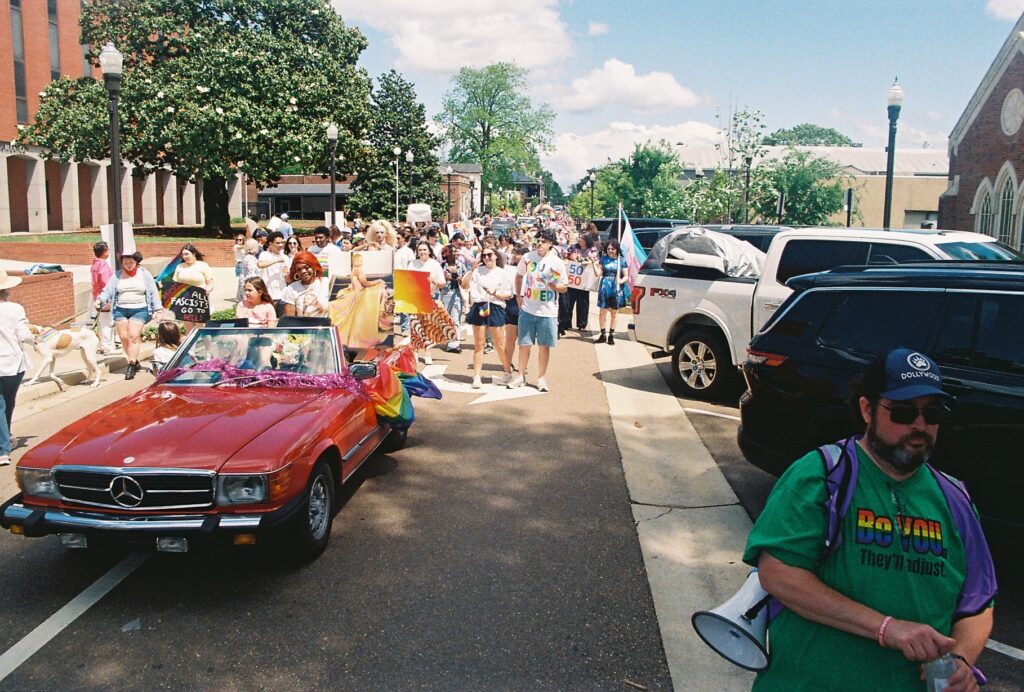
Oxford MS Pride parade. Photo by Author.
On the evening of her birthday in July 2022, Stephanie Lee called the Oxford, Mississippi Police Department to request a wellness check. Her child, Jimmie “Jay” Lee, a 20-year-old public policy student at the University of Mississippi, had not called that morning as he always did. Jay was last seen leaving his apartment dressed in a silver robe, gold bonnet, and gray slippers. Known for his boldness — he had run for homecoming king posing in a dress, performed at Code Pink, a local drag night, and spoken publicly about the complexities of his gender identity — Jay was a vibrant presence in Oxford’s queer community.
His body was not found for nearly three years. In February 2025, deer hunters in Carroll County, Mississippi discovered human remains and a gold necklace engraved with the name “Jay Lee.”
The man accused of his murder, Sheldon Timothy Herrington, is a fellow Ole Miss graduate. Prosecutors alleged that Herrington killed Jay to prevent their discreet sexual relationship from becoming public — a relationship that existed, they argued, in direct tension with Herrington’s prominent role in a conservative church his grandfather founded. In December 2024, the case went to trial.
I watched the trial the way most people did — alone, toggling between tabs, phone lighting up with messages from friends and family who were watching the same streams. I grew up in Grenada, Mississippi, about thirty minutes from where Jay’s remains were eventually found, and I know people connected to this case. That proximity made me a researcher and a community member at the same time, often in the same moment. What surprised me was how many others seemed to occupy that same dual position. The comment sections were a cacophony of neighbors, classmates, churchgoers asserting local knowledge the courtroom couldn’t formally admit. “We all went to school together, he ain’t slow!!!” someone replied when another commenter wondered whether Herrington really knew Jay was a man.
After eight days of testimony, the state rested its case that Herrington “ended Jay Lee’s life to protect his own future.” The defense, emphasizing that he “[hates] to talk about this stuff,” ended with confusion on Lee’s “kinks” and sexual desires. After just over nine and a half hours of deliberation, the judge announced to the packed courtroom that the jury could not come to a unanimous verdict. The mistrial was announced matter-of-factly. Time had stretched and compressed for those watching – thousands following the live stream from grocery stores, bus stops, and commutes across multiple time zones. The judge outlined the next steps, details that would be dissected in living rooms and kitchens across the state for the next year while they prepared for the retrial. On December 1, 2025, the day jury selection was set to begin for the retrial, Herrington pleaded guilty in Madison County to second-degree murder and tampering with evidence. He was sentenced to 40 years in the custody of the Mississippi Department of Corrections, with 10 years suspended.
A conviction. And yet, the community continues to wade in the wake. I came to this case as a sociologist studying Black community responses to anti-queer violence in the American South. What I want to explore here is not only what happened to Jay, but what the trial itself revealed: how institutions process Black queer life, and what happens when a community is forced to watch that processing in real time.
The Church, the Closet, and the Motive
Prosecutors built their case around a story about shame and secrecy. The theory was straightforward: Herrington, active in his grandfather’s conservative church, feared that his sexual relationship with Jay would become public. That fear, the state argued, motivated murder. This framing placed religion at the heart of the legal narrative. The church was not an incidental background — it was the engine of the alleged motive, the institution whose expectations Herrington supposedly could not bear to violate.
In North Mississippi, the church doesn’t always outright condemn what it can’t name. Sometimes prayer is all one can give. One man I interviewed described how his community handled everything from gun violence to homosexuality the same way: “That’s the most you can do. That’s how we was raised. It could have been teenage pregnancy, homosexuality, lesbianism — whatever. It was always go to church and pray about it.” The church isn’t a site of explicit rejection so much as a tradition of careful silence, a container for things that exist but cannot be spoken directly. That silence has a shape. It looks like a man who participates fully in church life while maintaining a private sexual self that the congregation doesn’t formally acknowledge.
But silence in Grenada also has a price. Another man I spoke with described the stakes of masculine respectability in a community dealing with significant gun violence: “If you’re not a who’s who, you’re just another dead nigga in the street.” He talked about learning toughness young — older men enforcing norms on the basketball court and in the streets. What he is describing is a community where being known, being legible as a respectable man, is a form of protection. And where losing that legibility carries real consequences. Jay Lee, openly and visibly queer, was navigating a world where that visibility carried different risks entirely. The trial’s preoccupation with secrecy, shame, and dangerous concealment never quite got at this. It wasn’t just that Herrington was hiding something. It was that the community had built, over generations, a whole architecture for not seeing it.
“They Would Kill You Before Their Dirty Little Secret Gets Out”
From the first day of testimony, both prosecution and defense repeatedly returned to a single concept: the “down low,” or “DL” — a term generally understood to describe Black men who have sex with men while publicly presenting as heterosexual. The prosecution used the DL figure to establish motive. The defense used it to suggest that Jay’s willingness to engage with closeted men made him somehow implicated in what happened to him.
One of the prosecution’s early witnesses, a gay man from Atlanta who was among the last people to communicate with Jay, described advice he had given the younger man:
“I would tell him that like a down low man or like a man who isn’t comfortable with their sexuality is not someone you want to be out here hooking up with. I was like, because, you know, I told him, I said they would kill you before their dirty little secret gets exposed.”
The prosecution positioned this witness as a community expert, using his testimony to authenticate a narrative about closeted Black men as inherently dangerous. But something more complicated was also happening: the courtroom was being asked to accept that closeted Black sexuality — not the alleged act of murder — is what requires explanation. The shame associated with Black queer life became both the motive and, implicitly, a warning that Jay should have heeded.
The defense pressed further. During cross-examination, they attempted to reframe Jay’s own behavior as “down low” — arguing that his use of nicknames for people he dated amounted to the same culture of secrecy:
Defense: “He kept it himself, right?” Witness: “Yes, sir.” Defense: “Okay, so it would be a fair statement… he was keeping secrets from you and all other people… about what he was doing in his personal sexual life…”
Jay’s witness asked the defense to rephrase. But the legal framework ultimately required him to acknowledge that Jay maintained privacy — a practice common to virtually everyone that, within the “DL” discourse, became evidence of deviance. The defense was constructing Jay as a participant in the very culture allegedly responsible for his death.
This is how stereotypes function as legal tools. The “down low” figure, saturated with racial and religious anxiety, was deployed by both sides to make the crime legible. For the prosecution, it explained why a church-going man might kill. For the defense, it suggested the victim bore some responsibility for engaging with such men. Neither approach required anyone to examine the broader conditions — including what a community’s treatment of queer sexuality costs people — that make concealment feel necessary in the first place.
“He Dressed as Jay Lee”
The second major axis of the trial involved Jay’s gender presentation. Despite Jay’s clear identification as a cisgender gay man, the defense spent considerable time trying to fix his identity within categories the court could more easily process — specifically, characterizing his feminine presentation as intentional deception. During cross-examination, the defense suggested that Jay “enjoyed” encounters where men would meet him dressed femininely and only later realize he was not a woman. A close friend pushed back plainly: No. The defense persisted:
Defense: “Well, he dressed up in a feminine way? Fair statement?” Witness: “Generally, yes, but not just specifically to hook up, as you say…” Defense: “He dressed up flamboyantly as — basically as a woman? Correct? A lot of times?” Witness: “He dressed as Jay Lee.”
That response — “He dressed as Jay Lee” — is the moment I keep returning to. The courtroom needed Jay to be a category. His friends knew him as a person who made categories feel less urgent.
One of Jay’s friends told me about the first time she came out to anyone. It was Jay. She tested the waters by mentioning her girlfriend was coming over, just to see how Jay would respond. “He completely ignored it,” she told me. “And I was like, okay, well, this is great.” When the girlfriend left, Jay asked quietly: “So how long you been…?” That initial non-reaction — no gawking, no bad response, just space — was everything. “It empowered me,” she said. “That next week I probably told ten people. Because it’s like, actually, it’s normal.” What the defense was calling trickery, what the legal system struggled to categorize, was experienced by the people around Jay as simply permission to exist.
Courts require legible categories: male or female, honest or deceptive, victim or provocateur. Jay’s self-expression defied these binaries, creating institutional anxiety about how to categorize — and therefore protect — him. The defense eventually asked directly:
Defense: “Is it a fair statement that Mr. Lee was transsexual?” Witness: “It is not.” Defense: “Well… what is your representation? That he was straight?” Witness: “So as I mentioned previously, I said that he was cisgender, and he also liked men as well. And he was comfortable in his own skin.”
The witness had to explain, repeatedly, that gender identity and sexual orientation are distinct — that a man can dress femininely and be gay without being transgender, and that none of this constitutes deception. The patience required to deliver that explanation, in a courtroom, on a live stream, in front of thousands of viewers, is its own form of labor. And the fact that it was necessary at all reveals something important about how institutional frameworks determine which bodies deserve protection.
The Epistemological Gap
Perhaps the most telling moments of the trial came when legal actors confronted their own ignorance about queer life. Law enforcement officers, prosecutors, and defense attorneys depended entirely on queer witnesses to explain basic aspects of community knowledge — dating apps, kinship terms, social norms. One witness described law enforcement’s initial outreach: “They knew absolutely nothing about how we communicate. At all. So I had to explain to them.”
This dependency created an impossible position for community witnesses. They were needed to educate the court—but once they demonstrated expertise, that expertise became a target. Knowledge of how queer people date and communicate was reframed as evidence of recklessness or moral looseness. When another witness described his friendship with Jay using the term “sister” — common in queer communities as a term of deep affection — the prosecution immediately asked whether Jay identified as a woman. The witness explained: “He was actually cisgender. He was comfortable with how he was born. That may not appear in the way he presented himself physically, but we had many conversations.”
Queer social bonds became sites of suspicion, requiring translation and justification before they could be treated as ordinary. The courtroom, for all its authority, could not hold what the community already knew about Jay.
What Courts Reveal About Religion and Sexuality
Religious and legal institutions share frameworks for organizing and adjudicating sexuality. Both tend to operate through binary categories — saved or unsaved, innocent or guilty, conforming or deviant. Both struggle to accommodate lives that don’t map neatly. And both, in the American South, have historically constructed Black queerness as a particular kind of problem — one that violates norms of racial respectability as much as sexual norms.
The “DL” figure that dominated this trial is a cultural artifact sitting at the intersection of racial shame, religious expectation, and legal legibility. The public had already reached a verdict on the church’s role long before closing arguments. “The hammer of religion was too deeply ingrained,” one commenter wrote. Another, “His upbringing is largely to blame. They taught him how to walk and carry himself in their presence — but not how to be an honest man in the real world.” The courtroom treated the church as a motive backdrop. The community understood it as the conditions.
The social conditions that make it possible to kill black queer life makes it that much more impossible to have a unified understanding of how to deal with that killing. The plea gives the victim’s mother Stephanie Lee something. But a sentence resolves the legal question without touching the underlying conditions—the violence Black queer Mississippians continue to endure. The comment sections have gone quiet after the plea. But the questions people were asking — about DL men, about the church, about what Black communities owe their queer members—those don’t get answered by forty years in Parchman. They continue to echo through the land and shape the decisions we all make in our search for justice. ♦
Jarvis Benson (he/they) is from Grenada, Mississippi, and is a fifth-year doctoral candidate in sociology at the University of North Carolina at Chapel Hill. His research examines the intersections of race, gender, sexuality, and violence, with a focus on Black community life in the South.
Recommended Citation
Benson, Jarvis. “Theater of Heteropatriarchy: Black Sexuality in Legal Discourse .” Canopy Forum, April 29, 2026. https://canopyforum.org/2026/04/29/theater-of-heteropatriarchy-black-sexuality-in-legal-discourse/.
Recent Posts