The Dangerous Religious Framing of the War with Iran
John Daoud
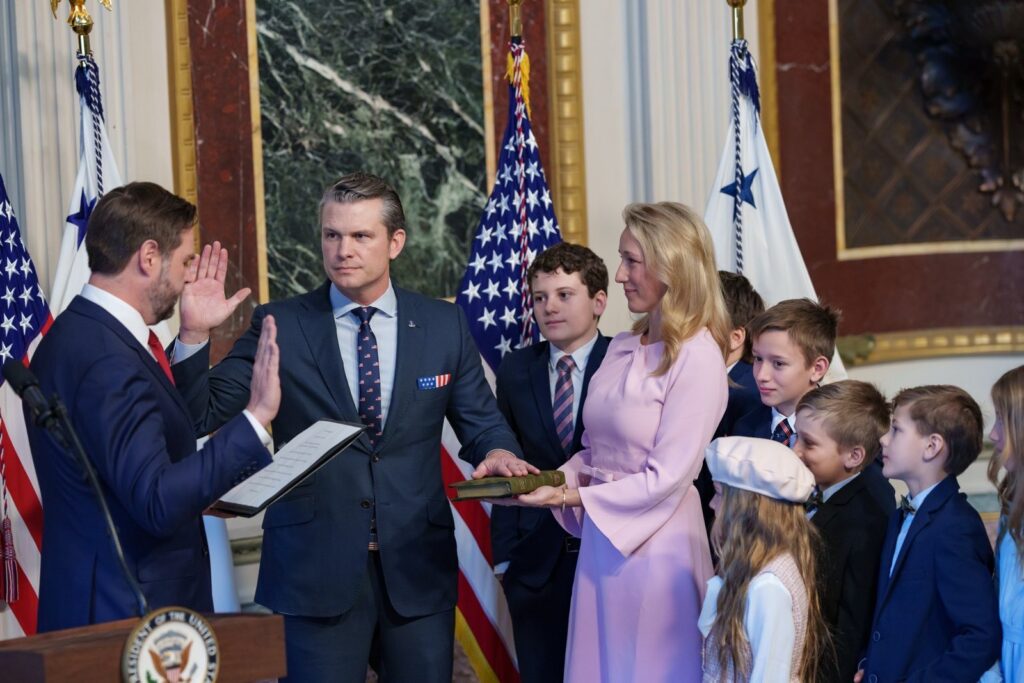
Pete Hegseth’s confirmation as Secretary of Defense (US-PD).
On February 27, 2026, President Donald Trump launched Operation “Epic Fury.” Within a day, the United States had killed Iran’s Supreme Leader Ayatollah Ali Khamenei, 170 people at the Shajarah Tayyebeh Elementary School in Minab, and, alongside Israel, begun a war with Iran. From the beginning, the war has been framed in overtly religious terms. Israeli Prime Minister Benjamin Netanyahu was quick to liken the Iranians to the biblical Amalek (and he wasn’t the only one to see things that way). In the United States, senior military leaders reportedly referenced the war as a means to herald Armageddon and the coming of Jesus Christ. Defense Secretary Pete Hegseth didn’t shy away from religion either, referring to the Iranian government as “hell-bent on prophetic Islamist delusions.” The willingness of leaders in both the United States and Israel to engage in a sort of religious reasoning for the war is itself curious, but the content of each set of religious references provides insight into the propositions for which the war has come to stand.
In the American context, so much of the war’s religious framing has been spearheaded by Secretary of Defense Pete Hegseth (or as he prefers to be known, the Secretary of War). Since the start of the war, Hegseth has led seven press briefings with senior military leaders. In his first briefing, where he referred to “prophetic Islamist delusions,” Hegseth also concluded his remarks with a prayer for the troops, calling for “Almighty God” to extend his “providential arms of protection” over the American military. That theme of divine protection and providence over the troops has been consistent in Hegseth’s public statements.
Indeed, Hegseth’s use of biblical passages and prayer in his public remarks demonstrates how consistently he has viewed this war through a religious lens. On March 10, at his press briefing with the Chairman of the Joint Chiefs, Hegseth concluded his remarks by invoking Psalm 144 in prayer:
““Blessed be the Lord, my rock, who trains my hands for war and my fingers for battle. He is my loving God and my fortress, my stronghold and my deliverer, my shield in whom I take refuge” (Psalm 144:1-2, NIV). May the Lord grant unyielding strength and refuge to our warriors, unbreakable protection to them and our homeland, and total victory over those who seek to harm them. And amen. God bless our troops and this mission.”
It seems that it is not enough to pray for God’s protection over the troops, but rather, God must be seen as playing an active role in preparing the troops to fight.
Hegseth’s God doesn’t just protect American troops, he “trains” soldiers for “war” and “battle.” Hegseth omits the remaining clause of verse 2, rendered as, “ who subdues peoples under me” (Psalm 144:2, NIV). That omission, though, particularly for the Christian audience with whom Hegseth identifies, arguably calls to mind the omitted clause more than its inclusion. Hegseth’s God doesn’t just “shield” the troops, he “subdues the peoples” under them. Hegseth’s prayer further continued to invoke divine protection and ask for “total victory.”
Through such a prayer, Hegseth casts Operation Epic Fury (a furious name that makes OperationIraqi Freedom sound almost noble) as a new holy war. For someone with tattoos of the Jerusalem Cross and “Deus Vult,” and a book titled American Crusade, the whole matter is almost too demonstrative of his belligerence on-the-nose. If Hegseth’s narrative is to be believed, God is on America’s side and actively involved in supporting America’s war effort, but it is the Iranian government that is powered by “prophetic Islamist delusions.” In fact, in his March 19 press briefing, Hegseth described one of the “core industriesindustr[y]” of the Iranian government as “violent messianic Islamist ideology chasing some sort of apocalyptic endgame.” The irony of Hegseth’s religious framing was made even more apparent during his March 13 press briefing, where he made very clear that it is he who “serve[s] God” first and his April 8 press briefing, where he noted that “God deserves all the glory” for the success of American forces.
In a press conference on April 6, that is, Easter Monday, Hegseth analogized the plight of an American airman to Jesus, comparing the airman’s plan being shot down on Good Friday, his struggle to evade capture, and his eventual rescue on Easter Sunday to Christ’s crucifixion, burial in the tomb, and resurrection from the dead. This analogy of an American soldier to the crucified and resurrected Christ is almost shocking in its audacity. But, more than anything, it demonstrates the specific Christian religious lens through which Hegseth approaches this war.
By casting the war between the United States and Iran as a fervent religious struggle–or as Hegseth might say, a crusade–the administration is able to frustrate opposition to the war, which is considerable. To oppose the war is not just to oppose the Trump administration or its priorities. Rather, Hegseth’s narrative would claim that opposition to the war is siding with “radical Islamism” and against God–never mind that Muslims and Christians claim to worship the same God.
Furthermore, it’s not as though this point is in any way implicit. Hegseth himself has cast aspersions at criticism of the war. On April 16, he compared the press to the “Pharisees,” as discussed in Mark 3:1-6. The passage itself discusses Jesus healing a man’s withered hand on the Sabbath and whether doing so was a violation of Jewish law. As the passage tells it, after Jesus heals the man’s hand, the Pharisees begin plotting to kill him.
Here, Hegseth maligned the press as being led by “politically motivated animus for President Trump” that “nearly completely blinds [them] from the brilliance of our American warriors.” Just like the Pharisees, Hegseth says, the press only knows how to look for Trump’s legal and procedural shortcomings instead of any substantive victories. Hegseth’s comparison didn’t stop at his view that the press was unfair to President Trump, though. Instead, he was careful to note that “[a]s the passage ends, the Pharisees went out and immediately held counsel against him [on] how to destroy him.” By hammering home that point of comparison, Hegseth makes the press an enemy. Just like the Pharisees sought to destroy Jesus, Hegseth would have one believe that so too does the press seek to destroy the President.
And, lest it be forgotten, the Pharisees are recurring antagonists in the biblical narrative of the life of Jesus. In the context of Hegseth’s analogy, this makes clear that he views the press as a constant enemy.
To Hegseth, then, in a similar way the Iranians are motivated by radical religious beliefs, God is on America’s side, and those who question the war–whether bearing press credentials or citizen concerns about the use of military force without Congressional approval are enemies. Even so, framing opponents to the war as enemies is not Hegseth’s ultimate end–rather, his focus is remaking the United States into a “Christian nation.”
In addition to transgressing the norms that many Americans have come to associate with a principle of separation of church and state (not actually in the Constitution), the framing of the war as a religious conflict for political ends has actually allowed Hegseth to move towards an endorsement of his specific brand of Christianity. Hegseth has been outspoken in his views as a member of a specific denomination, the Communion of Reformed Evangelical Churches. So deep is his commitment to the denomination that one of its leaders, Pastor Doug Wilson, helped start a parish in Washington, D.C. that Hegseth regularly attends. The church has numerous policy positions on various matters, but gained notoriety when Pastor Wilson gave an interview with CNN where he admitted that his mission to turn the United States into a “Christian nation” and agreed with the value of supplanting other religions. He and his followers have advocated for a variety of other controversial policies, including their opposition to women’s suffrage and support for the repeal of the 19th Amendment.
While Hegseth’s membership in the Church might be alarming on its own, not to mention his public praise of Wilson, his framing of the war as a great religious conflict demonstrates how that theology has infected his leadership of the Department of Defense and pushed the United States closer to his specific, preferred version of a “Christian nation.” Even before the war, consistent with his church’s statements on the role of women as “homemakers,” Hegseth pushed for the further exclusion of women from the military. And now, as the war has carried on, Hegseth has put into practice his pastor’s goal of supplanting Islam and Muslims. In acting as though the Iranian government is not a rational actor, but rather led by “religious fanatics who seek a nuclear capability in order for some religious Armageddon,” but acting as though he is merely a “man of faith,” Hegseth demonizes Islam and Muslims while hearkening to his own view of the Christian God. With every comment about God being on America’s side and Iran being powered by “radical Islam,” Hegseth otherizes Muslims, and reinforces his view of America’s identity as a Christian nation. In doing so, he very deliberately thrusts his own Christian nationalist beliefs into the spotlight and forces their gradual acceptance into the mainstream. ♦

John Daoud is a 2026 graduate of Emory University School of Law. He is passionate about exploring the intersection of law and religion as relates to the contemporary and historical Middle East.
Recommended Citation
Daoud, John. “The Dangerous Religious Framing of the War with Iran.” Canopy Forum, April 30, 2026. https://canopyforum.org/2026/04/30/the-dangerous-religious-framing-of-the-war-with-iran/.
Recent Posts