

Small, Neat, Plain, and Conservative: The Strategy of Modesty in Goldman v. Weinberger
Paul Baumgardner
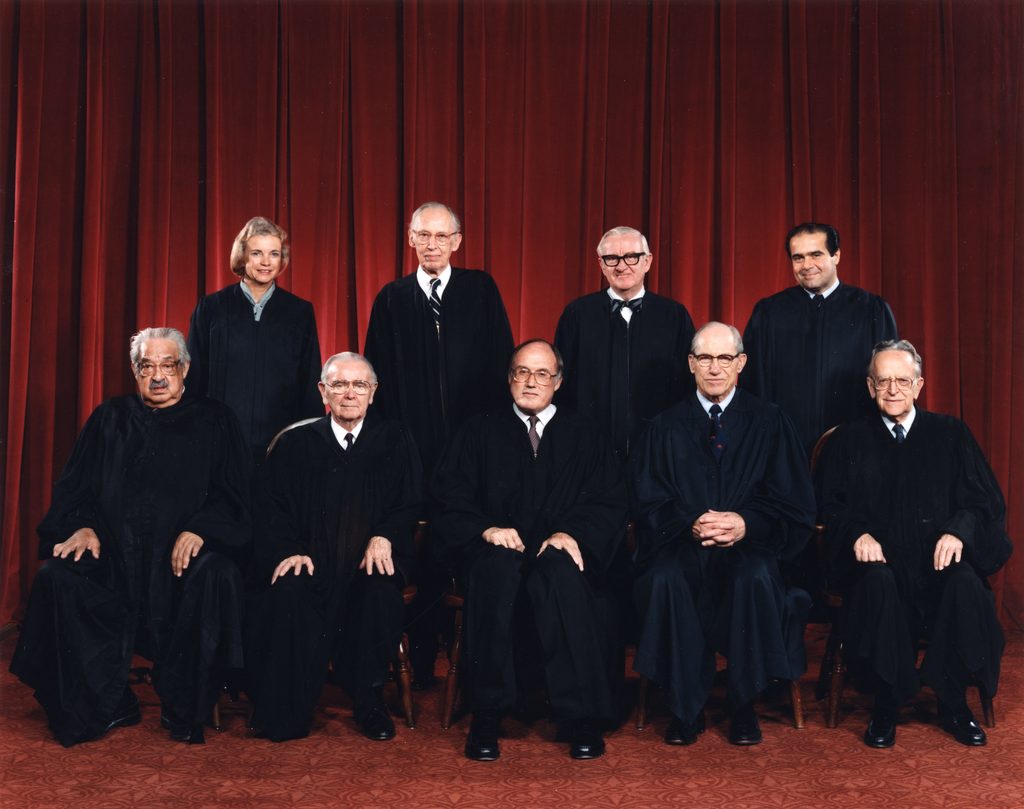
Rehnquist Court (1986-1987), Supreme Court Official Photo, (US-PD)
Today, I am wearing a navy blue polo shirt. It has a gray, wrinkled collar. Below my shirt, I have on a pair of khaki shorts. It is the summer, and I suppose this morning I didn’t see a reason to commit to pants (an article of clothing that easily becomes uncomfortable, in my opinion). No shoes, just socks. I don’t own much jewelry, but I do wear a wedding ring and a nice watch that my wife bought for me a few years back. I haven’t shaved for a few days (again: it’s the summer).
Reading back through this self-description, it seems unprofessional. Or “TMI” for a scholarly essay. These just aren’t the kinds of things that I would write about normally or even want to discuss or defend with another person. Frankly, I don’t find them to be very important to my sense of self. But self-description and the careful presentation of specific aspects of one’s appearance do arise in professional settings. They even are the kinds of things that become central to rights claims. Which brings me to Goldman v. Weinberger.
In 1986, the U.S. Supreme Court decided Goldman v. Weinberger. In its ruling, the closely divided Court rejected a First Amendment challenge to a U.S. Air Force dress code regulation. Although Congress did craft a statutory accommodation in response to the Supreme Court’s decision, Goldman really isn’t behind us. It remains a canonical case in free exercise of religion jurisprudence. It has been analyzed in law review articles, it features prominently in constitutional law casebooks, and it has been cited in subsequent First Amendment cases. However, the scholarly and judicial commentary surrounding the case has largely ignored the extent to which the petitioner’s sartorial self-description animates both the oral arguments and written opinions in Goldman.
We can describe ourselves—and others—in an infinite number of ways. We make choices about how to appear and about how to describe the appearances of ourselves and others. This is especially true in Goldman v. Weinberger. During oral arguments before the Court, the attorney representing S. Simcha Goldman chose to engage in what might be called a “strategy of modesty” to sway the justices, repeatedly emphasizing why the modest characteristics of Dr. Goldman’s yarmulke justified an exemption from the Air Force’s dress code regulation. In turn, the Supreme Court chose to evaluate Goldman’s appearance; the justices substantively engaged with Goldman’s strategy of modesty, both during oral arguments and in the Court’s written opinions.
In this essay, I closely analyze Goldman’s strategy of modesty during the oral arguments of Goldman v. Weinberger and explore how the nature of Dr. Goldman’s religious headwear became woven into the First Amendment rights claim in the case. I also show how this strategy generated divergent responses in several of the Court’s written opinions in Goldman.
The Origins of Goldman v. Weinberger
To understand the petitioner’s strategy in Goldman v. Weinberger, it will help to retrace the background facts that led to this legal dispute. S. Simcha Goldman was an Orthodox Jew and ordained rabbi who served as a clinical psychologist in the U.S. Air Force. Goldman worked at a mental health clinic on an Air Force base. While working, Goldman wore a yarmulke (although he would place his Air Force service cap over his yarmulke when going outdoors). A dress complaint was lodged against Goldman in 1981, citing an Air Force regulation—AFR 35-10—that forbade the wearing of unauthorized headgear while on duty.
Goldman was instructed by his superiors to stop wearing his yarmulke while on duty. But Goldman claimed that wearing a yarmulke was an important part of his Jewish faith, so he continued to wear it. The Air Force then formally reprimanded Goldman for violating the dress code regulation. Goldman sued the U.S. Secretary of Defense, Caspar Weinberger, arguing that his First Amendment right to freely exercise his religion was being infringed by the Air Force and that a religious exemption should be made to the relevant dress code regulation.
Oral Arguments and the Emerging “Dress Divide”
Lower federal courts were divided over Goldman’s First Amendment claim, and the Supreme Court granted certiorari. Oral arguments before the Supreme Court took place on January 14, 1986. In this section, I will delve into the case’s oral arguments, which will be quoted and dissected in detail. Unfortunately, this important stage of Goldman often gets overlooked. No scholarly work on Goldman has addressed the oral arguments stage of the case or highlighted the significant “dress divide” that already was forming at this stage.
This divide stems from the explicit strategy of Goldman’s attorney, Nathan Lewin. In his opening statement to the Court, Lewin immediately describes Goldman’s yarmulke as “a neat, small, conservative article of clothing that does not interfere with the execution of any military task.” For Lewin, the clothing’s modesty reveals how discriminatory the Air Force is being with its dress code enforcement: “This is a case where the military has simply said, absolutely, unequivocally, we will permit not the slightest departure whether it presents a danger or not, from the dress code.”
But this strategy of depicting a simple, modest article of religious faith being banished by an inflexible military behemoth does not sit well with Justice Rehnquist, leading to an extended back-and-forth between Lewin and Rehnquist. During this heated exchange, Lewin connects the smallness of Goldman’s yarmulke to other small religious displays of faith, and then he connects the small yarmulke to the smallness of the religious exemption requested. For example, he tells Justice Rehnquist: “I’m quite astounded, Justice Rehnquist, that they [the Air Force] have taken the position that such small departures as a yarmulke on the top of one’s head or even a Kumkum as cited in the brief that they refer to—the dot that a Hindu might wear—very small departures from the uniform.”
But this strategy only pulls in more critics. Chief Justice Burger jumps into the discussion and highlights how even small religious displays can create large impositions on the military. Burger points to a religious sect that “forbade the contact of metal on the body. You couldn’t have metal buttons or a belt buckle that was made out of metal. It had to be something else… Suppose you had a person of that faith came in and said, ‘No, I can’t have brass buttons. I want plastic buttons or buttons made out of natural wood or something, stone.’ The military must accommodate it?”
Lewin presses on, attempting to distinguish Chief Justice Burger’s scenario from the case at hand. Again, Lewin reiterates the smallness of Goldman’s yarmulke and how little it imposes or requires of others: “If he’s asking the military to provide buttons for him, I think that may cast a burden which a yarmulke does not. One of the things about the religious observance in this case is, it imposes no burden upon anyone.” Lewin’s sartorial message is clear. Throughout his presentation to the Court, he refers to small, neat, plain, and conservative dress as socially appropriate and also a reasonable basis for religious exemptions. At one point, Lewin even refers to this as “the basic question” before the Court, namely, “whether somebody should be able to wear something that’s neat, conservative, nonobtrusive, but a minor variation?” Garish items may be set aside, Lewin reiterates, but religious clothing that is modest should be protected.
But again, several justices are uncertain about these modesty arguments and wonder if they would lead to unsustainable constitutional distinctions around the size, visibility, and obtrusiveness of clothing. When asked by Justice Brennan if there was a “distinction” between Goldman’s yarmulke and the “headgear” of other religious groups, Lewin answers: “I think distinctions are possible under a standard that says that where there would be a clear danger in terms of morale or discipline, it seems to me it’s possible.” But Justice Stevens returns to Brennan’s question later in the oral arguments, asking Lewin: “What about different kinds of headgear that are somewhat more obvious?” Stevens then provides the example of a turban. This line of questioning is worth quoting at length, as it poses serious challenges to Lewin’s strategy of modesty. Several justices are wary of evaluations into clothing’s visibility or obtrusiveness, leaving Lewin on the back foot:
Lewin: There is a point, Justice Stevens, I think where a headgear or a head covering could become so obtrusive that it interferes.
J. Stevens: Obtrusive, no—doesn’t have any physical impairment. It’s just obtrusive in the sense that it’s readily noticed that it’s different from everyone else. Is that the test?
Lewin: Well, no. I think that “readily noticed”—obviously a yarmulke is noticed.
J. Stevens: Right.
Lewin: So, noticed is not the test. I think the question is—
J. Stevens: Well then, I take it a turban would have the same constitutional protection?
Lewin: It would be another case. I think it should.
J. Stevens: Why is it another case?
Lewin: Well, because it is larger. If one talks about—
J. Stevens: The only thing that means is it’s more visible?
Lewin: Yes.
J. Stevens: And I think you are saying visibility doesn’t make any difference?
Lewin: Justice Stevens, to the extent that the military thinks that extraordinary visibility does—
J. Stevens: They think the visibility of a yarmulke is enough.
Lewin: Well, and what we are saying is that when it is that slight, then it can’t really—it can’t be sufficient to overcome the constitutional objection.
J. White: If your client wanted to satisfy his religious beliefs in the Air Force by wearing a derby. “So, I don’t need to wear a yarmulke. I’ll wear a derby.”
Lewin: I understand.
J. White: I suppose you would say that is protected.
Lewin: I would say that if there is a solid religious basis for it, I think—
J. White: There’s just as solid as there is—
Lewis: I think the military would have to indicate that it does interfere. I think, at the very least, Justice White, I am saying in those circumstances the military has got a burden to say, ‘Yes, we think this interferes in such an obvious way with military discipline that it is prohibited.’ On the other hand, when—
J. White: How could it interfere with the discipline—under your theory—enough? Discipline?
Lewin: Yes.
J. White: The only interference with discipline is somebody’s refusal to live up to the dress code.
Lewin: No, I think, frankly, Justice White, if an article of clothing is so obvious and so extreme that when one looks at it one sees only it and doesn’t see the uniform, I think our military could make a determination—a reasoned determination—that that’s going beyond what is permissible. That’s simply not true of very small items such as a yarmulke. When someone wears a yarmulke, one barely notices it. The truth is, if one looks closely one sees it, but it is not as a derby or a top hat or a saffron robe. It doesn’t totally take over.
Written Opinions from a Fractured Court
Two of the reasons why an exploration of the oral arguments in Goldman are so valuable are because (1) they show the lengths that the attorney representing S. Simcha Goldman goes to connect the petitioner’s constitutional claim to the modest and diminutive nature of a yarmulke, and (2) members of the Supreme Court respond to this sartorial self-description during oral arguments and then explicitly engage with it in their written opinions.
In a 5-4 ruling, the Court rejected Dr. Goldman’s First Amendment claim. According to the majority, the U.S. Air Force did not violate Goldman’s right to freely exercise his religion, and the armed forces are not constitutionally required to provide a religious exemption to their dress code in this instance. Writing on behalf of the majority, Justice Rehnquist reasoned that the military has done what Lewin suggested and does take the visibility of religious apparel into account in a perfectly reasonable manner: “The Air Force has drawn the line essentially between religious apparel that is visible and that which is not, and we hold that those portions of the regulations challenged here reasonably and evenhandedly regulate dress in the interest of the military’s perceived need for uniformity.”
Justice Stevens’s concurring opinion, which Justices White and Powell joined, included even more language related to the appearance and visibility of a yarmulke—just as Mr. Lewin suggested—but still rejected Goldman’s constitutional claim. The opening paragraph of Stevens’s concurring opinion pointed out that “[t]he yarmulke is a familiar and accepted sight”; Stevens even quoted from the petitioner’s brief on the “increasingly visible” yarmulke in American society and discussed the powerful symbolism attached to this religious article of clothing. But this case should not be decided on the basis of appearances, Stevens wrote. In fact, following Lewin’s advice and creating constitutional distinctions based on the appropriateness of the appearance of religious clothing would lead to uneven and unfair protections between religions. To elaborate on this point, Stevens relied on the same turban example that he had presented to Lewin during oral arguments two months earlier: “For the difference between a turban or a dreadlock on the one hand, and a yarmulke on the other, is not merely a difference in “appearance”—it is also the difference between a Sikh or a Rastafarian, on the one hand, and an Orthodox Jew on the other.”
However, most of the dissenting justices in Goldman were sympathetic to Lewin’s framing. For example, Justice Brennan’s dissenting opinion, which Justice Marshall joined, demonstrated how the Court might translate Lewin’s arguments on small, neat, plain, and conservative dress into a test for granting religious exemptions. From the onset, Brennan’s dissent criticized the majority for being overly deferential to the military at the expense of Goldman’s constitutional rights. According to Brennan, the Court opted “to abdicate its role as principal expositor of the Constitution and protector of individual liberties in favor of credulous deference to unsupported assertions of military necessity.” The majority should have determined that different kinds of dress are afforded different levels of constitutional protection: “If Dr. Goldman wanted to wear a hat to keep his head warm or to cover a bald spot, I would join the majority. Mere personal preferences in dress are not constitutionally protected. The First Amendment, however, restrains the Government’s ability to prevent an Orthodox Jewish serviceman from, or punish him for, wearing a yarmulke.” The nature of clothing matters. Goldman was not wearing a derby or a toupee. He was wearing a modest piece of clothing that was instrumental to his Jewish faith.
The modesty of Goldman’s yarmulke was significant, as Justice Brennan saw some merit in Lewin’s distinctions between exemptions made for unobtrusive, professional articles versus obtrusive and garish articles:
The Government dangles before the Court a classic parade of horribles, the specter of a brightly-colored, “rag-tag band of soldiers.” Although turbans, saffron robes, and dreadlocks are not before us in this case, and must each be evaluated against the reasons a service branch offers for prohibiting personnel from wearing them while in uniform, a reviewing court could legitimately give deference to dress and grooming rules that have a reasoned basis in, for example, functional utility, health and safety considerations, and the goal of a polished, professional appearance.
Lewin’s framing also can be seen in Justice Brennan’s dissenting opinion. Although he does not sign onto Brennan’s dissent, Blackmun echoed Brennan’s (and Lewin’s) emphasis on modest dress in his solo dissent. Blackmun writes, “I agree with the Court that deference is due the considered judgment of military professionals that, as a general matter, standardized dress serves to promote discipline and esprit de corps. But Goldman’s modest supplement to the Air Force uniform clearly poses, by itself, no threat to the Nation’s military readiness.” While some clothing could reasonably be viewed as subverting the daily work and institutional mission of the U.S. Air Force, Justice Blackmun found that Dr. Goldman’s modest yarmulke could not have this effect.
Closing/Clothing
In the news and in the classroom, Supreme Court decisions too frequently get reduced to narratives about the deep ideological and methodological divides amongst the justices. But focusing exclusively on these sorts of divides can provide an incomplete and simplistic picture of the nature of rights claims before the Court. To have the public believe that every meaningful judicial divide over rights is, at its core, a divide over first principles and sophisticated credos certainly burnishes the Court’s reputation and restores some gravitas and high-mindedness to the institution. But these are not the only consequential divides that can develop between the justices during a case. It is important that we do not lose sight of when and how the justices split on other matters, such as clothing and claimants’ appearances, both in their written decisions and also beforehand.
In the 1986 case of Goldman v. Weinberger, the attorney representing S. Simcha Goldman—Nathan Lewin—chose to engage in a strategy of modesty during oral arguments. He consistently framed Dr. Goldman’s yarmulke as small, neat, plain, and conservative, and he argued that this sort of socially appropriate dress was deserving of a religious exemption from the military’s regulations. The Supreme Court justices differed markedly in how they reacted to this sartorial strategy, both during oral arguments and in their written opinions. On this matter, there is no reason to think that the justices were dividing on the basis of political party, ideology, or constitutional methodology. This was a dress divide—the justices were perceiving the clothing at issue in Goldman differently, and they were thinking in diverse ways about how clothing of this kind related to the clothing restriction at issue in the case. Nathan Lewin made a specific description of Dr. Goldman’s appearance central to the rights claim before the Court, the Court weighed that description, and a majority ruled against Dr. Goldman.
Recommended Citation
Baumgardner, Paul. “Small, Neat, Plain, and Conservative: The Strategy of Modesty in Goldman v. Weinberger” Canopy Forum, November 25, 2026. https://canopyforum.org/2026/11/25/small-neat-plain-and-conservative-the-strategy-of-modesty-in-goldman-v-weinberger/.
Recent Posts


