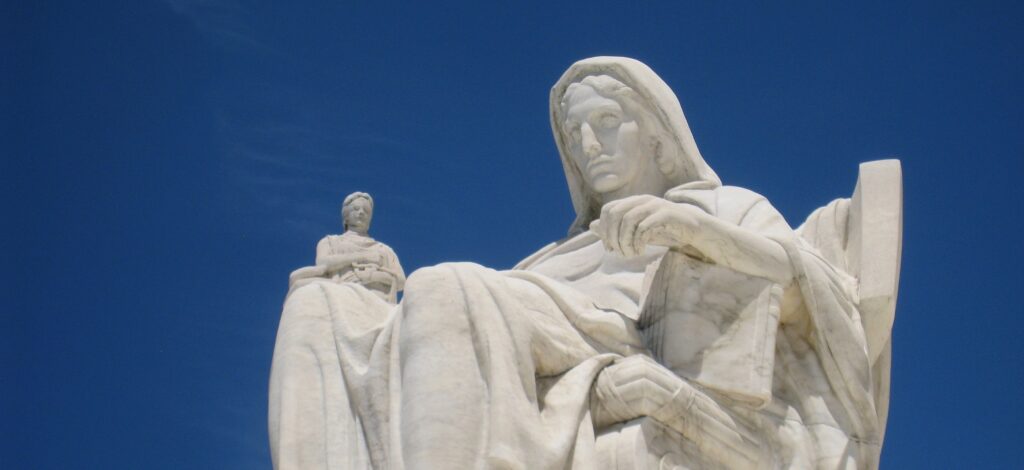
“Contemplation of Justice” by James Earle Fraser, US Supreme Court, DC, USA (US-PD).
On October 15 at 10:00am ET, Canopy Forum, hosted by the Center for the Study of Law and Religion, held an online book symposium regarding Donald L. Drakeman’s upcoming book, to be published November 2026, titled The Free Exercise Clause and the Rights of Conscience (Harvard University Press). Participants discussed the new book, and its main themes, ideas, and Drakeman’s argument.
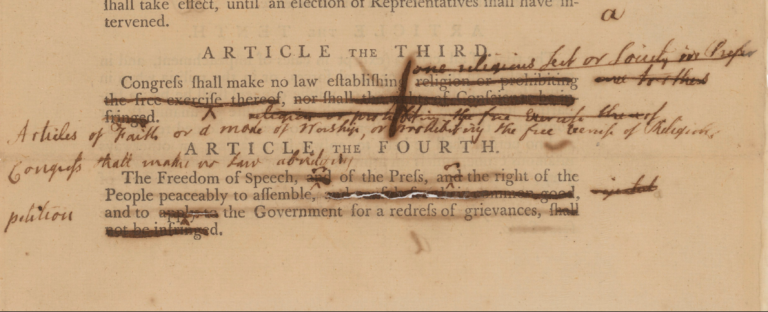
In the Free Exercise Clause and the Rights of Conscience, Donald Drakeman demonstrates that some readings of the First Amendment are dramatically overbroad. Numerous newly available sources clearly show that when the Bill of Rights was ratified, Americans understood “free exercise of religion” as a well-established term of art referring solely to the ability to hold public worship services. That meaning remained unchanged well into the twentieth century. Time and again, when believers asked the courts for conscience-based exemptions from statutes, judges turned them down, telling them to address the legislature instead. It was only in the mid-twentieth century that the Supreme Court radically reimagined the Free Exercise Clause, granting religious exemptions from statutory duties for the first time in American history.
As a result, today’s Free Exercise Clause bears little resemblance to that of the framers and the American tradition of religious liberty. Given the Supreme Court’s heavy emphasis on original meaning and tradition when interpreting the Constitution, Drakeman’s discovery could have significant implications for the future of conscience-based exemptions and the First Amendment itself.
Below, find the essays published by our symposium participants. They will continue to be published weekly through early November. ♦
This event took place on October 15, 2026. A recording of the webinar is to come.
Donald L. Drakeman J.D., Ph.D., is Distinguished Research Professor in the Center for Citizenship and Constitutional Government at the University of Notre Dame and a Fellow of the Centre for Health Leadership and Enterprise at the University of Cambridge.

Review, The Free Exercise Clause and the Rights of Conscience
John Witte, Jr. is Woodruff University Professor of Law, McDonald Distinguished Professor of Religion, and Faculty Director of the Center for the Study of Law and Religion. He has published 50 plus books and the 350 plus articles.

Drakeman’s Faint-hearted Originalism
Andrew Koppelman, the John Paul Stevens Professor of Law at Northwestern University, is the author of “Burning Down the House: How Libertarian Philosophy Was Corrupted by Delusion and Greed.”

The Free Exercise Cat is Out of the Bag: Can History and Tradition Lure It Back In?
Whittney Barth is an associate teaching professor at Emory Law School and executive director and Charlotte McDaniel Scholar at the Center for the Study of Law and Religion at Emory University. She holds a JD from the University of Chicago Law School, MDiv from Harvard Divinity School, and BA from Miami University. Views expressed are the author’s own and do not necessarily reflect those of CSLR.
Does the “Exercise of Religion” Equal Public Worship?
Steven D. Smith, J.D. Yale 1979, B.A. BYU 1976, recently retired from his position as a Warren Distinguished Professor of Law at the University of San Diego. He has published numerous articles and books on constitutional law, religious freedom, and legal philosophy.

Does the Free Exercise Clause Protect Only Public Worship?
Eric Wang is a McDonald Scholar in Residence at the Center for the Study of Law and Religion at Emory University. He clerked at the U.S. Court of Appeals for the Eleventh Circuit and at the Supreme Court of Georgia, after receiving a JD/MTS from Emory and a BA from Princeton.

Building a Mountain Too Steep To Climb
Steven T. Collis is a Professor of Law, First Amendment Jurisprudence, and Civic Leadership (by courtesy) at the University of Texas at Austin. He is the founding faculty director of Texas’s Bech-Loughlin First Amendment Center.
Recent Posts