State of Religious Freedom in Nicaragua: An Analysis of the Violent Incidents Database
Teresa Flores
Colonial-era Church in the Granada, Nicaragua by Monge Najera (CC BY-SA3.0)
Freedom of religion or belief is formally recognized in Nicaragua’s legal framework. The former Constitution of Nicaragua established that the State had no official religion and guaranteed the right to profess or not profess a religion. However, constitutional reforms adopted since 2019 and further amended in 2025 have contributed to a framework in which the exercise of fundamental rights is conditioned by broadly defined notions of public order, sovereignty, and political principles established by the State. These provisions allow for discretionary interpretation and have enabled restrictions on religious activities under administrative or security justifications.
Nicaragua is governed by President Daniel Ortega and Vice President Rosario Murillo, leaders of the Sandinista National Liberation Front (FSLN). The current freedom of religion or belief (FoRB) context is closely linked to the political developments following the nationwide protests that began in April 2018. Initially triggered by proposed social security reforms, these protests rapidly evolved into a broader movement expressing dissatisfaction with governance, political repression, and institutional control. The State’s response involved widespread repression, which significantly affected civil society actors, including religious leaders and institutions.
Consequently, the relationship between the government and religious actors, particularly the Catholic Church, has deteriorated significantly. Since the 2018 social protests, religious leaders have played visible roles in mediation, humanitarian assistance, and public commentary on the national situation Authorities have increasingly framed certain religious actors as politically aligned with opposition sectors or terrorists, leading to heightened scrutiny, stigmatization, and pressure.
A series of laws adopted in recent years (including Law 1055/2020, Law 1115/2022, Law 1145/2023, Law 1042/2020, reforms to the Penal Code, and others) have expanded the State’s capacity to sanction individuals considered to act against national interests. Under this framework, religious leaders, clergy, laypeople, congregations, among others, have been subject to arrest, prosecution, forced exile, and loss of nationality, particularly where their actions or statements are perceived as critical of the government.
The legal and administrative environment has also enabled extensive control over religious organizations. These measures allow authorities to cancel legal status, restrict activities, and confiscate assets, directly affecting religious institutions engaged in social, educational, and humanitarian work.
Nicaragua’s current FoRB context reflects a structural tension between formal legal guarantees and their practical implementation. While the constitutional framework nominally protects religious freedom, the expansion of discretionary state powers has enabled sustained intervention in religious life. As a result, religious actors operate within an environment where legal recognition does not translate into effective protection, but rather coexists with mechanisms that facilitate restriction, monitoring, and sanction.
This article aims to explore how these political and legal frameworks affect religious leaders and communities in practice, based on documented incidents recorded in the Violent Incidents Database (VID). The analysis highlights the ways in which patterns of repression against religious actors have changed during 2024-2025.
Nicaragua: Key VID findings 2024-2025
This section presents the main findings based on data from the Violent Incidents Database (VID), a tool developed in collaboration with the International Institute for Religious Freedom that collects, records, and analyzes violent incidents related to violations of freedom of religion or belief across all continents. The VID figures should be understood as indicative of documented patterns rather than a comprehensive record of all incidents. Variations in reporting capacity, access to information, and security conditions on the ground likely result in some incidents going unreported.
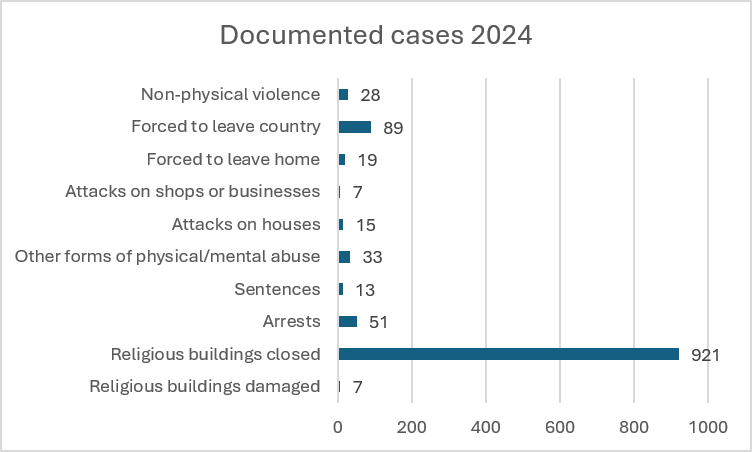
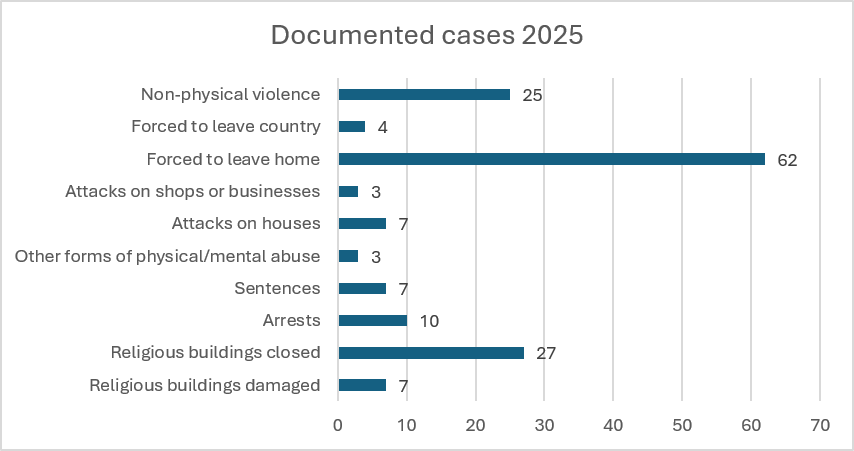
The prominence of “forced to leave home” (62) in 2025 represents a significant increase compared to 19 cases recorded in 2024. However, the rise is largely driven by a limited number of large-scale expulsions affecting religious communities, rather than a generalized expansion of this practice across the year. In contrast, the number of cases classified as “forced to leave country” (4 cases) is markedly lower than in 2024 (89 cases), when forced exile was a central feature of documented incidents. The decline in cases does not indicate that exile has ceased to function as a mechanism of pressure. A similar pattern can be observed in the category of “religious buildings closed” (27 cases), which shows a sharp decline compared to 921 cases in 2024. This does not necessarily indicate a change in policy but may instead reflect a variation in its implementation.
The category of arrests (10 cases) also shows a decrease compared to 51 cases in 2024. Fewer new detentions are recorded, but repression persists, including through the continued detention of individuals from previous years. Other categories, such as sentences (7 cases, compared to 13 in 2024) and non-physical violence (25 cases, compared to 28 in 2024), show more limited variation, while attacks on houses (7 cases, compared to 15 in 2024) and other forms of physical/mental abuse (3 cases, compared to 33 in 2024) appear at lower levels. Regarding the victims’ religion, in 2025 the VID documented a predominance of Christian victims (64 cases), while other categories remain minimal, with only 2 cases classified as “other.”
Notable trends documented
The 2025 data points to a shift in how religious repression operates in Nicaragua. Compared to 2024, there are fewer highly visible measures such as mass legal cancellations, arrests, or forced exile. This does not indicate an improvement in the FoRB context. Instead, the cases show a more entrenched form of control, exercised through surveillance, administrative pressure, restrictions on movement, control over religious spaces, and limits on public worship.
Government authorities are the main actors involved in the recorded incidents, including the National Police, administrative bodies, and other state-linked entities. Their actions reflect a centralized pattern of control over religious life. Documented incidents are reported across multiple regions of Nicaragua, with higher concentrations in Managua, Matagalpa, León, Chinandega, Carazo, Masaya, and Jinotega, and additional cases in the South Caribbean Coast, Estelí, Granada, and Rivas. While the pattern is nationwide, these concentrations may also reflect differences in reporting and documentation.
A consistent pattern is the restriction of public religious expressions, particularly Catholic processions, pilgrimages, and traditional festivities. Cases include limitations on Holy Week activities and major celebrations such as Christ the King, Santa Ana, Santiago Apóstol, and the Blood of Christ, as well as pilgrimages to El Sauce. In several instances, activities were confined to church premises or blocked through police checkpoints and security operations. The database documents repeated monitoring of Catholic clergy, parish activities, Masses, meetings, and Holy Week services. In some cases, police were present inside churches, photographing or recording attendees, monitoring homilies, requesting activity plans, and warning priests about politically sensitive messages. This shows that interference extends beyond specific events to ongoing oversight of religious leadership and discourse.
While Catholic clergy and lay movements remain highly visible in the database, the cases also include Evangelical pastors, independent churches, deacons, and Christian ministries, especially those with a strong grassroots presence or leaders who are perceived as non-compliant. The database’s documented pressures include denial of re-entry to the country, pressure to align with pro-government religious structures, fines, confiscation of worship equipment, threats of losing homes or legal status, and restrictions on religious meetings held in private spaces.
The data includes multiple ministerial agreements cancelling or recording the voluntary dissolution of Christian organizations, ministries, churches, and faith-based associations, affecting religious, educational, humanitarian, and community-oriented institutions. Although the number of closures is lower than in 2024, the 2025 cases show that administrative measures continue to be used against these organizations. Several incidents involve the seizure, occupation, or confiscation of properties linked to religious institutions, including seminaries, monasteries, retreat centers, schools, clinics, foundations, and ecclesial residences. These cases affected both religious infrastructure and social or educational works connected to faith-based communities. The category “forced to leave home” is the largest in the 2025 figures, but it is strongly shaped by specific high-impact incidents, including the expulsion of more than 30 Poor Clare nuns from monasteries in Managua and Chinandega and the eviction of approximately 30 seminarians from the San Luis Gonzaga Major Seminary in Matagalpa. This category represents severe but concentrated events, not a uniform trend across the year.
The database shows a strong decrease in documented arrests, from 51 cases in 2024 to 10 in 2025. While this reduction is significant, it should not be interpreted as a de-escalation of repression. Several cases documented in 2025 involve individuals detained in previous years, showing that prolonged detention continues to be used as a form of pressure. At the same time, the decline in new cases shows the cumulative impact of earlier repressive actions, including exile, imprisonment, and the removal of religious leaders from public life.
Finally, the database includes incidents affecting educational spaces, including the imposition of FSLN symbols in public and private institutions, coercion of students to participate in partisan activities, and pressure on teachers to use partisan language or demonstrate political loyalty. These cases raise concerns regarding freedom of conscience and the ability of students, families, and educators to act according to their religious or ethical convictions.
Conclusion
The VID data suggest that the repression against religious actors who are perceived as critical of the government has not diminished, but rather evolved into a more institutionalized form of control. Compared to 2024, the 2025 data show fewer highly visible incidents, such as mass closures, arrests, and forced exile. However, practices like surveillance, intimidation, and subtle forms of repression remained in place. Over time, these practices have become increasingly systematic. Their embeddedness in the day-to-day regulation of religious life, together with limitations in reporting linked to fear of retaliation and restricted access to information, increases the likelihood that many of these incidents remain underreported.
In other words, although highly visible cases of persecution against religious actors and communities in Nicaragua are less common than they were in 2024, day-to-day pressure rooted in the legal landscape and administrative practices such as regulation and monitoring of religious life represents one of the greatest risks to the gradual erosion of the freedoms of the religious communities that still remain in the country. As such, continued attention and monitoring of the situation of freedom of religion or belief in Nicaragua remains essential. ♦

Teresa I. Flores is a lawyer who graduated from the Santo Toribio de Mogrovejo Catholic University, Peru, with a Diploma in Religious Studies from the Pontificia Universidad Católica de Chile. She is the director of the Observatory of Religious Freedom in Latin America and a member of the Latin American Consortium of Religious Freedom, with experience in research and the study of religious freedom in the region.
Recommended Citation
Flores, Teresa. “State of Religious Freedom in Nicaragua: An Analysis of the Violent Incidents Database.” Canopy Forum, June 3, 2026. https://canopyforum.org/2026/06/03/state-of-religious-freedom-in-nicaragua-an-analysis-of-the-violent-incidents-database/.
Recent Posts