
A Free Exercise Surprise
Donald Drakeman
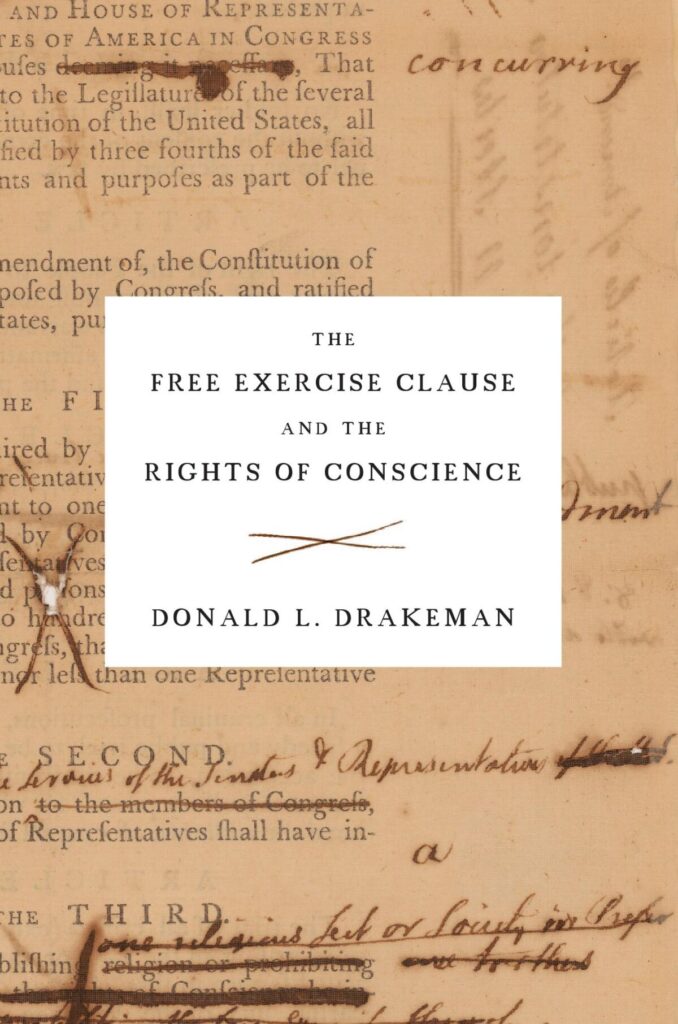
The following is an introductory essay to Donald Drakeman’s upcoming book, The Free Exercise Clause and the Rights of Conscience (Harvard University Press, 2026). Drakeman’s work will be available for purchase November 2026. In October, Canopy Forum will host an online book symposium to discuss Drakeman’s work. Read more about the upcoming event here.
I hadn’t expected to write a book about the Free Exercise Clause. My work on the religion clauses has focused on the original meaning of the Establishment Clause — which was simply to prohibit a national church — and why the Supreme Court deviated so sharply from that meaning in the 20th century.
Then a journalist asked where James Madison found the “free exercise of religion” language for the Virginia Declaration of Rights. To try to find an answer, I searched through a vast array of historical documents that had only recently become accessible thanks to the digitization of libraries and archives. I found far more appearances of “free exercise of religion” than I had expected – and a surprising answer to the question of what that phrase meant in the Founding Era. The result of that research project is The Free Exercise Clause and the Rights of Conscience, from which this essay is drawn.
The Meaning of Free Exercise of Religion
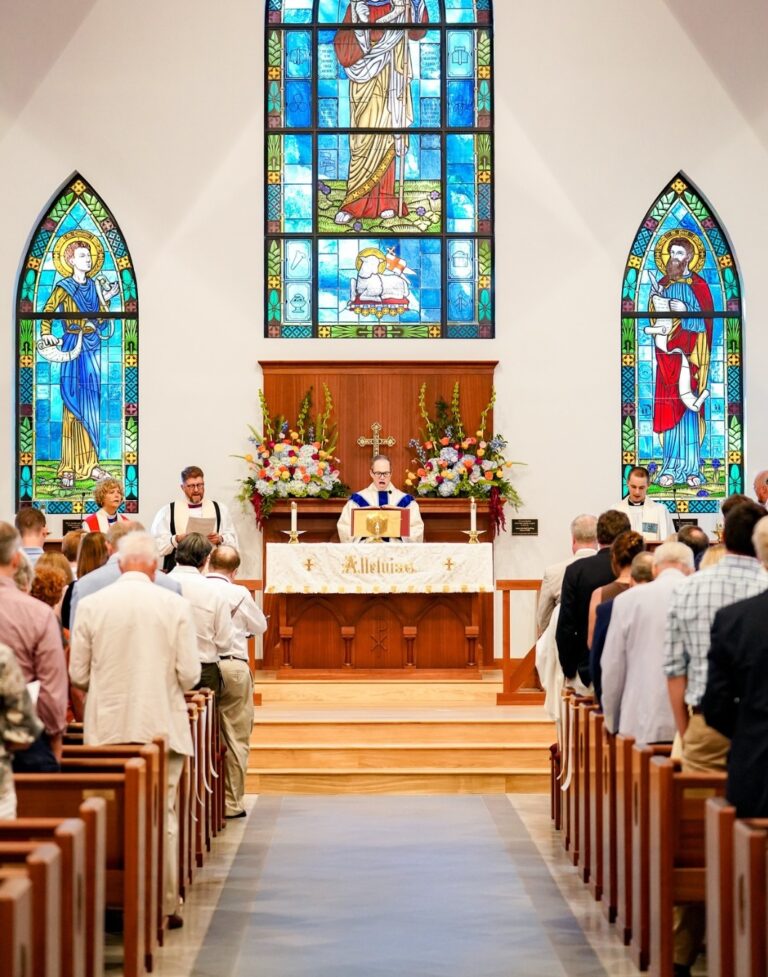
The extensive documentary record made it clear that the phrase “free exercise of religion” was a well-known term of art in the founding era. The meaning of “free exercise of religion” was clear and well understood, and people in the founding era did not argue about what it meant. It meant the ability to hold a worship service in a public place, such as a church, as opposed to having to worship inside private homes, or, in some cases, not at all.
The concept of the free exercise of religion developed in the context of laws in Europe and colonial America that required worship services to follow specified rites and ceremonies and outlawed all other religious gatherings. Among other things, rulers worried that allowing unregulated religious meetings would lead to sedition.
Dissenters seeking to worship in public had to apply for permission. In the Anglican colony of Virginia, for example, Presbyterians needed government-issued licenses to hold public worship services. If a congregation navigated that process successfully, the members would be granted “the free exercise of their religion” on the condition that it occur only “at such place of public worship . . . as they shall desire to be recorded by the county court.”
That the “free exercise of religion” was a well-known term of art can be seen in many documents ranging from petitions and deeds to treaties and translations. When the New Netherland council resolved in 1641 to give some English Puritans land where they could have the vrye exertie van Religie (literally, free exercise of religion), the grant specified what they meant: the “power to build . . . a church or churches, to exercise the Reformed Christian religion.”
The Treaty of Westphalia (1648), which ended the Thirty Years War in Europe, provided Lutherans living in Catholic-ruled states (and vice versa) the “free exercise of their religion,” according to a founding era English translation. Meanwhile, a more literal translation of the original Latin text would say that Lutherans were free to carry out public worship in churches. Along the same lines, the Edict of Milan (313 C.E.) gave all Romans the “free exercise of their respective religions,”according to a 19th Century translation, while that Latin phrase actually said, the “free and unrestricted opportunity of religious worship.”
Why was the freedom of worship so important? To allow people to fulfill their duty to worship God as required by the 1st and 4th Commandments. The New England Primer instructed generations of Americans on their duties under those Commandments: “The Sabbath is to be sanctified by . . . spending the whole Time in public and private Exercises of God’s Worship.” As the Massachusetts 1780 Constitution said, following the mandates of the Westminster Confession, “It is the right as well as the duty of all men in society, publicly … to worship the Supreme Being.” In fact, it might enrich the debates over the public display of the 10 Commandments to point out that the Framers adopted the Free Exercise Clause — and similar provisions in state constitutions — specifically to enable people to fulfill their duties under two of the commandments.
The Difference between Free Exercise and the Rights of Conscience
“Exercise” had a lengthy history of referring to a worship service, and it would not have made sense to late eighteenth-century Americans for a religious freedom claim to be based on the “free exercise of religion” unless it related to an act of worship. When dissenters wanted any other legal relief, such as the elimination of religious taxes or exemptions from military service, they did not base their claims on the concept of the free exercise of religion. Instead, those demands were based on what they believed was the proper understanding of the rights of conscience.
People argued a great deal about what the rights of conscience entailed. The conventional view was that the rights, or liberty, of conscience only covered internal beliefs. Anglican Bishop Samuel Parker said that the rights of conscience encompassed only what was “invisible.” As John Winthrop sternly warned Anne Hutchinson, “Your conscience you must keep it or it must be kept for you.”
Beginning in the 17th century, some dissenters began to argue that the rights of conscience extended beyond “invisible” beliefs to include the act of worship. Writing in his Great Case of Liberty of Conscience, William Penn explained that by “liberty of conscience, we understand not only a mere liberty of the mind, … but the exercise of ourselves in a visible way of worship.”
In the18th century, Baptists would assert that the rights of conscience should allow them to be free of religious taxes, while John Adams countered that the community’s conscience demanded the taxes. The Quakers and other peace churches sought, with mixed success, to be given a conscience-based exemption from military service requirements.
On the eve of the Boston Tea Party, Massachusetts Anglicans made the unpopular claim that the rights of conscience entitled them to have a Church of England bishop in America. In rejecting that request, the minutes of the town meeting pointed out that Episcopalians in America had “the free exercise of their Religion,” and that was all they were going to get.
In short, while people in the founding era understood the “free exercise of religion” to mean the freedom of public worship, they had many arguments about what the “rights of conscience” meant.
Free Exercise and the Rights of Conscience in the Drafting of The First Amendment
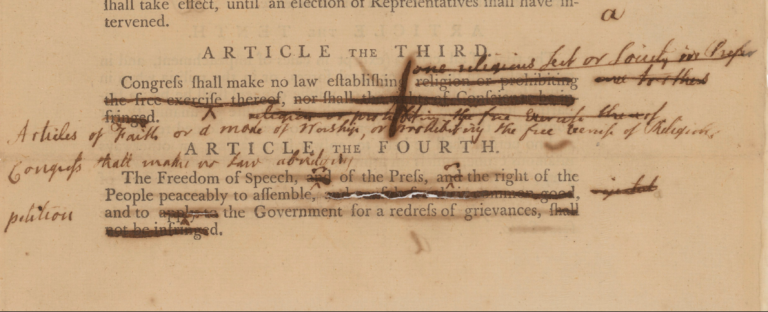
Prompted by James Madison, who was fulfilling a campaign pledge to his Baptist constituents, the House of Representatives included the phrase “rights of conscience” twice in the proposed Bill of Rights. Article 3, which applied to Congress, said “nor shall the rights of conscience be infringed,” and Article 14 provided that “No state shall infringe … the rights of conscience.”
The Senate summarily rejected both “conscience” provisions, scratching out Article 3’s “nor shall the rights of conscience be infringed” with an especially bold stroke. The Senate also deleted the House’s language in Article 5 saying that “no one religiously scrupulous of bearing arms” could be required to serve in the military. The House had also proposed a “free exercise” clause in Article 3, which the Senate ultimately accepted.
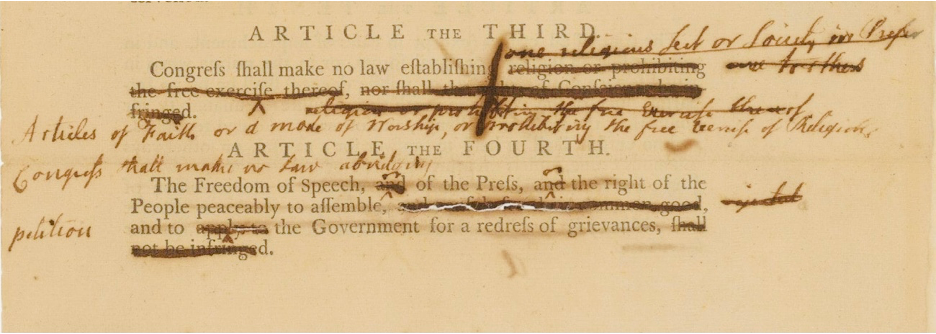
In insisting on these changes to the House’s proposed religious liberty provisions, the Senate made two fundamental choices: (1) to protect the freedom of worship via a crystal-clear Free Exercise Clause, and (2) to make sure other religious liberty issues would not become constitutional cases under the much-contested concept of the rights of conscience. As New York Congressman Egbert Benson said in opposing the military exemption, “If this stands part of the constitution, it will be a question before the judiciary on every [militia] regulation… whether it comports with this declaration or not.”
A Tradition of No Judicial Exemptions from Statutory Duties
I also discovered a sizeable number of post-Bill of Rights cases where religious claimants asked the courts for exemptions from statutory duties. From the Bill of Rights to the New Deal— abolitionists, polygamists, Sabbatarians, the Salvation Army, and others invoked constitutional religion clauses in hopes of convincing judges to exempt them from their legal duties. Not a single nineteenth-century court granted a religious exemption to a statutory duty.
Worried that a “dogged unwillingness, perverse obstinacy, or the most inhuman selfishness, might be concealed under pretended scruples of conscience,” South Carolina’s constitutional court rejected the notion of religious exemptions. Instead, the 1823 opinion paraphrased St. Paul in instructing all citizens to “obey the powers that be.”
In1854, the Maine Supreme Court observed that claims of a religious “exemption from the operation of a general law” have been considered by “Courts of the greatest learning and ability,” and they have uniformly held that the “conscientious belief of religious duty furnishes no legal defence to the doing or refusing to do what the State . . . may require.”
Along the same lines, the Arkansas Supreme Court denied a religious exemption in 1886, expressing the concern that if judges granted exemptions on the grounds of religious conscience, people would violate statutes “with impunity.” The Chief Justice wrote, “if people think “the law operates harshly, as laws sometimes do, the remedy is in the hands of the legislature.”
Sherbert’s Break with Text, History and Tradition
In a clear break with text, history and tradition, the Supreme Court adopted an active approach to religious liberty exemptions in the 1963 case of Sherbert v. Verner. To lay a foundation for issuing further exemptions, Justice Brennan dramatically expanded the meaning of “free exercise of religion” and imported a test from other individual-rights cases requiring the government to have a “compelling” interest.
But as much as Sherbert may have aligned the Free Exercise Clause with other aspects of mid-twentieth-century civil liberties jurisprudence, the Court’s new approach was no longer directly connected to the constitutional history and legal tradition of the right to the free exercise of religion in America.
Then, in 1990, Employment Division v. Smith brought free exercise jurisprudence closer to that history and tradition by casting aside Sherbert’s across-the-board requirement of a “compelling state interest.” In repositioning the Court’s approach to the Free Exercise Clause, Justice Scalia’s majority opinion admitted that “leaving accommodation to the political process will . . . disadvantage those religious practices that are not widely engaged in.” Nevertheless— and here Scalia sounds a great deal like many judicial opinions in religious exemption cases before the middle of the twentieth century— “that unavoidable consequence of democratic government must be preferred to a system in which each conscience is a law unto itself.”
Replace Smith with a Renewed Judicial Power to Grant Exemptions?
Religious liberty advocates have been calling for the Court to do away with Smith’s restrictive approach to exemptions. The current Supreme Court seems willing to do so, and the justices who are calling for a fresh interpretation of the Free Exercise Clause have also committed themselves to a “history and tradition” method for interpreting constitutional rights. The problem is that history and tradition do not provide a basis for judicially granted religious exemptions to statutory duties, which is a very modern phenomenon.
Moreover, the notion that the “free exercise of religion” extended to a wide range of religiously inspired acts other than worship did not appear until Sherbert. That case was handed down 170 years after the ratification of the Bill of Rights. To paraphrase the Court’s conclusion in Dobbs when it reversed Roe v. Wade, until the middle of the twentieth century, there was no support in American law for a constitutional right protecting conscience-based actions other than holding a worship service.
The decision in Smith may have brought free exercise jurisprudence closer to its traditional approach in which legislatures, not courts, had the authority to grant religious exemptions from statutory requirements. But it also left many Americans dissatisfied with the level of legal protection available for religiously inspired actions. As a result, Congress adopted the Religious Freedom Restoration Act (RFRA) as a legislative effort to return to the Sherbert approach. Soon thereafter, the Court, in City of Boerne v. Flores, held that RFRA could not constitutionally extend to state laws.
Or Replace Boerne? — a Legislative Approach to Judicial Exemptions
Nearly 400 years ago, the Massachusetts Bay Colony granted a religious exemption: wine for the “churches’ public use” was freed from an excise tax. From that time until Sherbert, exemptions from statutory duties were solely a matter for the legislatures.
If Supreme Court justices seek to provide a broader degree of protection for conscience-based acts while remaining true to history and tradition, the Court could overrule the Boerne decision rather than Smith. Doing so would allow RFRA again to apply to actions of state and local governments. Reversing Boerne would also bring about a return of a strict scrutiny standard when the Court evaluates state cases involving burdens on “religious exercise.”
Since the Court would be applying the terms of a recently enacted federal statute, it could look to the meaning of “religious exercise” as that term was understood by Congress when it enacted RFRA in 1993. That definition, as of thirty years after Sherbert, included a much broader array of conscience-driven actions than was the much narrower focus of the constitutional free exercise right.
Federal legislation expanding the protection for religion beyond the limits of the Free Exercise Clause could be appropriate under the Fourteenth Amendment, depending on the relevant facts, as Boerne acknowledged. The key question is whether there have been “constitutional violations” since Boerne.
In fact, state and local governments have directly targeted the free exercise of religion, especially during the COVID-19 pandemic. A number of these restrictions infringed the free exercise of religion exactly as the framers understood it— the ability to hold public worship services.
A decision that would base an expanded Supreme Court religion jurisprudence on a federal statute would make it consistent with the traditional approach to exemptions from statutory duties, which originated in the legislature rather than the courts.
Summary
Much to my surprise, these materials yielded a much clearer and more specific definition of the phrase “free exercise of religion” than I had expected. It meant the freedom of worship. Perhaps even more surprising was the fact that this understanding persisted in judicial decisions throughout the nineteenth century and much of the twentieth century.
As recently as 1962, the South Carolina Supreme Court said, in denying an exemption in the Sherbert case, the right guaranteed “by the Constitution of this State and by the Constitution of the United States” is the “right of a person to worship God in such manner and form as he may desire.”
That opinion, in denying an exemption and interpreting the the “free exercise of religion” as limited to the freedom of worship, was simply summarizing the history and tradition of the free exercise right in America as had existed since the time of the Bill of Rights. ♦

Donald L. Drakeman, J.D., Ph.D., is Distinguished Research Professor in the Center for Citizenship and Constitutional Government at the University of Notre Dame and a Fellow of the Centre for Health Leadership and Enterprise at the University of Cambridge.
Recommended Citation
Drakeman, Donald. “A Free Exercise Surprise.” Canopy Forum, July 15, 2026. https://canopyforum.org/2026/07/15/a-free-exercise-surprise/.
Recent Posts