
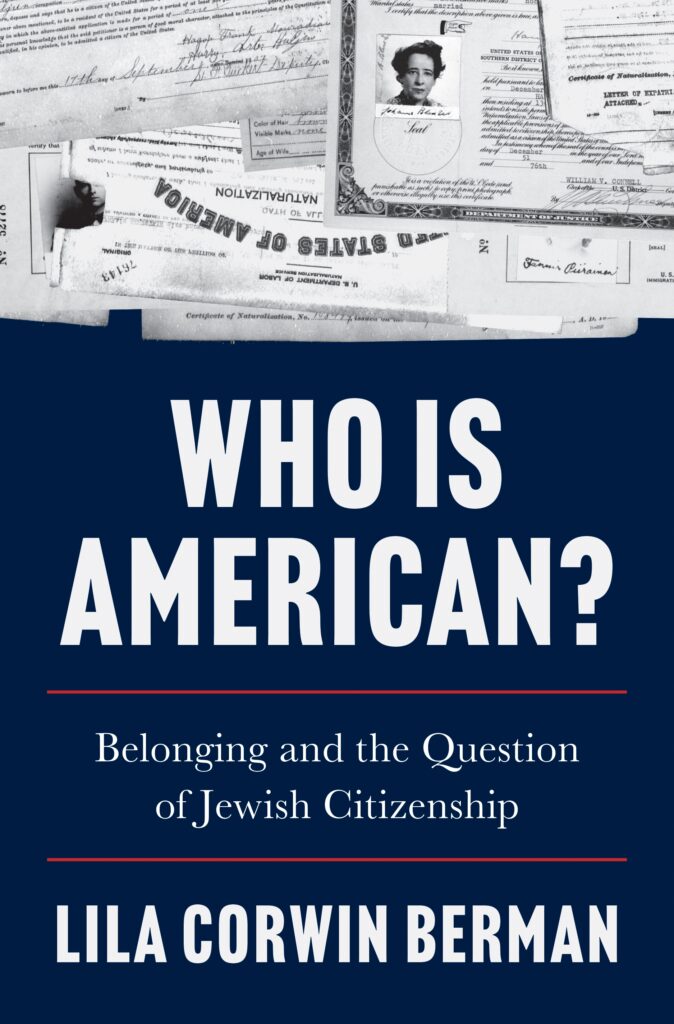
Who Is American? Belonging and the Question of Jewish Citizenship
Lila Berman
The following excerpt is from Who Is American?: Belonging and the Question of Jewish Citizenship © 2026 by Lila Corwin Berman. Reprinted by permission of Princeton University Press.
In her recently published book Who Is American, Lila Corwin Berman draws on case law, statutes, and debates to argue that both the laws of American citizenship and Jews’ position in them changed repeatedly across the twentieth century. Courts, policymakers, and the public persistently asked what it meant to be Jewish under the law. Were Jews a race, a nationality, a religion—or some combination of each? The answer carried profound legal consequences. Not only did it determine Jews’ citizenship status, but it also affected the rights they could exercise. Just as significantly, the meaning of the categories under law changed over time, affecting Jews’ self-understanding, their political ideals, and their relationships to other groups of Americans. This excerpt is taken from the introduction to her third chapter which explores how the category of religion affected Jews’ rights as citizens.
When he opened Crown Kosher Super Market in the summer of 1953 in Springfield, Massachusetts, Harold Chernock planned to serve customers every day of the week except late Friday afternoon and Saturday. Less than a year later, in the spring of 1954, however, his business hours earned him a trip to the city’s police department. It was up to him if he wanted to close for the Jewish Sabbath, but his decision to open the store on Sundays, the Christian Sabbath, had violated state law. Originating in colonial times, Massachusetts’s Sunday law held, “Whoever on the Lord’s Day keeps open his shop, warehouse, or workhouse, or does any manner of labor, business or work, except works of necessity and charity, shall be punished.” A state court assessed a $15 fine for each offense, and after a failed appeal, Chernock paid.
Things likely would have ended there had it not been for Chernock’s business partner, who insisted that more than the modest fine was at stake. With his prodding, a team of attorneys sought a federal injunction against the state law, alleging that it was unconstitutional under the First Amendment. As the case proceeded over the next seven years, eventually appearing before the US Supreme Court in 1960, it exposed a pressing—perhaps the most pressing—question about how citizenship worked for Jews in the United States: Was it possible for Jews to exercise the full and effective rights of citizenship under laws that enshrined Christian power?1Lund, “Sunday Closing,” 279–280; and Crown v. Gallagher, U.S. District Court for the District of MA, Final Decree, June 12, 1959, case heard Nov.13, 1958, Folder 17, Box ,46, RAJCong. Barbara Welke distinguishes between formal citizenship and elective citizenship, which she defines as citizenship “invested by law with full personhood.” See Welke, Law and the Borders of Belonging in the Long Nineteenth Century (New York: Cambridge University Press, 2010), 3–4.
In the spring of 1954, just as Chernock was being brought up on state charges for violating the Sunday law, a US Senate subcommittee held hearings about a Christian amendment to the Constitution.2Hearings Before a Subcommittee of the Committee on the Judiciary United States Senate, 83rd Congress, 2nd Session, on S.J. Res. 87, Proposing an Amendment to the Constitution of the United States Recognizing the Authority and Law of Jesus Christ, May 13 and 17, 1954. Since the 1860s, Protestant groups had proposed versions of such an amendment, seeking to enshrine “the authority and law of Jesus Christ” as the ruling doctrine over the United States. If the long- standing acceptance of Sunday laws across the country were any indication, the call for a Christian amendment was simply an effort to make explicit what already prevailed. Still, a recent Supreme Court decision limiting the role of religion in public education had put advocates of Christian civic power on the defense, motivating them to safeguard Christianity’s centrality to American law through constitutional reform.3On the history of the Christian Amendment, see Katharine Batlan, “One Nation Under Christ: US Christian Amendment Attempts and Competing Visions for America in the 1940s and 1950s,” Journal of Church and State 61, no.4 (Autumn 2019): 658–679; Naomi Cohen, Jews in Christian America (New York: Oxford University Press, 1992), 66–67; and Kevin Kruse, One Nation Under God: How Corporate America Invented Christian America (New York: Basic Books, 2015), 95–98.
Despite going unnamed in the Constitution, Christianity suffused the civic and political life of the nation from its establishment. In its original context, the First Amendment’s instructions that Congress avoid legally establishing religion and permit the free exercise of religion reflected the Founders’ refusal to select a single Christian church to reign supreme. But the dictates hardly evidenced the eschewal of Christianity as a prerequisite for the full rights of belonging in the republic. Limited in scope and intent, the First Amendment gave no pause to state constitutions that established Christianity (generically or through a specific Protestant branch) as the state creed and licensed religious tests and oaths for political service. Throughout the early years of the republic, judges routinely cited British common law, rooted in the Anglican church’s state authority, as the legitimating basis for laws that extended Christian authority in the United States.4For an excellent discussion of the restrictions that Jews faced and the coincidence of reforms to these restrictions with sharper racialized lines of citizenship, see Eric Eisner, “The Most Generous, Disinterested, and Philanthropic Motives: Race and the 1826 Maryland Jew Bill,” American Jewish History 107, no.4 (Oct. 2003): 757–779.
Christianity could ease belonging for some, while for others it erected legal hurdles to attaining the full rights of citizenship. Even after the 1830s, when every American state had formally disestablished Christianity, state governments enforced laws predicated on the faith, and their courts invoked Christianity as the basis for legal determinations. Over the next century, states developed piecemeal religious exemptions that allowed non- Christians to participate in political life without swearing Christian oaths or to engage in certain otherwise prohibited activities on Sunday. Under the logic of these exemptions, non-Christian practices remained outside the norm but still deserving of tolerance. The practice of religious exemption often amplified Christianity’s definitive role in public life—not to be Christian was to require special treatment. By the late nineteenth century, as states expanded their police powers, new laws to regulate morality and welfare followed this same pattern, with Christianity serving as a proxy for good behavior and the public good.
Only beginning in the 1940s did federal courts regularly hold states accountable to the First Amendment, transforming the patchwork principle of state-level religious exemption into a guide for adhering to constitutional protections. Federal courts recognized that laws with sound public purposes might incidentally burden members of specific religious groups. Especially if the courts found no other way to achieve the law’s purpose, groups that experienced secondary damages could not call on the Constitution to overturn the law. But they could petition for an exemption under the First Amendment’s guarantee of the free exercise of religion. Accordingly, by the mid-twentieth century, many states amended their Sunday laws to include some exemptions for “Sabbatarians,” or people who celebrated the Sabbath on Saturday. Similar carve-outs existed in many public schools across the country, allowing non-Christians to abstain from prayers or religious instruction. Even the 1954 proposed Christian amendment included what one of its most vocal detractors, a Jewish lawyer named Leo Pfeffer, characterized as an “escape clause” so that non-Christians could still swear their loyalty to the Constitution.5Hearings on Proposing an Amendment to the Constitution of the United States Recognizing the Authority and Law of Jesus Christ, May 13 and 17, 1954, 74.
The religious exemption offered Jews, as a class of non-Christians, a pathway toward expanded rights through the conjoined principles of religious tolerance and freedom. But judgments about whose practices were religious and whose freedoms were tolerable reinforced “the normalcy of the powerful and the deviance of the marginal,” as the political theorist Wendy Brown writes. Beginning with the definitional question of what constituted a religion, the Christian norm in American life held sway. It created an authoritative framework for jurists’ interpretations of religious beliefs and practices. Even when a group, such as the Jewish plaintiffs in midcentury Sunday law cases, achieved legal recognition as a religion, this earned them tolerance, not equality. The legal resolutions to competing bids for religious freedom reinscribed past hierarchies, reiterating a division between the normal or unmarked citizen and the citizen whose practices had to be tolerated, marked as deviant through an exemption. Overlapping with other markers of difference, such as race and nationality, religion did not solve the puzzle of Jews’ status in American citizenship as much as it raised new questions about the categorical limitations the law placed on putatively individual rights.6For a series of essays that grapples with the complexity of using law to address religion, see Joshua Dubler and Isaac Weiner, eds., Religion, Law, USA (New York: New York University Press, 2019). For a broad reflection on the trope of freedom in American history, see Jefferson Cowie, Freedom’s Dominion: A Saga of White Resistance to Federal Power (New York: Basic Books, 2022). ♦

Lila Corwin Berman is the Paul and Sylvia Steinberg Professor of American Jewish History at New York University, where she directs the Goldstein-Goren Center for American Jewish History. She is author of The American Jewish Philanthropic Complex: The History of a Multibillion-Dollar Institution (Princeton) and Metropolitan Jews: Politics, Race, and Religion in Postwar Detroit.
Recommended Citation
Berman, Lila. “Who Is American? Belonging and the Question of Jewish Citizenship.” Canopy Forum, July 29, 2026. https://canopyforum.org/2026/07/29/who-is-american-belonging-and-the-question-of-jewish-citizenship/.
Recent Posts