What distinguishes humans from AI robots? An Islamic Perspective
Mariam al-Attar
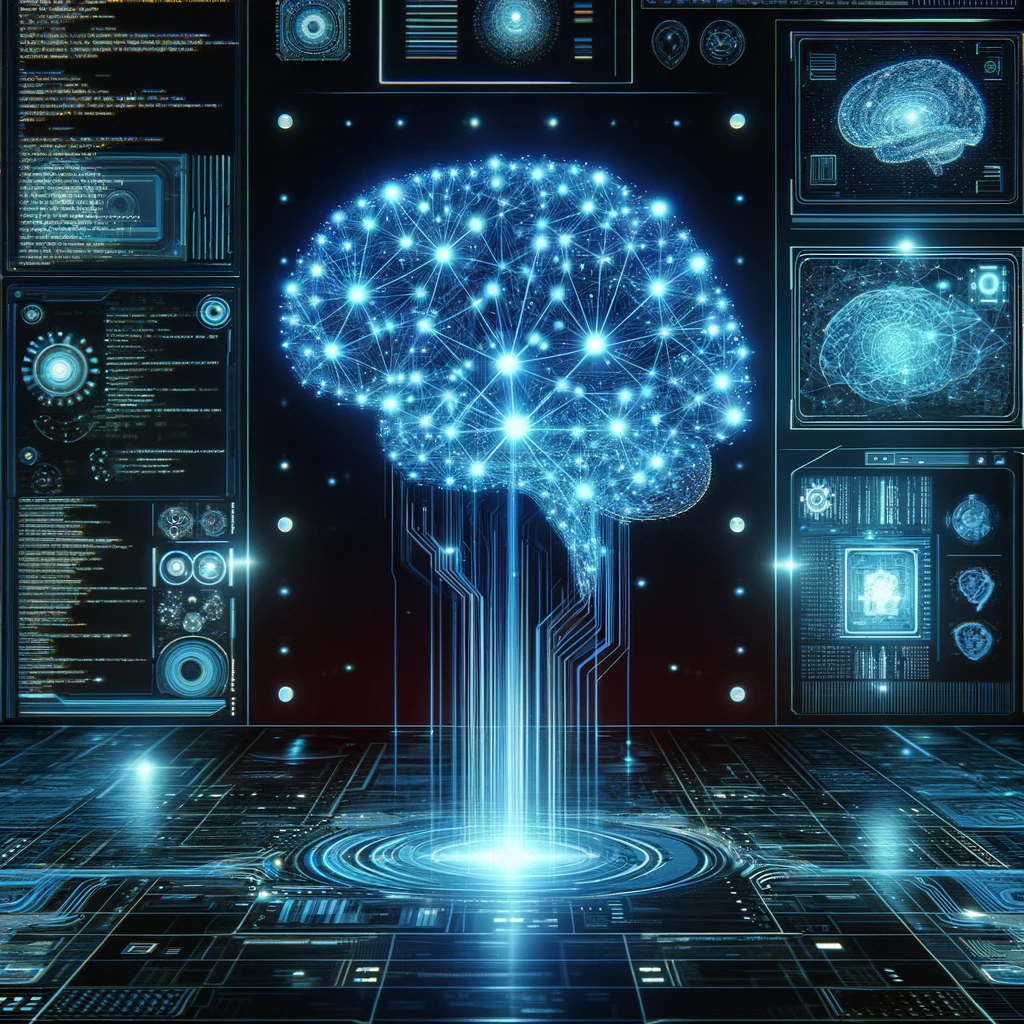
ChatGPT Rendering of AI via Wikimedia Commons (US-PD).
In recent decades, philosophers have intensely debated the meaning of personhood and what it means to be human. Some have sought to blur the lines between human beings and non-human animals, while others challenge the distinction between humans and machines. The rise of “enhanced humans” and AI robots in technologically advanced societies risks devaluing “normal” humans—potentially justifying hierarchies and even new forms of racism. No wonder then that many scholars attempt to safeguard human dignity by emphasizing distinctive dimensions of human existence like consciousness, self-awareness, emotions, and the human soul.
An understanding of “what it means to be human” rooted in the Islamic intellectual tradition, including speculative theology (kalām) and philosophy (falsafa) could contribute to the ongoing debate. Before the advent of Islam, the word nafs was used to refer to the self or person, as is evident from pre-Islamic poetry, while rūḥ meant breath and wind, which was also the case in Hebrew and Greek languages. This understanding seems to have continued in the Qur’an, which in most cases uses nafs to refer to the human self or person, while ruḥ is the “breath of life” since Allāh blew (nafakha) of His rūḥ into Adam, giving life to Adam’s body. The Qur’an uses the terms insān (human), nafs (soul) and Rūḥ (spirit) and al–mir’, that can be translated to (person), referring to different ontological dimensions of human beings.
In the early history of Islamic thought, ideological and theological motives played a considerable part in drafting and answering questions about the human self. One of the main religio-political issues raised by early speculative theologians (mutakallimin) of the 8th century was free will versus predestination. Theories of action that stressed man’s causal power were developed by the Mu’tazilite theologians, and that sparked the debate about the true essence of the human being, which is the locus of this power or capacity to act.
Is it corporeal or incorporeal? Is it located in the heart, the brain, or the whole of the human body? Is it divisible into different powers or faculties, or is it one? How should we understand the self in relation to our natural philosophy and theology? What was at stake was who or what the nature of the true agent is. Some thought that it is an entity separate from the human body; others believed that it is immanent in the human body; and some emphasized that it is basically the human body itself that has various qualities that distinguish it from the bodies of other beings.
In their understanding of the human self, the mutakallimūn had to fit their view into the framework of their natural philosophy. And human ontology in the kalām tradition is based on the theory of atomism in natural philosophy. But in fact, it is not always evident how the theory of atomism held by most of the mutakallimīn can be applied to describe the nature of the human being. (Atoms or substances (jawāhir) are essentially basic concepts into which all things can be classified, and accidents (aʿrāḍ) are the various properties or qualities that inhere in these atoms or in bodies.) Variations of the theory allowed for different understandings of the nature of the human self.
Views of the human self
Most of the early speculative theologians (mutakallimῑn), including the Mu’tazilites and the Ash’arites, emphasized the corporeal or bodily nature of the human self. They rejected body-soul dualism and, with that, the view that the soul is the essence of a human being that can exist on its own. This remained the prevailing view of Muslim theologians up to the late 11th to early 12th century.
The position of the mutakallimin can be compared to that of the philosophers who followed in the Greek tradition. The focus of these philosophers was centered on the soul (nafs), understood in line with Neo-Platonic philosophy, as a spiritual incorporeal entity, higher and nobler than the body. It is only in the late eleventh century, and most probably under the influence of Ibn Sina (d. 1037) and other philosophers, that the Ash‛arite mutakallimūn,who by then became the mainstream theologians, including Abū Ḥāmid al-Ghazālῑ (d. 1111), turned away from this non-dualistic theory of man towards a philosophically influenced body-soul dualism. Before that prominent members of both Mu’tazili and Ash’ari schools of kalam, who otherwise disagreed on many issues, such as al-Qaḍī ʿAbd al-Jabbār al-Asadabādī (d. 415/1025) and Al-Bāqillānī (d. 403/1013) emphasized the corporeal nature of the human being. Abu Hasan al-Ash‘ari (d. 324/936)- after whom the Ash’arite school of kalam was named – followed Abu al-Hudhayl al-Allaf (d. 841) the Mu’tazilite, in holding that the definition of “man” is “this visible body that is composed in this manner of composition and structured in this type of specific structure” (hadhā l-jasad al-ẓāhir al-murakkab bi-hādhā al-tarkıῑb al-mabnῑ bi hādha al-darb min al-binyat al-makhṣūṣa).
ʿAbd al-Jabbār dedicated a section of his 20-volume book al-Mughni to discuss the disagreement on the nature of human being (dhikr al-khilāf fi al-insān). He argued against the belief that the soul is what defines a human being and that life and power exclusively belong to it. He rejects the idea of a soul that is distinct from the body. For him and other theologians, it is this whole and composite body (jumla) that is alive and able and not something in it or above it. Interestingly, he compared the view that life and power belong to something other than the composite and whole body, which he called (al-jumla), to the view that blackness, for example, or whiteness is an entity that can exist on its own. For him, just as the black indicates nothing but its locus (al-maḥall) or the black object, the human soul (al-nafs) indicates nothing but the whole of the human structure (al-jumla wahida), or the human body with all its sophisticated structures. Thus for him, power or capacity to act cannot exist without connection to a body, just as blackness or any color cannot exist on its own without a body. Whereas, the spirit (al-rūḥ) is often identified confusingly with the soul (nafs) and is viewed as a breath or gasp of air (nafas) which is not considered to be a living entity and is not described as living. But it is a prerequisite for life, just as blood and bodily structure (bunya) are prerequisites for life.
It seems that what really matters for ʿAbd al-Jabbār and other early mutakallimῑn is not the ontological nature of man but what it means to be a human person or a moral agent. In other words, he was interested in responding to the question “what it is to be a human being?’”not “what is the nature of a human being?” Therefore, he preferred to use the term moral agent (mukallaf) over the term insān (human being). He dedicates a few chapters to the discussion of the conditions that must be fulfilled by amukallaf. These conditions are in fact the qualities of a human being that make them a true, responsible person. They include maturity, moral knowledge, the ability to comprehend ethical judgment, and the ability to choose and perform the chosen course of action. The moral agent (al-mukallaf) is able (qādir), knowing (ʿālim), perceiving (mudik), living (ḥayy), and willing (murīd) regardless of his/her ultimate ontological structure.
Why is this still relevant today?
In his book The Order of Things, Michel Foucault famously announced the death of man. He claimed that the human being is an invention that is now “erased, like a face drawn in sand at the edge of the sea.” This form of antihumanism constitutes a springboard for the subsequent posthuman philosophies and movements that are still unfolding. Posthumanists seem to argue that we must reject the values attached to the idea of “the human” along with all the other binaries, such as: human/animal, man/woman, white/black, reason/passion, and born/made. The posthumanist approach also tends to break away from the notion of personhood in their argument against human exceptionalism. Meanwhile, emerging technologies destabilize concepts like “person” that were once taken for granted in different world cultures. Nevertheless, as argued by a Danish professor of psychology, Svend Brinkmann, “we have good reasons to retain a notion of personhood despite posthuman claims.” Indeed, undermining and rejecting the concept of person is tantamount to throwing the baby out with the bath water.
A moral agent (al-mukallaf) or, in a more secular Arabic language, a person (al-shakhs) is a whole who has thoughts, emotions, identities, and various psychological properties. A person is a being to which an ensemble of dispositions can be ascribed, including the characteristics and abilities related to moral responsibility. A human person is also a set of relationships that define who they are. They include relationships with nature, society, and self. A person is also a vulnerable being with many needs that are essential for their survival. This is why they have rights that machines, including the most sophisticated AI robots, don’t.
This does not represent a problematic “human exceptionalism” any more than the ability of bats to use echolocation represents “bat exceptionalism.” Moral agency and personhood belong to humans, not to animals and not to the more recent human-like robots or humanoids, no matter how useful or advanced they become. ♦

Mariam al-Attar is a researcher who explores the intersections of moral philosophy, theology, law, and contemporary Arab thought. Her background in physics informs her approach to questions at the intersection of science, philosophy, and religion.
Recommended Citation
al-Attar, Mariam. “What distinguishes humans from AI robots? An Islamic perspective.” Canopy Forum, September 4, 2026. https://canopyforum.org/2026/09/04/what-distinguishes-humans-from-ai-robots-an-islamic-perspective/.
Recent Posts