De-Mystifying the Sino-Vatican Agreement: What Post-Vatican II Agreements Reveal About Law, Papal Diplomacy, and China
Thomas Ching Wei Tu (凃京威)
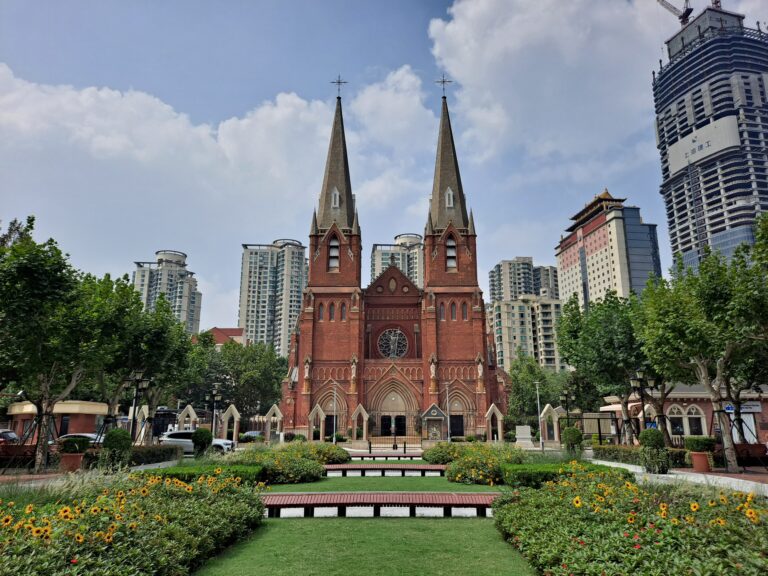
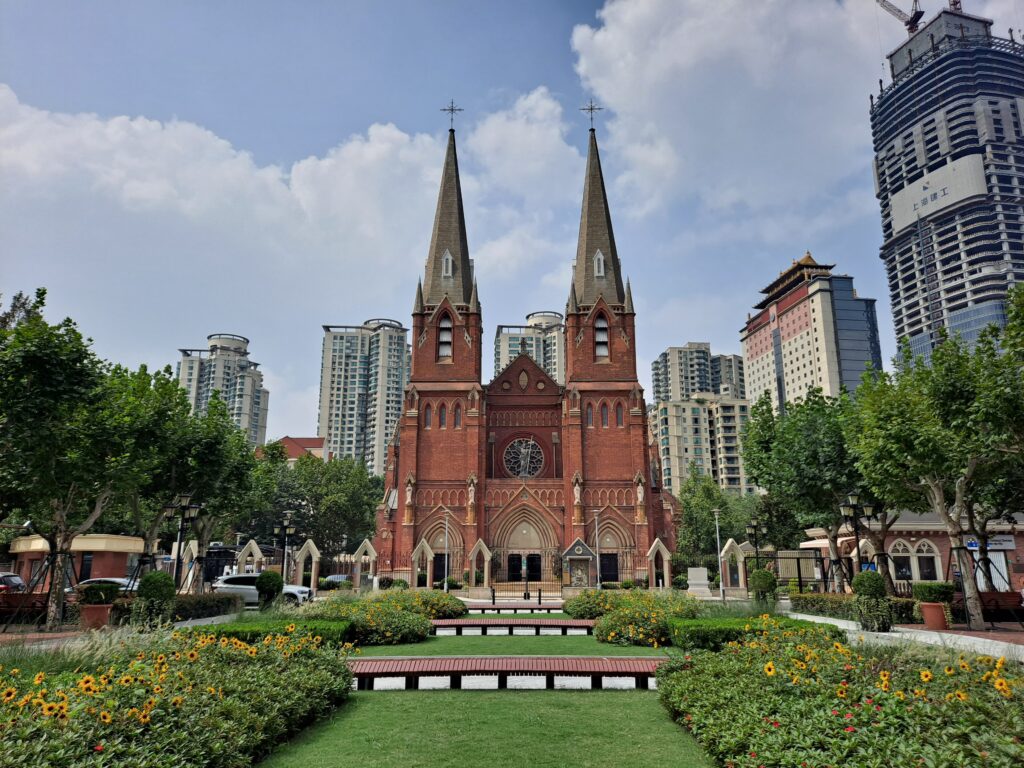
The St. Ignatius Cathedral in Shanghai in Shanghai, China (National Cathedral Church of China) by 钉钉 (CC-BY-SA4.0)
In September 2018, the Holy See and the People’s Republic of China signed a historic, but largely secret Provisional Agreement on the appointment of Catholic bishops in China. Provisional treaties made by the Holy See are signed, but not authorized for public disclosure. The Sino-Vatican agreement, while still at the provisional stage, has been controversial. The Holy See has sought to counter public concerns by only highlighting the agreement’s effects, rather than its legal contents. Some critics have seen the agreement as a secret deal.
Renewed in 2020, 2022, and again in 2024, the Sino-Vatican Provision Agreement remains one of the most fiercely debated geopolitical and religious developments of our time. Critics have accused the Vatican of capitulating to an authoritarian regime, selling out the long-suffering “underground” Catholic community, and compromising canon law to placate Beijing’s aggressive campaign to “Sinicize” religion. Supporters, meanwhile, frame the deal as a necessary pastoral compromise to heal a decades-long schism and ensure the survival of the Catholic Church in China.
Yet, much of this passionate debate suffers from a fundamental flaw: it views the Sino-Vatican deal in a vacuum. Disagreements are frequently reduced to a binary struggle between human rights advocacy and Realpolitik, or between religious freedom and total state control. By stepping back from the immediate diplomatic intrigue and placing the Sino-Vatican agreement within the broader legal tradition of Vatican diplomacy—specifically, the Holy See’s post-Vatican II international agreement practice—a far clearer picture emerges. When examined through the lens of canon law, international law, and comparative agreement design, the mysterious Sino-Vatican agreement ceases to be an unprecedented anomaly. Instead, it reveals itself as a calculated continuation of the Catholic Church’s centuries-old strategy of treaty diplomacy, adapted to the harsh realities of twenty-first-century state sovereignty.
The Meta-Logic of Vatican Diplomacy: Faith over Politics
To understand why the Vatican negotiates with regimes like Beijing, one must first understand what the Holy See actually seeks when it signs an international agreement. Unlike sovereign states, whose foreign policies are primarily driven by economic interests, military security, or territorial expansion, the Holy See operates under a distinct “meta-logic.”
As a sovereign entity in international law, the Holy See’s primary diplomatic goal is to secure the conditions necessary for the Catholic Church to fulfill its spiritual mission. Historically, the primary tool for securing these conditions has been the concordat: a formal treaty governed by international law between the Holy See and a sovereign state, regulating the legal status of the Church within that state’s territory.
For centuries, concordats served as mutual defense pacts between throne and altar. However, the Second Vatican Council (1962–1965) marked a radical paradigm shift in Catholic legal doctrine. In its landmark declaration Dignitatis Humanae, the Council affirmed the right to religious freedom and explicitly called for the Church to disengage from state privileges. Crucially, Vatican II declared that civil authorities should no longer be granted rights or privileges in the nomination, election, or appointment of bishops. This principle was formally codified in Canon 377 §5 of the 1983 Code of Canon Law: “In future no rights or privileges of election, nomination, presentation or designation of Bishops are granted to civil authorities.”
How, then, can the Holy See negotiate an agreement with a Marxist-Leninist state that grants Beijing an active role in selecting Catholic bishops without directly violating its own Canon Law? The answer lies in the flexible design of modern concordats.
Four Models of Episcopal Appointment: A Comparative Perspective
An analysis of the 38 framework agreements signed by the Holy See between 1965 and 2024—available through public databases like the Pontifical Gregorian University’s Canon Law Resources—reveals that the post-Vatican II Church does not use a “one size-fits-all” template. While Canon 377 establishes the papal prerogative over episcopal appointments as an absolute norm, the Holy See has developed at least four distinct diplomatic models to accommodate varying political realities:
● Model 1: Complete Autonomy
Used predominantly in democratic nations (such as post-communist Eastern European states or Latin American democracies), these agreements state that the appointment of bishops belongs exclusively to the Holy See. The state is merely given a courtesy notification before the official public announcement. This is a model based on power consolidation.
● Model 2: Nationality Constraints
In states and regions with strong Catholic practicing traditions (e.g., Poland, Italy, Brazil), the Holy See agrees to appoint only bishops who hold citizenship of that
country, ensuring that local hierarchy remains rooted in the national culture while keeping the appointment power entirely in papal hands.
● Model 3: Voluntary Waiver of Historical Privileges
In nations where ancient monarchies or past concordats granted governments a direct veto or presentation right over bishops (such as Haiti, Slovakia, or San Marino), the Holy See systematically negotiates the gradual surrender of these state privileges, bringing the local church into alignment with Vatican II norms.
● Model 4: Political Non-Objection
In situations where state authorities insist on vetting religious personnel, agreements allow the government to raise “political or social objections” against a candidate before the Pope makes a final appointment. This model—seen in varying forms in historical agreements with Argentina, Colombia, or Monaco— strikes a delicate balance: the state gets a political safeguard, but the Pope retains ultimate legal authority to appoint or reject. This is a model based on veto and consultation.
Reconstructing the Sino-Vatican Text: A Simulated Agreement
Because the exact text of the 2018 Sino-Vatican Provisional Agreement remains a closely guarded state secret, public commentary has long been dominated by speculation. However, by synthesizing comparative concordat methodology—drawing particularly from the Holy See’s 1990 Memorandum of Understanding with Kuwait and post-Vatican II “Political Non-Objection” model—we can reconstruct the likely structural mechanics of the agreement.
If we translate the bilateral compromise into formal treaty language, the core mechanism of the provisional agreement likely resembles the following simulated articles:
● Preamble (Foundational Principles): Establishes a bilateral commitment between the Holy See and the People’s Republic of China (PRC) to foster friendly relations in political, religious, and cultural spheres, strictly adhering to mutual respect for sovereignty, independence, and non-interference in internal affairs.
● Article 1 (Consultative Meetings & Working Groups): Mandates regular senior official consultative meetings to deepen cooperation on bilateral and international issues, with authorization to establish specialized working groups or expert meetings.
● Article 2 (Frequency, Venues & Third-Country Missions): Sets the frequency of consultative meetings to once every two years (alternating between Vatican and Beijing) or as needed, while allowing diplomatic missions in third countries to exchange information.
● Article 3 (Formal Diplomatic Channels): Requires both parties to agree on representation levels, dates, venue, and agenda through formal channels.
● Article 4 (Confidentiality of Consultations): Enforces strict non-disclosure of consultative meeting outcomes unless mutually agreed upon.
● Article 5 (Joint Commission for Future Agreements): Outlines the intent to further develop relations across all fields and levels, including setting up a Joint Commission to draft a formal bilateral Agreement governed by international law.
● Article 6 (Recognition of Church Functions & Personnel): Secures formal PRC recognition of the Catholic Church’s rights to carry out its religious, moral, educational, and charitable functions, maintain its own institutions, and deploy personnel accordingly.
● Article 7 (Exclusive Papal Authority & Canon Law): Affirms that the appointment of Bishops in China is the exclusive authority of the Pontiff, and that the Catholic Church retains sole responsibility for ecclesiastical appointments pursuant to Canon Law.
● Article 8 (National Clergy & Territorial Independence): Declares that no Chinese ecclesiastical jurisdiction shall depend on a foreign see, mandates that bishops in China must be Chinese citizens, and prohibits Chinese bishops from joining foreign episcopal conferences.
● Article 9 (30-Day Review & Strict Secrecy): Establishes a procedural timeline wherein the Roman Curia presents consent or disagreement to the Chinese Government within 30 days—with silence interpreted as no objection—conducted under the strictest secrecy.
The Mechanics of a Legal Compromise
As illustrated by these provisions, the agreement establishes a sophisticated diplomatic and canonical framework balancing two distinct legal and political paradigms. From Beijing’s perspective, Articles 8 and 9 safeguard core constitutional and sovereign priorities. By restricting bishop selection to Chinese citizens, prohibiting foreign territorial jurisdiction, and integrating a 30-day review period with state interaction under strict secrecy, the text preserves Beijing’s emphasis on national sovereignty and religious independence. From the Vatican’s perspective, Articles 6 and 7 protect fundamental Catholic doctrine and ecclesiology. Article 7 explicitly guarantees that the appointment of bishops remains the exclusive authority of the Pope under Canon Law, while Article 6 formally secures the legal space for the Catholic Church to operate its spiritual, educational, and charitable institutions in China.
To create a framework for ongoing relations, Articles 1 through 5 transition the bilateral relationship from ad-hoc dialogue to formal diplomatic machinery. Through regular high-level meetings, third-country diplomatic channels, the confidentiality protocols contemplated in Article 4, and the roadmap toward a future Joint Commission contained in Article 5, the agreement provides a structured pathway toward long-term stabilization.
Testing the Model: Legal Loopholes and Political Realities
Of course, legal frameworks are only as robust as the political will of the parties enforcing them. The empirical test of any treaty lies in its execution. Since 2018, the agreement has achieved its primary pastoral objective: avoiding illicit, uncanonical bishop consecrations. However, the agreement’s implementation has suffered serious friction, exposing critical legal loopholes. In late 2022 and early 2023, Chinese authorities unilaterally transferred Bishop John Peng Weizhao to the Diocese of Jiangxi and appointed Bishop Joseph Shen Bin to the Diocese of Shanghai without prior Vatican approval. Beijing argued that moving an already-consecrated bishop to a different diocese was a “transfer,” rather than a new “appointment.”
This episode highlighted a classic problem in international legal design: semantic ambiguity. While the provisional agreement covered the appointment of new bishops, it apparently left the procedure for the reorganization of diocesan boundaries and episcopal transfers undefined. To prevent a total breakdown of the diplomatic dialogue, Pope Francis eventually ratified Shen Bin’s transfer ex post facto several months later, while gently calling on Beijing to respect established consultation procedures in the future.
Furthermore, the agreement remains deeply asymmetrical. It addresses the legal mechanism of episcopal appointments, but it leaves untouched the broader, harsher realities facing Chinese Catholics under President Xi Jinping’s ideology of religion. The forced registration of clergy with the patriotic association, the destruction of unauthorized religious sites, and the digital surveillance of underground communities continue unabated.
What the Sino-Vatican Deal Teaches Us About Law and Religion
The Sino-Vatican Provisional Agreement offers vital insights for scholars, policymakers, and the public interested in the intersection of law, religion, and international affairs.
First, it demonstrates that religious law and international law are deeply interdependent. The Holy See’s unique status as a subject of international law allows it to use diplomatic treaties to defend the internal autonomy of canon law within secular, authoritarian states. Where domestic constitutional law fails to protect religious freedom, international bilateral agreements become the Church’s last line of legal defense.
Second, it reveals the enduring necessity of institutional pragmatic flexibility. The Catholic Church’s willingness to engage in concordat diplomacy with regimes whose ideologies are fundamentally hostile to religion is not a novel invention of Pope Francis. From the Reichskonkordat of 1933 to the Ostpolitik negotiations with Soviet-bloc states during the Cold War, the Vatican has consistently chosen difficult, messy diplomatic engagement over ideological purity whenever the sacramental life of the faithful is at stake.
Finally, the agreement reminds us of the limits of formal legal instruments. A treaty can define mechanisms for appointing leaders, but it cannot alter the fundamental nature of an authoritarian state that views “sovereignty over heaven and earth” as absolute.
As the Sino-Vatican agreement moves through its successive renewal cycles, its ultimate success will not be measured by the elegance of its undisclosed legal language. It will be measured by whether this fragile exercise in treaty diplomacy can preserve a space—however small—where an ancient religious community can remain genuinely Catholic while living under the watchful eye of a modern totalizing state. ♦

Thomas Ching Wei Tu (凃京威) is a Ph.D. candidate at the Graduate Institute of East Asian Studies, National Chengchi University, Taiwan. His research focuses on religion and global politics, Vatican-Holy See diplomacy, and church-state relations in contemporary Asia.
Recommended Citation
Ching Wei Tu, Thomas. “De-Mystifying the Sino-Vatican Agreement: What Post-Vatican II Agreements Reveal About Law, Papal Diplomacy, and China.” Canopy Forum, September 8, 2026. https://canopyforum.org/2026/09/08/de-mystifying-the-sino-vatican-agreement-what-post-vatican-ii-agreements-reveal-about-law-papal-diplomacy-and-china/.
Recent Posts