Religious Freedom in Public Funding Requires a Four-Part Test
Amy Stambach
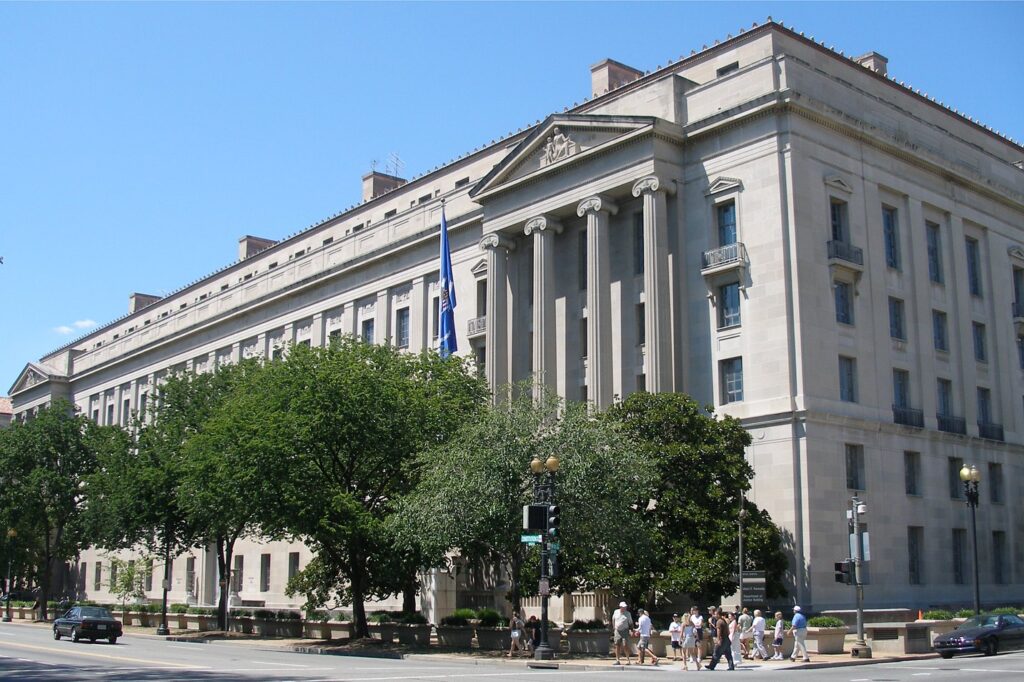
U.S. Department of Justice Headquarters by Sebmol (CC-BY-3.0)
Disputes over religion and public funding require careful consideration of the rights of religious grantees, the religious freedom of others affected by public programs, and the consequences of proposed remedies. Those considerations came into sharper focus on August 25, 2026, when the Justice Department opened a new front in the debate over religion and public money. In a 39-page opinion, the Office of Legal Counsel (OLC) concluded that restrictions on the anticipated religious use of federal funds are presumptively unconstitutional. The opinion addresses Department of Health and Human Services (HHS) programs that support welfare services, substance-abuse treatment, and childcare. Some of the rules at issue barred grant money from being used for worship, religious instruction, or proselytization. Others required religious content to be separated in time or location from the federally funded service. The OLC concluded that these restrictions discriminate against religious exercise without a compelling government interest.
This is a consequential change. Faith-based organizations feed families, operate shelters, treat addiction, and care for children. They should be able to compete for generally available public funds on fair terms. A church-run provider should not have to conceal its identity simply to qualify for a grant. The Supreme Court has steadily reinforced that principle. In Trinity Lutheran Church of Columbia, Inc. v. Comer, it held that Missouri could not exclude a church from a playground-resurfacing grant solely because of its religious character. In Espinoza v. Montana Department of Revenue, it ruled that Montana could not bar families from using a scholarship at a religious school. In Carson v. Makin, it rejected Maine’s attempt to limit tuition assistance to nonsectarian schools. The OLC reads those decisions to mean that the government usually cannot distinguish between religious status and religious use when it distributes a public benefit.
Yet the OLC Opinion did not arrive as a neutral update to doctrine. It also sits within a government-wide campaign against what the administration calls anti-Christian bias. An executive order created a task force to identify and remedy federal conduct said to be hostile to Christians. Its April report gathered findings from seventeen agencies. The August Opinion then cited that work while reconsidering restrictions on grants. The sequence matters. A legal claim about equal treatment has become part of a much broader official account in which Christians are treated as a vulnerable class across the federal government.
Constitutional and Institutional Analysis: Four Questions
As an anthropologist who studies religion and public institutions, I think the constitutional analysis needs an institutional one beside it. Courts ask whether the government has discriminated against religious exercise. Agencies must also decide how a claim should shape grants, exemptions, enforcement, and access to services. Those decisions require facts that doctrine alone will not supply. Before an institution accepts a claim of religious marginalization, it should ask four questions: What happened? Where does power sit? How did the claim become official? What would the remedy do?
First, what happened? This requires naming the act, the actor, the rule, and the burden. “Anti-Christian bias” is a conclusion, not a description. Was a congregation denied a grant because it was Christian? Was a provider required to keep worship separate from a taxpayer-funded program? Was an employee disciplined for prayer? Each allegation may raise a different legal question and call for a different response. Precision does not minimize religious injury. It makes the injury possible to test and the remedy possible to defend.
This first question also prevents a narrow dispute from standing in for an entire tradition. An individual Christian can face discrimination in a country where Christians hold extensive political and institutional influence. A Muslim, Jew, Hindu, atheist, or member of a small Christian denomination can exercise authority in one setting and be exposed in another. I use “majority-status claim” to describe a claim made in the name of a religious tradition that has broad demographic or institutional standing. The term does not decide whether the claim is true. It signals that the evidence must connect a specific burden to the larger assertion of marginalization.
Second, where does power sit? National population numbers are a poor shortcut. Power may lie in a county government, a school board, a hospital system, a prison, or the network of organizations eligible to administer public services. A national majority can be vulnerable in a local setting. A national minority can control access to jobs or aid in a particular institution. The relevant question is who can set the rule, obtain a hearing, command resources, and impose costs where the alleged harm occurred.
Nigeria shows why scale matters. Christians have endured killings, kidnappings, and attacks on churches. These harms deserve direct recognition and protection. But the country’s violence also includes attacks on Muslims and others, and it varies across regions. Political conflict, organized crime, land disputes, and ethnic tensions overlap with religion. As a Council on Foreign Relations analysis has noted, a frame focused only on Christian persecution can miss the wider threat. A national label may identify some victims while obscuring others who face the same armed groups. Good protection begins with the local configuration of danger and authority.
Third, how did the claim become official? Institutions do not merely discover religious injuries–they select evidence, choose categories, and authorize some people to speak for a community. Executive Order 14202 did more than invite complaints. It created a task force, assigned agency representatives, and directed them to produce a government-wide account. Once that account entered official reports, it could guide later legal opinions and policy changes. Officials should therefore record who defined the injury, whose evidence counted, what contrary evidence was considered, and who was absent from the process.
This question is especially important when public money and foreign policy reinforce the same category. For example, Hungary Helps funds humanitarian and development projects for persecuted Christians and other communities, often through faith-based partners. Its projects have supported schools, health services, and reconstruction. At the same time, research places the program within Hungary’s migration policy and its cultivation of Christian networks abroad. Aid can meet real needs and advance a political identity at the same time. That is precisely why the process that certifies persecution should be visible and open to challenge.
Fourth, what would the remedy do? Some remedies remove a barrier and restore equal access. Others give a provider new authority over employees, clients, or public programs. The distinction cannot be drawn from the term “religious freedom” alone. Officials must examine the people who will encounter the remedy in practice. Will a grant condition disappear? Will a provider be permitted to include worship in a service paid for by the government? Can a beneficiary decline religious participation without losing food, treatment, or childcare? Is another provider realistically available?
This is where the freedom of beneficiaries must remain in view. A person seeking emergency shelter or addiction treatment is not choosing in an ordinary market. Transportation may be scarce. The next provider may be hours away. A parent may have no affordable alternative for childcare. In an earlier Canopy Forum essay, Melissa Rogers argued that protections for faith-based providers should be paired with notice and meaningful alternatives for beneficiaries who object to a provider’s religious character. That principle remains useful. Equal access for religious organizations and freedom of conscience for the people they serve should be treated as complementary obligations.
The OLC Opinion does not erase every beneficiary protection. The HHS regulations it discusses also bar discrimination against a beneficiary because of religion, religious belief, refusal to hold a belief, or refusal to participate in a religious practice. But the Opinion weakens a boundary that once kept explicitly religious activity separate from directly funded services. If agencies act on that conclusion, they should say how they will prevent coercion, preserve voluntary participation, and provide a practical alternative when a recipient objects. A legal right on paper is not enough if exercising it means going without care.
Critics may object that a four-question test adds bureaucracy to rights that the Constitution already protects. In a clear case of exclusion, the government should act quickly. A church denied a generally available grant solely because it is a church should not have to prove that Christians are powerless. The first question will identify that concrete unequal treatment, and the remedy can be limited to ending it. The additional questions become essential when officials move from correcting a specific violation to declaring a community broadly marginalized, changing multiple programs, or granting exemptions that affect other people.
Urgency presents a second objection. People facing violence cannot wait for a long institutional study. They should not have to. Credible threats call for immediate protection, followed by independent review and a way for affected communities to challenge the record. The four questions can be answered briefly. Their purpose is to discipline judgment, not postpone it.
Federal agencies can begin with a simple practice. Before changing a funding rule, granting an exemption, or giving a religious community special recognition, the responsible office should write down its answers to all four questions. The record should identify the evidence, the geographic and institutional scale of the finding, the people affected by the remedy, and the facts that would change the agency’s judgment. Congress and inspectors general could then examine whether a response addressed documented discrimination or expanded beyond it.
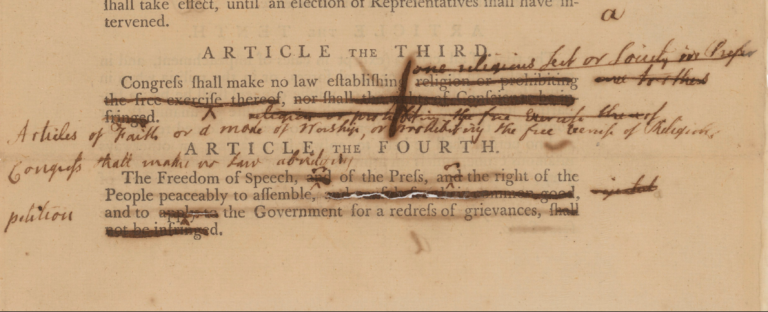
The First Amendment does not require government to distrust religion, nor does it relieve government of the duty to examine power. Religious organizations deserve equal treatment when they serve the public. Beneficiaries deserve equal seriousness when their conscience or access to services is at stake. The Justice Department’s August Opinion should begin a more exact inquiry, not end one. Religious freedom is strongest when public institutions can show whose freedom they protected, from what burden, and at whose cost. ♦

Amy Stambach is a visiting scholar at American University’s School of International Service and a research associate at the Smithsonian’s National Museum of Natural History. An anthropologist, she writes about religion, education, nationalism, and U.S.–Africa relations.
Recommended Citation
Stambach, Amy. “Religious Freedom in Public Funding Requires a Four-Part Test.” Canopy Forum, October 20, 2026. https://canopyforum.org/2026/10/20/religious-freedom-in-public-funding-requires-a-four-part-test/.
Recent Posts