Does the Free Exercise Clause Protect Only Public Worship?
Eric Wang
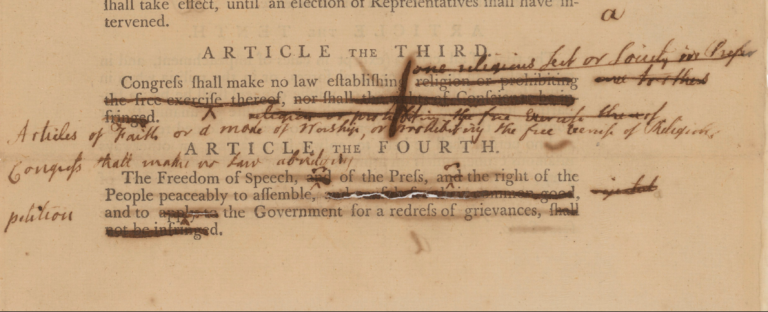
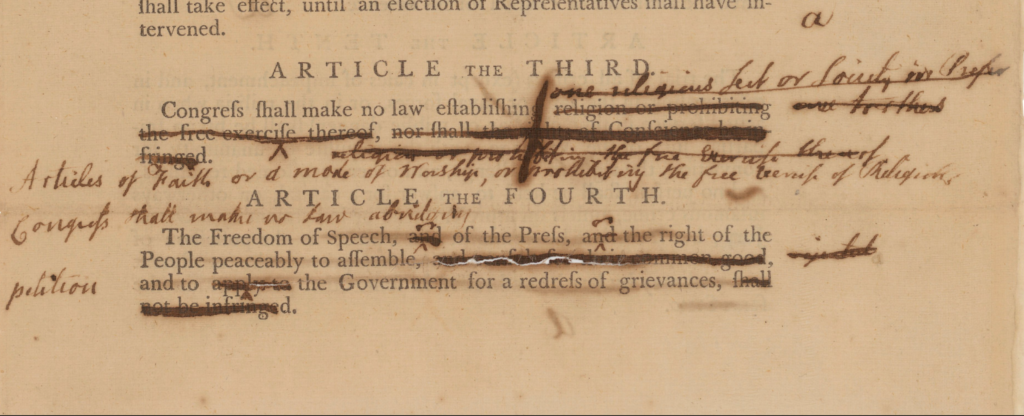
Senate Revisions to House Proposed Amendments to the U.S. Constitution, National Archives (US-PD)
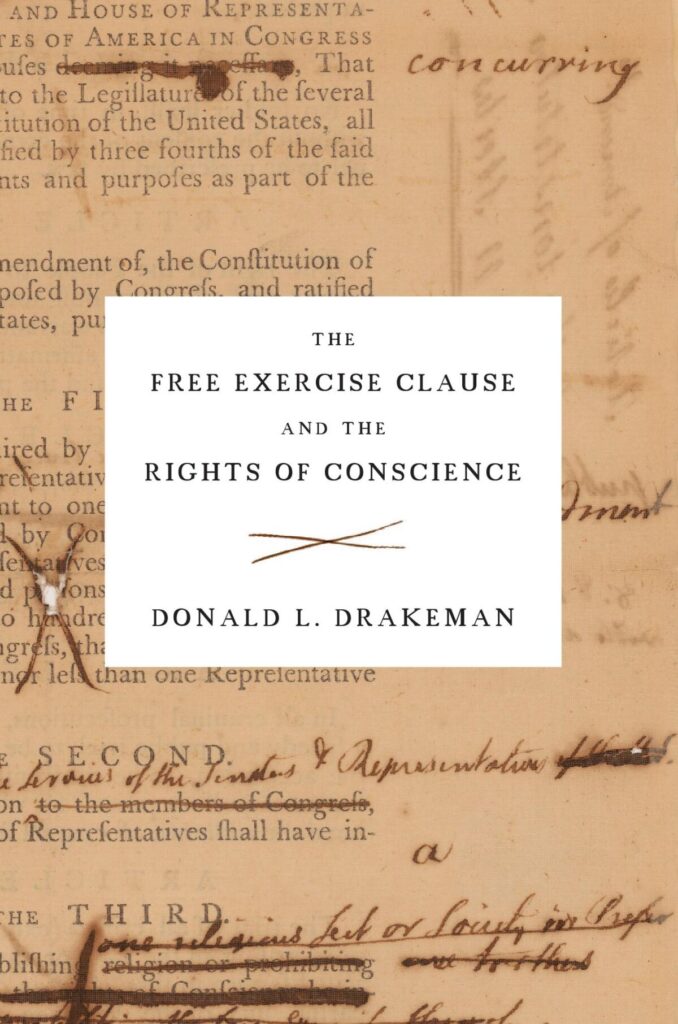
On October 15, Canopy Forum, hosted by the Center for the Study of Law and Religion, will be organizing an online book symposium regarding Donald L. Drakeman’s upcoming book, to be published November 2026, titled The Free Exercise Clause and the Rights of Conscience (Harvard University Press, 2026). The following is a review essay of Professor Drakeman’s book in anticipation of the symposium.
Donald L. Drakeman presents a powerful and challenging account of the original meaning of the Free Exercise Clause. Primarily, he argues that until the mid-twentieth century, “free exercise of religion” protected solely the ability to hold public worship services. Secondarily, he argues that until then, courts did not grant religious exemptions from generally applicable statutes.
It will be hard for conservative originalists to accept these two theses; it will be even harder to reject them. For one, Drakeman supports his theses with countless new historical sources from databases like the Oxford Text Archive (6–8). Two, Drakeman’s theses do not align with his own expectations and religious-liberty policy preferences (19), making them more persuasive.
And three, Drakeman covers originalism’s bases. For original-public-meaning originalists, he provides evidence from the Edict of Milan (313 A.D.) to the 1940s suggesting that “free exercise of religion” meant only the ability to hold public worship services (chs. 3–5). For original-intent originalists, he argues the framers likely chose the phrase “free exercise of religion” instead of “rights of conscience” because the former was well-known at ratification to mean public worship, whereas the latter was ambiguous and disputed (101–02). For original-law and original-methods originalists, Drakeman argues the founders would have used Blackstone’s interpretive tools to understand “free exercise of religion” as a “term of art” (39–41). For those attending to constitutional liquidation, Drakeman offers evidence from 1791 to Sherbert v. Verner (1963) suggesting that religious free-exercise was limited to public worship (chs. 4, 5). For those who prioritize the meaning of “free exercise of religion” near 1868 and not 1791, he argues that in both periods, the phrase meant the same thing (129).
That said, I have two problems with Drakeman’s book. Both concern his primary thesis that until Sherbert, “free exercise of religion” protected only public worship. First, he shoehorns many different activities into “public worship,” undercutting his effort to portray the Free Exercise Clause as protecting only a “very specific right” (138) to “hold a worship service in a public place” (3). Second, much of the evidence he presents does not support his public-worship thesis. Below, I take each problem in turn.
The Public-Worship Umbrella
Drakeman treats a host of activities as synonymous with or part of public worship—something that, perhaps strategically, he never defines. Sometimes, he describes public worship as the ability to “hold” a “worship service” “in public” (3, 4, 29, 52, 103, 149). The phrase “free exercise of religion” meant “the ability to hold a worship service in a public place, such as a church,” he writes (3). “[U]ntil the middle of the twentieth century,” American constitutional law did not protect “conscience-based actions other than holding a worship service” (149). Drakeman suggests “worship service” means a Sunday church service or something like it. For instance, he says that for religious readers who “attend church services every week, or even more often than that,” the value of constitutional protections for religious worship may seem obvious (8).
Other times, Drakeman ties public worship to the Decalogue’s first table (12, 81–82). These commandments made worshiping God not just a “voluntary choice” but a “duty,” he writes, citing the Westminster Confession of Faith and Shorter Catechism (12). So when the Virginia Declaration of Rights (1776) indicated that a free-exercise right could enable Virginian citizens to fulfill what that declaration called “religion, or the duty which we owe to our Creator,” Drakeman treats this “duty” as the “First Table duties of worshiping God”—as duties “in the public and private exercises of … worship” (81–82). Those first-table duties included a duty to practice the Sabbath (12).
Further, Drakeman treats confession, marriage, and other sacraments as public worship too. On sacramental confession as public worship, he discusses People v. Philips (1813) and Commonwealth v. Cronin (1856). Both cases held that Catholic priests could not be compelled to disclose statements made to them during confession, because confession, as a sacrament of religion, fell within the scope of a state constitutional provision that protected religious free exercise (110–11). On sacramental marriage as public worship, he discusses Reynolds v. United States (1878), a case where the Supreme Court refused to exempt Reynolds, a polygamist, from a criminal ban on polygamy even though Reynolds believed that Latter-day Saint (LDS) doctrine required him to practice polygamy. Drakeman says Reynolds “could have pointed to his second marriage as an act of worship” because LDS members “considered polygamy ‘an indispensable salvation-granting sacrament’” (126–27). For Drakeman, both sacramental confession and marriage can fall within free-exercise protections because those protections cover worship, and a “sacrament of the church” is “an essential element of the freedom of worship” (112).
Lastly, Drakeman includes within public-worship protections not only “modes of worship” and “sacraments,” but also “religious rites” and “statements of faith” (154). All these things would be protected, he writes, if free-exercise jurisprudence returns to its original “focus on religious beliefs and acts of worship” (154).
But some of these activities—Sabbath, marriage, confession, and other sacraments (which, for some Christians, include anointing the sick)—are different from holding public worship services. Sabbath might prioritize worship, but seems different from a worship “service.” A marriage ceremony might be liturgical like a service, but is different from a worship service. Few things are less public than confession. The sick are often anointed outside a worship service, let alone a public one. If all these activities also count as public worship services, then Drakeman’s “surprising” (167) thesis that “free exercise of religion” protected only the ability to hold public worship services until Sherbert is not that surprising—or accurate. To wedge all these activities into public worship risks the “semantic inflation” (107) that Drakeman associates with nineteenth-century religious-liberty advocates.
But the problem runs deeper than just naming. Once we start seeking the throughline between these protected activities, we move further in substance from Drakeman’s thesis (that free exercise of religion protected the “very specific” right to hold a public worship service (2, 37, 138)), and closer to the thesis he seeks to refute—that the free-exercise right also covers non-worship actions motivated by religious precepts (134, 138–39). What do church services, Sabbath, marriage, confession, and anointing the sick have in common? If Drakeman answers that all these things are worship, the next question is, what is worship? The definition of “worship” needed to cover all these activities will need to be broader than something like Sunday liturgies. But if so, consider the implications of broader definitions of worship. One candidate is “activities that express adoration for a divine entity—that exalt or glorify the divine.” That definition includes far more than public worship services. For some, it encompasses everything; Christians are called to “do all to the glory of God” (1 Cor. 10:31) and offer themselves as a “living sacrifice, holy and acceptable to God” (Rom. 12:1).
Another possible definition uniting the free-exercise activities above is that religion is a primary or but-for explanation for all of them; they are religious activities. One cannot explain why someone would keep the Sabbath, confess to a priest, or anoint the sick without pointing to religion. This common denominator more aptly describes the activities above than does the “ability to hold a worship service in public” (4). But if that throughline—activities taken with religion as a primary or but-for cause—is the original meaning of “free exercise of religion,” then contra Drakeman, Sherbert was hardly revolutionarily when it read “free exercise of religion” to include actions “motivated by religious precepts” (134). Hardly any daylight exists between actions motivated by religious precepts and actions taken with religion as a primary or a but-for cause.
Perhaps one believes the Free Exercise Clause protected more than just the ability to hold public worship services, but still less than any activity taken primarily out of religious obligation or motive; maybe to be religious free exercise, an activity must be “formally established” (112) as part of a religion’s “rites” (154), ceremonies, liturgies, or rituals. But these definitional limitations would face other problems. To start, one would need to prove that a religious act’s rituality, formality, or ceremonial quality historically mattered for whether it was part of free exercise. Further, if only formalized religious acts count, free-exercise protections would not protect religious acts equally; they would disfavor religions with less official modes of worship. This inequality would not only clash with modern establishment-equality jurisprudence; recall Catholic Charities Bureau, Inc. v. Wisconsin Labor & Industry Review Commission (2025), which held that a state law violated the Establishment Clause by confining its religious tax exemption to religious organizations that met criteria disfavoring some religions. It would also clash with the founding generation’s concern that religious exercise be protected equally. The state constitutions of New York (1777) and South Carolina (1790), for instance, required that “the free exercise and enjoyment of religious profession and worship” be allowed within the state “without discrimination or preference.” Finally, these limitations would likely face church-autonomy issues too. Questions on whether religious acts are formally established or ritualized will likely fall under “matters of church government as well as those of faith and doctrine” that courts lack the tools and constitutional permission to resolve.
In sum, the ability to hold public worship services does not characterize the religious activities that Drakeman says were covered by “free exercise of religion.” Instead, when we consider all those activities—Sabbath, marriage, confession, and other sacraments—the throughline seems closer to Sherbert’s.
The Strength of the Evidence
Second, much of the data Drakeman uses to support his public-worship thesis does not quite bear that weight.
1. Start with the founding-era data—specifically, the twelve founding-era state constitutions and declarations that Drakeman frames as evidence in chapter 4. “By the time the federal Bill of Rights was ratified,” he writes, “every state adopting a new constitution would provide for ‘all men’ or ‘all persons’ to have the free exercise of religion or would use an essentially equivalent phrase relating specifically to worship” (81, emphasis added). I am unconvinced by Drakeman’s framing of these documents, for several reasons. First, “[n]one of those state provisions explicitly defined what ‘free exercise of religion’ meant” (27), as Drakeman himself notes when challenging Professor Michael McConnell’s analysis of the same provisions. Second, of the twelve founding-era documents he discusses, only two used the phrase “free exercise” of “religion,” (Virginia and Georgia) (94), and it’s unclear that by “religion” they only meant worship. Drakeman says that the Virginia Declaration of Rights described religion as “the duty which we owe to our Creator” and protected religious free-exercise to enable fulfillment of that duty (81). But the evidence does not establish that such “duty” meant only worship services. Drakeman relies largely on the Westminster Confession to argue that many Protestants believed worship was a duty of religion (12, 81), but that does not mean that when Protestants spoke of religious duty they spoke only of worship. Third, five other state documents also used the words “free exercise” with religious “worship”—some protected “free exercise of religious worship” (Delaware, Pennsylvania, Vermont), and others protected the “free exercise and enjoyment of religious profession and worship” (New York, South Carolina)—but it’s unclear that these two phrases meant the same thing as each other or as Virginia and Georgia’s free-exercise provisions.
2. Drakeman also uses founding-era data to support his public-worship thesis by arguing that the framers used the phrase “free exercise of religion”—and not “rights of conscience”—because the former had a well-settled meaning (only public worship) whereas the latter was disputed. That argument challenges what Drakeman calls “Assumption 1,” the claim that these two phrases were synonymous (41).
Drakeman’s argument has support: the state constitutions or rights declarations in chapter 4 all protected worship, but protections for conscience rights varied (94–95). Yet, two points challenge his argument. First, the founders ratified explicit, constitutional protections for disputed aspects of the rights of conscience. Consider religious tests. As Drakeman suggests, founding-era Senators were “well aware” of the disputes over whether the “rights of conscience” precluded religious tests for office (145). Yet, the founders ratified Article VI, Clause 3 of the U.S. Constitution, which provides: “[N]o religious Test shall ever be required as a Qualification to any Office or public Trust under the United States.” If the framers used “free exercise of religion” because it included only uncontroversial protections, it seems odd that they would constitutionalize a disputed prohibition on religious tests for office.
Second, if the Free Exercise Clause was meant to cover religious-liberty protections that the founding generation agreed upon, it is strange that the Clause does not protect religious belief. As Drakeman repeatedly argues, the phrase “free exercise of religion” protected only public worship; he makes no argument that this phrase, like the “rights of conscience,” also included freedom of religious belief. Why did the founders not also include religious belief? The answer can’t be that they thought protection of religious belief was already so widely accepted that there was no need to include that protection; Drakeman argues that widespread acceptance was the core reason why the right to public worship was included in the First Amendment.
Two better answers challenge Drakeman’s thesis. The first is like Assumption 1 (that “free exercise of religion” and “rights of conscience” are synonymous). Perhaps like the word “coin” in the Coinage Clause, the phrase “free exercise of religion” was a synecdoche—it was part and representative of the full package of religious-liberty rights, which included the freedom of religious belief. This answer would undercut Drakeman’s thesis that “free exercise of religion” protected only the public-worship stick of the religious-liberty bundle. A second answer is that the framers saw the Bill of Rights as not the source of constitutional rights, but as a non-exhaustive declaration of rights that already existed and deserved protection regardless of explicit enumeration. If so, then perhaps the right to religious belief—and other “rights of conscience” too—were just as fundamental and enforceable as ones listed in the First Amendment. This answer would challenge the idea that constitutional protections extend only to public worship and not other aspects of religious liberty.
3. Drakeman also points to religious tests and to peace, safety, and licentiousness restrictions to support his public-worship thesis, but these limitations cannot bear that weight. In the founding era, he stresses, some states protected free exercise of religion even as they established religious tests for office (e.g., Georgia, Delaware, Pennsylvania, and Vermont), and refused to protect religious activity that would threaten peace or safety (e.g., Georgia, New York) (83–86). Before the founding era, the Maryland Toleration Act (1649) and the Charter of Rhode Island and Providence Plantations (1663) refused to countenance free exercise of religion as an excuse to disturb the civil peace or engage in licentiousness (65–66). The English Ranters of the 1640s could not rely on religion to justify exemptions from laws on sexual morality and property (54).
Facts like these, Drakeman suggests, implied that religious free exercise did not protect more than worship (95). The underlying logic seems to be that had free exercise of religion protected activities beyond worship, we would not see the limitations above. But a broader free-exercise definition that includes religious conduct beyond worship does not conflict with these limitations. Running for office is usually not a religious activity; restricting political office to members of a religion does not directly restrict members of other religions from engaging in religious conduct, worship or beyond. Peace, safety, and licentiousness limitations indicate either that (1) state interests in these priorities can overcome the right to engage in religious activity or (2) free exercise of religion does not include religious activities that disturb these priorities; none of this means that free exercise of religion includes only activities that pertain to public worship. Many religious activities that do not specifically concern worship, are also neither violent nor illicit.
4. Finally, Drakeman refers to instances where “free exercise” means worship, but in context, those words meant worship only because the nouns that followed them specifically tied to worship. For instance, Drakeman notes that Leveller Richard Overton’s pamphlet “clearly us[ed] the word ‘exercise’ to mean worship services” when Overton “insisted ‘that all Statutes … made for the compulsion of persons to heare the Common Prayer Booke, and for the exercise of other Popish Rites, and Ceremonies, may be abrogated’” (53, emphasis added). In this context, “exercise” means to engage in activities of worship, but that is only because the items that follow the verb—“Popish Rites, and Ceremonies”—already are or can be deemed worship. This evidence does not mean that whenever “exercise” is used with “religion,” the word “religion” only means worship.
Likewise, some of the state court cases that Drakeman discusses, protected religious worship because the state constitutional laws at issue (unlike the First Amendment) explicitly protected worship. For example, City Council of Charleston v. Benjamin (1848), a South Carolina case, dealt with “language in South Carolina’s constitution protecting ‘free exercise and enjoyment of religious profession and worship’” (115–16, emphasis added). Similarly, Ferriter v. Tyler (1876) analyzed Vermont’s constitutional protections for ‘the rights of conscience in the free exercise of religious worship’” (130, emphasis added). The fact that state court cases focused on worship when enforcing state constitutional laws that explicitly protected worship, is not evidence that the First Amendment’s protection of the free exercise of “religion” covered only worship.
This may appear too nit-picky, but Drakeman’s public-worship thesis turns on nit-picking the text. He treats “free exercise of religion” as a “term of art” (2), the type of term where peculiarities of wording matter. Further, the words “free exercise” were used, near and before the founding, with nouns other than worship. The Charter of Rhode Island provided for “the free exercise and enjoyment” of “civill and religious rights.” As one scholar has noted, “Antebellum Supreme Court cases” used “free exercise” to describe a “free exercise of commerce, volition, or judgment as independent and unencumbered” or to describe “an independent and sovereign use of rights or powers.” In other words, “free exercise” meant different things depending on the nouns that followed: it was not a self-contained phrase that meant worship. The fact that worship-specific nouns often followed the words “free exercise,” doesn’t mean that “free exercise of religion” referred only to worship.
Conclusion
Because many of Drakeman’s data points do not support his public-worship thesis, and because a denominator broader than “public worship services” better unites the religious activities falling within historical free-exercise protections, I disagree with Drakeman’s claim that up until Sherbert, “free exercise of religion” protected only the ability to hold public worship services. Nonetheless, for the reasons above—the volume of Drakeman’s evidence, his originalist chops, and the expectation and policy costs of his argument—I cannot but still feel the gravitational pull, or at least nudge, of his erudite book. I look forward to seeing its impact on religious-liberty scholarship. ♦

Eric Wang is a McDonald Scholar in Residence at the Center for the Study of Law and Religion at Emory University. He clerked at the U.S. Court of Appeals for the Eleventh Circuit and at the Supreme Court of Georgia, after receiving a JD/MTS from Emory and a BA from Princeton.
Recommended Citation
Wang, Eric. “Does the Free Exercise Clause Protect Only Public Worship? Book Review” Canopy Forum, October 14, 2026. https://canopyforum.org/2026/10/14/does-the-free-exercise-clause-protect-only-public-worship-book-review/.
Recent Posts