Does the “Exercise of Religion” Equal Public Worship?
Steven D. Smith
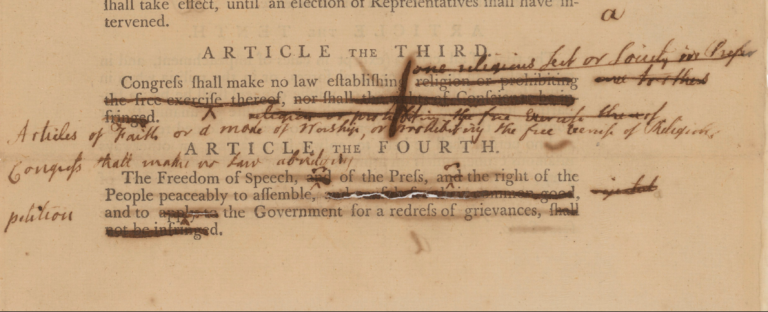
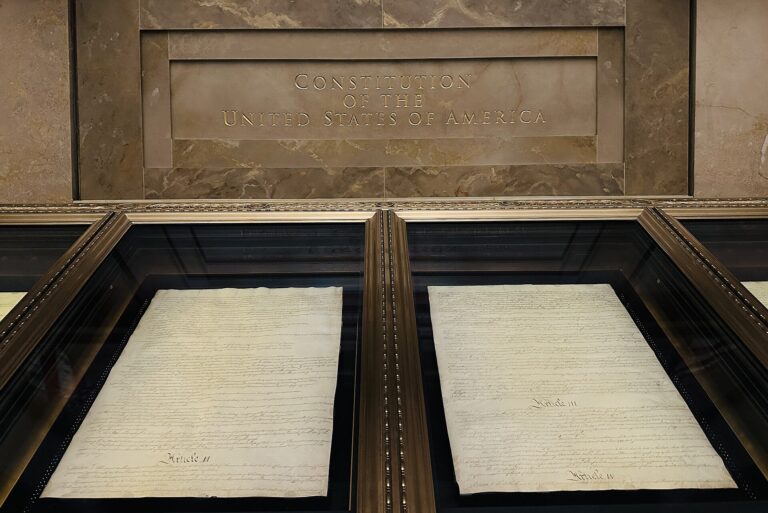
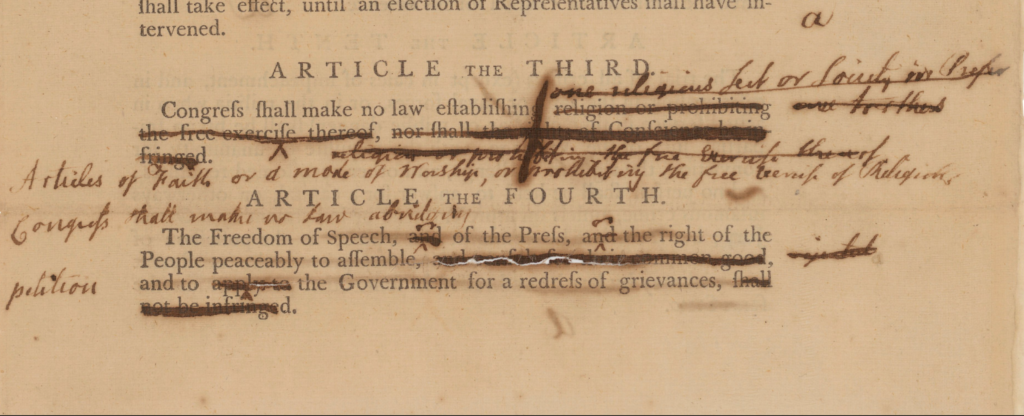
Senate Revisions to House Proposed Amendments to the U.S. Constitution, National Archives (US-PD)
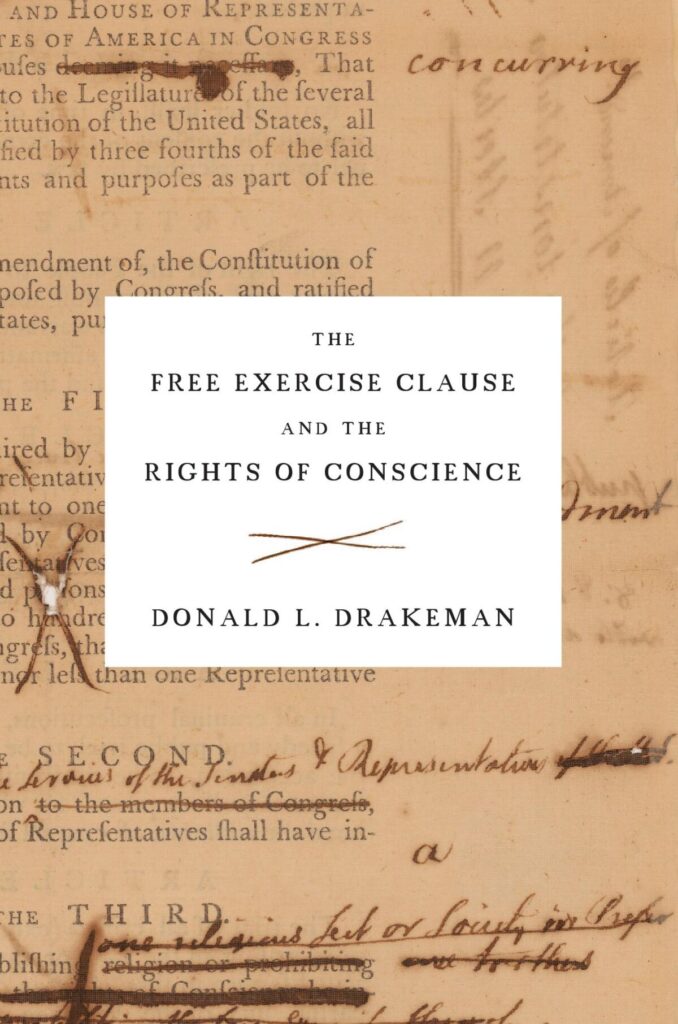
On October 15, Canopy Forum, hosted by the Center for the Study of Law and Religion, will be organizing an online book symposium regarding Donald L. Drakeman’s upcoming book, to be published November 2026, titled The Free Exercise Clause and the Rights of Conscience (Harvard University Press, 2026). The following is a review essay of Professor Drakeman’s book in anticipation of the symposium.
In 1960, Leonard Levy published an important book, Legacy of Suppression, that drastically altered the development of constitutional free speech doctrine.
Or at least you might think that it would have. Or at least that it should have.
But in fact it didn’t.
After providing virtually no constitutional protection in the eighteenth and nineteenth centuries, the Supreme Court had begun by Levy’s time to expand the scope of expressive freedom. Justices like Hugo Black and William O. Douglas were describing the First Amendment’s protection for speech as “absolute.” As Justice Black said in several contexts, “‘No law’ means no law!” And scholars like Zechariah Chaffee were advocating much more ample protection for expression. But Levy’s book purported to show that freedom of speech as conceived at the time of the founding had been much narrower in scope. Back then, while condemning “prior restraints,” free speech did not forbid post hoc punishment of objectionable speech. It did not even preclude punishment for “seditious libel”–i.e., speech hostile to the government.
So one can imagine a conscientious Court reading Levy’s book and then declaring, “Oops. We got it wrong. Our speech-protective decisions are hereby overruled.”Of course, nothing of the kind happened. Instead, the scope of free expression continued to grow, in cases like New York Times v. Sullivan and Brandenburg v. Ohio. No one doubts, I think, that Legacy of Suppression was a major scholarly contribution. But its actual impact on constitutional doctrine was negligible.
Parallels with Donald Drakeman’s The Free Exercise Clause and the Rights of Conscience are apparent. During the nineteenth and early twentieth centuries, the courts provided scant constitutional shelter for the practice of religion. Then, beginning in the mid-twentieth century, the Supreme Court extended and scholars argued for more ample protection; nor did this expansionary trend terminate, as some anticipated, with Employment Division v. Smith. But Drakeman now makes a case for the provocative proposition that before, at, and for many decades after the founding, “free exercise of religion” was a term of art that covered public religious worship. Nothing more.
So then, should free exercise be curtailed to fit the narrower meaning that Drakeman discerns at the founding and thereafter? Or will the parallel to Levy’s book hold? Will Drakeman’s book go down as an important scholarly contribution, albeit one without significant impact on actual constitutional doctrine and decisions?
There is a difference, of course. The justices of the Warren Court were notoriously nonchalant about the Constitution’s original meanings. Their vision was more of a “living Constitution” that could expand to reflect current needs and notions. So we can imagine those justices reading Levy and saying, “It’s an interesting book, Professor Levy, and you might even be right about what ‘freedom of speech’ meant then. But we get to say what ‘freedom of speech’ means now, and we think it means a heck of a lot more than ‘no prior restraints’.” This sort of dismissive stance seems less available today when most justices claim to be committed to following original meaning. Even so, it is likely that Drakeman’s important book will–and arguably should–share the fate of Levy’s with respect to actual constitutional law as announced and used by the courts for reasons I will try to explain.
Does Drakeman’s Evidence Support His Conclusions?
The most obvious reason is that readers– including scholars and especially justices– may not find Drakeman’s historical argument entirely convincing. This is one thing that happened with Levy’s book. Although his research was impressive, critics offered rebuttals; and indeed Levy himself eventually modified his position. Will the same happen with Drakeman’s book? I suspect so.
Drakeman offers solid evidence that at some point in the distant past “free exercise of religion” was generally understood to mean “freedom of public worship.” He also acknowledges that by now this meaning has been almost entirely forgotten, which is why his book was worth writing. Today, the idea of “exercise of religion” seems to include but to go well beyond mere worship. Somewhere along the line, the meaning of “exercise of religion” changed. But when and how did that change occur?
One hypothesis is that the “free exercise means worship, period” meaning remained constant for centuries and until roughly the early twentieth century, after which the meaning expanded relatively suddenly into the broader understanding the term typically elicits today. This is Drakeman’s view.
A different hypothesis might be that the meaning of free exercise changed, yes, but in a more gradual and haphazard and subterranean fashion. By 1970 “free exercise of religion” included a lot more than it did in, say, 1670. But it is impossible to identify any particular point or period when that tectonic shift occurred.
This latter hypothesis seems to me intrinsically more plausible–more consistent with the way language, and human beings, and law, typically function. After all, whether we are talking about the eighteenth century or the twentieth, it seems reasonable to suppose that hardly anyone, including lawyers and judges, routinely asks, “What does the ‘free exercise of religion’ mean?” This just isn’t the sort of question that people ponder in their spare time. So if the question does somehow pop up, there will not be any automatic and confident response. People will have to think about it. And they will likely give divergent responses. There may be consensus about some things, disagreement about other things, uncertainty about still other possible meanings. Over time the area and scope of consensus might shift. But it would be artificial to claim “In year 10, the term meant X, but in year 50 (or 150) the term meant Y.” That sort of precision is just not to be expected.
So if we ask what the conscious consensus about the precise meaning of “free exercise” was in 1790, or 1890, or 1950, the most accurate answer would likely be “There wasn’t one. At all those times ‘free exercise’ was, as they say, a contestable concept.”
So far I’m just arguing from observations about how law and language typically work, and I take it that Drakeman’s response goes like this: “That may or may not be the way linguistic change usually happen, but in this case the evidence decisively shows continuity of meaning–of the “exercise equals worship” meaning–up until and into the twentieth century.” But does the evidence–Drakeman’s evidence–decisively support this claim?
I’m not sure it does. Drakeman is persuasive that before the mid-twentieth century, courts were averse to giving constitutional protection to objectionable religious practices, especially when those practices violated an enacted statute. Just as courts gave very little constitutional protection to objectionable speech. But does his evidence show that the reason for this reluctance was a conscious and consensual understanding that the “exercise of religion” meant public worship and nothing more?
Consider the kinds of evidence that a proponent of Drakeman’s hypothesis would ideally provide. It would be telling if the members of the first Congress who drafted and debated what became the free exercise clause had explicitly said as much: “Free exercise means public worship, period!” But I don’t see any strong affirmative evidence of that kind in Drakeman’s presentation. Instead, we see the Congressmen casually shuffling around among various proposed wordings, seemingly without any very precise or settled understanding of exactly what the different wordings meant.
Moving forward, Drakeman acknowledges that nineteenth-century advocates often advanced arguments asserting that free exercise covered religiously-motivated conduct (149-150). Apparently these advocates did not share an understanding that free exercise meant worship and nothing more.
To be sure, as Drakemans shows, these more expansionary arguments almost always lost in litigation: courts consistently declined to order religion-based exemptions to statutory requirements. But Drakeman’s own interpretation would be more compelling if the courts that rejected such exemptions had explicitly responded to the advocates with something like, “What are you even talking about? Your case doesn’t concern worship. And everybody knows that ‘free exercise of religion’ covers public worship and nothing more.” But the dismissals do not say that.
Instead, they give a variety of reasons for declining to order exemptions. Exemptions would benefit individuals but would harm the public, or endanger the public peace. Opportunistic claimants might feign faith in order to avoid complying with the law. Granting an exemption in the particular case would create slippery slope concerns. And so forth. (E.g., 157, 167, 180) The idea that “‘exercise of religion’ means worship” often shows up as well (and of course some state constitutional provisions were explicitly worded in terms of “worship”); but it is one ingredient in the overall mix. There does not seem to be any conscious consensus that this is the decisive element. And indeed, as Drakeman reports, even when a case did involve worship, as in the Salvation Army cases, courts were likely to refuse constitutional protection. (179-183)
One South Carolina decision–City Council v. Benjamin–suggested that maybe the Jewish merchants who sought to be excused from a Sunday closing law (because their Sabbath was Saturday, and closing up shop on both Saturday and Sunday would be a serious financial burden) would have a valid claim if their religion actually prescribed working on Sunday (115, 118). Jewish teaching didn’t contain any such prescription, the court thought, so the merchants lost. (158-159) But that is quite different from an explanation that says “Only worship is protected; commercial business isn’t worship; QED.”
The overall sense I gain from Drakeman’s thorough and valuable review of the nineteenth century cases is again that courts were very reluctant to order constitutional protection for religion– even for worship. But not that courts were simply applying or rearticulating a well-established and conscious understanding that free exercise meant worship and nothing more.
It strikes me that Drakeman is tacitly relying on a sort of presumption–namely, that a legal term that had a fairly definite meaning at Time One retains that meaning until a new consensus coalesces around a different meaning. Much like domicile: if you were once domiciled in Kansas, then you might roam around the world for decades, never setting foot in Kansas, but you retain your Kansas domicile until you definitely establish domicile somewhere else. Likewise with free exercise: the term had at one time meant public worship, and until a different and definite meaning came to be consensually accepted, that is the meaning the term continued to have. Drakeman says, for example, that there is “no evidence in the historical record that the meaning changed” in the revolutionary period. (106) That might be right. But the inverse inference–namely, that the meaning therefore remained constant–seems less compelling.
As with domicile, I can imagine arguments in favor of such a presumption of continuity. And given such a presumption, the same argument that I am using to question Drakeman’s conclusions–the argument, namely, that changes in the meanings of fraught terms usually happen gradually and mostly unconsciously–could work to support his conclusions. But I am also not sure that such a presumption of continuity of meaning is warranted, or widely accepted. And if we are asking about actual historical understandings, the matter just seems to me murkier than Drakeman allows.
Diego’s Dilemma
But of course I may be wrong. For purposes of argument, let us say that I am wrong, as an empirical matter. Imagine that there are clear and recurring statements from the First Congress and from nineteenth century courts explicitly saying, “‘Free exercise of religion’ means public worship, period.” Would it follow that conscientious justices sincerely committed to following original meaning–or history and tradition–would necessarily have to scale back free exercise doctrine so that it protects only public worship?
Maybe. Or maybe this suggestion underestimates both the conceptual complexities of language–and of human thought–and the suppleness of the originalist and traditionalist approaches to constitutional law. There is no space here for a lengthy exposition. I’ve already exceeded my word limit, so let me just offer a hypothetical analogy.
Imagine a country called “Maradonia” in which soccer is a national obsession. Virtually all kids grow up playing soccer; hardly anyone plays baseball or basketball. In everyday parlance, consequently, the terms “sports” and “soccer” become pretty much fungible. If someone says “sports,” people immediately think “soccer.” It would not be disconcerting to hear a parent respond to the question “Do your kids play sports?” with “No–but my daughter does play basketball.”
A wealthy philanthropist, Diego, bequeaths millions of dollars to the Sports Foundation to support “youth sports leagues.” For decades, this money is used to subsidize Little League soccer programs. But gradually the culture changes, and then some enterprising parents (immigrants from North America maybe) decide to start a basketball league for kids who don’t enjoy soccer; and they apply to the Foundation for a supporting grant. One director of the Foundation says, “Why not? Basketball is a sport too, isn’t it?” But other directors object. “When Diego said ‘youth sports leagues,’ he meant soccer. For him, and for pretty much everyone in this country at that time, ‘sports’ was equivalent to ‘soccer.’ So only soccer programs are eligible.” So then, which view is right?
Suppose that through some kind of high-tech seance we can bring Diego back for a brief deposition. So we ask: “Diego, when you donated money to support ‘youth sports leagues,’ what did you mean? Did you mean only soccer? Or did you mean to include other ‘sports’ as well?”
How will Diego answer? There is a range of possibilities.
(1) I was and still am a linguistic Platonist (says Diego); I believe words have true or objective meanings. So there are necessary and sufficient conditions for the correct usage of a word. And soccer– the “jogo bonito”– is the only activity that meets the conditions of a “sport.” I realize that people sometimes describe basketball as a sport, but they are abusing the word. “Sports leagues” means soccer leagues, no more and no less.
(2) I’m a linguistic Platonist, but there are activities other than soccer that meet the conditions for being a “sport.” Such as basketball. Give the kids the money.
(3) I’m a linguistic conventionalist. Words mean what people use and understand them to mean. And in the linguistic conventions of my time and place, “sports” and “soccer” were synonymous, fully interchangeable, identical terms. Maybe usages are different today, or elsewhere, but that’s what the words meant then and there. So the bequest was only for soccer.
(4) I’m a linguistic conventionalist. But people of my time and place understood that “sports” and “soccer” were not synonyms, exactly. It was unusual but perfectly intelligible to describe basketball as a “sport.” Even so, I was using “sports leagues” as the kind of synecdoche in which a whole (“sports”) stands for a part (“soccer”). As in “Spain beat Argentina in the World Cup final,” where “Spain” stands for the Spanish soccer team. And I meant the synecdoche to be mandatory: that’s because I wanted to support the essence of Maradonian culture and identity–soccer, obviously. Not unseemly atrocities like basketball–just imagine players actually touching the ball with their hands!– that will only dilute and subvert Maradonian culture.
(5) Yes, I guess I was employing synecdoche; I understood that although “sports” is a broader category, most people would take the word to mean “soccer.” But I didn’t intend this narrower reference to be mandatory. If that had been my intention, I would have said “youth soccer leagues.” My desire was to help nurture physical fitness, team spirit, competition, and discipline, and if other sports help to nurture these virtues, why would I want to exclude them?
(6) Huh? I’m sorry, but I didn’t really think all that carefully about the question. In fact, I’m not even sure exactly what you’re asking.
The point is that whether associated terms have the quality of synonymity or synecdoche can be an elusive question. Elusive not just empirically but also conceptually. Normally that question will not have important practical implications–synonymity, synecdoche, who cares?–but when it does, those practical implications can be complicated as well. That is true even when, as here, we simplify the matter by artificially positing a single speaker who can be brought back from the dead for close interrogation. If instead we posit a multi-member meaning-maker–like Congress, or a fortiori something like “the public”–the questions become even more daunting. And no merely empirical showing about conventional usage, however persuasive, will serve to settle the conceptual and legal questions that may arise.
Instead of “sports” and “soccer,” now substitute “exercise of religion” and “public worship.” The same confounding or perhaps intriguing, or liberating possibilities present themselves.
Conclusion
None of the above is meant in any way to question the significance of Donald Drakeman’s valuable historical research. His book is, in my opinion, one of the most important books published on this subject in recent years. Moreover, given the diffuse and unmoored quality of modern jurisprudence on the subject of conscience and free exercise, and at a time when as a result advocates can with a straight face contend, for example, that free exercise protects the right to abortion, there is something refreshingly grounded in the notion that free exercise is limited to actual worship. I’m not sure, but that might be the most attractive interpretation whether or not the historical evidence requires it.
My challenges are only meant to suggest that Drakeman’s historical case does not so much settle the matter of the meaning of the free exercise clause as present further questions to be addressed and debated. Which, at least for younger scholars contemplating careers in this field, ought to be an additional reason to be grateful for Drakeman’s impressive scholarly achievement. ♦

Steven D. Smith, J.D. Yale 1979, B.A. BYU 1976, recently retired from his position as a Warren Distinguished Professor of Law at the University of San Diego. He has published numerous articles and books on constitutional law, religious freedom, and legal philosophy.
Recommended Citation
Smith, Steven. “Does the “Exercise of Religion” Equal Public Worship?” Canopy Forum, October 7, 2026. https://canopyforum.org/2026/10/07/does-the-exercise-of-religion-equal-public-worship/.
Recent Posts