
Why So Many Churches Are Turning To Bankruptcy to Reorganize
by Pamela Foohey
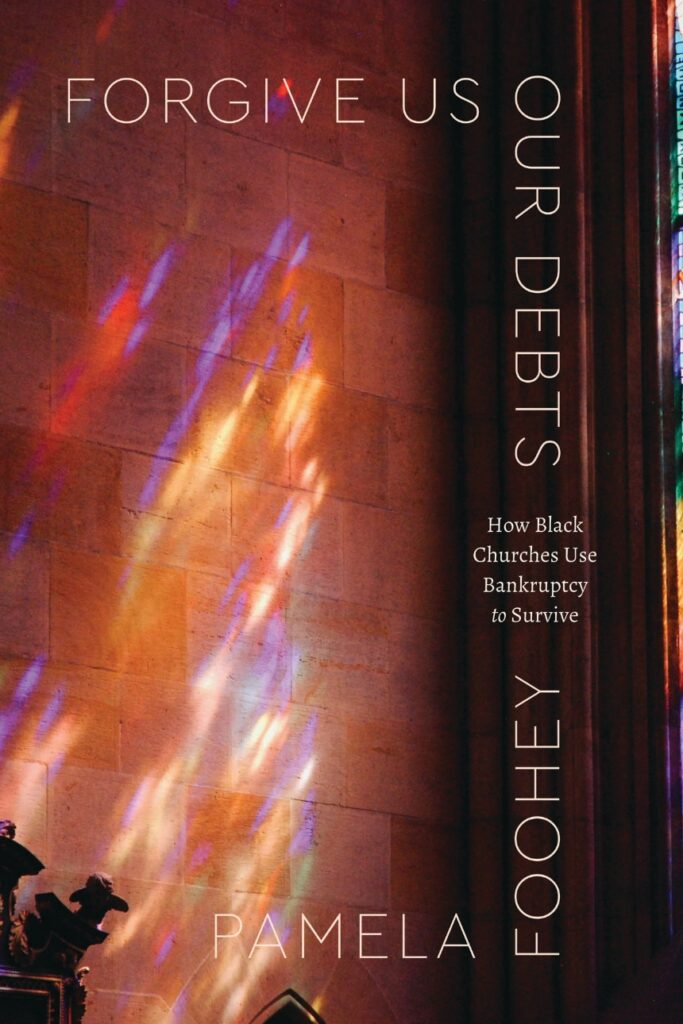
The following is an introductory essay to Pamela Foohey’s forthcoming book, Forgive Us Our Debts: How Black Churches Use Bankruptcy to Survive (University of Chicago Press, 2026). Foohey’s book will be published on September 21, 2026.
I never meant to write a book about churches filing chapter 11 bankruptcy. Chapter 11 provides a path for businesses to reorganize, typically restructuring debt and streamlining operations. When I launched the project that led to Forgive Us Our Debts: How Black Churches Use Bankruptcy to Survive, I thought it would fill a gap in research about non-profit organizations, such as cultural institutions and hospitals, that filed chapter 11. Then I noticed that churches consistently make up the majority of non-profits seeking to reorganize. These churches are not the Catholic diocese that may readily come to people’s minds. They primarily are small non-denominational or congregationalist churches. And most of them are Black churches—congregations with at least 80% Black members. Indeed, Black churches seek to reorganize at a disproportionately high rate compared to their proportion of congregations nationwide.
Within churches’ bankruptcy filings I found a study of a skewed lending market and the Black community’s struggle to keep hard-earned wealth. I also found some power to fight back against recalcitrant lenders. Forgive Us Our Debts details that study and tells Black churches’ story of survival and tenacity. At its core, this book is about lending to Black-owned businesses.
Churches Seeking to Reorganize
Every year, dozens of churches across the country file chapter 11 in hopes of reorganizing. Between 2006 and 2021, based on my review of court records, over 1,000 churches filed this type of bankruptcy. Most turned to reorganization after experiencing the operational and financial hiccups that can plague any business, for-profit or non-profit, such as over-expansion or the effects of a recession. Almost all of the churches that filed owned a building—their spiritual home. And almost every church filed with the goal of keeping its spiritual home.
Like other businesses and families, churches need to take out credit to fund large purchases, such as the buying or construction of houses of worship. When they filed bankruptcy, churches’ buildings often were in the midst of foreclosure proceedings or under the threat of foreclosure. Many churches also seemed to want to hold onto the money—known as equity—in their buildings. Seeking to reorganize made sense. The process pauses foreclosure and because of the bankruptcy law’s structure, pushes lenders to negotiate. Reorganization offered a path forward.
And bankruptcy court records indicated that lenders negotiated. Among the churches that filed between 2006 and 2021, over half emerged from reorganization either still owning their spiritual home or with enough money to move down the street and continue worshipping together as a congregation. The alternative for these churches likely would have been disbandment and dissolution. The congregations also would have lost the accumulated equity in their buildings.
The Surprise in Churches’ Bankruptcies
Still, aspects of churches’ court records didn’t make sense to a researcher steeped in thinking about the bankruptcy system. Most of the churches submitted financials that evidenced solvency when they filed. Their assets were worth more than the debts they owed. Because their main assets were their houses of worship, that meant that the churches had equity in their buildings—the equity that many churches likely sought to hold onto through reorganization. Additionally, some churches filed even after it seemed that they had recovered from operational and financial hiccups. And though a success rate of half of churches reorganizing successfully may strike one as low, in terms of smaller businesses using chapter 11, this success rate was higher than I expected to find.
Churches’ reorganization cases centered around negotiating with the lenders that had financed their spiritual homes. But given their cases, I thought that turning to the legal system and invoking the reorganization process shouldn’t have been necessary for this. More lenders should have been willing to negotiate outside bankruptcy.
To learn more about churches’ bankruptcy cases, I spoke with over 150 church leaders and bankruptcy attorneys. From these conversations, I realized that I should focus more on the congregations’ demographics. I searched for every church that had filed to determine its membership makeup.
Over 60% of the churches that sought to reorganize were Black churches. No more than a quarter of congregations nationwide are Black churches. Black churches seek to reorganize at three times the rate they appear among churches in the United States.
Something drove Black churches, year after year, much more so than other churches, to resort to the legal process of reorganization to force their lenders’ hands. Hidden within the 1,000 church reorganization cases was a story of lending to the Black community—and a story of successfully leveraging bankruptcy law and process when facing recalcitrant lenders.
Lending to the Black Community
Research has consistently shown that Black people pay more across credit products—auto loans, credit cards, home loans, and student loans. Black-owned businesses are less likely to be offered credit by traditional lenders. Lenders may have extended Black churches loans with onerous terms or may have been unyielding in negotiations when Black churches experienced difficulties. Such would correspond with the history of lending to Black households and businesses.
Indeed, there’s no reason the Black church would be immune from widespread disparities in the lending market. Churches have always been prominent places for the Black community to gather. They continue to serve as anchors of economic development. Church buildings themselves are one of the leading places where the community can grow its money and wealth.
My discussions with church leaders and bankruptcy attorneys confirmed that loans and lenders shaped their decisions to reorganize. Some Black churches were sold the equivalent of subprime home loans to purchase, renovate, or expand buildings. These loans often came from financial institutions that would be more likely to sell churches expensive loans. Black churches sometimes approached these lenders after mainstream banks had turned them away. And Christian-based lenders sold some churches loans with high interest rates and expensive terms.
Even those Black churches that started their financial journeys with more conventional loans encountered stubborn lenders when they fell behind on the loans because of financial or operational problems. Their lenders were slow to negotiate or simply refused. Faced with onerous loans and silent lenders, church leadership and membership rightly surveyed options. Finding little help in federal and state laws to address their situations, they fell back on bankruptcy law and the reorganization process.
Black Churches and Reorganization
I searched for other explanations for why a disproportionately high number of Black churches seek to reorganize. Drawing on my data, I looked for distinctions among churches: location, denomination, leadership structure, or the reasons churches took on loans. Nothing explains why Black churches would need to file bankruptcy to reorganize more often than other churches—except their Blackness, which connects with onerous loans and silent lenders.
My discussions with church leaders and bankruptcy attorneys confirmed that loans and lenders heavily influenced their decisions to turn to reorganization. The legal process brought lenders to the negotiating table, sometimes pushing them to give churches the deals they should have gotten in the first place and sometimes more simply forcing them to talk with church leadership.
Forgive Us Our Debts details how Black churches found a place in bankruptcy court and through the reorganization process to fight back and survive. It draws on case studies of six Black churches and one white church. For instance, Rosedale Park Baptist Church, a Black church in Michigan, had disagreements with its main contractor and several subcontractors involved in the construction of an addition to its building. These disagreements culminated in lawsuits. The church’s mortgage lender threatened foreclosure. Although the construction issues and a lingering lawsuit played a role in its reorganization case, the breakdown in negotiations with its mortgage lender outside bankruptcy shaped its filing and then the case itself.
These seven churches’ stories link the United States’ long history of predatory lending to Black churches’ predominance in bankruptcy courts. Their stories form the book’s narrative arc, chronicling churches’ reorganizations journeys. Insights from the totality of churches’ chapter 11 cases supplement these stories.
Although churches find remarkable success in reorganizing, their leadership and congregations know they often pay more money than they should need to and sacrifice time that they could be helping their communities for their successes. Leadership simultaneously valued bankruptcy law and the reorganization process to bring justice for their churches and questioned the need for filing–questions that stemmed for their churches’ interactions with lenders. The church lending market deserves a rigorous review of its practices.
Moving Beyond Bankruptcy
In Forgive Us Our Debts, I link the reason why so many Black churches have filed bankruptcy in recent years seemingly to the unequal and discriminatory U.S. financial system. That system includes mainstream banking and lending institutions and new products promoted by companies aimed at allegedly increasing access to credit specifically for churches. Black churches are not alone in struggling in the financial system. Since its creation and through its expansion, the banking and credit system has been skewed against the Black community.
This has led the federal government and state governments to enact legislation to try to lessen the inequality and eliminate the discrimination. These laws and regulations have proved to be blunt instruments. Yet these are the legal solutions currently available to Black churches other than turning to bankruptcy. Their bluntness confirms why reorganization currently remains Black churches’ best path to deal with lenders.
In addition to being integral parts of their communities, churches are, at their core, businesses. As businesses, lending to Black churches presents a microcosm of the Black community’s experience in the financial sector. Black churches’ path to and through reorganization provide accounts of the lived experience of the unequal U.S. economy. For now, filing bankruptcy to reorganize will remain Black churches’ leading place to contend with lenders and to survive. ♦

Pamela Foohey is the Curtis Bradbury Kellar Professor of Law at the University of Minnesota Law School. She also is the co-author of Debt’s Grip: Risk and Consumer Bankruptcy (2025).
Recommended Citation
Foohey, Pamela. “Why So Many Churches Are Turning to Bankruptcy to Reorganize.” Canopy Forum, August 10, 2026. https://canopyforum.org/2026/08/10/why-so-many-churches-are-turning-to-bankrupcy-to-reorganize/.
Recent Posts