Law and Religion in Revolutionary Pennsylvania
Aaron J. Walayat
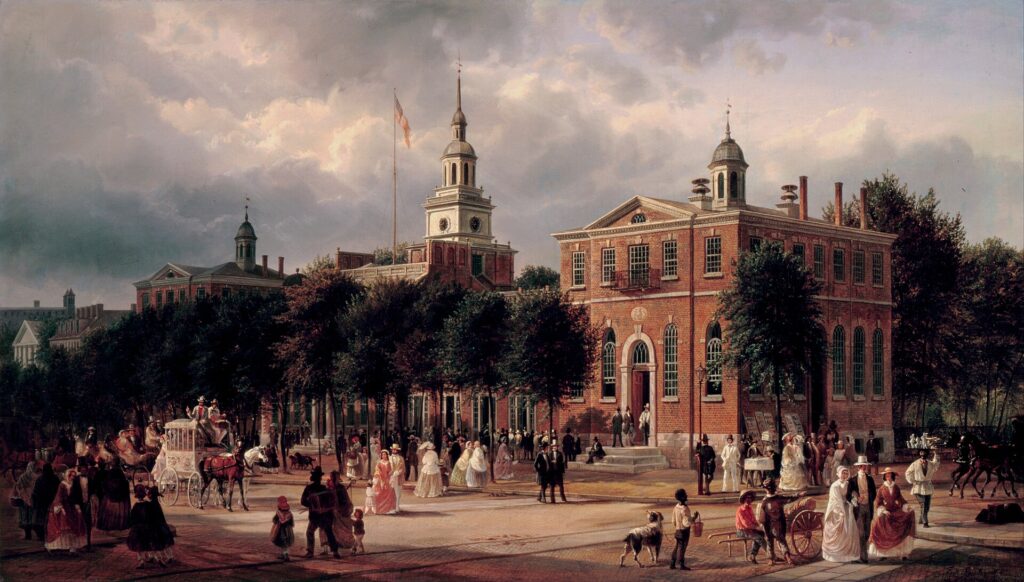
Crowds outside of Independence Hall in Pennsylvania by Ferdinand Richardt (US-PD-Art)
The thirteen colonies,” wrote Alexis de Tocqueville, “that simultaneously threw off the yoke of England at the end of the last century had, as I have already said, the same religion, the same language, the same mores, nearly the same laws; they struggled against a common enemy. So, they must have had strong reasons to unite closely together, and to be absorbed into one and the same nation.”
The passage, which appeared near the beginning of Tocqueville’s magisterial Democracy in America, reflected on the unifying factors among the American colonists, including, but not limited to, a shared religion. Modern commentators have celebrated Tocqueville’s writings on the foundational power of religion on American democracy. Tocqueville’s observations about the religious similarities of the American colonists are generally correct, as demonstrated by shared references to Christianity. Nevertheless, religious and ethnic differences among them, with the important caveat that religious diversity was uniformly Christian and ethnic diversity was still uniformly European, still played a meaningful role at the founding and, particularly, in the politics of revolutionary Pennsylvania.
From the years 1774 to 1790, Pennsylvania experienced a period of transformative, revolutionary change. The revolutionary shift in the colony led to the adoption of the 1776 Pennsylvania Constitution, considered the most radical of the revolutionary state constitutions. But the story does not stop there, and Robert Brunhouse chronicles how, almost immediately after the adoption of the 1776 Constitution, a “counter-revolution” sprung up in Pennsylvania. This led to a political struggle between the supporters and opponents of the 1776 Constitution, eventually leading to victory by the opponents and the adoption of the more conventional 1790 Pennsylvania Constitution. This article provides a short sketch of the political struggle in revolutionary Pennsylvania, exploring how law and religion intersected in this critical time in American history. As the breadth and depth of this history would be extensive, this article gives only a general overview of this period’s politics without focusing on the minutiae of every election and vote.
Colonial origins and early divisions
In 1681, William Penn, a Quaker, founded Pennsylvania as a proprietary colony on the promise of religious liberty. In 1701, the Charter of Liberties (or the Charter of Privileges), formulated by Penn, would serve as the colony’s constitution until 1776. Though the colony was founded in the spirit of religious liberty, its politics were effectively controlled by a Quaker aristocracy which dominated the provincial assembly. This domination continued even after the Penn family, who continued to govern Pennsylvania as proprietors until the revolution, left Quakerism and returned to Anglicanism.
Nevertheless, Pennsylvania’s promise of religious liberty brought individuals from a number of Christian sects and European ethnicities into the colony. These immigrants settled the colony, making their presence noticeable in specific counties. This included the Scots-Irish, many of whom settled in the western frontiers of the colony. The ethnically English Quakers and Anglicans settled in Philadelphia, Chester, and Bucks County in eastern Pennsylvania, becoming the “wealthy and aristocratic element[s] in the province.” There were also German immigrants, which included Lutherans and Reformed as well as other “pietistic sects” including Moravians, Schwenkfelders, Mennonites, and Dunkers, who settled in Lancaster, Berks, and Northampton counties. Acknowledging the ethnic, class, and geographical distinctions between these groups, J. Paul Selsam describes how these groups sometimes formed early alliances along political lines, with Quakers forming alliances with German sects in tension with Presbyterians, Episcopalians, German Reformed, and Lutherans. This early alignment, however, was not permanent and would realign with changing political circumstances.
Scholars have recognized the importance of tensions between Pennsylvanians on the local level, arguing that these local concerns were even more significant in stoking revolutionary fervor than British policy. Richard Alan Ryerson notes that while Pennsylvanians certainly felt “imperial pressures,” the “proprietary executive shielded them from the full force of new British policies for several years”, a move that appeared to backfire as Pennsylvanians began to believe that “problems with their executive were primarily a function of proprietary government and not of empire.” Additionally, as to the legislature, Selsam writes that, “[c]ontrary to accepted belief, the revolutionists in Pennsylvania had far greater grievances against the rule of the Eastern aristocracy than against the policies of the English ministry.” Despite tensions, elite control appears to have been maintained because ordinary people did not see themselves as a political force and did not organize themselves as such. The turning point came, however, with the American Revolution.
The formation of committees
With the events in Boston, anger toward British colonial policy was stoked, even in Pennsylvania. Ryerson chronicles how radicals in Pennsylvania began to organize local committees of correspondence and committees of safety, beginning around 1774, beginning a unique shift in the revolutionary movement in Pennsylvania. Through these committees, writes Ryerson, “legions of political novices formed the first wave of a new kind of political leadership in Pennsylvania, one based less on inherited wealth and status than upon the driving ambition of self-made men.” He concludes that the committees “revolutionized Pennsylvania politics not only by what they planned, said, and did, but also by what they were.”
During the revolution, the population split between revolutionary Whigs and loyalist Tories. Among the Whigs, however, there was a split between more radical and conservative elements. These conservatives were represented by leaders like John Dickinson, Robert Morris, and James Wilson who wanted the old charter of Pennsylvania preserved, and who, despite their support for independence, insisted that it should not be proclaimed until “every means of conciliation had been exhausted.” When the Continental Congress finally recommended that the individual colonies establish new governments, however, it was the radical Whigs in the Pennsylvania committees that answered.
First, in early June, ultra-Whig members of the Assembly stopped attending sessions preventing a quorum and paralyzing the old colonial Assembly. Then, the committees of the various Pennsylvania counties sent delegates to an extra-legal provincial conference. Branning writes that this conference took a pro-independence stance and usurped the powers of the Assembly, passing a resolution calling for a constitutional convention.
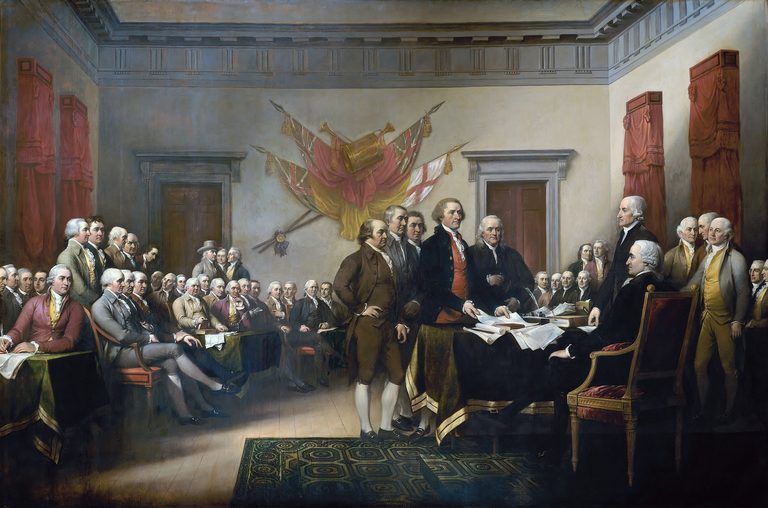
Per the resolution passed, a constitutional convention convened to draft a new constitution for Pennsylvania, meeting on July 15, 1776 and continuing deliberations until late September. Brunhouse describes those attending this convention as mediocre, with the only person of major profile being Benjamin Franklin, and the extent of his participation is a matter of some contention. On September 28, 1776, this convention adopted the Pennsylvania Constitution of 1776. With the aid of the Congress and the revolutionary spirit that enraptured the colonies in 1776, the radicals in Pennsylvania gained traction and, eventually, power.
The ethno-religious distinctions that marked tensions before the revolution carried over into the revolution. Even though the establishment expressed concerns regarding British policy to the colonies and permitted participation in the Continental Congress, the conservative element of the Quakers and Anglicans did not favor separation. When war came, other German sectarians, pacifist in their ideology, tended to side with the conservative establishment. By contrast, Scots-Irish Presbyterians sided with the radicals, with other Germans, not including the sectarians, joining them after the adoption of the Declaration of Independence.
The Pennsylvania Constitution of 1776
What made the Pennsylvania Constitution so radical? It is important to note that it was radical for its time. Branning details the document. It appropriated representation by taxpaying population, removed property qualifications for voting, and held elections annually. It had a unicameral legislature, though this was not really a major innovation given that the provincial assembly was also unicameral. There was no executive officer, and this position was instead replaced by a council. The judiciary was under the control of the legislature. The only effective check on the legislature’s power was a Council of Censors, a novel body that would meet periodically of assessing the performance of government officers examining if the constitution had been violated, and even calling a new convention if necessary. This body, however, was not insulated from political bickering and Brunhouse chronicles the fight between factions for control of the censors.
John Adams criticized the 1776 Pennsylvania Constitution, concerned specifically with the unicameralism of the Pennsylvania legislature. Adams had criticizes unicameralism in his 1776 essay Thoughts on Government as unable to constrain human passions, preferring instead bicameralism. Benjamin Rush wrote that “So great was [Adams’s] disapprobation of a government composed of a single legislature, that he said to me upon reading the first constitution of Pennsylvania, ‘The people of your state will sooner or later fall upon their knees to the King of Great Britain to take them again under his protection, in order to deliver them from the tyranny of their own government.’”
Almost immediately, opposition to the constitution sprang up. Supporters and opponents of the 1776 Constitution formed what might realistically be called political parties, with the radical supporters of the constitution dubbed “Constitutionalists” and the conservative opponents of the constitution dubbed “Republicans.”
Law and religion
Despite the defeat of the revolutionaries by the conservatives in 1790, however, Selsam reflects on the overall takeaways of the period and their influence on the future of American politics, including the enduring influence on immigration and geography in American politics.
Of the politics of revolutionary Pennsylvania, Selsam concludes that these events demonstrated the “[t]wo great themes in American history are the influence of immigration and the frontier upon the life and institutions of the country.”
In addition to immigration and geography, Ryerson also notes the influence of class and occupation in the organizing of the revolutionary committees. Howard Zinn, in his famous polemic, approaches the conflict almost entirely through the lens of class, describing the counter-revolution in Pennsylvania as an example of the elite during the American Revolution exercising its power to prohibit the revolution from going too far as a popular movement.
Owen S. Ireland notes how much of the scholarship around the politics of revolutionary Pennsylvania focuses on the geographical and class distinctions. He argues, however, that this analysis is incomplete, arguing that most analyses treat ethnicity and religion as secondary to more materialistic factors.
Sectarian and ethno-religious differences permeated the political parties that emerged after the establishment of the 1776 Constitution, with the Constitutionalists drawing “their leadership and their electoral support largely from Presbyterians, who were principally Scots-Irish, and from Germans of the Reformed faith” while the Republicans “drew their leadership and electoral support from a more heterogenous coalition” that included Anglicans, Lutherans, Quakers, and German sectarians.” The influence of the religious divisions that Ireland explored in his work may even be observed in some of the political issues of the time. The test laws, which required citizens to swear an oath, might be interpreted as a successful political ploy by the Constitutionalists to disenfranchise potential voters from religious groups who refused to swear oaths. These voters likely would have supported the Republicans.
Religious analysis also gives way to theological sources, and Ireland considered some potential of the historical and theological reasons for Scotch-Irish Presbyterians to be more supportive of American independence. But even ethno-religious differences should not be interpreted as the determinative factor in revolutionary Pennsylvania politics. Though Ireland shows how religious alignment permeated the parties, despite geographical or even wealth lines (both Constitutionalists and Republicans had wealthy supporters), this should not take away from the interlocking nature of political identities in revolutionary Pennsylvania, demonstrated by the fact that each side could identify individuals from each religious tradition among their ranks. Wealth, class, religion, ethnicity, ideology, and history all appear to be influential factors in the individual political identities of eighteenth-century Pennsylvanians without any one being determinative.
Familiarity and contempt
There is something amusingly modern in observing the politics of revolutionary Pennsylvania. The political pendulum swung back and forth between political parties, organizing reliable, but not necessarily monolithic, blocs along ethnic, religious, class, and geographical lines. All of this occurred during a period of intense political polarization in society. Brunhouse describes violent altercations along political lines as well as political polarization that bled into even the most minute areas of life. Polarization was also demonstrated in the barrage of newspaper commentary and attacks, including anonymously authored pieces. Indeed, personality also appears to have played a factor. This article, unfortunately, does not have the space to profile some of the larger-than-life figures, like Benjamin Franklin, George Bryan, Anthony Wayne, William Findley, and Robert Morris, to name a few, who featured on both sides of the political struggle. In light of these similarities, Selsam and Ryerson see within this period the origin of modern American politics. It is with some familiarity, and perhaps some contempt, that we look to revolutionary Pennsylvania as a sign of things to come and the legacy of an American politics that was forged by the participation of ordinary men, with all of their identities, in politics. ♦

Aaron J. Walayat is Assistant Professor of Law at the University of Dayton School of Law in Dayton, Ohio. He graduated with his J.D. from Emory University in 2019 and his B.A. from Washington & Jefferson College in 2016. While at Emory, he was a former member of the Journal of Law and Religion.
Recommended Citation
Walayat, Aaron J. “Law and Religion in Revolutionary Pennsylvania.” Canopy Forum, September 28, 2026. https://canopyforum.org/2026/09/28/law-and-religion-in-revolutionary-pennsylvania/.
Recent Posts