Drakeman’s Faint-hearted Originalism
Andrew Koppelman
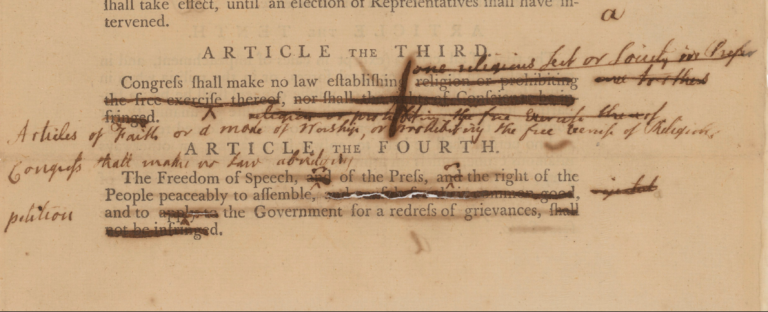
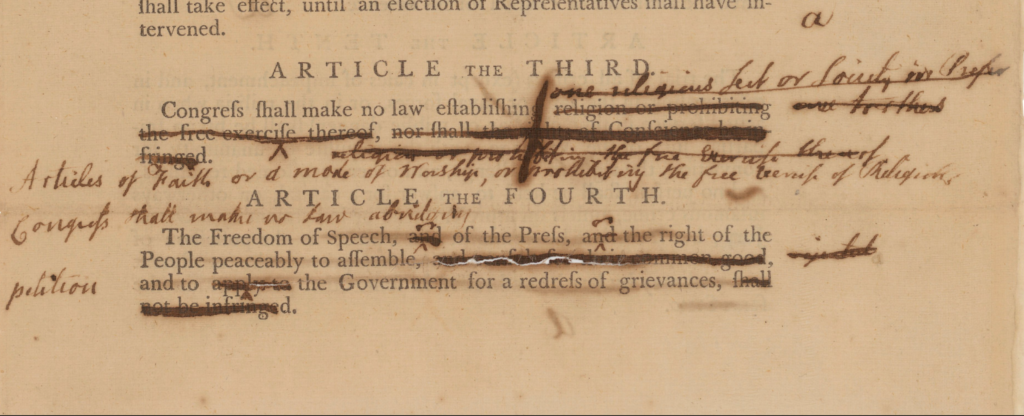
Senate Revisions to House Proposed Amendments to the U.S. Constitution, National Archives (US-PD)
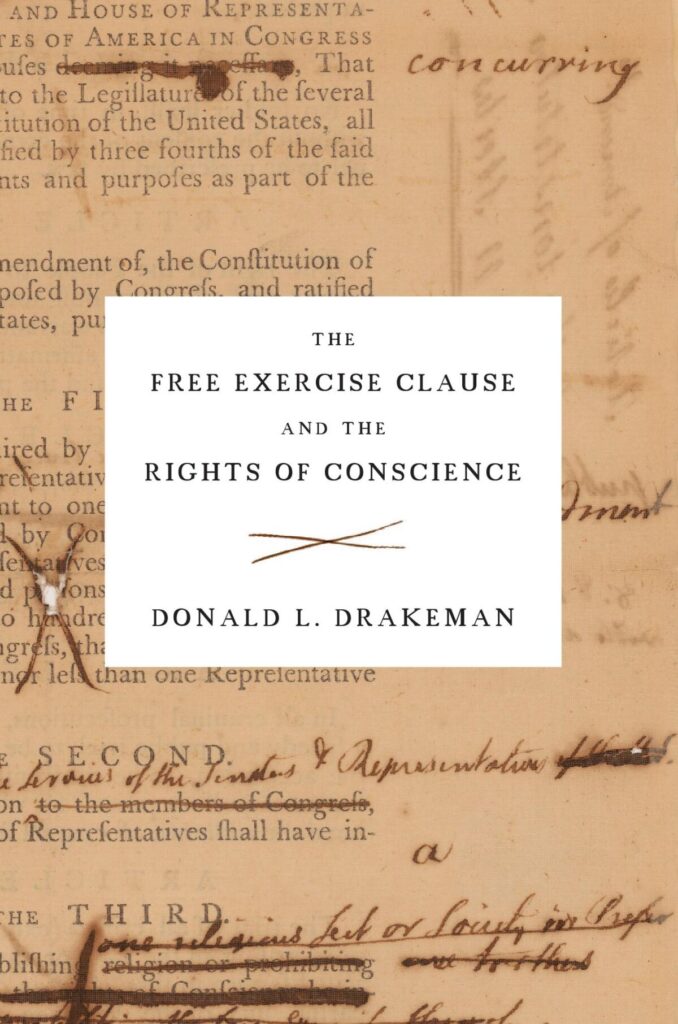
On October 15, Canopy Forum, hosted by the Center for the Study of Law and Religion, will be organizing an online book symposium regarding Donald L. Drakeman’s upcoming book, to be published November 2026, titled The Free Exercise Clause and the Rights of Conscience (Harvard University Press, 2026). The following is a review essay of Professor Drakeman’s book in anticipation of the symposium.
Donald Drakeman’s impressive historical research poses a formidable challenge to the idea that the original meaning of the Free Exercise Clause mandates religious exemptions from generally applicable laws. He has uncovered important and surprising new evidence of that meaning. This book will pose a sharp test of whether the Supreme Court’s self-styled originalists, who favor such exemptions, actually care about evidence.
I’m not a historian and can’t judge Drakeman’s historical account. But I can say something about what courts should do, if he is right. His findings are not sufficient reason to revolutionize our constitutional rules. Drakeman himself shrinks from some of his own conclusions, which give religion even narrower protection than he thinks his research entails. Justice Antonin Scalia famously wrote that “in a crunch I may prove a faint-hearted originalist,” because “[i]n its undiluted form” originalism “is medicine that seems too strong to swallow.” Drakeman doesn’t admit it, but he too is a faint-hearted originalist, and the point at which he faints is idiosyncratic and driven by his presentist political judgments. His idiosyncrasy shows the limits of originalism: does it ever make sense for us to radically change our law because of new historical research?
Consider six ways in which government action might burden religion:
1. The law expressly forbids certain religious groups “to hold a worship service in public.” (4)
2. A generally applicable law, not referring to nor motivated by hostility to religion, makes it hard or impossible for certain religious groups to hold worship services.
3. A generally applicable law, not referring to religion, makes it hard or impossible for certain religious persons to perform certain religiously motivated actions. The law is motivated by hostility to the religion in question and its purpose is to make the practice of that religion difficult or impossible.
4. A generally applicable law, not referring to religion, makes it hard or impossible for certain religious persons to perform certain religiously motivated actions. The law is NOT motivated by hostility to the religion in question, but it reflects selective sympathy and indifference on the part of the lawmakers. They give the value of religion less weight in their deliberations than a reasonable person would.
5. A generally applicable law, not referring to religion, makes it hard or impossible for certain religious persons to perform certain religiously motivated actions. The law is NOT motivated by hostility to the religion in question, its purpose is NOT to make the practice of that religion difficult or impossible, and the state has NOT unreasonably devalued religion.
Arguments about religious freedom sometimes conflate these categories. For instance, Mark Satta has shown that the Court has repeatedly used the language of “hostility” to justify intervention in cases of 4, above, even though the word normally signifies, and so insinuates, 3.
This kind of conflation sometimes happens in Drakeman’s book. He says that free exercise was originally intended to protect worship, but the laws he describes that the framers meant to block are all instances of 1. Yet he infers without additional argument that the protection of free exercise extends to 2, “giv[ing] everyone the right to attend the worship services of their choice,” (149-150) so that, for example, a law prohibiting the gathering of multiple households during a pandemic, which was motivated entirely by public health concerns, violates free exercise (153). When he discusses the pandemic cases, he also (158-159) mentions comparable nonreligious activities that the state permitted. He thus implicitly relies on the most-favored nation theory that he otherwise rejects (152-153), which calls for judicial intervention in 4. He lists, among the judicially created rules of which he is skeptical, the bar on “laws targeting religion” – which is to say, 3 – but it is hard to see how 4 could call for intervention while a court defers in cases of 3. If indifference is a culpable state of mind, so is an affirmative desire to harm.
He is right that some judicial creativity is necessary in order to get to the strict scrutiny of 5. This was already clear when Alito inventively parsed constitutional language in order to make his purportedly originalist case for overruling Smith v. Employment Division. (I confidently predict that Alito will be entirely unmoved by this book.)
Drakeman thinks it permissible to limit the right to worship on the basis of “peace and safety,” a limitation that appeared in some but not all state constitutional protections of free exercise (154). But there is no such provision in the federal First Amendment. He claims that he is agnostic on the question whether there should be strict scrutiny (236n45), but it’s hard to see how he can do without some kind of balancing. Human sacrifice is one form of worship service.
It is, of course, possible to read the paradigm case of 1 in a different way, as not confined to worship services alone but extending to any law that aims to injure unpopular religious minorities. The specific targeting of worship services is one way the state can do that, but there are others. The worst aspect of the narrowed free exercise clause he envisions is that it would leave untouched official bigotry toward such minorities, as is animating state law now with Muslims in Texas.
The most prominent varieties of originalism treat law as a set of rules, laid down in the past, that can mechanically be applied based on their plain meaning. Originalists tend to be hostile to purposive readings of text: one must simply apply the original meaning of the rules. Drakeman usually writes as though this were the appropriate method.
Yet, he also has a rhetorical aim. He claims that giving almost all live issues related to religious exercise to the legislature, with no constraint from the courts, will produce a better regime than we have now: “legislatures are simply better constituted to make policy decisions than courts are,” and (he attributes this to the framers, but with evident approval) the Supreme Court should not be “the national decision-maker-in-chief for the remarkably difficult task of fashioning a workable policy that would govern every occasion where the law intersects with religious beliefs and institutions.” (166)
What are those claims doing in his book? What has an historical inquiry into the original meaning of free exercise got to do with contemporary questions of what would make America better?
It turns out that his approach to constitutional law is not so mechanical as it claims. If it were, he’d have to say, “the rule that I’ve discovered might be good or it might be bad, it might in fact produce cruel oppression of religious minorities, but that’s not a problem that constitutional lawyers should worry about.”
(He proposes that the Court broaden protection for religion by reviving the federal RFRA (156), but doesn’t answer the logic of Boerne v. Flores: if the free exercise clause is narrowly construed, then there are few violations and so little for Congress to remedy (152). A fortiori this must be correct if one construes the clause even more narrowly than the Court has.)
The other problem with the ideal he offers is deeper. It is the assumption, shared by many originalists, that we should upend the law we have inherited on the basis of the latest historical findings. The announcement of new historical discoveries happens all the time. It remains to be seen whether scholars converge around Drakeman’s claims. Even if they do, there are great professional rewards for professors who successfully attack the conventional wisdom. Someone is always trying. So if we change the law in response to Drakeman’s research, it is quite possible that some later academic will show us that he was wrong. Then, we must lurch back to the law we had before. At least until the next bit of historical research comes along. This would be a silly way to run a civilization. ♦

Andrew Koppelman, the John Paul Stevens Professor of Law at Northwestern University, is the author of “Burning Down the House: How Libertarian Philosophy Was Corrupted by Delusion and Greed.”
Recommended Citation
Koppelman, Andrew. “Drakeman’s Faint-hearted Originalism.” Canopy Forum, September 23, 2026. https://canopyforum.org/2026/09/23/drakemans-faint-hearted-originalism/.
Recent Posts