
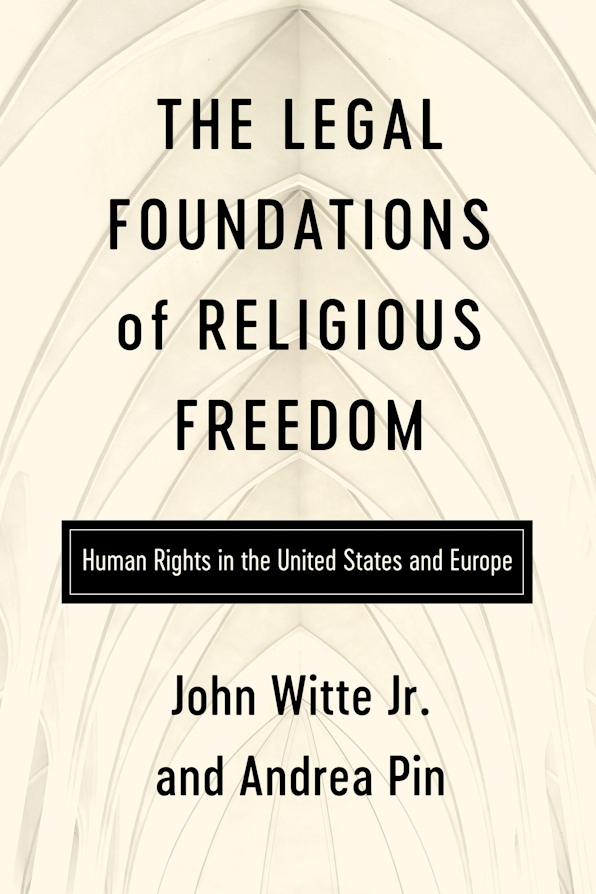
The Legal Foundations of Religious Freedom: Human Rights in the United States and Europe
John Witte Jr. and Andrea Pin
Material excerpted from The Legal Foundations of Religious Freedom: Human Rights in the United States and Europe by John Witte Jr. and Andrea Pin © 2025 by the University of Notre Dame. Excerpted with permission from the publisher. The following text is excerpted and adapted from chapters 1 and 20.
This volume explores the classical, Christian, and liberal origins of rights in the Western legal tradition and the complex interplay between human rights and religious freedom norms in modern law, religion, and culture. The authors analyze historical developments and recent cases from the United States Supreme Court, the European Court of Human Rights, and the Court of Justice of the European Union to uncover the historical, theoretical, and legal interactions of human rights and religious freedom on both sides of the Atlantic. They also expose the serious new threats to religious minorities on both continents, and the threat to traditional religious accommodations and church-state relations in Europe. The authors caution, however, that religious freedom and other human rights norms can only do so much to bridge the growing cultural divide over law and religion in modern Western societies and call instead for a renewed embrace of the fundamental goods of dignity, fraternity, and justice.
The Rise and Fall of Religious Freedom and Human Rights
The right to religious freedom has long been a foundational part of the gradual development of human rights in the Western tradition, and today it is often regarded as a cornerstone in the edifice of human rights. In its most basic sense today, the right to religious freedom is the freedom of individuals and groups to make their own determinations about religious beliefs and to act upon those beliefs peaceably without incurring civil or criminal liabilities. More fully conceived, freedom of religion embraces a number of fundamental principles of individual religious liberty – freedom of conscience, exercise, speech, association, worship, diet, dress, and evangelism; freedom from religious discrimination, coercion, and unequal treatment; freedom of religious and moral education; and freedom of religious travel, pilgrimage, and association with coreligionists abroad. It also involves a number of fundamental principles of corporate religious liberty – freedom of religious groups to organize their own polity and leadership; to hold and use corporate property; to define their own creed, cult, confessional community, and code of conduct; to establish institutions of worship, education, charity, and outreach; and to set standards of admission, participation, and discipline for their members and leaders. These are now standard principles of religious freedom in modern instruments of international and regional human rights, and in many national constitutions.
The Western legal tradition came to this robust understanding of religious freedom only after many centuries of hard and cruel experience to the contrary, and only as the tradition gradually developed many other human rights and liberties to make these religious rights and freedoms ever more real. The phrase “freedom of religion” (libertas religionis) first emerged at the turn of the third century in Church Father Tertullian of Carthage’s plea against Roman persecution. The classic Roman law phrase “right to freedom” (ius libertatis) first emerged prominently in the twelfth century in reference to religious freedom including Pope Gregory VII’s clarion call for “freedom of the church” (libertas ecclesiae). This libertas ecclesiae language was part of the church’s attempt to establish individual and corporate religious freedom against overreaching secular authorities, and to define the core jurisdictions and points of overlap and cooperation between religious and political authorities. The language of libertas and iura also helped define the proper interactions among clerics, officers, and institutions of various ranks and the procedures for vindicating these rights claims, as well as the interactions between clergy and laity and between laypersons in their religious lives and relationships. While the church’s medieval and early modern canon law provided an increasingly complex and sophisticated network of religious rights and freedoms, which were echoed and elaborated during the sixteenth century Protestant and Catholic Reformations, it took until the later seventeenth century for “the right to religious freedom” (ius libertatis religionis) to become a common phrase in secular laws, too, and for the abridgement of this fundamental right to trigger a cause of action in court, rather than a reason for victims to flee or revolt.
While guarantees of religious freedom against political authorities became more common in treaties and constitutions after the seventeenth century, they were still often honored in the breach by leaders of religious establishments and secular states alike. And while the nineteenth and twentieth centuries brought powerful new guarantees of religious freedom in both national and international human-rights instruments and court cases, vicious religious persecution remains a commonplace of modern life around the globe, including in many Western lands that have recently turned authoritarian.
Even so, religious freedom protections have come a long way in the modern West. European countries that used to discriminate against or persecute religious minorities have embraced more capacious understandings of religious freedom. Countries with established churches or concordats with the Holy See still now also formally respect and protect all peaceable religions. Since 1940, the United States Supreme has issued more than 250 cases applying the no establishment and free exercise of religion protections enshrined in the First Amendment, and both Congress and state legislatures have issued hundreds of special legislative protections for religious freedom. Since 1983, the European Court of Human Rights in Strasbourg has issued more than 150 religious freedom cases using the European Convention on Human Rights, joined in recent years by the Court of Justice of the European Union in Luxembourg
In the new millennium, however, all three of these apex courts have struggled with expanding and changing religious freedom claims by all manner of new or newly prominent religious groups; with hard cases that juxtapose traditional religious freedom norms and new claims of sexual liberty and same-sex marriage; with challenges to strict new regulations on religious gatherings born of the Covid-19 pandemic and other new public health and vaccine protocols; with navigating the shifting boundaries between public institutions and private entities in the delivery of social welfare and educational services; and with the rise of arbitration of family and financial disputes in religious tribunals.
These three apex courts have also faced growing ideological hostilities that have sometimes pitted religious freedom against other human rights claims. All three courts have responded by embracing a hands-off neutrality approach that can often deny justice to religious parties, particularly religious minorities. While neutrality is no longer the watchword of the US Supreme Court’s most recent First Amendment jurisprudence, it has become increasingly prominent in both the pan-European courts in Strasbourg and Luxembourg.
Human Dignity as the Foundation of Human Rights and Religious Freedom
The past decade has shaken the strong foundations of human rights and religious freedom. Increasingly religious and ideological pluralism has challenged the cultural and constitutional equilibrium that both Europe and the United States had reached in the aftermath of World War II. The crisis of globalization and internationalism in the new millennium has both caused and reinforced nationalism, nativism, and state- or culture-centered narratives, which have fueled identitarian rhetoric and often deprecated the needs of religious and cultural minorities. In Europe, international and supranational institutions have often prioritized economic rights and second-guessed the labor and employment practices of religious groups and traditional concordats. In the United States, strong new authoritarian moves by the federal government have jeopardized many traditional human rights and civil rights protections and encouraged new forms and forums of Christian nationalism in schools, the military, political debate, and public life.
It is essential, in our view, to balance religious freedom of all parties with other fundamental rights and freedoms, including sexual and same-sex freedoms, and find responsible ways of living together with all our neighbors. Europe and the United States have been dealing with the needs of religious minorities for a long time, particularly since the horrors of the Holocaust, and have only gradually come to a still imperfect modus vivendi. They will have to develop a comparable modus vivendi to mutually reconcile cultures that have deeper roots in Western Christianity with sexual, cultural, and linguistic minorities, as well as new immigrants, refugees, and other vulnerable parties. The increasing tribalism, xenophobia, and hostility among rival groups in recent years is particularly perverse, feeding mutually destructive strategies of defaming, demonizing, and destroying those who hold other viewpoints and lifestyles. In a rule of law liberal state, rival groups need to learn to live together as good neighbors, sometimes putting up high fences between them as needed.
Recent attempts to privilege religious freedom over other rights, or Christianity to the deprecation of other faiths betrays the foundational idea of human dignity. Long a staple in European constitutionalism, the idea of dignity has also entered the jurisprudence of the United States Supreme Court, particularly through the opinions of Justice Anthony Kennedy. Parties and judges at the national, supranational, and international level have routinely deployed the idea of human dignity to magnify the seriousness of any sincere rights violation, and the humiliation that victims of discrimination may face if a court rejects their claim.
Dignity may not serve as a ready compass to decide concrete cases. But it still serves important purposes. It highlights the importance of protecting human beings as such, and thus encourages everyone not to overlook what individuals and groups value as important for their own lives. It requires that judicial claims be taken seriously, as they often stem from deeply held beliefs, and reminds institutions that people who are not given utmost judicial attention and solicitude may not only lose their case but also might be deeply humiliated. Dignity also recommends a holistic understanding of rights and interests that appreciates the complexity of human beings and social institutions, and the claims that they can make. Balancing rights and interests so much as possible is often the best course of action for judges and especially for democratically elected bodies.
The theory and practice of balancing and proportionality has proven particularly successful in Europe at the domestic and pan-continental level. Largely thanks to the contribution of German constitutional scholarship and of the German Federal Constitutional Court, judges across Europe have developed refined notions of balancing and proportionality in judging cases before them. Now a staple also in the pan-European courts in Strasbourg and Luxembourg, this type of scrutiny processes state policies in a precise way and evaluates whether the benefits of a ruling outweigh the damages caused to other interests and rights.
American academics, brought up on earlier legal realist theories or on more recent critical legal studies movements, have often criticized the European judiciary’s practice of balancing and proportionality. They see this as a mere fig leaf for judicial arbitrariness, a wordy way to hide the judges’ personal preferences underneath a veneer of judicial neutrality and discipline. There is a grain of truth in such criticisms; however, the logic of balancing has become increasingly important, as courts confront clashes between various fundamental rights claims. This technique has found its way into United States constitutional law as well. In both religious freedom and other fundamental rights cases, American courts must balance whether there is a substantial burden on one or more rights, whether government has an important or compelling state interest to impose this burden, and whether there is a lesser restrictive alternative for achieving the government’s interests and protecting the rights claims at issue.
Balancing rights and interests is a quintessential feature of democratic institutions that respect the rights and freedoms of all their citizens. As Jamal Greene recently documented, pushing or vindicating only a single right or rights agenda while ignoring the social consequences of that effort, is a recipe for the tribalization of politics and the weaponization of institutions. It is also a betrayal of human dignity. Other, more sophisticated tools may eventually replace proportionality as a standard means of balancing rights and interests, including religious freedom claims. But until such a new approach takes hold, striving to reconcile competing world views and individual and collective priorities, both through legal means and other forms and forums of cultural navigation, is a far better recipe for fostering justice, peace, dignity, order, and rule of law. ♦

John Witte, Jr. is Robert Woodruff University Professor of Law; McDonald Distinguished Professor of Religion, and Faculty Director of the Center for the Study of Law and Religion at Emory University.

Andrea Pin is Full Professor of Comparative Public Law at the University of Padua and McDonald Distinguished Senior Fellow in the Center for the Study of Law and Religion at Emory University.
Recommended Citation
Pin, Andrea & John Witte, Jr. “The Legal Foundations of Religious Freedom: Human Rights in the United States and Europe.” Canopy Forum, May 13, 2026. https://canopyforum.org/2026/05/13/the-legal-foundations-of-religious-freedom-human-rights-in-the-united-states-and-europe/.
Recent Posts