Puccini’s Suor Angelica and the Question of Suicide Between Catholic Theology and the Law
Davide Dimodugno
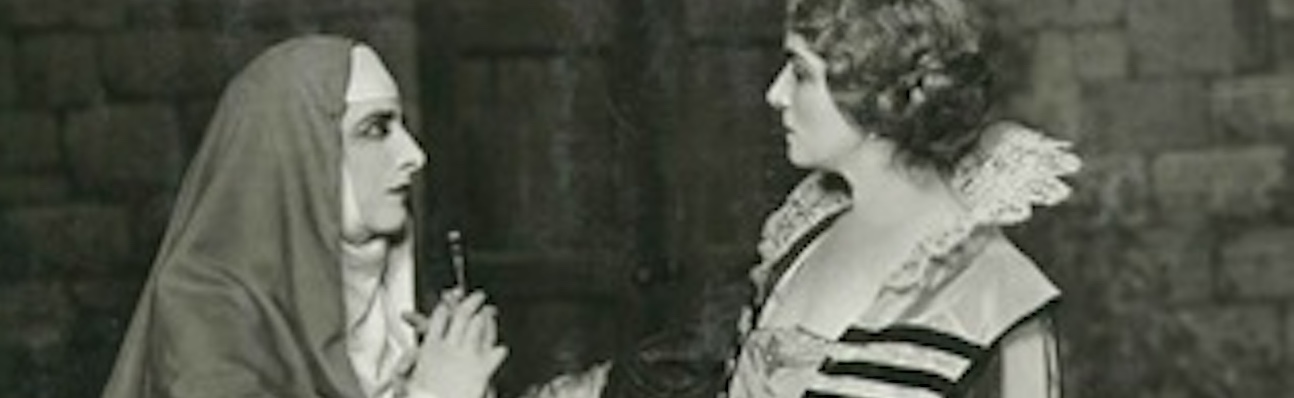
The world premiere of Puccini’s “Suor Angelica”, Metropolitan Opera, New York City, 1918 by White Photo Studio.
This paper summarizes and translates into English the chapter Suor Angelica: il suicidio tra teologia e diritto, from the book Puccini in Law: Raccolta di studi in occasione dell’anno pucciniano, edited by Domenico Di Micco, Mario Riberi, and Matteo Traverso, published in the series Quaderni del Dipartimento di Giurisprudenza dell’Università di Torino by the University of Turin, 2026.
Giacomo Puccini, whose centenary of his death was commemorated in 2024, often described himself as a narrator of “great sorrow in little souls.” His music reveals the inner landscapes of human beings, especially women, in ways that move audiences beyond generations. While remembered as a man of appetites, Puccini was also shy and profoundly sensitive, with a spirituality that resurfaced strongly in his later years, to the point that he received religious comfort on his deathbed. His unfinished Turandot symbolically closed three centuries of Italian opera, leaving behind a repertoire in which compassion, death, and the longing for transcendence intertwine. Within this legacy stands Suor Angelica, also known as Sister Angelica in English, which premiered at the Metropolitan Opera in New York on December 14, 1918. It is one of the few operas in melodramatic history built almost entirely around female voices, and it is one of the composer’s most personal works.
Suor Angelica, composed as the central panel of Il trittico, contrasts starkly with its companions. Where Il tabarro depicts urban misery and murder, and Gianni Schicchi revives the comic traditions of opera buffa, Suor Angelica unfolds in a convent at the end of the seventeenth century, telling of a noblewoman forced into monastic life after giving birth to an illegitimate child. Structured almost like a seven-station Way of the Cross, the libretto moves from serene convent life to despair when the Princess Aunt reveals, with cold detachment, that Angelica’s son has died two years earlier. Faced with unbearable grief, Angelica prepares a fatal potion with hemlock and takes her life, seeking reunion with the child she never knew. At the climax, she invokes the Virgin Mary, who grants a “sign of grace” in the form of a vision of the Madonna herself and the child. Whether staged as mystical miracle or subjective vision, this moment opens a space where divine mercy can overcome sin, even the sin of suicide.
The work bore special resonance for Puccini, whose sister Iginia was a cloistered nun. He entered her convent in Vicopelago, a hamlet of Lucca, by ecclesiastical privilege to teach the nuns music and even performed Suor Angelica for them at the piano, gauging whether such a daring subject would scandalize. In Italy of 1918, where Catholicism was still “the only religion of the State,” a nun’s suicide risked appearing blasphemous. Yet the sisters themselves, far from being offended, declared Angelica “saved” and “blessed.” Such reception highlights the opera’s ability to humanize doctrine and to evoke compassion beyond legalistic boundaries.
The opera’s text underwent revisions. The “aria of the flowers,” in which Angelica names the blossoms of the convent garden before invoking hemlock to aid her suicide, was cut in early Italian performances. Conductors argued that the passage slowed the drama and sounded too modernist, though self-censorship may also have played a role, especially in Rome, where papal and royal audiences might have been scandalized by overt reference to Socratic death. Puccini lamented the loss of this aria, which clarified Angelica’s intent and deepened the psychological portrait of her choice.
Moreover, the miracle scene, whether interpreted as a real vision or hallucination, sets in tension Catholic doctrine and human desperation. Angelica, realizing she has died in mortal sin, prays for mercy; the Virgin appears with her child, allowing her to die reconciled. By staging such an ending, Puccini and librettist Giovacchino Forzano blurred boundaries between theology, law, and art. The work invites reflection on suicide not simply as an act of despair, but as a question of mercy, justice, and the limits of ecclesiastical condemnation.
From a theological and canonical perspective, suicide has long been judged severely. Augustine, Aquinas, and the canon law tradition consistently considered it a sin against God, society, and self. Medieval councils forbade clerics to accept bequests from suicides, while the 1917 Code of Canon Law (Can. 1240 §1, no. 3, and Can. 2350 §2) explicitly denied ecclesiastical burial to those who deliberately killed themselves. Only with the 1983 Code was this rule relaxed, allowing case-by-case assessment and recognizing mitigating circumstances such as mental anguish (Can. 1184). The Catechism today acknowledges that grave psychological suffering can diminish responsibility, while still affirming the sacredness of life. Thus, while the Church still condemns suicide in principle, it now prays for those who have taken their own lives, entrusting them to divine mercy.
This evolution parallels broader cultural shifts. Where once an illegitimate birth brought social disgrace severe enough to justify cloistering a woman for life, contemporary European societies treat children born outside marriage as equal in rights, a transformation enshrined in Italian law since 2012. With nearly half of Italian children now born to unmarried parents, the tragic premise of Suor Angelica—that motherhood outside wedlock must be hidden or punished—belongs to another era. Today, legal and social mechanisms would likely protect, rather than condemn, a woman in Angelica’s situation, reducing the likelihood that she would see death as her only escape.
Yet the opera continues to resonate precisely because it transforms an individual’s suffering into a collective experience. The aria “Senza mamma” embodies a grief recognized across cultures: the loss of a child, an experience so universal that it touches nearly every family history. Audiences empathize not only with Angelica but with all mothers who mourn children lost to illness, accident, or war. In this sense, the Virgin Mary’s appearance is not simply miraculous spectacle but theological reassurance: as Mary herself knew the pain of Calvary, she cannot ignore the anguished plea of a mother.
The tension between condemnation and mercy, law and compassion, makes Suor Angelica an emblematic case for the modern confrontation between the Church and questions of bioethics. Today, debates on assisted suicide, euthanasia, and end-of-life care reveal societies caught between the value of life and the claim of personal autonomy. In Italy, these debates have reached the highest judicial level: the Constitutional Court, with its landmark decisions (order no. 207/2018 and judgment no. 242/2019), recognized the possibility, under strict conditions, of exempting from punishment those who assist the suicide of a patient kept alive by life-sustaining treatments but fully capable of free and informed decision-making. However, this principle does not apply in the case of the suicide of a person who is not being kept alive by life-sustaining treatment (Constitutional Court, judgment no. 66/2025). Such rulings, prompted by the “Cappato case,” have forced Parliament to confront the delicate balance between Article 580 of the Penal Code, the inviolability of life, and the constitutional principles of human dignity and self-determination, even though no law on end-of-life issues has been passed to date. This jurisprudence reflects a legal landscape still in evolution, where “imperfect laws,”—as suggested by the Lexicon on end-of-life issues published by the Pontifical Academy for Life—may represent the only viable solution in a pluralistic democracy.
The Catholic Church, insisting on the primacy of life from conception to natural death, resists any legal recognition of assisted suicide. Yet it must navigate a secular and multicultural society where its moral teaching competes with alternative ethical frameworks. Some within the Church advocate uncompromising defense of “non-negotiable principles,” while others stress the importance of dialogue and pastoral accompaniment, recognizing the limits of juridical prohibition in shaping personal choices. The debate thus mirrors the opera itself: Angelica’s despair collides with doctrine, but compassion and mercy ultimately prevail.
After the reconciliation between the Church and modernity, which took place with the Second Vatican Council, art was recognized as a meeting point between humanity and divinity, between finitude and infinity. As Pope Benedict XVI remarked, beauty in music and opera can lift the human spirit to God, while Pope Francis has demonstrated in his first interview – while comparing to the theological virtue of hope with the solution of the first enigma in Puccini’s Turandot – that opera and music themselves can become effective tools for evangelization. In this sense, even a work such as Suor Angelica, once considered problematic, can be reinterpreted as a testimony of mercy, maternal love, and the mystery of salvation.
In this light, Suor Angelica offers not only a narrative of sorrow but a parable of negotiation between tradition and modernity. The libretto dramatizes precisely the tension between doctrine and lived experience, between law’s rigidity and the demand for mercy. Angelica’s suicide, though condemned by theology, is redeemed by love and compassion, showing that human frailty can still encounter grace. Opera here becomes more than entertainment: it becomes a medium where art, theology, and law intersect, a stage upon which society explores dilemmas that remain unresolved.
Puccini’s music—immediately accessible yet harmonically complex—offers a path of beauty leading toward the divine. In Suor Angelica, that path converges on one of the most difficult issues of human existence: the suicide and the life after death. Through art, the Church can communicate mercy more powerfully than through doctrine alone. By showing compassion for Angelica, Puccini demonstrates how music can soften the hardest judgments, reminding us that God’s justice is inseparable from God’s mercy.
Thus, more than a century after its premiere, Suor Angelica continues to challenge jurists, theologians, and believers alike. It reminds us that the law, while necessary, cannot exhaust the mystery of human suffering; that theology, while rigorous, must be tempered by compassion; and that art, through its capacity to embody grief and hope, can still mediate between human fragility and divine transcendence. Puccini’s nun who dies for love of her child remains not merely a character but a mirror of humanity’s enduring struggle between despair and redemption, between the rule of law and the promise of grace and salvation. ♦

Davide Dimodugno received his PhD in “Law and Institutions” with honours in 2022 from the University of Turin, Law Department, where he is a Postdoctoral Researcher in Law and Religion. He is a member of EUARE, European Academy of Religion, ICOMOS, International Council for Monuments and Sites, FRH, Future for Religious Heritage, ICLARS, International Consortium for Law and Religion Studies, and an aggregate member of ADEC, Association of Academics in Law and Religion in Italy. He is licensed to practice law.
Recommended Citation
Dimodugno, Davide. “Puccini’s Suor Angelica and the Question of Suicide Between Catholic Theology and the Law.” Canopy Forum, June 20, 2026. https://canopyforum.org/2026/06/20/puccinis-suor-angelica-and-the-question-of-suicide-between-catholic-theology-and-the-law/.
Recent Posts