A Missing Century of Law and Education without Religion: 101 Years After Pierce
Mary Elizabeth Marquardt
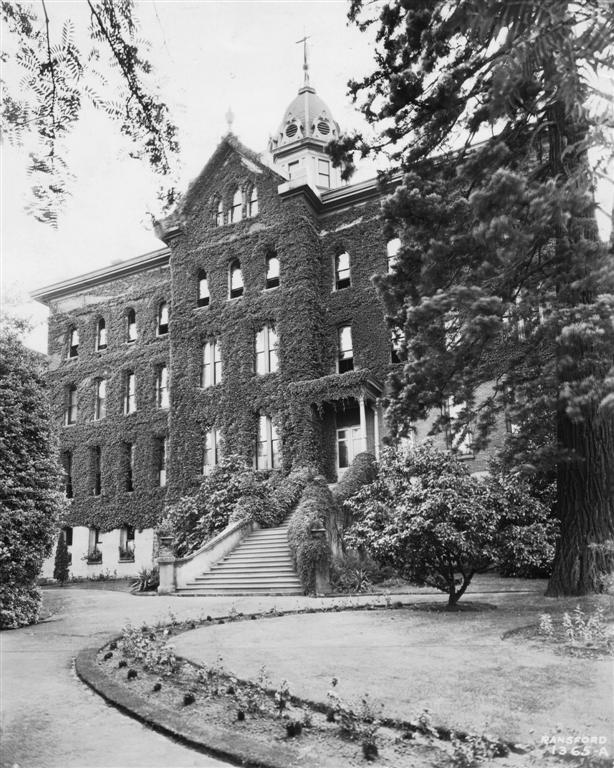
St. Mary’s Academy, Image Courtesy of SNJM Archives.
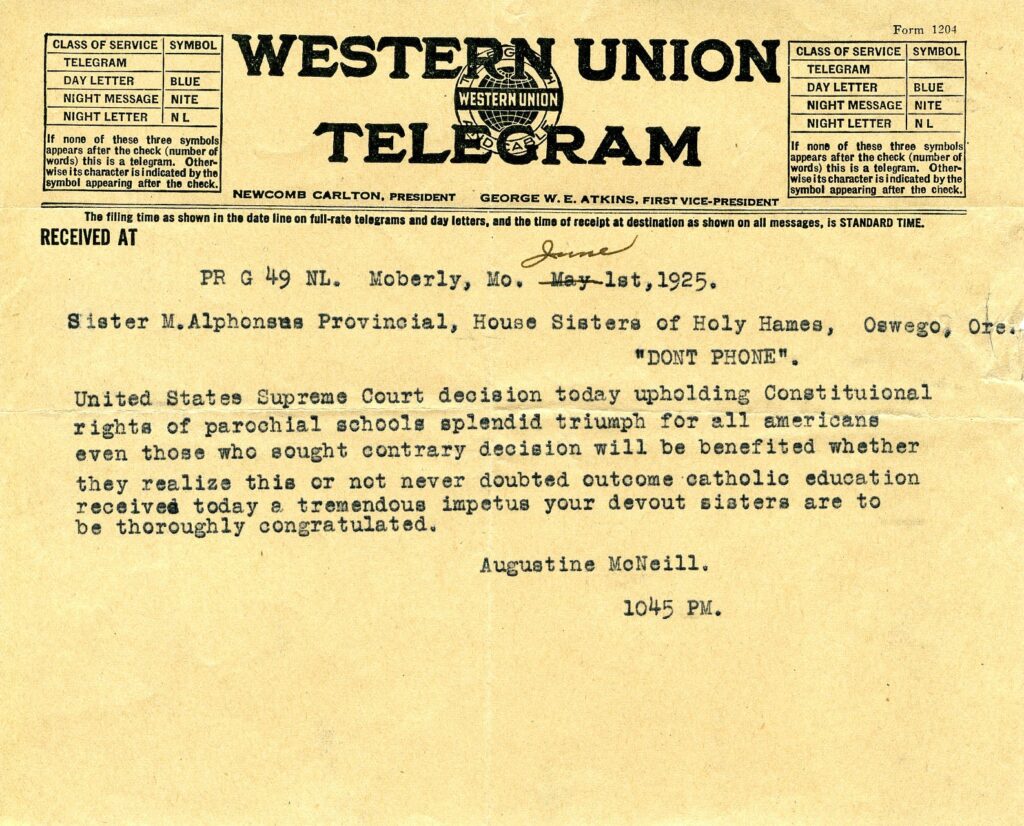
This week, the first of the state of Oregon’s public schools will open their doors to a new school year. Teachers will reenter their classrooms to unfamiliar students, filled with the emotions of the fall’s start. In the next few weeks, the state’s private schools will join public schools in their return to the classroom. Included in these institutions is St. Mary’s Academy, a Portland school at the center of a battle over Catholic education a century ago. Debates over the future of private schooling in the state culminated in Pierce v. Society of Sisters, 268 U.S. 510, a case decided by the Supreme Court during the summer of 1925. Had their lawyers lost, the start to this academic year might be the centennial commemoration of private schools’ permanent closure.
Last year, at the hundredth anniversary of Pierce’s decision, many organizations—from law schools to homeschooling networks and education blogs to Catholic dioceses—all commemorated the case’s history. Few groups, however, have taken time this year to reflect on a different anniversary: that of the failed school bill’s original implementation date. Many legal scholars know Pierce, ruling an Oregon compulsory public education law unconstitutional, as a precedent in matters of education law, employment, parental rights, and Fourteenth Amendment Due Process. The legislation at the heart of the case, the Oregon Compulsory Education Bill, would have mandated that parents send their children to public schools beginning in the fall of 1926. During the proceedings of the case’s rise through the appellate court system, that date loomed large: the lawyer for the Society of Sisters had to justify filing the case prior to the law’s implementation in his complaint in District Court and Chief Justice Taft and the State of Oregon’s lawyer went back-and-forth in oral arguments about its place in the Bill. Its promise of compulsory public schooling, though, never came to be.
In a modern era when the Court has focused on religious freedom and education, marked by landmark decisions such as Mahmoud v. Taylor and Kennedy v. Bremerton, reflecting on the centennial of what did not happen in Pierce reminds us of history’s contingent nature. Questions about schooling, religious freedom, nativism, and claims to Americanism found in the 1920s controversy in Oregon remind us that animated debate over the place of religion in schools has flourished for over a century. That has been, in part, made possible by this week’s non-anniversary of the “missing century” of compulsory, public, and mostly secular education that did not happen as a result of Pierce. Today, religious education in private schools continues.
The Oregon Bill and Religious Freedom
During the period between November 1922, when voters of Oregon made compulsory public schooling the law of the land by ballot initiative, and June 1925, when the U.S. Supreme Court undid the restriction on private schools in Pierce v. Society of Sisters, the case animated a national debate over the meaning of religious freedom. In the United States, religious freedom is guaranteed in the First Amendment’s balance of the Free Exercise Clause and the Establishment Clause. But to the high court, the state of Oregon violated the rights of Catholic schools, their teachers, and the parents who chose to send their children to them on a Fourteenth Amendment claim. The plaintiff’s complaint, discussed during oral arguments, alleged that the law attempts to “deny plaintiff of its property” by making school buildings unusable, the result of which was to “deprive parents of their right to direct and control the education of their own children,” “impair the obligation of the contract between the [Oregon] and the plaintiff,” and “delegate arbitrary and unlimited power and authority to the County School Superintendents of the State of Oregon.” The Society of Sisters’ non-sectarian co-litigant in the Pierce case, the now long-defunct Hill Military Academy, anticipated the success of this Fourteenth Amendment claim in their arguments, cementing the underlying justification for the high court’s decision.
The nuances of the litigants’ constitutional arguments did not matter in the news cycles, though: “religious liberty” and “freedom” language reigned over claims to contracts or property rights for the schools. In the midst of anti-Catholic nativist sentiments, religious bigotry, and Progressive Era nationalism, rhetoric about Catholic education came to define struggles for parental rights and state overreach. American Catholic primary schools, which increasing numbers of Americans saw as incubators of a foreign religion threatening domestic national security, became the vehicle through which this religious liberty was protected by courts.
In the century since its decision, Supreme Court justices have often referenced Pierce in due process cases, cementing it as case law precedent. From its citation in Griswold v. Connecticut, legalizing a right to oral contraceptives, to Lawrence v. Texas, ruling unconstitutional a law to criminalize gay sexual activity, the precedent Pierce set has moved far beyond the context of education. And though all of these issues—Christian schools, birth control, and homosexuality—might invoke religious concerns, courts decided none of them with any references to religious freedom. This is primarily due to the legislation at the center of the Pierce case itself. On paper, it did not ban Catholic schools due to their explicitly religious nature. Rather, the Oregon compulsory public school law in effect abolished parochial and religious order schooling by requiring parents to send their children to public schools instead, beginning in the fall of 1926. This was the clear intent of the law’s proponents. Thus, the rhetorical firestorm following the law, through district court and into the halls of the nation’s highest court, centered on religious liberty and parental rights language. Popularly, if not doctrinally, Pierce served as a mid-1920s referendum on religion in schools.
Catholic Education and Nativism at the start of the Twentieth Century
The timing of the Oregon compulsory education bill came at the end of a decades-long push for Catholic education in the United States. As the nineteenth century came to a close, the Church hierarchy reinvested in religious education for Catholic children. The highest councils of the American Church used their meetings to direct parents, by any means necessary, to ensure their children were enrolled in Catholic schooling and instructed in Church teachings in their households. In asserting this wish, the hierarchy communicated that religion should not be restricted to the private sphere—namely, the family—but that it was an integral part of public life. The bishops reminded Catholic parents nationwide that the work of their children’s schools was as important as that of their own homes. The two spheres had to work in tandem to ensure the full development of children; one or the other would not suffice.
The work of the American bishops in the century prior was validated, reasserted, and further developed by the Vatican’s 1917 Pio-Benedictine Code of Canon Law. The Code addressed education in both the home and the schools. It is stark in its language, stating that “In every elementary school, children are to be given religious instruction [adapted] to their age” and “Catholic children should not frequent non-Catholic, neutral, or mixed schools” (Canon 1373 and Canon 1374). This explicit affirmation of the centrality of the Catholic school to Catholic teaching drew on the work of prior published writings by bishops and other Church leadership. Merely five years later, a state law in Oregon would test its legality in a non-church context, illegalizing Catholics’ convictions towards their own codes and canons.
The Oregon law rendered illegal Catholic parents’ choice to send their children to religious school, preventing them from exercising the call that canon law and the American bishops made to fully practice their faith. The language of the 1917 Code of Canon Law and guiding church documents are all decidedly far from a familiar American legal vernacular. Heavy with appeals to God’s call and divine commission, they have strong theological backing and implications. More important to the Oregon context, the complexity of Catholic allegiance to these documents was unfamiliar to many in the United States. Some anti-Catholic Americans recognized, skewed, and exploited that unfamiliarity, contributing to a nativism that defined the 1920s.
Inspired by the same nativist sentiments, advocates allied with Masonic orders and the emergent Ku Klux Klan convinced the state legislature to put the compulsory public education initiative on the 1922 November ballot. The basic principle underlying the OCEB was that the public schools were the only suitable place for the education of patriotic, American children. It required the parents of all children ages 8-16 to “send such child to a public school” during the entire school year. While the bill contained no language that technically prohibited private schools from operating, it forced their potential student bodies into attending public schools. Advocates spoke out for and against the bill, including in published government sources. Many Oregonians rightfully saw it as a concerted attack on Catholic parochial education, the primary alternative to public schooling.
Catholics fought back, amassing a defense in Oregon that won at the nation’s highest court. Parents’ groups and national organizations like the National Catholic Welfare Conference (NCWC), a precursor organization to the United States Conference of Catholic Bishops, defended parental rights to send children to religious school with appeals to patriotism and American constitutional principles. But for lay Catholics at the time, messages they received in masses or from teachers urging Catholic education generally came from very different rationales. The historical context surrounding the movement to educate every Catholic child in a Catholic school, a phenomenon canonically codified a mere five years prior to the Oregon school law, points towards why parents and national organizations fought fervently against the legislation. In Catholic doctrinal conceptualizations, their private schools were a protection from the encroaching, nominally-secular state actually imbued with Protestant values and bolstered by anti-Catholic nativism.
From Early School Battles at the Court to Today
The broad legal fight for religious education gained legitimacy in Pierce. As the twentieth century progressed, conservative activists would adopt three of its motifs: rhetoric pushing for religious freedom, argumentation based on parental rights, and claims to due process. Perhaps ironically, in light of its use by conservatives to support parental rights in education, Pierce has also undergirded decisions in privacy cases that have shielded what is left of more liberal objectives like reproductive and same-sex rights. Catholics have been at the forefront of many facets of these diverse legal movements. As the century progressed, Catholicism entered the legal mainstream with arguments forged in its own vernaculars, staking claims in the nation and eschewing Progressive Era nativism.
Claiming diverse ideological backing, Catholicism has animated legal debates about education from Pierce to the present. Catholic schools continue their operation in Oregon and around the nation, and in the proceedings of the court, though the Supreme Court has recently ruled against what would have become the nation’s first publicly-funded, Catholic virtual school. In the century since Pierce, major Supreme Court cases have centered on issues having to do with Catholic schools. That is likely to hold true in our current era. The choice in Pierce that is the subject of this week’s centennial-that-wasn’t guaranteed that Catholic and other religious schools would have a future in Oregon and the nation. It also guaranteed that religion in schools would continue to be a recurring topic in American law, and religious schools would remain perennial topics in law and religion. ♦

Mary Elizabeth Marquardt is a JD/PhD student at Emory University focused on the legal history of Christian private schooling. Prior to her matriculation at Emory, she earned an MAR from Yale Divinity School and an undergraduate degree from Princeton University in history and African American studies.
Recommended Citation
Marquardt, Mary Elizabeth. “A Missing Century of Law and Education without Religion: 101 Years After Pierce.” Canopy Forum, August 25, 2026. https://canopyforum.org/2026/08/25/a-missing-century-of-law-and-education-without-religion-101-years-after-pierce/.
Recent Posts