Scandal as a Concept in Anglican Canon Law
Samuel L. Bray
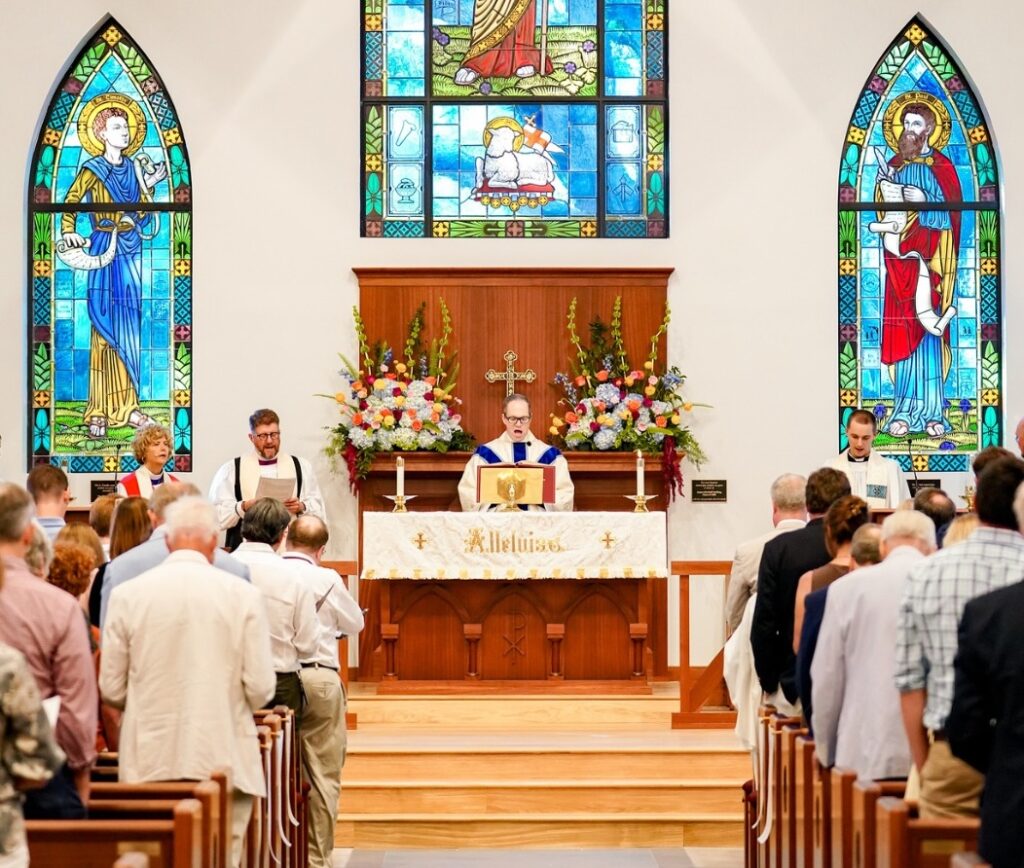
Chapel dedication at Porter-Gaud School. Courtesy of Porter-Gaud School, used with permission.
Recently, a private school in Charleston, South Carolina, dedicated its new chapel. The school has long had an Anglican/Episcopal connection, and its board of directors includes both the bishop of the Episcopal Diocese of South Carolina and the bishop of the Anglican Diocese of South Carolina. Given the history of these bodies and their denominational split, it was remarkable and salutary that both bishops, in an ecumenical spirit, participated in a eucharistic service of dedication for the new chapel. Some people objected, with some even calling for one of the bishops to be subjected to canonical charges for giving “just cause for scandal or offense.” These reactions offer a good occasion to restate some of the basic Anglican canon law on “scandal.”

This Essay analyzes “scandal” in Anglican canon law. This analysis supports the following conclusions about what scandal is not: First, “scandal” in the canonical sense is not about public outrage. Second, “scandal” in the canonical sense does not extend to accidents, misunderstandings, or well-intentioned actions. Third, “scandal” in the canonical sense is not used to police ecumenical engagement, including participation by bishops in services with clergy of other denominations.
The Anglican History and Theology of Scandal
We should begin with a bit of history and theology, which are intertwined in Anglican canon law. There is a longstanding principle in Western Christian canon law that causing “scandal” is a matter of serious concern. The term (Latin scandalum) appears repeatedly in Gratian and other medieval sources.
The roots of this principle lie in the Gospels, and in particular in Matthew 18 and Mark 9 (cf. Luke 17:1-2). Both chapters recount a shocking warning from Jesus. He had just gathered a small child into the middle of the disciples, and told them that this child was their model for what it meant to be great in the kingdom of heaven. Then Jesus said, “If any of you cause one of these little ones who believe in me to sin [Greek skandalisē; Latin scandalizaverit], it would be better for you if a great millstone were fastened around your neck and you were drowned in the depth of the sea” (Matthew 18:6). The King James Version translates this as “whoso shall offend one of these little ones,” and scandal and offense are used interchangeably in this area.
To be clear, “scandal” and “offense” are not implicated just because somebody–or even a lot of somebodies–are outraged or upset. In his famous Of the Laws of Ecclesiastical Polity, Richard Hooker made this point:
The common conceipt of the vulgar sort is, whensoever they see any thing which they mislike and are angry at, to thinke that every such thing is scandalous, and that them selves in this case are the men, concerning whome our Saviour spake in so fearefull manner, saying, Whosoever shall scandalize or offend any one of these little ones which believe in me [that is as they conster it, whosoever shall anger the meanest and simplest Artizan which carrieth a good minde, by not removing out of the Church such rites and Ceremonies as displease him] better he were drowned in the bottom of the sea. But hard were the case of the Church of Christ if this were to scandalize. Men are scandalized when they are moved, led, and provoked unto sinne (I: bk 4, ch 12, s 2, 320).
Thus the key point, as summarized by my colleague Richard Helmholz, is that
The biblical and medieval understanding of the term “scandal” was not identical to our own. Common usage today has reduced its meaning to a public outcry raised in reaction to wrongful or outrageous conduct by public figures. The biblical term, by contrast, had a more limited and more serious significance. It meant conduct that provided an occasion for and also an incitement for others to sin. (260)
In medieval canon law, scandal worked as a kind of aggravation of an offense. In one thirteenth-century case from the Diocese of Canterbury noted by Professor Helmholz, for example, “the reason given in the record for taking extraordinary and harsh action against Simon Renham, accused of incest, was that to do any less would be ‘not without the greatest scandal of the people’” (264-65).
But “scandal,” in the technical sense, was not just an aggravating factor. Concern about scandal could also be a kind of mitigating factor in exceptional circumstances, a consideration against publicity—as when “a woman suspected of adultery was permitted to escape public prosecution ‘lest the rumor come to the ears of her husband’” (267). In the words of one canon law scholar, “presence of a scandalum could lead to a mitigated, as well as to a harsher punishment” (92). Another author makes a similar point about Thomas Aquinas’s discussion of scandal as restraint of correction of wrongdoing (45).
And scandal was a reason to come down hard on those who spread scandalous stories that harmed the reputation of others—even when the stories were true (262-63, 270-73). As Helmholz summarizes it, “behavior that caused discord among one’s neighbors or made it harder for them to live properly was what made a person a scold in the ecclesiastical forum” (271). This sense of “scandal” as requiring a careful use of speech to protect the reputations of others is reinforced by the Scandalum Magnatum statutes enacted by Parliament, which allowed peers and bishops to collect damages from those who spread rumors about them (781–82), and sometimes the damages were staggeringly large (230).
Although “scandal” had its technical meaning of inciting and being the occasion for others to sin, it also was part of a more general concern for the reputation of the church within society. That reputation is degraded by many things, such as, for example, clergy suing each other in civil courts, which was “contrary to canon law” (264).
Since medieval times, the canon law of the Catholic Church has retained scandal as a distinctive and legally developed concept. In the current Code of Canon Law in the Catholic Church scandal may be an aggravating factor (Canon 1364, §2) or an element of an offense (Canon 1378, § 2; Canon 1395, §1).
The medieval canon law is also background for canon law in the Anglican tradition (whole articles and books have been written on that sentence, but that is all that needs to be said for now). Even so, the Anglican tradition has not always had a distinct canonical offense or aggravating factor of scandal. One example is the Canons of 1604, which had force in the Church of England for more than three centuries. These canons do not treat “scandal” as an independent offense or aggravating factor. They use the term only once, borrowing it as part of the label for a category of “Notorious Crimes and Scandals” that represents an intersection of publicity and severe violations of public order (Canon 109).
Perhaps this was a studied omission because of the malleability of the scandal concept in a time of intense religious conflict. On the one hand there were always Puritans ready to cry “scandal” about practices like making the sign of the cross in baptism, kneeling at communion, wearing surplices, and bowing at the name of Jesus. As bishops and canonists knew, someone was always offended about something, and it was child’s play for objectors to repackage their indignation as an argument that these benign practices invited others to sin. On the other hand, the Puritans themselves may have feared accusations of “scandal” because of their harsh invective.

There was, however, one notable event involving an Archbishop of Canterbury where “scandal” made an appearance, and it bears on the contours of the concept in the Anglican tradition. In 1621, the Archbishop of Canterbury, George Abbot, went hunting with a cross-bow, but instead of shooting a deer, he shot a gamekeeper, who died of his wounds. There was no accusation that the archbishop had shot the gamekeeper on purpose, but it still remained the case that the highest cleric in the Church of England had just killed a man. King James I (VI of Scotland) appointed an ecclesiastical commission to investigate, and one of the questions the king specifically asked was whether the event was a cause of “scandal.”
The ecclesiastical commission investigated and produced its answer: No. More exactly, what the commission said was: “Whether any Scandal may arise out of this Act? We are of the opinion, a Scandal may be taken by the Weak at home and the Malicious abroad; tho’ most of us believe there was no Scandal given by the said Right Reverend Father.” (123)
Although the commission did not explain itself more fully, it is clear that the unintentional nature of the killing, even if careless or reckless, was critical in deciding there was no scandal. For if the Archbishop of Canterbury had shot a man in cold blood, that would surely have been an occasion and invitation for others throughout the kingdom to do the same: in a word, scandal. And the incident reinforces the point that mere outrage—at home and abroad, in Archbishop Abbot’s case—is not scandal in the canonical sense.
There are now some provinces of the Anglican Communion that include scandal or offense in their canon law (85). The terms scandal and offense are used interchangeably. Consider one example. The Church in Wales has a canonical offense of “conduct giving just cause for scandal or offence” (ch IX, pt III, § 9(c)). Two clergy were recently convicted of this canonical offense: a bishop who had sexually assaulted a young teenager, and a priest who had pleaded guilty of possessing child pornography. In both cases, the Disciplinary Tribunal of the Church of Wales repeated the standard that church has developed for what counts as “scandal”:
The Provincial Court decided that for an offence alleging just cause for scandal or offence to be proved, the Tribunal must be satisfied of three matters. First, we have to be satisfied that there was a course of conduct knowingly entered upon by the Respondent. Secondly, we have to be satisfied that the course of conduct must, in the eyes of the Church, be judged to be inherently wrong. Thirdly, we have to be satisfied that the course of conduct must bring such discredit upon the Respondent and the Church that, in the eyes of a person of reasonably robust persuasion, such a person would describe it as scandalous or offensive.
Other provinces prohibit “conduct unbecoming a minister in Holy Orders, sometimes adding that the conduct must be such as to give cause for scandal or offence to the church” (85).
The Concept of Scandal in Anglican Canon Law
We can draw a few implications from this overview of the concept of “scandal” in Anglican canon law.
First, “scandal” in the canonical sense is not about public outrage, whether of a fringe group or even a large number of people. Whether the word scandal or the word offense is used, it is not simply about people being scandalized or offended in the non-technical sense. It is true that “scandal” involves some kind of publicity, but the canonical offense is the scandalous act, not the reception of the act.
Second, “scandal” in the canonical sense does not extend to accidents, misunderstandings, or well-intentioned actions. The offense is about objectively wrong actions of great severity that also incite others to sin, with recurring examples, both medieval and modern, being adultery, incest, rape, and homicide. These kinds of acts are not only themselves wrongful, but if widely known they might offer an occasion for others to imitate the cleric’s wrongful behavior. Other canonical offenses and penalties (not to mention the state’s criminal laws, in some cases) are aimed at these wrongful behaviors even when they are not widely known. What “scandal” adds is not only that the person acted wrongfully, but that the person’s conduct was an occasion for and an enticement to others to fall into the same transgression. In the words of one Bible translation, it is about causing another person’s “downfall” (Mark 9:42 REB).
And to these kinds of examples like incest and homicide was added, by medieval canon law and the Scandalum Magnatum statutes, the actions of the divisive scold. That connection between scandal and abusive speech lives on, for example, in a canon of the Anglican Church of Southern Africa, which prohibits “conduct giving just cause for scandal or offence; including without limitation, offensive or abusive language, and any inappropriate relationship or activity of whatever nature” (Canon 37.1(h)).
Third, a canonical offense of scandal is not, and to my knowledge has never been, used to police ecumenical engagement by Anglican/Episcopal bishops, such as participation in services with clergy of other denominations.
This is especially noteworthy because there have often been “scandals” in the non-technical sense when Anglican/Episcopal bishops have participated in services with those from other denominational bodies. In the nineteenth century, there were strident objections to the participation of an Episcopal bishop, George Cummins, in a eucharistic service with a non-episcopally-ordained minister, and that incident led to the schism creating the Reformed Episcopal Church. In the twentieth century, there was harsh criticism of two Anglican bishops for participating in a eucharistic service with Methodists and Presbyterians in Kikuyu, British East Africa, and the Archbishop of Canterbury had to reject calls from another bishop that they be tried for heresy and schism. In the twenty-first century, Pope Benedict XVI and Archbishop of Canterbury Rowan Williams jointly led a vespers service, leading some Catholics to criticize the Pope for praying with “heretics.”
In short, participation in services by clergy from different denominations has often been fraught, and there have always been critics ready with accusations of heresy. These cries of outrage are not the Church’s finest hour, but even though they recur, I am not aware of bishops in the Anglican tradition ever being convicted of “scandal” for participating in services with clergy of other denominations. In Anglican canon law, “scandal” is simply not a club used to bludgeon people for their ecumenical generosity.
Conclusion
Given the history and theology that inform the concept of “scandal,” as a matter of Anglican canon law, it would be a gross abuse of power to bring, support, or in any way approve a charge of “just cause of scandal or offense” for a bishop who participates in a eucharistic service of dedication for a school chapel with clergy of other Christian denominations.
Nor is it possible to evade the force of this straightforward conclusion with the insinuation that the bishops participating in the school dedication were not all from “Christian” churches. To be sure, that “not part of a true church” thinking animated the critics of Bp. George Cummins and the Kikuyu bishops (not to mention the critics of Pope Benedict). But assertions like that must be tested against the Anglican tradition’s capacious understanding of what counts as another “church.” That capacious understanding can be seen, for example, in the canons and liturgies of the Episcopal Church and the Anglican Church in North America. It can be seen in the development of the Chicago-Lambeth Quadrilateral as a basis for ecumenical engagement. And it is much more deeply rooted than those sources. The capacious understanding of what counts as a “church” goes back to the insistence by Richard Hooker that the Catholic Church was truly part of the visible Church of Christ and “of the familie of Jesus Christ” (I: bk 3, ch 1, s 10, 202). Although that position is obvious today, it was a courageous one when Hooker advanced it in his Laws, for the cataclysm of the Reformation, greater than any rupture experienced by Christian churches in the subsequent centuries, was still in living memory. ♦

Samuel L. Bray is a Professor of Law and Walter Mander Research Scholar at the University of Chicago Law School, and he is a McDonald Senior Distinguished Fellow at the Emory Center for the Study of Law and Religion. He is grateful for comments from Dick Helmholz. This Essay was substantially completed by August 28, 2026 and is not addressed to subsequent developments.
Recommended Citation
Bray, Samuel L. “Scandal as a Concept in Anglican Canon Law.” Canopy Forum, September 13, 2026. https://canopyforum.org/2026/09/13/scandal-as-a-concept-in-anglican-canon-law/.
Recent Posts