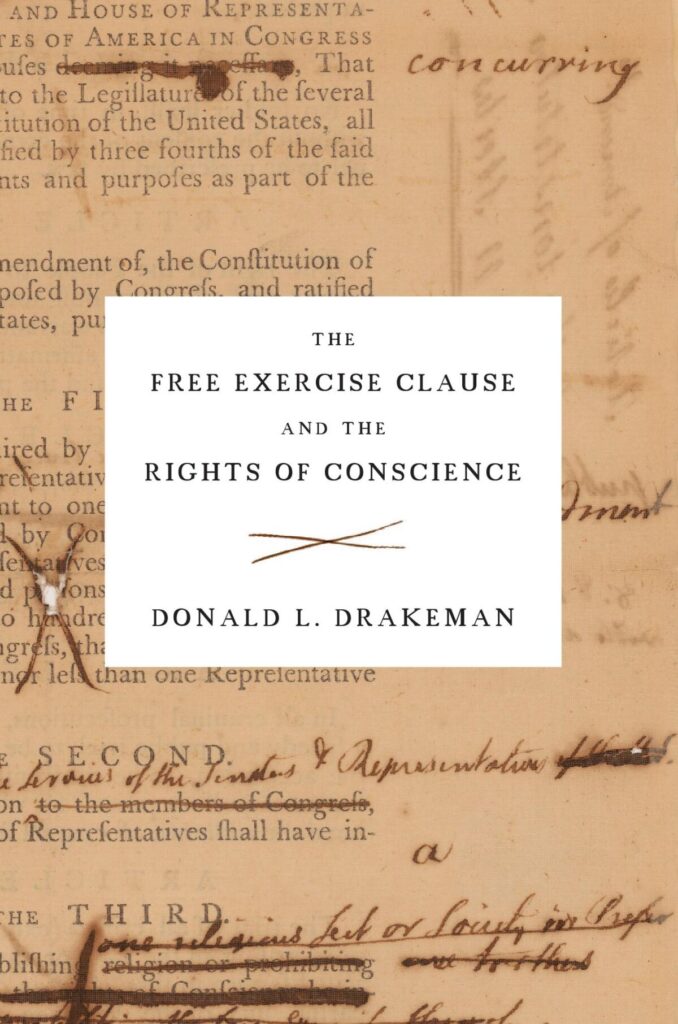
The Free Exercise Clause and the Rights of Conscience by Donald L. Drakeman
Review by John Witte, Jr.
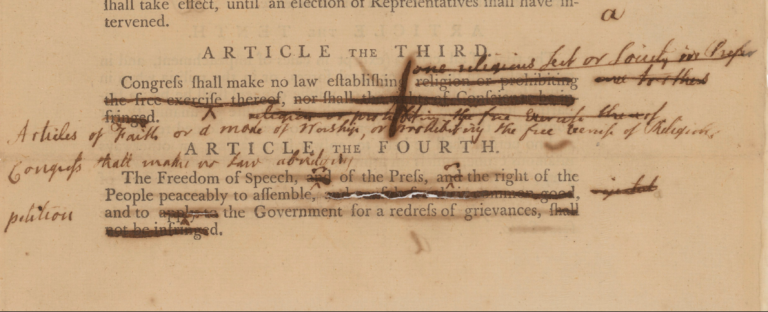
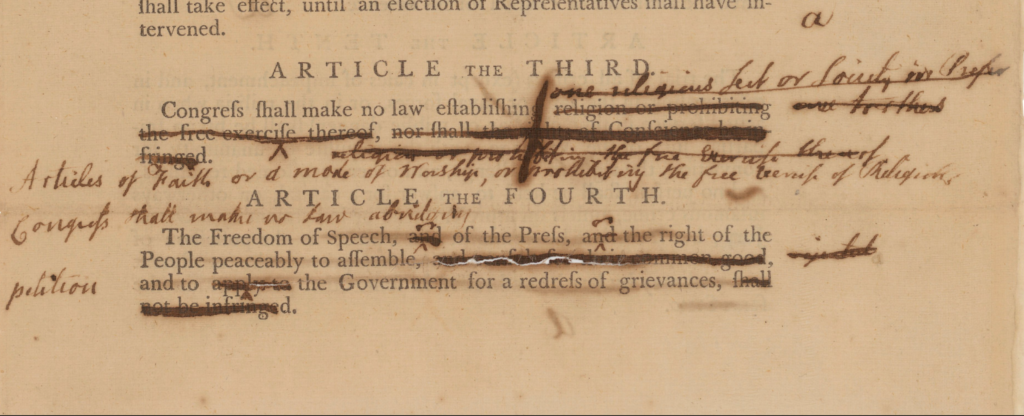
Senate Revisions to House Proposed Amendments to the U.S. Constitution, National Archives (US-PD)
On October 15, Canopy Forum, hosted by the Center for the Study of Law and Religion, will be organizing an online book symposium regarding Donald L. Drakeman’s upcoming book, to be published November 2026, titled The Free Exercise Clause and the Rights of Conscience (Harvard University Press, 2026). The following is a review essay of Professor Drakeman’s book in anticipation of the symposium.
Donald L. Drakeman’s powerful new book poses a seismic challenge to constitutional originalists who champion sweeping free exercise rights today. The original state and federal free exercise clauses, forged between 1776 and 1791, protected freedom of religious worship alone, he argues, adducing an array of freshly discovered sources from newly digitalized archives. Moreover, almost all federal and state free exercise cases before 1963 protected religious worship alone and refused to grant religious claimants judicial exemptions from general legislation. The modern Supreme Court’s expansive free exercise and religious exemption regime, introduced by Sherbert v. Verner (1963) and resurging anew today, might well be a boon for religious freedom, Drakeman recognizes. But it cannot be defended on the originalist constitutional logic favored by several current Justices. The Supreme Court must either abandon its constitutional originalism or shrink its free exercise law, leaving most religious freedom protections to legislatures and state courts as the First Amendment drafters had intended. This fact-driven, deeply researched, and quietly argued text, by a leading constitutional jurist and historian, is free from ideological axe-grinding or rhetorical grandstanding, but both the right and the left will take it as a thundering cri de coeur.
I will leave it to real First Amendment experts to sift through the implications of this landmark book for modern religious freedom jurisprudence. Instead, let me focus on two (of many) historical questions: (1) Was free exercise of religion more than freedom of religious worship in the American founding era? (2) Were there, and should there be, judicial exemptions for religion before Sherbert? “Yes” is my answer to both questions.
More than Freedom of Religious Worship?
Professor Drakeman argues that the guarantee of “free exercise” of religion in the First Amendment and early state constitutions was a “term of art with a very specific meaning relating only to public worship” (2; also 3-4, 22, 44-46). “Free exercise of religion” had always meant “freedom of religious worship” in the Western legal tradition, and it retained that meaning from the founding era until the mid-twentieth century. That striking argument, however, deprecates the novelty of what the American founders gave us in outlawing all religious establishments and guaranteeing full freedom of religious exercise, including but going well beyond freedom of worship.
Drakeman is right that in early modern Europe and in most American colonies, “free exercise of religion” (liberum exercitium religionis) was focused on freedom of religious worship, though the term had broader meanings, too. This focus on worship was shaped by the reality that every early modern European polity established and favored one form of Christianity – whether Catholic, Lutheran, Calvinist, Anglican, or Orthodox. But most states also granted religious toleration to one or two other Christian groups, sometimes Jews, too – if for no other reason than that these tolerated communities provided valuable labor, commodities, skills, taxes, soldiers, and more. But all these tolerated religions had only limited rights, and those could end quickly. Ask medieval Jews, 16th-century English Puritans and Catholics, 17th-century French and English Calvinists, and 18th-century Russian Catholics and Protestants, all of whom were tolerated for a time, but then banished, often with bloody violence.
The right to religious worship in a worship center was the single most important right for these tolerated religions. Not only was religious worship a core form of religious identity and expression for most groups. But the church or synagogue was the nerve center of each tolerated minority community – its religious, political, economic, educational, charitable, artistic, and labor hub. Having this religious home and hub was critical to religious minorities, since their members were often foreclosed from public life, and their communities were often consigned to segregated neighborhoods or countrysides. For these tolerated religions, freedom of worship and the right to have a worship center was essential. Close or destroy the church or synagogue, and they would die or leave.
In early modern Europe, free exercise rights were staggered accordingly. The established religion had full rights of what was called exercitium religionis publicum That included the right to have open churches, usually furnished and maintained by the state; to hold public religious worship services; to maintain parsonages, seminaries, charities, schools, hospitals, cemeteries, monasteries, guilds, and other religious houses and buildings; to have clergy and other religious officials licensed and funded by the state, and given tax exemptions, clerical immunity, rights of sanctuary, military service exclusions, and more. Tolerated religions had more modest rights of exercitium religionis privatum. That included the right to worship in private and modest worship centers hidden from public view. It also included attendant rights to have religious houses for their clergy as well as cemeteries, their own religious texts, vestments, and worship materials, as well as freedom to use their own marriage, initiation and burial rituals. In more relaxed times and places, tolerated religions also had the free exercise rights to have small schools, charities, and publishing houses for internal use. Still narrower rights of exercitium religionis domesticum – effectively house churches or synagogues — were sometimes granted to non-tolerated faiths temporarily domiciled in a region for trade, diplomatic, or other purposes.
Many American colonies before 1776 repeated this European tradition of establishing one religion — either Anglicanism or Calvinism — and then granting religious toleration to some other faiths, usually with more limited free exercise rights. Some American colonies, however, had no religious establishments, and in those colonies free exercise rights went well beyond religious worship and included a plurality of faiths. The softer the religious establishment, the wider the ambit of free exercise of religion was the pattern.
Roger Williams’s Rhode Island is a good example. The colony early on banned religious establishments. Its 1663 Charter then granted four enumerated religious freedom rights to peaceable parties: (1) “full liberty in religious concernments”; (2) “the free exercise and enjoyment of all their civil and religious rights appertaining to them”; (3) “liberty, in the true Christian faith and worship of God”; and (4) guarantees that “all … persons may … freely and fully have and enjoy his and their own judgments and consciences, in matters of religious concernments.” “Liberty … of worship” is protected here, but “free exercise” attaches to all other “civil and religious rights.” Lord Baltimore’s Maryland, too, provided in 1649 that “noe person . . . professing to belieive in Jesus Christ, shall from henceforth be any waies troubled, Molested, discountenanced for or in respect of his or her religion nor in the free exercise thereof within this Province.” Georgia’s Royal Charter (1732) guaranteed that “forever hereafter, there shall be a liberty of conscience allowed in the worship of God, …and that all such persons, except papists, shall have a free exercise of their religion,” so long as it was “quiet and peaceable” without “giving offence or scandal to the government.” Again “liberty of worship” is guaranteed separately from the peaceable “free exercise of religion.”
The early state constitutions from 1776 to 1784 had both narrow and broad free exercise provisions. Most new state constitutions now did explicitly guarantee only a narrow “free exercise of religious worship” or “religious profession,” as Drakeman shows (80-95). These explicit new constitutional limitations to “worship” or “profession” are striking. Earlier colonial and European provisions had mostly generic guarantees of free exercise, with a broader or narrower ambit of attendant public and private religious rights, depending on whether the faith was established, tolerated, or just temporarily accommodated. Now these American states imposed narrower free exercise rights on everyone, even while most of them still established one religion.
But states without, or with shrinking, religious establishments guaranteed more expansive free exercise rights — without limiting them to religious worship or excluding any faith communities. The 1777 Constitution of Georgia provided simply: “All persons whatever shall have the free exercise of their religion; provided it be not repugnant to the peace and safety of the State.” The 1776 Declaration of Rights of Virginia, Article 16 was more expansive:
That religion, or the duty which we owe to our Creator and the manner of discharging it, can be directed by reason and conviction, not by force or violence; and therefore, all men are equally entitled to the free exercise of religion, according to the dictates of conscience; and that it is the mutual duty of all to practice Christian forbearance, love, and charity towards each other.
Here religious freedom is defined as: (1) theistic (“our Creator”); (2) rationally grounded (“directed by reason and conviction”); (3) based on “duties owed to our Creator” and the “manner of discharging” those duties in one’s life; (4) those duties included practicing “Christian forbearance, love and charity” towards all neighbors; (5) with all persons “equally entitled to the free exercise of religion according to the dictates of conscience.” Virginia’s religious freedom guarantee certainly includes the rights and duties of religious worship. But its free exercise guarantee covered all manner of religious acts and “manners” of religious exercise for every theist.
The members of the First Congress of 1789 that crafted the First Amendment knew the differences between these narrow and broader formulations of free exercise rights on offer in these state constitutions and in their colonial antecedents. The First Congress also collected the states’ recommendations of religious liberty provisions to be included in what became the First Amendment. No state recommended “free exercise of religious worship” alone. But four states recommended more expansive free exercise rights. Virginia, North Carolina, and Rhode Island recommended an abridged version of Virginia’s Article 16, with its sweeping “all men are equally entitled to the free exercise of religion, according to the dictates of conscience.” New York, whose own new state constitution of 1777 still spoke more narrowly of “the free exercise and enjoyment of religious profession and worship” recommended more expansive language for the First Amendment: “That the people have an equal, natural, and unalienable right freely and peaceably to exercise their religion, according to the dictates of conscience.”
The First Congress drafters chose the broader language of “free exercise” of religion—without defining or delimiting what kind of religious exercises might be protected. Significantly, they also chose the broader prohibitions on “establishment of religion.” Earlier drafts of the First Amendment proposed had focused more narrowly on avoiding the establishments of “a mode of worship,” or “articles of faith,” or of establishing “one religious sect or society in preference to others.” The First Amendment drafters again chose the broader framing of “no establishment of religion.” That yielded the two unqualified and complimentary provisions of religious freedom: “Congress shall make no Law respecting an establishment of Religion, or prohibiting the free exercise thereof.”
It is further notable that various American founding era documents referenced other kinds of religious free exercise for individuals and groups beyond religious worship. They spoke of: the “free exercise of religious opinions,” “free exercise of private judgment in questions of religion,” “free exercise of natural and moral powers”; “free exercise of the Rights of Conscience,” “free exercise and enjoyment of all their civil and religious rights,” “free exercise of the natural rights of every man,” “free exercise of their natural religious rights,” “and “free and full exercise of … the fine and vigorous movements of the soul.” The unqualified constitutional term “free exercise of religion” could well be read to cover all these exercises and expressions of religion. Peaceable parties were free to exercise their faith, alone or with others, in accordance with their own conscience, judgment, reason, powers, natural rights, and movements of their hearts and souls.
Given this history and context, I read the First Amendment as a clear and deliberate rejection of the long Western tradition of government establishing one form of Christianity and merely tolerating a few other faiths and granting them variant and limited rights of religious worship and limited correlative rights for their churches, clergy, and communities. The First Amendment was instead ushering a new world of religious freedom, which featured free exercise for all religion, and governmental establishment of none. By 1833, all states had followed.
Judicial Exemptions for Religion?
That said, I agree with Professor Drakeman that we should not conflate the question of the ambit of free exercise with the hard question disputed since Employment Division v. Smith (1990): does the First Amendment free exercise clause (without a freedom of conscience clause) allows for constitutional exemptions from general laws for religious claimants? I agree with Drakeman that the American founders preferred to leave most such exemptions—from oath swearing, tithe payments, military service, and the like—for the legislatures to sort out by granting statutory accommodations. As George Washington put it to a group of beleaguered Quakers: “the conscientious scruples of all men should be treated with great delicacy and tenderness: and it is my wish and desire, that the laws may always be as extensively accommodated to them, as a due regard for the protection and essential interests of the nation may justify and permit.” James Madison, however, emphasized the dangers of “tyranny” of the legislative majority as well: “Wherever the real power in a Government lies, there is the danger of oppression. In our Governments the real power lies in the majority of the Community, and the invasion of private rights is chiefly to be apprehended, not from acts of Government contrary to the sense of its constituents, but from acts in which the Government is the mere instrument of the major number of the constituents.”
That leaves open the question whether the First Amendment empowers the judiciary to grant religious exemptions for religious minorities when the legislature fails to accommodate them. Michael McConnell has made the best historical case for the propriety of judicial religious exemptions under the original meaning of the First Amendment free exercise.\ Drakeman politely but firmly counters McConnell’s case (27-31). I don’t have much to add to this new “clash of the titans,” beyond what I have written before. I do worry about the capacity of legislatures –historically and today–to rein in their religious prejudices and accommodate unpopular religions. Where should peaceable minority faiths go when the legislature does not give them an oasis of non-conformity to enjoy the “free exercise of religion, according to the dictates of conscience”? The historical answer, repeated by some today, is that these minorities should just leave–at gunpoint if necessary. The First Amendment rejected this harsh traditional regime. That seems to leave the judiciary as the best positioned branch of government to step in, especially when the executive branch does nothing or foments the legislature’s religious prejudices.
But Drakeman argues that, until the early twentieth century, the judiciary rarely granted such religious exemptions, vindicating his reading of the original understanding of free exercise. In a long series of new state and federal cases that he has dug up from “the long nineteenth century,” courts routinely rejected free exercise exemptions for religious claimants, even while they upheld legislative accommodations for religion, sometimes quite generously (105-42). “Throughout American history up until the twentieth century,” Drakeman writes, “the legislature has taken responsibility for granting exemptions (or not) from generally applicable laws. When courts have been asked to grant [religious] exemptions from statutory duties, the traditional response has been to refuse to do so” (142). That’s a sobering finding for Sherbert fans looking for better historical grounding to argue for judicially-created free exercise exemptions.
It could be argued that the half dozen Supreme Court cases on intrachurch disputes over property well before Sherbert – from Watson v. Jones (1871) to Kedroff v. St. Nicholas Cathedral (1952) – were a judicially-created exemption regime that protected more than religious worship. All these cases insisted that courts “defer” to the resolution of the dispute issued by the highest religious authority that the litigants had recognized before their property dispute broke out. The “deference test” at work in those cases was at least a judicially-created exception to, if not an exemption from, traditional legislative and common law rules of property division and distribution after a trust or association divides or dissolves. To be sure, before 1952, the Supreme Court had grounded this deference test in “federal common law” and “general liberty” standards. But Kedroff for the first time imported this deference regime directly into the First Amendment free exercise clause. And later cases like Hosanna Tabor v. EEOC (2012) took these early church property dispute cases as the root from which the free exercise “ministerial exception” doctrine has grown and indeed flourished, supported by a 9-0 Supreme Court no less. Drakeman writes off these early church property dispute cases in a few lines since they are still about religious worship centers, not religion writ larger; at most about general liberty and not free exercise rights; and the Kedroff free exercise case strikes down the offending legislation rather than granting a judicial free exercise exemption (137). Fair enough.
Even so, I wonder if there’s more to this idea that nineteenth-century courts granted religious claimants judicial exemptions on other grounds besides the free exercise clause, creating important prototypes, if not precedents, that Sherbert and other cases eventually consolidated under the First Amendment free exercise clause. A good number of nineteenth-century cases involving religious parties — on church property, polity, clergy, sanctuary, privilege of forum, benefit of clergy, charities, missionaries, monasteries, schools, marriages, trusts, foundations, and more — were pled on grounds of fundamental rights, general liberty, basic fairness, natural justice, and natural law, along with more explicit constitutional provisions. Some of these cases provided religious litigants with injunctive relief and forms of judicial exemption and accommodation that anticipated what Sherbert later made available under the free exercise clause. I don’t know enough to state this categorically but have seen several examples of this kind of “legal transplantation” that are worth noting.
Take Cummings v. Missouri (1867), where the reconstruction state required clergy and teachers to swear a loyalty oath declaring that they had not supported the confederate government during the prior civil war. Cummings, a Catholic priest, working in a very anti-Catholic state at the time, refused to take the oath and was fined, imprisoned, and stripped of his license to preach. The Supreme Court declared this an ex post facto law and a bill of attainder. While important for later ex post facto legislation cases, the Cummings precedent eventually helped to build the case for free exercise exemptions from oath swearing, anticipated in several cases, and constitutionalized in Torcaso v. Watkins (1961). Take the long series of special religious association cases — from Goesele v. Bimeler (1852) to Order of St. Benedict v. Steinhauser (1914) — that used inventive readings of secular contract and associational law, and decidedly “not canon law and ecclesiastical discipline,” to protect what would later become the explicit “corporate free exercise rights” of religious groups and their canon law and other internal religious legal systems. Take the six early twentieth-century cases on religious education – especially Meyer v. Nebraska (1923) and Pierce v. Society of Sisters (1925)– that provided relief to religious schools, parents, and children on “fundamental liberty” grounds. These cases eventually became core precedents for free exercise rights of religious education that the Supreme Court is again strongly reinforcing today in a series of striking new cases starting with Trinity Lutheran Church v. Comer (2017).
These and other lines of cases suggest to me: (1) that religious liberty protections, including judicial exemptions for religious claimants, have long found refuge in other constitutional provisions besides federal and state free exercise provisions — and sometimes still do, for example in free speech jurisprudence applied to religion today; (2) that Sherbert v. Verner might accordingly be viewed less consequently as an efficient constitutional consolidation of scattered religious liberty protections rather than an unconstitutional invention of living constitutionalism; and (3) that even if the effort to overturn Smith and restore Sherbert fails, religious liberty claimants still have all manner of constitutional and statutory means, alongside “soft constitutional” cultural, communal, and local political methods to protect themselves.
Legislative Rather than Judicial Protections?
Donald Drakeman’s landmark new book is not a brief against religious freedom. He does not deny the remarkable achievement of the American founders in granting at least freedom of public worship to every peaceable faith in defiance of a 1,500-year Western legal tradition of religious persecution. He celebrates the profusion of statutory protections of religious freedom from the founding era statutes protecting religious worship, properties, corporations, schools, charities, and missionaries to the latest religious freedom restoration acts and their echoes in hundreds of other federal and state laws. He recognizes that federal and state courts sometimes do need to address and redress bald prejudicial actions for or against religious parties, and he calls for legislatures to provide even stronger statutory and procedural means to protect beleaguered religious minorities and to protest belligerent religious hegemony. But he puts his faith in religious freedom first and foremost in the people and their local elected legislative representatives, not the courts, and certainly not the federal courts. And he puts his trust above all in the efficacy of negotiation and cooperation among good faith citizens and non-state associations to foster a society where each person and community can enjoy free exercise of religion according to the dictates of conscience.
While I genuinely applaud this ideal, and concur in this distinguished author’s support for religious freedom, I don’t have nearly as much trust in our Congress or state legislatures as he does. Nor am I sanguine that in our crude and coarsened day we can have peaceful rational deliberations among local neighbors about the hot topics of religion without at least occasional resort to the courts. Nor do I have nearly so narrow a view of the original First Amendment religious liberty guarantees. Both originalists and living constitutionalists, in my view, can find space and solace in the founders’ First Amendment vision that true religious freedom requires free exercise of all religion and state establishment of none. ♦

John Witte, Jr. is Woodruff University Professor of Law, McDonald Distinguished Professor of Religion, and Faculty Director of the Center for the Study of Law and Religion. He has published 50 plus books and the 350 plus articles.
Recommended Citation
Witte, Jr., John. “The Free Exercise Clause and the Rights of Conscience, Review.” Canopy Forum, September 15, 2026. https://canopyforum.org/2026/09/15/the-free-exercise-clause-and-the-rights-of-conscience-review-witte/.
Recent Posts