
Gods, Judges, and Presidents and the Sacred Grammar of Constitutional Authority
by Charles Edward Andrew Lincoln IV
The following is an introductory essay to Charles Lincoln’s recently published book, Gods, Judges, and Presidents: Trifunctional Archetypes in American Law and Government (Bloomsbury Press, 2026).
The American Constitution is usually introduced as a diagram. Congress legislates, the President executes, and the courts judge. The picture is so familiar that the three branches can seem less like a particular constitutional arrangement than a natural description of political authority. My recent book, Gods, Judges, and Presidents: Trifunctional Archetypes in American Law and Government, asks what becomes visible when we stop taking that familiarity for granted.
The book is not an argument that the framers secretly copied an ancient religious scheme. Nor does it claim that every society naturally divides power into three parts. Its question is instead historical and interpretive. Across religion, mythology, philosophy, and political thought, human communities have repeatedly distinguished different forms of authority. Judgment is not the same thing as force. Force is not the same thing as making rules or sustaining social order. Modern constitutionalism gives these distinctions legal form, but it did not invent the underlying human problems.
That is why a book about American constitutional structure begins far outside the text of the Constitution. It moves through comparative mythology, classical political thought, the Enlightenment, and modern psychology before returning to judges, presidents, and legislatures. The point of that journey is not to make law less legal. It is to see more clearly the cultural and symbolic assumptions that help make legal institutions intelligible.

Why three kinds of authority keep returning
The central comparative figure in the book is Georges Dumézil, the twentieth-century scholar of Indo-European religion and mythology. Dumézil identified a recurring threefold pattern in the traditions he studied. In simplified form, the first function concerned sovereignty in its sacred and juridical dimensions, the second concerned martial force, and the third concerned fertility, production, and material prosperity.
The attraction of this framework is easy to misunderstand. Dumézil does not provide a template into which a modern constitution can simply be inserted. A Supreme Court justice is not a priest, a president is not a mythic warrior, and Congress is not a fertility cult. The comparisons become useful only when they remain comparisons rather than equations.
What Dumézil provides is a vocabulary for noticing that authority itself is differentiated. Some authority presents itself through judgment, interpretation, legitimacy, and the articulation of norms. Some appears through decision, action, command, defense, and coercive capacity. Some concerns the organization and reproduction of the social world, including rules, resources, representation, and material life. Those categories overlap, and no modern branch possesses one of them exclusively. Yet the distinctions help explain why different offices carry different expectations even when all of them are creations of the same constitutional text.
This is where religion matters to the argument. Religious traditions do not merely tell stories about gods. They give communities languages for imagining authority. They ask who may judge, who may command, what makes an order legitimate, how social abundance is secured, and how power becomes something other than brute force. A secular constitution answers those questions differently, but it still has to answer them.
An older conversation about ordering the political world
The book therefore places Dumézil beside a much longer intellectual conversation. Homer, Plato, Polybius, Montesquieu, and Freud appear not because they all say the same thing, but because each offers a different way of thinking about differentiated authority, social order, or the structure of human action.
In the Republic, Plato famously connects the order of the city with a tripartite account of the soul. His guardians, auxiliaries, and producers do not anticipate the American branches, and treating them as if they did would flatten both Plato and the Constitution. What matters is the deeper habit of thought. Political order can be understood by distinguishing kinds of activity and asking how they should relate to one another.
Polybius is important for almost the opposite reason. His account of mixed government is a warning against assuming that every political triad is an instance of the same pattern. Three-part descriptions can arise from very different theories of power. A serious comparative method therefore needs disconfirmation as much as resemblance. The recurring number is less important than the function each category is expected to perform.
By the eighteenth century, the question had become recognizably constitutional. Montesquieu examined legislative, executive, and judicial power as part of the architecture of political liberty. His categories entered the intellectual world of the American founding, but even there the separation was never absolute. In Federalist 47, James Madison defended the proposed constitution by explaining that the celebrated models of separated power allowed partial participation by one department in the work of another. The constitutional danger was not every overlap. It was the concentration of whole powers in the same hands.
That observation is crucial to the book. The three branches are not sealed vessels containing three pure substances called legislative, executive, and judicial power. Congress investigates and judges in impeachment, controls expenditure, and supervises administration. Presidents participate in lawmaking through recommendations, vetoes, and administration. Courts do more than mechanically resolve private disputes when constitutional review requires them to define the boundaries of public power. The categories remain meaningful precisely because institutions can participate in more than one function.
From sacred office to constitutional office
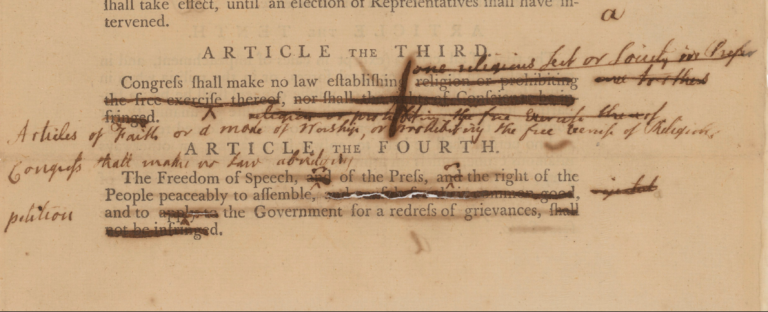
The United States Constitution is secular in a particularly revealing way. The Oaths Clause in Article VI, requires public officials to be bound by oath or affirmation to support the Constitution, but the No Religious Tests Clause in the very same provision forbids a religious test for federal office. Religious conformity is rejected, yet solemn commitment remains.
The presidential oath makes the point more visibly still. The Constitution does not merely say when a President begins working. It prescribes a public undertaking to faithfully execute the office and to preserve, protect, and defend the Constitution. A modern republic thus separates office from theology without stripping office of ceremony, symbolism, or moral weight.
That distinction helps explain what I mean by the persistence of sacred categories inside secular constitutionalism. I do not mean that constitutional authority is secretly divine. I mean that secular institutions inherit very old problems of legitimacy. Power must be distinguished from the person who temporarily possesses it. Judgment must claim to be something more than preference. Coercion must be authorized rather than merely available. Public rules must be presented as binding on rulers as well as the ruled.
Religious systems have often addressed such problems through sacred office, ritual, myth, and divine sanction. Constitutionalism uses elections, jurisdiction, written texts, procedure, oaths, rights, and public justification. The forms are different. The human need to differentiate legitimate authority from naked power is not.
Judges, presidents, and legislatures as constitutional roles
Seen in this light, the three branches are not interesting only because they possess different legal powers. They also carry different constitutional personalities. Courts are associated with hearing, judgment, interpretation, reason-giving, and restraint. The presidency gathers expectations of unity, decision, energy, execution, protection, and response. Legislatures embody plurality, representation, deliberation, bargaining, general rulemaking, taxation, and the ordering of collective resources.
None of those descriptions is complete. Courts rely on executive force to make judgments effective. Presidents make rules through administration. Legislatures conduct investigations and sometimes perform functions that look strikingly judicial. The overlap is not an embarrassment to the framework. It is one of its main lessons. Institutions can participate in several functions while still being symbolically associated with one role more strongly than another.
That helps explain why disputes over constitutional power often become disputes over institutional identity. Americans do not argue only about whether a branch technically possesses a power. They argue that a court is “legislating,” that a president is acting like a “king,” or that Congress has surrendered its proper role. Such criticisms invoke an image of what each institution is supposed to be. Constitutional culture therefore contains an imaginative map alongside the legal one.
I use the word “archetype” here in a deliberately limited, comparative sense. Although the term has a technical history in C. G. Jung’s writings on archetypes and the collective unconscious, I am not claiming that the three branches instantiate a fixed Jungian structure. Here the word is shorthand for recurring cultural figures through which authority becomes recognizable. Judges, warrior-rulers, and lawgivers long predate the specialized, rule-bound offices associated with modern bureaucracy. Constitutional institutions can retain traces of those older images even when their authority is grounded in a written secular charter.
What the book is trying to add
Gods, Judges, and Presidents ultimately asks readers to hold two ideas together. The first is that the American constitutional structure has a specific history. The Constitution emerged from eighteenth-century political conflicts, Enlightenment thought, British and colonial experience, and the concrete institutional problems facing the founding generation. Mythology cannot replace that history.
The second is that constitutional ideas do not operate in an intellectual vacuum. The people who design, inhabit, and interpret institutions bring much older ways of imagining judgment, force, law, order, office, and legitimacy. Comparative religion and political mythology can therefore contribute to constitutional interpretation without pretending to supply a hidden original meaning.
For law and religion scholarship, that opens a space between two familiar stories. One story treats the modern secular state as if sacred modes of authority simply disappeared. The other treats political institutions as disguised religion. I think both are too simple. Secular constitutionalism can reject theological rule while retaining forms of solemnity, symbolic differentiation, and institutional meaning that have deep cultural histories.
The payoff is not a new formula for deciding cases. It is a different way of seeing constitutional government. The three branches are legal institutions, but they are also answers to recurring questions about how a community should judge, act, and order its common life. Religion and mythology do not dictate those answers. They help reveal how old the questions are.
That is the conversation I hope the book can bring to readers of law and religion. The boundary between sacred and secular authority is real and important. But boundaries are often most illuminating when we ask what survives on both sides of them. ♦

Charles Edward Andrew Lincoln IV is a lawyer and Ph.D. candidate in International Tax Law at the University of Groningen. He is the author of Gods, Judges, and Presidents: Trifunctional Archetypes in American Law and Government, published by Bloomsbury Academic in 2026.
Recommended Citation
Lincoln, Charles. “Gods, Judges, and Presidents and the Sacred Grammar of Constitutional Authority.” Canopy Forum, September 11, 2026. https://canopyforum.org/2026/09/11/gods-judges-and-presidents-trifunctional-archetypes-in-american-law-and-government/.
Recent Posts