
How Modern is the U.S. Constitutional Order?
Jeffery Pojanowski
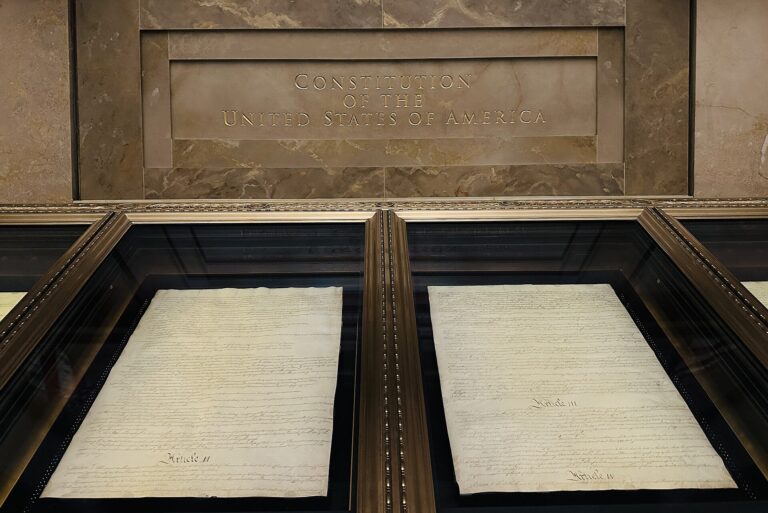
The U.S. Constitution on display at the National Archives of the United States by APK (CC-BY-SA 4.0)
This article is part of a forthcoming series on the 250th Anniversary of the Declaration of Independence.
This contribution addresses two questions of legal and political theory in connection to constitutionalism in general, and in the United States in particular. First, it asks what the classical natural law tradition—one drawing on Aquinas’s understanding of human law—has to say about constitutions and their interpretation. The upshot of this inquiry is that relatively formal, even originalist, approaches to constitutional interpretation are at home in that tradition. Second, it asks how modern and individualist the original United States constitutional order is. It argues that the original constitutional order can be understood on surprisingly pre-modern terms with respect to sovereignty, social groups, and citizens. This latter point is old news to Continental critics of United States constitutionalism. Bringing both points together complicates the claims of some natural lawyers that interpretive originalism about the U.S. constitutional order is a positivist, modernist project.
On the first question: what does classical natural law theory have to say to legal officials who must interpret texts like constitutions? There is a strong argument that the tradition points toward an understanding of interpretation that is close to the formalism or originalism prominent in American constitutional law today. The Thomistic tradition teaches that the natural law is unclear on many important questions of constitutional design and statutory policy. Although the natural law sets limits on the range of reasonable choices we can make when framing human law, much is left to the realm of determination. And, in fact, most human law is a complex mix of derivation and determination from natural law. Who ought to make those constitutive choices? Russell Hittinger has argued, plausibly, that Aquinas prefers positive legislation to adjudication in implementing the natural law. Good legislation only requires a few good people, whereas adjudicative governance would require many; legislators have the time and resources to consider a problem from all angles, while adjudicators have to decide on the fly; legislators can consider matters in the abstract, whereas adjudicators may be affected by the equities of a particular case or prejudice against particular parties. Being dubious of muscular judicial implementation of the natural law does not make one a moral skeptic or a positivist.
Once framers choose a reasonable set of constitutional arrangements, what was morally indifferent takes on a different character. The natural law tells us we need a reasonably fair system of law for human flourishing and the common good, so honoring such a system’s norms is a matter of obligation even if we would, as a matter of prudence, have chosen different ones within that range of reasonableness. And for those choices to do their moral work, they must be reasonably durable, otherwise what reasonably settled becomes unsettled again, thus undermining the goods of authority. Thus, there is moral importance to identifying and adhering to reasonable arrangements embedded a system of positive law.
A comparatively formal theory of legal interpretation emerges from this natural law reasoning. Healthy legal orders are, for the most part, matters of determination by legislators with care for the community. To make determinations effective (and therefore get the benefits of government) one needs to adhere to them. And to adhere to them, you need to go back to the origins and see what choices were made. Thus, the original positive law that authority created when it enacted the text is the lodestar of legal interpretation, even if its content, however reasonable, were not what the interpreter would have chosen if he had authority. (We can bracket for now the choice facing interpreters called to interpret unclear or deeply unjust legal norms.)
There are natural law arguments for a more robust role for interpreting officials. One could adopt an irrebuttable presumption that the legal content of an enacted provision is the morally true understanding of the term. Constitutional provisions about liberty, equality, cruelty in punishment, or reasonableness would pick out the morally true concept of those terms, notwithstanding evidence of the framers’ intentions, the original public meaning, or background positive law. In law, as in ordinary life, there is no moral right to be wrong. We could soften it slightly by reading such generalities to convey the most justified interpretation that passes a threshold test of fit with the text and other legal materials, but in either case original public meaning or intention is not the interpreter’s lodestar. This approach, however, overestimates the precision with the natural law speaks to matters of constitutionalism, thus buying into a contestable kind of interpretive Platonism. Alternatively, it presumes that resolving moral uncertainty must fall to the interpreter even if the original authority had a different view on the matter. That seems difficult to square with Thomas’s preference for legislation and his understanding of the moral value of positive law and legal authority.
There’s a fallback argument here, however, that challenges the natural law formalist’s premises. The constrained natural lawyer assumes a picture in which pieces of positive law lay down norms for judges to find and, in an interestingly broad set of cases, one can identify those norms as a non-evaluative matter of fact. (Though one prioritizes the reasonable choices of authority for moral reasons at the level of interpretive method.) One could, channeling Ronald Dworkin, contend that it is impossible to identify a piece of positive law as an artifact separable from moral evaluation. This objection comes in a couple of formulations. A Gadamerian critique holds it is impossible to retrieve the historical facts of the past because our current standpoint colors what we see: even if there is an original intention or meaning, we cannot recover it without distorting corruption. A second, more Legal Realist formulation, says there is no neutral way to describe a piece of positive law, and that the level of generality we choose is morally laden in any case worth arguing about.
It’s not clear that a classical natural lawyer can help himself to these kinds of argument. Thomism teaches that a central task of human law is specifying the generalities of the natural law. And those specifications could only be able to do their work if they were durable and identifiable over time in a fashion that is relatively isolated from moral inquiry. Otherwise, we are back at square one, choosing among reasonable options. Determination is a central tool in the classical natural law tradition, but if the modern and postmodern objections above were true, authority would cast messages in bottles onto uncrossable seas. A strong form of this objection is intellectually serious, but hard to square with the role that determination plays in Aquinas’s understanding of how the natural law interacts with human law. A weaker form simply says that in hard cases one may have to appeal to moral judgment, which is a less interesting claim. More formalist natural lawyers need not be committed to believing there is always a clear norm to follow; rather they contend that in many cases, including ones tricky enough to bother litigating even up to apex courts, there can be a posited and presumptively obligatory “there” there.
In short, a “moral reading” approach that conclusively presumes that constitutional text adopts the morally true concept of a term is too demanding about the precision of practical reasoning. A “moral reading” that is deeply skeptical about our ability to recover original norms risks rendering the moral promise of positive law an illusion. Both undermine the central role of authority’s reasoned, determinate choice in the tradition’s account of human law. If this brief sketch (defended at great length elsewhere) is correct, the interpretive formalism of the current Supreme Court (and the comparative formalism of its pre-20th century jurisprudence) is not best read as part of a positivist, skeptical project that departed from the classical legal tradition.
But what about the original constitutional order such interpretation seeks to understand? The history here is complex and contested, but let’s take the standard “conservative” account of the constitutional order: a federal government of limited, enumerated, and separated (but supreme) powers; residual sovereignty to the States in the absence of federal power; and entrenched rights for individuals limited to a handful of negative injunctions against the government. To some, this arrangement bears a kind of Lockean original sin: it is either too modern (promoting an individualism that dissolves social wholes and undermines virtue) or too old-fashioned (protecting individualism in a way that prevents social solidarity, effective governance, and lets private power run unchecked). I would like to briefly complicate that story by offering a view of that original constitutional settlement as less modern, and more communitarian, than the standard account.
Here, I will draw on Robert Nisbet’s provocative argument in The Quest for Community that the “conflict between the central power of the political State and the whole set of functions and authorities contained in church, family, gild, and local community” is “the main source of those dislocations of social structure and uprootings of status which lie behind the problem of community in our age.” (I could just as well draw on Tocqueville, Walter Ullman, or Harold Berman here.) On Nisbet’s account, the modern, monist, sovereign state is the ultimate, and ultimately successful, rival of the various intermediate associations and social wholes that preexisted it. To be sure, the transition to the modern state, like all things, brought good and bad: along with the dissolution of overlapping groups in which persons could be at home came “visible emancipation, by the State and its law, of innumerable individuals from the often oppressive structures of gild, monastery, class, and village community.” For now, it is worth focusing on Nisbet’s argument about how we got to a place in which the individual and the state were the two remaining players in political theory and practice.
Nisbet contended that early on, “the State was hardly more than the king himself, at most a limited vertical relation between king and subject.” And the “powerful competing allegiances of Church, class, and economic association rendered the political tie, for a long time, a relatively tenuous one in the lives of most people.” Nevertheless, the modern drama of political theory has been “the gradual extrication of the political power from the fetters laid upon it by these earlier authorities, and in the increasing functional importance of political relationship in the lives of many human beings.” This path, he contended, was marked by transition. Even in Bodin’s work on sovereignty, we see a distinction between state and society and a respect for kinship associations and custom along with his impatience for legal pluralism. Only with Hobbes come political theories that “eradicate every element of social purpose and loyalty that did not proceed directly and logically from the presumed nature of the individual or from the explicit command of the state.” And with Rousseau, the sovereign state reaches its apotheosis in its freeing individuals from the oppression of “traditional society—class, church, school, and patriarchal family” by draining them of their power, which is “transmuted in into the single impersonal structure of the General Will arising out of the consciousness of all persons in the state.”
The traditional picture of the American constitutional order, in this story, sits in a transition point of this revolution. Nisbet himself noted “lingering traces in the American constitutional system of the older theory that there are inalienable rights which government may not absorb.” More importantly, one could understand the federal government’s limited and separated powers, and the conflicting sovereign claims of constitutive states, not as provision for a liberal individualist paradise, but a reservation for intermediate associations and social orders that could function without the total claims of a monist state. Like Bodin’s transitional theory of sovereignty, there is a tension between the lurking claims of a unified sovereign and respect for social and associational pluralism. As Nisbet noted, such rights against a central sovereign in the United States “are really not inalienable for they can be taken away by constitutional amendment” or, we might add, a shift in constitutional culture. There are only “practical limits” sustained by “by inertia, and by prudence and even by good will. But ultimately and theoretically they claim absolute authority as against all churches, associations, and persons within their jurisdiction.” One could look at the current role of the federal government and the extent to which national politics seeps into every corner of life in the United States and conclude that the inertia has yielded in substantial measure.
Yet we can contrast this with the constitutional law and culture on the Continent. Despite the worries like Nisbet’s, American constitutional law still largely regards rights as negative injunctions against the state. This seems to be both a remnant of the older constitutional culture and of an interpretive regime more inclined to originalist readings of a document framed in that era. Compare that with, say, the approach in Germany. As Mattias Kumm has argued, the FCC has taken textual guarantees of liberty and equality that are similar to that of the U.S. Constitution and given them a much broader interpretation, thus opening the door for a regime proportionality review. (347–48). Similarly, doctrinal innovations that either functionally (in the German context) or directly (in the CJEU context) constitutionalize relations between private parties marks a regime of “complete constitutional justice.” (369). In the context of law and religion, we can contrast the U.S. constitutional law’s “ministerial exception,” which treats many internal church affairs as insulated from civil jurisdiction and Court of Justice of the European Union (CJEU) cases like Egenberger and IR v. JQ, which submit religious institutions’ hiring and firing decisions to horizontal constitutional review for proportionality.
Kumm contends this dispensation is an outgrowth of the French revolutionary, republican tradition, where the task of politics is “delimit[ing] the respective spheres of liberty between individuals in a way that takes them seriously as equals and does so in a way that best furthers the general interest.” (367). Christina Bambrick’s recent book also draws connections between the constitutionalization of private law and republican political thought. Nisbet would not be surprised, though he would be less than enthusiastic about this development. He would see the culture of total constitutional justification of an outgrowth of Rousseau’s hostility toward mediation between the individual and the state. The total constitution, as Kumm contends, is a rights-protecting alternative to Schmitt’s total state, though one wonders whether such an arrangement trades one kind of centralizing dominance for another. And Nisbet would contend that European legal culture was particularly primed for such a revolution, as he sees a connection between Roman law, with its emphasis on the state and hostility to legal pluralism, and the rise of monist, imperial sovereignty.
We can conclude by asking how modern the American constitutional order is. Take the stereotypical picture of an originalist court trying to bring back a limited constitution in exile, whatever the truth of that picture or the wisdom in trying to bring it to life. Against critics from the postliberal right, there is a view of this picture in which the method of legal interpretation is faithful to Aquinas’s understanding of positive law and that contrary, antiformal positions may not be straightforwardly “classical” but quite modern indeed. (Nisbet’s connection between Roman law here is particularly poignant, given those critics’ affection for the law of the Digest.) Similarly, there is a reading of the original constitutional order not as a libertarian charter, but one more amenable in principle to the kind of legal and social pluralism that existed before the rise of the modern, central state as we know it. Common good constitutionalism’s focus on a strong central government in the U.S. context here looks strikingly more modern in contrast. Continental constitutionalists welcome the departure from such old-fashioned interpretive methods and constitutional arrangements; their primary difference with the most trenchant common-good critics of the American dispensation is their preference for judicial direction of the total constitution. ♦

Jeffrey Pojanowski is the Biolchini Family Professor of Law at Notre Dame Law School and a McDonald Distinguished Senior Fellow at Emory University’s Center for the Study of Law and Religion. He also serves as co-editor of the American Journal of Jurisprudence.
Recommended Citation
Pojanowski, Jeffery. “How Modern is the U.S. Constitutional Order?” Canopy Forum, September 17, 2026. https://canopyforum.org/2026/09/17/how-modern-is-the-us-constitutional-order/.
Recent Posts