The Global Legacy Of American Exceptionalism: The Sound of Liberty
Luca Pietro Vanoni
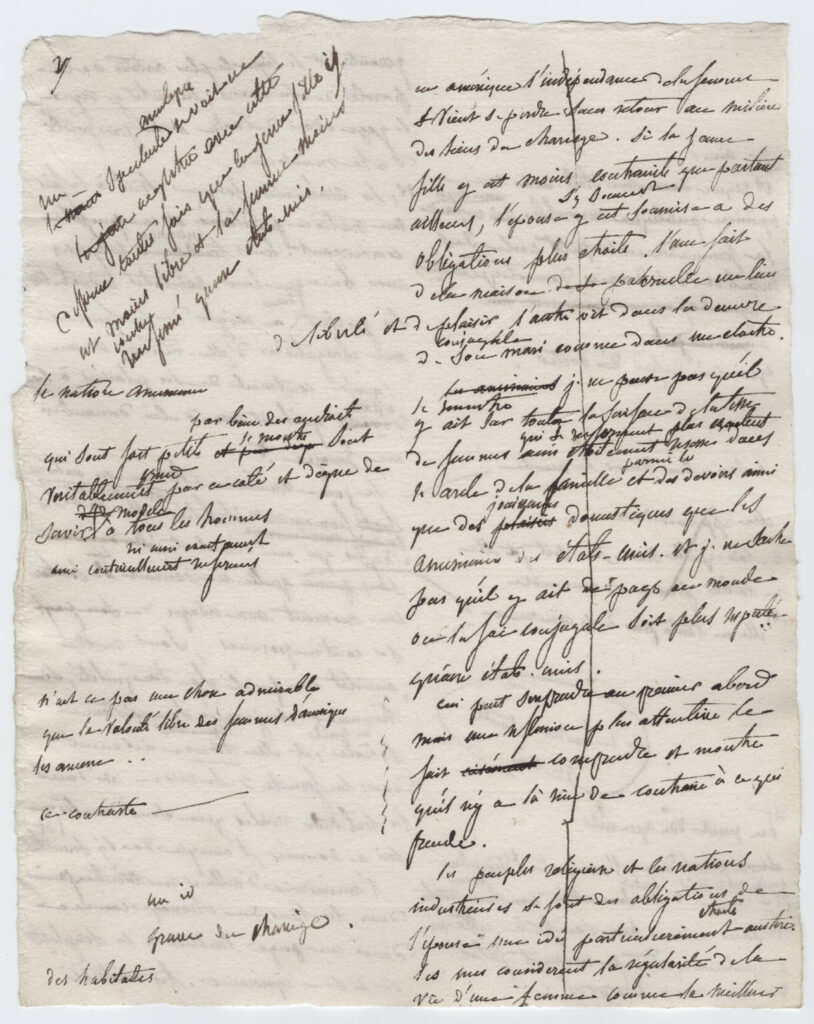
Page from original working manuscript of Democracy in America by Alexis de Tocqueville, held by Yale University (US-PD)
This article is part of a forthcoming series on the 250th Anniversary of the Declaration of Independence.
In political and legal discourse, American exceptionalism denotes the idea that the United States is a distinctive political community, both a model to emulate and a historical case apart from other modern constitutional systems. Its significance lies not only in national pride, but in the universalist claim that historically situated principles like written constitutionalism, individual rights, limited government, and a competitive market can travel as general coordinates of legitimate political order. The concept’s central tension is that the American “exception” presents itself simultaneously as irreducible difference and missionary vocation via the grammar of domestic constitutional identity and the language legitimizing external projection, respectively.
What Is American Exceptionalism For?
Yet, “American exceptionalism” remains one of Western political thought’s most contested and equivocal concepts. Historians, sociologists, philosophers, and political leaders have called it a double‐edged sword, a rhetoric, a myth, a false promise, and a nationalistic ideology. It has even been called a heresy, perhaps paradoxically, by both Joseph Stalin and Pope Leo XIII.
This makes tracing the global legacy of American exceptionalism anything but straightforward. Within the United States, it has never been a neutral idea: over 250 years, it has served both to criticize national myth-making and to celebrate constitutional tradition. In comparative perspective, it has been credited with shaping global human-rights systems, invoked to argue that liberal constitutionalism cannot be transplanted, and denounced as a synonym for colonization. Across legal disciplines, it has thus pulled in divergent, often opposing directions.
These difficulties raise two questions: what kind of exceptionalism is at stake in a comparative account of its global legacy? And if it substantially overlaps with liberal constitutionalism, can it still be called exceptional? I argue that the American constitutional system is indeed exceptional, but only if it recovers the true grounds of its uniqueness.
This essay proceeds in three steps. First, it traces the historical roots of “exceptionalism.” Second, it explains why the concept has been deployed in opposing ways. Finally, it shows how recovering its deeper constitutional meaning can illuminate liberal constitutionalism in the United States and abroad. It argues that American exceptionalism is best understood not as a claim of national superiority, but as a three-pillar constitutional tradition. Its first two pillars, natural rights and divided government, became global standards; its third, the alliance between liberty and religious self-government, remains its most distinctive and most neglected legacy.
The Three Faces of American Exceptionalism
Broadly speaking, American exceptionalism has at least three distinct historical roots. The first root is providential and almost mythological. It goes back to John Winthrop’s sermon as he stood on the deck of the Arbella on his 1630 voyage to New England, describing the new land before him as “a city upon a hill”. For the Puritans, this image was a call to duty and a reminder of the virtues required to build a new world. Over time, presidents such as John F. Kennedy and Ronald Reagan took up the same image to celebrate the uniqueness of the American experiment and its mission in the world. What began as a religious call to duty thus became a founding myth of American exceptionalism and of America’s role as a defender of freedom and democracy around the globe.
The second root is political and constitutional. It has to do with the uniqueness of the United States, a theme generally traced to Alexis de Tocqueville’s Democracy in America. Textually, Tocqueville used exceptionalism narrowly to explain why Americans “do so little to cultivate the arts and sciences”: since the harsh conditions of work in the New World deprived them of the time needed to develop a higher culture (Vol. I, Part II, ch. 9). Today, the term captures the distinctive conditions of American democracy in comparison with Europe; in this sense, exceptionalism as “being an exception to” is rooted in Tocqueville’s analysis and marks structural differences rather than American superiority.
The third root is perhaps the most surprising. According to some historians, the expression was first coined by Joseph Stalin in the 1920s, when he learned from the leader of the American Communist Party, Jay Lovestone, that the American working class was not inclined toward revolution. “That is the heresy of American exceptionalism,” Stalin replied, pointing to the deep gap between American society and Marxist expectations. Paradoxically, then, the term was originally used to express the inferiority of American society and its inability to free itself from the grip of capitalist egoism.
To recap, like the three-headed hound of Greek mythology Cerberus, American exceptionalism has three distinct faces, each pointing in a different direction. The first celebrates a nation set apart and entrusted with a special mission. The second marks structural differences between American and European democracies, insisting that the United States follows its own constitutional path. The third exposes American society’s inability to free itself from capitalism, casting the “exception” as moral and social failure rather than virtue. Together, these faces have shaped the global legacy of American exceptionalism,.
Looking at the historical roots of American exceptionalism helps explain why the term has become conceptually confused since the mid-twentieth century. Its three heads point in different directions, although all predate the United States’ rise as a global superpower. Only after 1945 did exceptionalism acquire genuinely global significance, serving both to justify and to condemn American intervention abroad.
After World War II, it supplied an ideological rationale for the United States’ role in building the liberal international order. During the Cold War, it portrayed America as the defender of constitutional democracy and human rights against totalitarianism. This explains why presidents as politically different as John F. Kennedy and Ronald Reagan both invoked the metaphor of the “shining city upon a hill” to foster unity and American leadership of the “free world”.
Political, economic, cultural, and military power then projected exceptionalism outward, making the American system an unavoidable reference point for democratization. During the Cold War’s peak, its providential strand supplied citizens with a narrative of America as guardian of liberal democracy and defender of oppressed peoples.
This self-portrait met a durable anti-Americanism, particularly in European socialist and communist circles, where exceptionalism was denounced as an imperial project incompatible with national self-determination. Its global legacy therefore unfolded along two opposed lines, one providential and the other anti-imperial, whose clash mirrored the later twentieth century’s bipolar order.
The rise of the new millennium and the so‑called multipolar era changed the providential v. imperial narrative, and during the Obama presidency, “American exceptionalism” became a partisan fault line. Asked in 2009 whether he believed in it, President Obama replied: “I believe in American exceptionalism, just as I suspect that the Brits believe in British exceptionalism and the Greeks believe in Greek exceptionalism.”
That elegant relativism pleased few. In one sentence, he affirmed the tradition while denying its singularity, and a claim to distinctive destiny became a widespread national sentiment. Conservatives read this as multilateralist relativism; critics of interventionism noted that his foreign policy, particularly under Secretary of State Hillary Clinton, did not decisively abandon American leadership. What had been a shared presidential idiom from Kennedy to Reagan thus became a test of political allegiance. The nation’s image as a beacon of democracy and refuge of liberty survived, but increasingly as a weapon rather than a common inheritance.
Beyond Genealogy: The Three Pillars of American Liberty
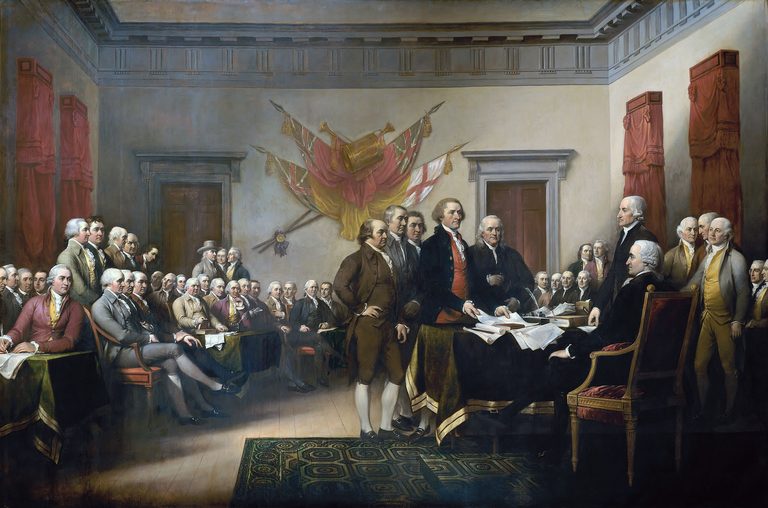
So, what is the legacy of American exceptionalism today, and how should comparative lawyers address its conceptual confusion? The inquiry should be reversed. Rather than beginning with the term’s shifting meanings, we should return to the politico-legal premises of the American constitutional order and ask whether, and how, they operate in comparative perspective. The Declaration of Independence states, with unusual economy, the thought that nourished American exceptionalism:
“We hold these truths to be self-evident, that all men are created equal, that they are endowed by their Creator with certain unalienable Rights … That to secure these rights, Governments are instituted among Men, deriving their just powers from the consent of the governed.”
These universally known words offer the most powerful constitutional expression of liberty as a limit on state authority, intertwined with the revolutionary spirit captured in Patrick Henry’s famous cry before the Second Virginia Convention: “Give me liberty, or give me death!” Liberty is both the premise and purpose of the American constitutional order. From it arose three pillars of American constitutionalism, whose third-dimension forms, in my view, its deepest exceptional core.
The first pillar lies in the Framers’ recognition that individual natural freedom precedes and limits both national and federal authority. Jefferson expressed this proposition carefully through the Declaration’s terms “self-evident,” “secure,” and “consent,” and carried them to their radical conclusion: when government becomes destructive of the ends for which it was instituted, the people have the right to “alter or abolish it.”
Second, because they prized liberty, the Framers distrusted every form of power, including majority power. Their response was neither a vague aspiration to moderation nor a mere statement of principle, but a durable constitutional structure of competing institutions and mutual checks. This second pillar appears in the Declaration’s indictment of concentrated power and runs through the Framers’ constitutional theory, from Madison’s account of faction in Federalist No. 10, institutional checks in No. 51, to Hamilton’s defense of limited, enumerated powers in No. 84. As Michael Novak put it, American political institutions “are designed to clang against each other. The noise is democracy at work.”
Third, the Framers understood liberty not just as freedom from coercive power, but as the condition for pursuing happiness. Political authority could secure that condition, but it could not supply its end. Liberty was therefore freedom from the state insofar as it was freedom for a life well lived. As Robert P. George argues, the freedom celebrated by the Founders was “freedom for virtue—for living good and honorable lives.” In this account, happiness meant neither the gratification of desire nor a pleasant psychological state, but “felicity all-round well-being, integral fulfillment, flourishing”.
This third pillar explains why American liberal constitutionalism developed alongside religion rather than in opposition to it, as in Europe, especially France. During the founding era, John Adams maintained that the constitutional order was not “armed with Power capable of contending with human Passions unbridled by morality and Religion,” and was “wholly inadequate” for any other kind of people. More recently, John Witte has likewise shown that the American experiment sought to escape Europe’s history of coercion and persecution. In Joseph Story’s words, the First Amendment’s “real object” was “to exclude all rivalry among Christian sects, and to prevent any national ecclesiastical establishment.” In the American constitutional imagination, religion was not liberty’s rival or its master, but its sound. It was the cultural and moral resonance that gave institutional freedom meaning, discipline, and civic force.
Leaving Religion Behind: The European Legacy of American Liberty
The normative inquiry of the Declaration of Independence provides the proper yardstick for assessing the global legacy of American exceptionalism. This legacy may be traced in the development of liberal constitutionalism after the Second World War, when two of its three pillars gained broad legal recognition.
The language of pre-existing natural freedom was translated into the modern law of human rights, a development in which Eleanor Roosevelt played a decisive role through her leadership of the United Nations Commission on Human Rights and its drafting committee. At the same time, constitutional tools such as separation of powers and checks and balances, which long supported the constitutional structure of American liberalism, played a role in reshaping postwar Constitutions, mostly through the diffusion of judicial review or constitutional adjudication. As noted by Steven Calabresi, American constitutional influence traveled chiefly through principles and ideas, not through institutional imitation. Nonetheless, both natural rights language and divided government structure ceased to appear as uniquely American ideas and became, at least in aspiration, marks of liberal democracy throughout the world.
The third pillar traveled less easily and eventually crashed with the advent of the secularization of society and the privatization of religion. Historically, this idea emerged as the French solution to the problem of preventing the fusion of spiritual and temporal power. It drew strength from the French Enlightenment, whose rallying cry, Écrasez l’infâme, signaled an early hostility to the Catholic Church and to religion as a source of public authority.
Here lay a decisive divergence between the two sides of the Atlantic. The American Framers embraced a “politics of liberty,” intended to secure freedom of religion for all; the French philosophes developed an “ideology of reason,” more inclined to seek the State’s freedom from religion. Both traditions confronted the dangers of clerical power, but they understood liberty differently. The former saw religious pluralism as a condition of liberty, while the latter more readily treated religion as a constraint from which public reason had to be liberated.
For a long time, sociologists of religion treated the continuing public relevance of religion in the United States as an anomaly, apparently at odds with secularization theory’s prediction that modern democracy would relegate religion to the private sphere. More recent leading scholars have revisited that conclusion. On questions concerning religion’s public role, Europe, not the United States, may be the more unusual case: differentiation in America and in much of the developing world has often encouraged religious pluralism and the continuing public activity of religious communities, rather than straightforward decline.
Yet the secularizing account entered American constitutional law. Through governmental neutrality and particular readings of the First Amendment’s Religion Clauses, it encouraged a conception of separation in which religion was increasingly cast as private and the public sphere as religiously denuded. This did not erase the American alliance between liberty and religion, but weakened its constitutional standing and obscured its role as a moral vocabulary and source of civic strength.
The consequence is a liberal constitutionalism that risks resting on only two pillars: individual rights and institutional restraint. Both remain indispensable. Yet, without the moral and associational resources that historically sustained them, they may prove insufficient to meet the social fragmentation and normative uncertainty of the post-modern age.
The Sound of Liberty
Many years ago, the genius of Alexis de Tocqueville captured the central paradox of American liberalism:
“Religion in America takes no direct part in the government of society, but it must nevertheless be regarded as the first of the political institutions of that country; for if it does not impart a taste for freedom, it facilitates the use of free institutions”.
This, in my view, is the neglected third pillar of American exceptionalism and, more importantly, the first lesson of the Framers. Liberty requires institutional safeguards, but institutions alone cannot sustain it. A free constitutional order also depends on the moral habits, shared convictions, and civic virtues that enable citizens to use freedom responsibly. Tocqueville’s point is not that religion should exercise political power, but that a self-governing people needs moral resources that political power cannot itself create. Therefore, religion and liberty stand as inseparable companions of classical liberalism; as Harvey Mansfield explains it in his seminal book America’s Constitutional Soul:
“The deepest lesson that the American republican Constitution teaches us today is not the celebration of national superiority. It is that liberty cannot sustain itself alone and political institutions need a shared moral culture, a common set of beliefs to rest on.” ♦

Luca Pietro Vanoni is Full Professor of Comparative Public Law at the University of Milan. He has held visiting research fellowships at the University of Notre Dame and City University of London.
Recommended Citation
Vanoni, Luca Pietro. “The Global Legacy Of American Exceptionalism: The Sound of Liberty.” Canopy Forum, September 21, 2026. https://canopyforum.org/2026/09/21/the-global-legacy-of-american-exceptionalism-the-sound-of-liberty/.
Recent Posts