Threading The Needle Between Tradition and Modernity: Examining India’s Hindu Marriage Act Today
Vivek Rallabandi
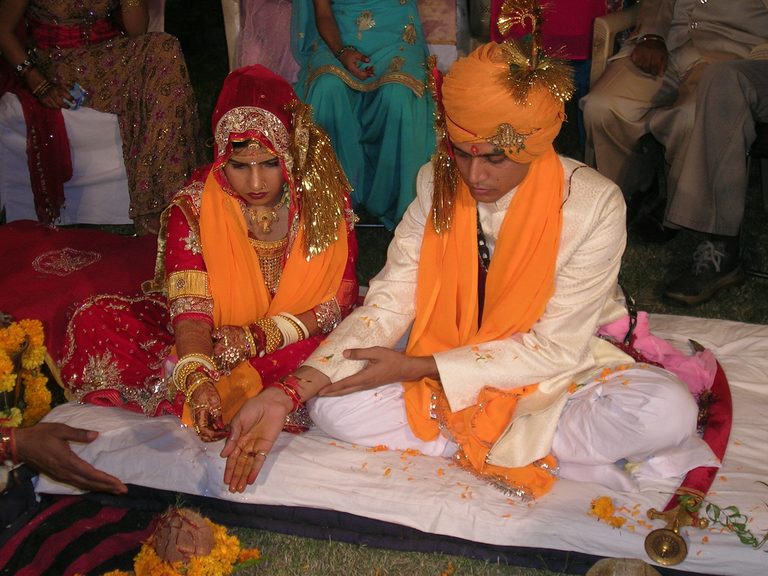
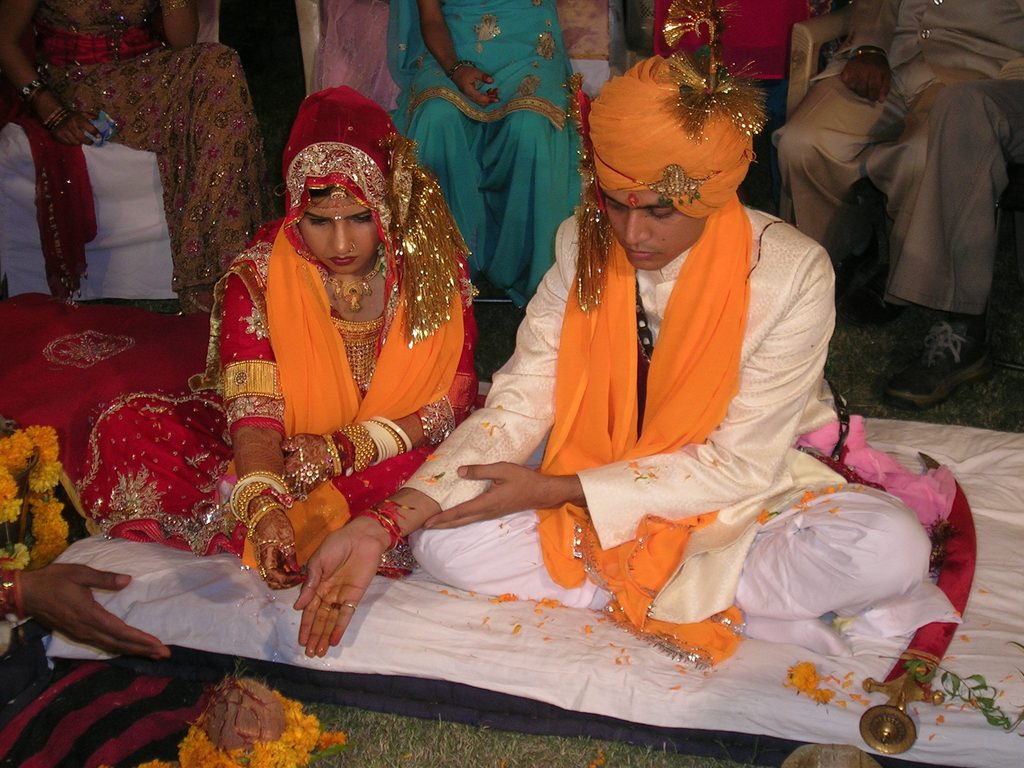
Hindu marriage ceremony from a Rajput wedding by Jaisingh Rathore, Wedpro Photography (CC BY 3.0).
Various religious traditions prescribe how two people, united through religious marriage, should end their sacramental union if they wish to do so. For the most part, Hinduism is not one among these traditions, for the concept of divorce itself is essentially alien to the faith. One of the key elements in a Hindu wedding ceremony is the sapatadi—the seven steps that the couple must take around the homa, the sacrificial fire which bears witness to their union. After the saptapadi is complete, the bond between the newly wedded couple is—from a religious standpoint—sealed for life, with virtually no exceptions. P.V. Kane, an acclaimed nineteenth-century scholar of the dharmashastras—the corpus of Hindu religious law—highlights these texts’ holding that “marriage when completed by homa and saptapadi is indissoluble.” Kane notes for instance that, under the dharmashastras, adultery by a wife cannot dissolve the marriage between her and her husband.
Yet today many Hindus, both in India and beyond, choose to get divorced, as is their legal right. In India, where the majority of Hindus worldwide live, the Hindu Marriage Act (HMA) provides a legal framework for marriage and divorce for Hindus who choose to marry through Hindu rites. The HMA, passed in 1955—less than a decade after India gained its independence from the United Kingdom—represented a continuation of British-era policy. In British India, colonial officials attempted to survey and interpret the dharmashastras—Hindu texts on morality mostly written in Sanskrit—to fashion “personal laws” that would govern Hindus. To those versed in the American legal system, the concept of personal law is novel and perhaps even a tad jarring. It upends their expectation that the same laws apply equally to all without any religious distinctions. For India’s British rulers, however, it made strategic sense to not offend the populace’s religious sensibilities. After the Mutiny of 1857—an early rebellion that was a watershed moment in India’s then-fledgling independence movement—the colonial government shifted toward a position of religious non-interference. Using personal law as interpreted and codified by colonial authorities to adjudicate disputes surrounding marriage, succession, and other related issues became the norm.
As political scientist Narenda Subramanian illustrates, the question of divorce presented something of a quandary for the framers of post-independence Hindu personal law. On the one hand, the black-letter religious law in the dharmashastras strictly enjoined against divorce. On the other hand, banning divorce entirely was perhaps impractical and ran counter to the reformist tradition that had entered into India during the colonial period. Spearheaded by the likes of Raja Ram Mohan Roy and Ishwar Chandra Vidyasagar—both of whom hailed from the eastern Indian region of Bengal—in the nineteenth century, the reformist strain of thought sought to remedy certain “social evils” prevalent in India, which purported to derive from Hindu doctrine. For instance, Vidyasagar—a prominent Sanskrit scholar and writer—was disturbed by the plight of young Hindu women who were married to substantially older men; upon their husbands’ death, they were compelled to live by the ascetic rules of a Hindu widow till death. Vidyasagar thus championed the proposition of widow remarriage—at odds with the orthodox Hindu position—and supported his stance by citing to scriptural authority. His efforts culminated in the British government legalizing the practice through the Hindu Widows’ Remarriage Act of 1856.
As such, the HMA forged a middle path between the orthodox position of banning divorce entirely and the liberal position of permitting it in all circumstances. According to Subramanian, even the reformists “were wary of the rapid growth of divorces, which they felt Western legal change had enabled.” Further complicating matters, many Hindus during the period did not favor divorce rights. Subramanian notes that opponents of the proposed HMA, who organized under the banner of the Anti-Hindu Code Bill Committee, “made divorce rights the focus of [their] opposition.” Though some Hindus already had divorce rights prior to the HMA’s passage—for instance, through the laws of some princely states in British India that permitted the practice—the HMA was a radical shift in that it extended the rights to all Hindus across India. Subramanian argues that the divorce provisions in the HMA evoked as much opposition as they did because they were not the organic outgrowths of “prior changes in opinion.” Though the proposed HMA’s detractors were unable to prevent the divorce provisions from passing, they nonetheless succeeded in weakening their scope. For example, couples seeking divorce based on grounds such as cruelty, adultery, and desertion needed to undergo a three-year period of judicial separation before filing a divorce petition—a measure Subramanian notes was intended to “encourage the reconciliation of estranged spouses.” It was not until 1976 that Parliament amended the HMA to eliminate judicial separation as a prerequisite for divorce and permit divorce based on mutual consent. Interestingly, Kane notes that one ancient Indian treatise, the Arthashastra, permitted divorce if both spouses assented, but only if their marriage was solemnized through three of the “lower”—that is, less highly regarded—forms of Hindu marriage. However, most Hindu weddings today are conducted through the Brahma form of marriage, which is considered the most exalted method among the eight forms of Hindu marriage.
As a religion-specific piece of legislation, the HMA is striking in that it permits a practice barred by the tenets of that very religion that it regulates. Yet, to date, the HMA does not permit no-fault divorce; that is, an individual in India cannot obtain a divorce on a mere pleading of irretrievable breakdown of marriage if their spouse does not consent. Rather, they must demonstrate before a court that they have a cause of action for divorce under a provision of the HMA. Of course, the HMA permits spouses to mutually choose to terminate their marriage. Essentially, the HMA protects a party to a Hindu marriage who adheres to traditional Hindu divorce principles, so long as they do not commit any “faults” that are grounds for divorce under the Act. Put differently, the moving spouse must show that the non-moving spouse’s conduct indicates a ground for divorce under the HMA in the absence of mutual consent.
Whether Indian law should recognize no-fault divorce has become a contested question in India today. A recent article in the Indian Journal of Law and Legal Research contends, for instance, argues that “breakdown of marriage irretrievably should be made specifically and expressly a ground” for divorce under the Hindu Marriage Act. The article’s authors observe that the current Hindu Marriage Act prevents Indian judges from granting divorce when a marriage has irretrievably broken down, solely because one party withholds their consent. In 2021, India’s Supreme Court—which has at times exercised its extraordinary powers to end marriages after finding that they have irretrievable broken down—noted that
society at large does not accept divorce, given the heightened importance of marriage as a social institution in India … it is far more difficult for women to retain social acceptance after a decree of divorce. This coupled with (the) law’s failure to guarantee economic and financial security to women in the event of a breakdown of marriage is stated to be the reason for the legislature’s reluctance to introduce irretrievable breakdown as a ground for divorce.
Importantly, the Court also highlighted marriage’s “sacramental” status in Hinduism, which envisions an “eternal union of two people.” The Court’s observation about social stigma surrounding women’s divorcee status comports with my own experience. While speaking with my aunt in India, I raised the possibility of legalizing no-fault divorce, reasoning that adjudicating a contested divorce case often takes several years and taxes both parties. My aunt, in turn, raised the plight of women whose husbands might unilaterally end their marriages under such a framework. To her point, obtaining a divorce is still perceived as a hurdle to a second marriage in many parts of Indian society, particularly for women.
The HMA is an important example of religion’s influence on family law in India. Though the Act provides avenues for divorces that the dharmashastras did not contemplate, it nonetheless circumscribes these pathways to foreclose unilateral divorces without cause. The Act thus adroitly balances competing interests—on one hand, the autonomy of individuals who wish to exit their marriage, and, on the other hand, the deeply held religious beliefs of Hindus who view marriage as a sacred lifelong commitment. Notably, the HMA’s influence extends to India’s Special Marriage Act (SMA), a law which lays out a non-religious marital framework. Individuals seeking a secular, inter-faith, or inter-varna (“caste”) marriage have a pathway through the SMA. As has been noted, even the SMA—a religion-neutral law—does not allow for no-fault divorce. As Subramanian has argued, this demonstrates the influence of Hindu thought on the broader Indian cultural milieu. If India’s Parliament does not legalize no-fault divorce, and family courts must continue to determine fault in contested divorce cases, case pendency in India’s family courts is an important legislative consideration. An Indian family law attorney recently wrote that “family courts today stand paralysed by staggering pendency” and that years-long court delays “steal … fertility” from women who want children. Indeed, India’s legal approach to divorce—deeply traditional, but imbued with a distinctively modern flavor—epitomizes the country’s position at the crossroads of a hoary past and a vibrant future.

Vivek Rallabandi graduated from Gettysburg College with majors in history and religious studies and a minor in public history. He is an aspiring attorney who is interested in and has worked within both the American and Indian legal systems.
Recommended Citation
Vivek Rallabandi, “Threading The Needle Between Tradition and Modernity: Examining India’s Hindu Marriage Act Today” Canopy Forum, November 9, 2026. https://canopyforum.org/2026/11/09/Threading-the-needle-between-tradition-and-modernity-examining-india’s-hindu-marriage-act-today/.
Recent Posts