More than Just Public Worship Services: Some Thoughts on “Free Exercise” and the History from Virginia
Mark Storslee
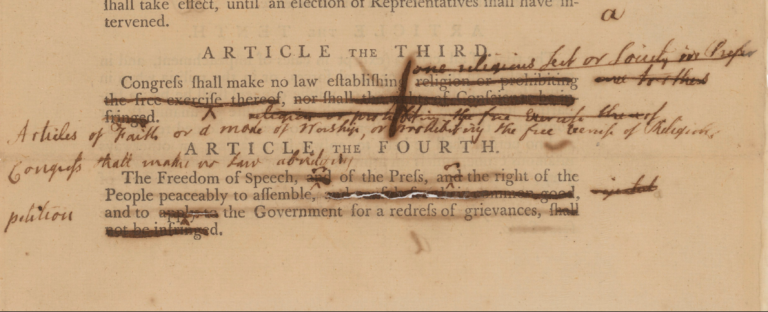
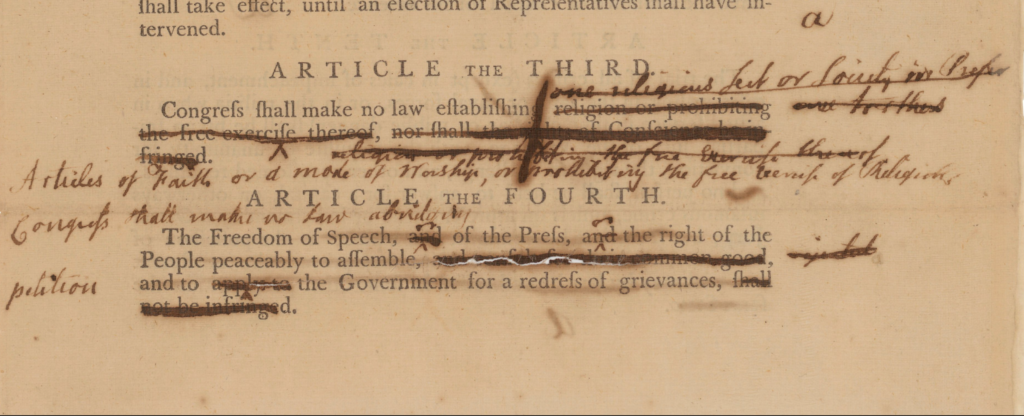
Senate Revisions to House Proposed Amendments to the U.S. Constitution, National Archives (US-PD)
On October 15, Canopy Forum, hosted by the Center for the Study of Law and Religion, held an online book symposium regarding Donald L. Drakeman’s upcoming book, to be published November 2026, titled The Free Exercise Clause and the Rights of Conscience (Harvard University Press, 2026). The following is a review essay of Professor Drakeman’s book written in anticipation of the symposium.
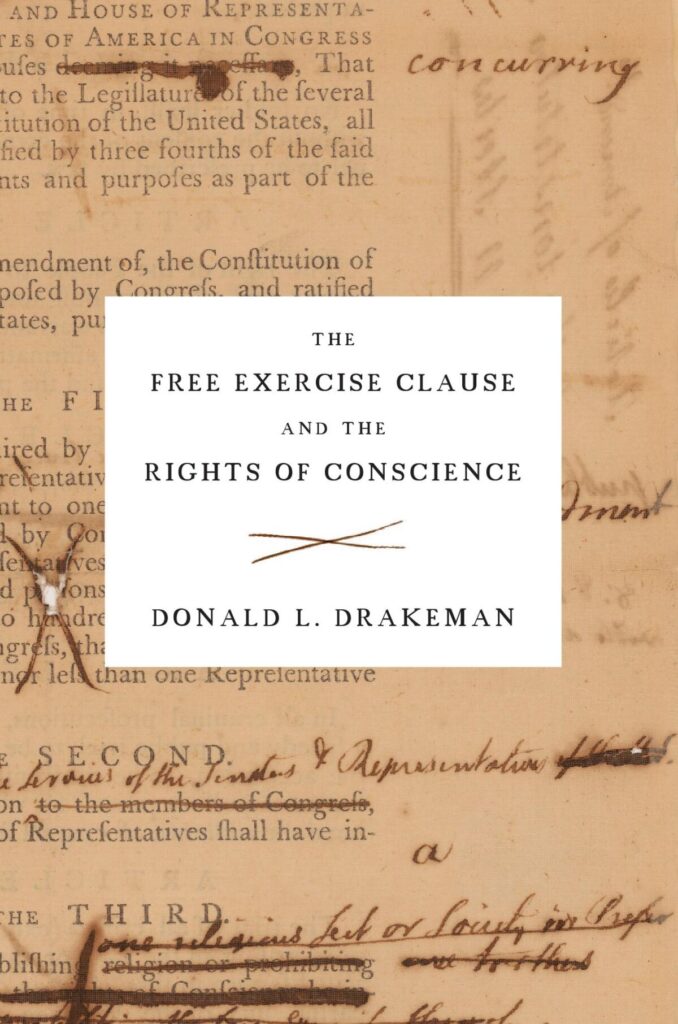
Donald Drakeman’s Free Exercise and the Rights of Conscience will surely attract substantial attention among scholars of constitutional law and religious liberty. Like Drakeman’s earlier works, Free Exercise has done much to identify important new historical sources relevant to our understanding of the Religion Clauses. And it does so with Drakeman’s typical readability and storytelling prowess.
Drakeman’s thesis is both highly ambitious and highly provocative. In a span of roughly 160 pages, the book proceeds to cover more than a millennium of history, from the Roman Empire through the end of the nineteenth century. And drawing on that historical account, Drakeman defends a surprising claim.
For generations, jurists and scholars have understood the Constitution’s protections for free exercise to include a variety of conduct “rooted in religious belief”—think about wearing a yarmulke, teaching religion to one’s children, or refraining from work on one’s Sabbath. But according to Drakeman, that widespread understanding is wrong. In his view, the phrase “free exercise of religion” was a “well-known term of art” in the eighteenth century that protected only one activity: “hold[ing] a worship service in a public place” (3).
An Exceedingly Narrow Reading
As should be obvious even from that brief description, Drakeman’s reading of the Free Exercise Clause is exceedingly narrow. On Drakeman’s account, the Clause only protects “the ability to hold public worship services” (105), or at most, “exercise of [a church’s] sacraments” (112). The implications of that view are shocking. Under this reading, government would be free to openly discriminate against religious organizations providing poor relief or social services, as Drakeman himself notes (155). It could prosecute Muslims for wearing a headscarf or Jews for engaging in practices like kosher slaughter. It could target religious schools specifically for their religious instruction. Drakeman even hints that state governments might be able to impose “religious tests for public office” or confiscate a religious group’s property, as long as it stops short of taking “buildings where worship services [are] held” (86, 155).
To be fair, Drakeman indicates that these results may not always “align with [his] own religious policy preferences” (19). Nonetheless, he claims that his hands are tied by “original meaning” (167).
I am skeptical about Drakeman’s general conclusions regarding the historical scope of the Free Exercise Clause, for some of the same reasons Professor Witte offered in his very fine post. In this brief essay, however, I want to focus on just one aspect of the historical record that is especially crucial for Drakeman’s theory—the battle over religious taxes in Virginia.
Besides Georgia’s Constitution of 1777, Virginia’s Declaration of Rights was the only state charter before the First Amendment to use the precise phrase “the free exercise of religion.” Thus, if the phrase was a well-known term of art limited to protecting public worship services only, the evidence from Virginia should offer some of the strongest support for Drakeman’s theory. Yet as I read the record, the Virginia evidence squarely undermines rather than confirms Drakeman’s core thesis.
Prelude to a Controversy
Start at the beginning. In 1776, Virginia enacted a Declaration of Rights. Among its provisions, Article 16 announced a broad principle of religious freedom. Because “religion, or the duty which we owe to our Creator, and the manner of discharging it, can be directed only by reason and conviction, not by force or violence … all men are equally entitled to the free exercise of religion, according to the dictates of conscience…”
The language of “the free exercise of religion” in Article 16 was no accident. As Drakeman notes in passing, James Madison intentionally inserted this language in place of George Mason’s original call for “toleration,” in part to emphasize that religious freedom was a matter of natural right, not government indulgence (82). Drakeman is also right that language of “free exercise” appears in earlier petitions which preceded Article 16’s passage. But as those familiar with this history know well, much more interesting is what followed.
In 1784, Patrick Henry proposed a so-called “general assessment.” Since its founding as an English colony, Virginia had imposed compulsory tithes to support the established Anglican church. Henry’s general assessment bill aimed to soften that system and its exclusive support for the established church, even as it retained religious taxation. Under the bill, each citizen would be taxed to support “teachers of the Christian Religion,” but would be free to direct those taxes to the Christian church of his choice, or alternatively to local “seminaries of learning.”
Arguments Against Henry’s Bill
James Madison and proponents of religious liberty in Virginia vehemently opposed Henry’s bill. Yet according to Drakeman, neither Madison nor his allies “actually [made] th[e] argument” that “the ‘free exercise of religion’ phrase in the Virginia Declaration of Rights had a broad enough meaning that it would preclude religious taxes” (91). Instead, Drakeman claims they argued only that those taxes violated the “natural rights of conscience” (91). But that conclusion is exceedingly difficult to square with what these people actually wrote.
Consider first the views of Madison’s allies. Opposing the general assessment, Presbyterians from Bethel Church submitted a memorial to the legislature in August 1785. As numerous historians have noted, this memorial was one of the “most popular of the whole campaign,” and thus functions as a particularly important guide for understanding popular thinking at the time. Drakeman acknowledges that this petition explicitly invoked the “free exercise of religion” in opposition to Henry’s bill (93, n.102). But he insists that the memorial offered only an argument about the bill’s “negative implications” (93).
According to Drakeman, the Bethel Presbyterians didn’t argue that Henry’s bill violated Article 16’s protection for the “free exercise of religion,” even though they used that language. Instead, the argument was that “if the legislature [were] deemed to have the authority to impose the religious tax, it [would] also have the ability to take away the free exercise of religion [i.e., the right to public worship]” sometime in the future (91, 93).
In my estimation, that is not a plausible reading. I would encourage readers to consult the memorial directly (beginning on page 236 of this source). The memorial begins by asserting that Henry’s bill was both a “departure from the proper line of legislation” and a “direct violation of the Declaration of Rights.” And consistent with those assertions, the memorial goes on to invoke Article 16’s idea that the “end of civil government is … to protect [mankind] in the free exercise of religion.” It then asserts that Henry’s bill trampled that boundary, amounting to an “unwarrantable stretch of prerogative in the Legislature.”
But the memorial didn’t stop there. Just a few paragraphs later, the memorial reiterates the legal point explicitly. Henry’s bill was “a direct violation of the Declaration of Rights”: “[t]he sixteenth article [i.e., the free-exercise provision] is clearly infringed upon by it.” (emphasis added). This is not an argument about “negative implications” or future violations. Instead, these authors and their army of supporters believed that the Declaration’s protection for “the free exercise of religion” extended beyond holding worship services in public. It also encompassed objections to religious taxes.
Madison on Free Exercise
The same difficulty accompanies Drakeman’s reading of Madison’s Memorial and Remonstrance. Drakeman insists that Madison didn’t actually argue that church taxes violated Article 16’s protection for the “free exercise of religion,” ostensibly because (again) this language applied only to holding public worship services. Instead, as with the Presbyterian memorial, he says that Madison argued only in favor of “the natural rights of conscience,” such that allowing religious taxes now would also allow the legislature to “eliminate the free exercise of religion” later (93).
Here too, however, Drakeman’s gloss does not square with what Madison actually wrote, at least as I read it. And again, I would encourage readers to go straight to the source and judge the matter for themselves.
Madison begins his Memorial by quoting Article 16’s contention that “Religion or the duty which we owe to our Creator and the manner of discharging it, can be directed only by reason and conviction, not by force or violence.” Drakeman is right that, at least in part, Madison relied on a larger vision of unalienable rights in matters of religion. But Madison didn’t stop there.
Later in his memorial, Madison returned to Article 16 explicitly, arguing that the clash between this provision and Henry’s bill presented a clear choice between the superiority of enumerated rights and the absolute will of the legislature. The discussion began by quoting Article 16:
Because finally, “the equal right of every citizen to the free exercise of his Religion according to the dictates of conscience” is held by the same tenure with all other rights … if we consult the [D]eclaration [of Rights] … it is enumerated with equal solemnity, or rather studied emphasis. Either then, we must say, that the Will of the Legislature is the only measure of their authority … or, that they are bound to leave this particular right [i.e., the right to free exercise] untouched and sacred. Either we must say, that they may controul the freedom of the press, may abolish Trial by Jury … or, we must say, that they have no authority to enact into law the Bill under consideration.
The clear implication of this passage is that, if “enact[ed] into law,” Henry’s bill would violate the “particular right” to free exercise as “enumerated” in the Declaration of Rights. And because that was so, the effect of enacting Henry’s bill would be to leave “the Will of the Legislature [as] the only measure of their authority”—not just as to free exercise, but as to other enumerated rights too, including the freedom of the press (Art. 12) and the right to Trial by Jury (Art. 8).
Madison is not speaking here about some future violation of the right to free exercise, construed as a right to hold public worship services only. He is claiming that if allowed to pass, Henry’s bill mandating religious taxes would violate Article 16’s protection for free exercise now, setting a precedent that the legislature may also violate any of the Declaration’s other stated rights. Here again, “free exercise” clearly meant more than a right to hold public worship services.
Many petitions from this period make similar arguments. In November 1785, a petition signed by scores of Quakers argued that Henry’s bill was an “infringement of Religious and Civil Liberty established by the [state’s] Bill of Rights.” Another petition from Caroline County makes the point even more explicit. According to this petition, “regulat[ing] … the manner of divine worship or [taxing] the inhabitants of this state for the support of teachers of the Christian religion” amounted to a “departure from … the bill of rights.” (emphasis added). One could try to read these petitions and others as not meaning what they appear to say—that Henry’s tax proposal violated the free-exercise provision of the Declaration of Rights. But it is an uphill battle to say the least.
Competing Arguments for Broad and Narrow Readings
To be sure, not everyone in Virginia agreed with Madison. And among these sources, one finds perhaps the best support for Drakeman’s theory. Arguing against Madison’s position, for instance, prominent statesman Richard Henry Lee contended that the general assessment was perfectly consistent with Article 16’s protection for free exercise. As Lee expressed it in a letter to Madison, “[t]he declaration of Rights … contends against forcing modes of faith and forms of worship, [rather] than against compelling contribution for the support of religion in general.”
Here, finally, is some direct evidence from Virginia supporting at least something like Drakeman’s thesis. And indeed, other supporters of Henry’s general assessment bill made similar arguments. But it is no mystery why Drakeman does not cite these sources or rely on them, although they are well-known to scholars in the field. Proponents of this view were on the losing side of the general assessment debate, not the winning one. To the extent that the Virginia evidence contains anything like Drakeman’s view, then, it also indicates that the public rejected this narrow interpretation of “free exercise” in favor of Madison’s broader, more capacious understanding.
Drakeman’s attempt to squeeze support for his theory from the outcome of the general assessment controversy fares no better. Following vigorous debate, the public in Virginia eventually sided with Madison and his allies. And in place of Henry’s bill, the legislature enacted Thomas Jefferson’s Bill for Establishing Religious Freedom. That law prohibited the legislature from coercing attendance at worship. But it also forbade compelling “support” for “any religious worship, place, or ministry whatsoever.”
Drakeman insists that Jefferson’s bill supports his narrow reading of “free exercise,” ostensibly because “Jefferson’s statute separated the no ‘compelled … religious worship’ clause from the no-compelled-support language” (92). But here again, the inference that the wording of Jefferson’s bill means that free exercise was limited only to a right encompassing public worship services seems to me a highly implausible take-away.
As we have already seen, Madison and his allies vigorously argued that the Declaration’s protection for “the free exercise of religion” encompassed objections to religious taxes, not just public worship. And given that, it is no surprise that Jefferson included a separate clause explicitly forbidding compelled “support.” After all, that was the main point of disagreement between proponents of a broad vision of “free exercise” like Madison and Madison’s (proto-Drakeman-ish?) opponents. Drakeman reads Jefferson’s bill as secretly endorsing the losing side’s view of free exercise. But much more likely, Jefferson’s bill was a specification of some of the things that the Declaration’s right to “free exercise” included. And just as Madison had argued during the controversy, that specification included much more than the right to engage in public worship only.
Surveying the Free Exercise Data Points
At this point, it’s worth taking stock of things. The evidence from Virginia is just one data point about the meaning of “free exercise” in this period. And I agree with Drakeman that the modern Supreme Court has sometimes given disproportionate attention to figures like Jefferson and Madison when analyzing Founding-era history. But given the unique “free exercise of religion” language in the Declaration of Rights, the Virginia evidence is probably the most important testing ground for Drakeman’s term-of-art theory. Yet the more one investigates, the more obvious it seems, at least to me, that Drakeman’s core claim is directly contrary to the evidence.
Drakeman argues that the phrase “free exercise of religion” was “clear and well understood,” and that its meaning “had been unchanged for a very long time” (3). But on my reading, the evidence from Virginia strongly suggests precisely the opposite—the concept of the “free exercise of religion” and its cognates was a matter of deep contestation and renegotiation in this period, marked by a desire for greater protection than English law had allowed.
In England, the Act of Toleration had provided limited freedom in the “Exercise of Religion” for dissenting Protestants in England, permitting them to meet and worship in ways that laws like the Conventicle Act had not. But the Act of Toleration explicitly stated that it did not “exempt any of the persons aforesaid from paying of Tythes or other Parochiall Duties.”
On a general level, Drakeman more or less argues that Founding-era Americans retained the narrow English understanding of the “exercise of religion,” even if they argued against religious taxes as a matter of “conscience” or natural-rights theory. But as I read the sources, it was exactly that restrictive approach to the “exercise of religion” that Madison and his allies in Virginia challenged and defeated. Rather than a governmental permission, fulfilling one’s duties to God was a natural right—the free exercise of religion. And as the sources above indicate, Madison and others also reached further than English law had done. They reached toward a vision of “free exercise” that protected against religious taxes and other impositions on conscience, not just against outlawing public worship services.
Drakeman’s book has provided a valuable and provocative story for anyone seeking to learn more about the Founding era. Whether that is the whole story is a question readers should judge for themselves. ♦

Mark Storslee is an associate professor and the C. Boyden Gray Distinguished Scholar at the University of North Carolina School of Law.
Recommended Citation
Storslee, Mark. “The Meaning of Free Exercise: Historical Complexity and Nuance” Canopy Forum, November 11, 2026. https://canopyforum.org/2026/11/11/more-than-just-public-worship-services-some-thoughts-on-free-exercise-and-the-history-from-virginia/.
Recent Posts