The Meaning of Free Exercise: Historical Complexity and Nuance
Kathleen A. Brady
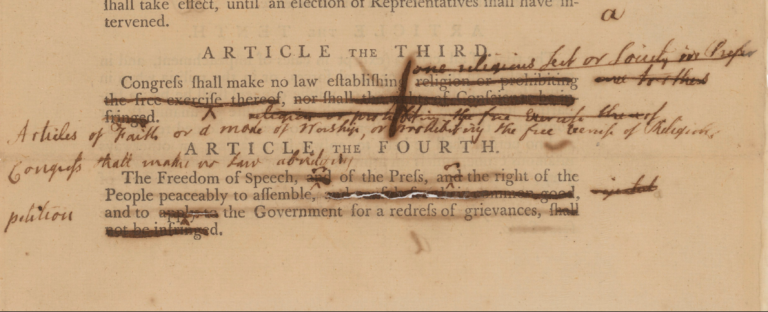
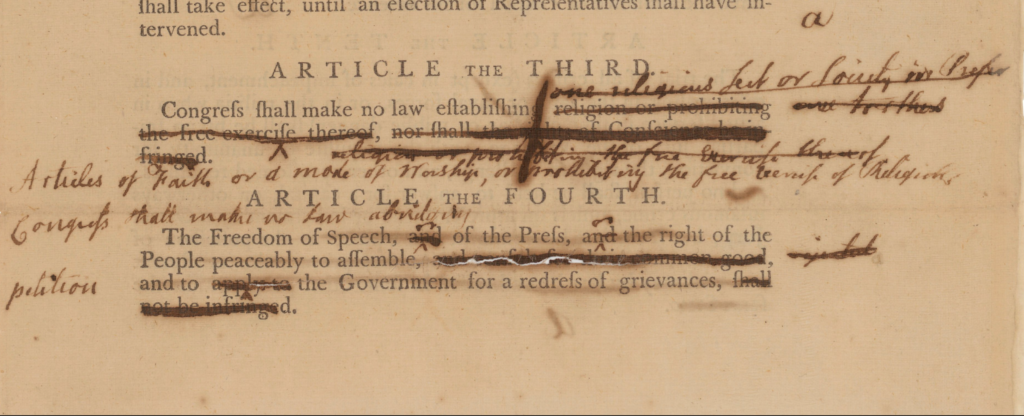
Senate Revisions to House Proposed Amendments to the U.S. Constitution, National Archives (US-PD)
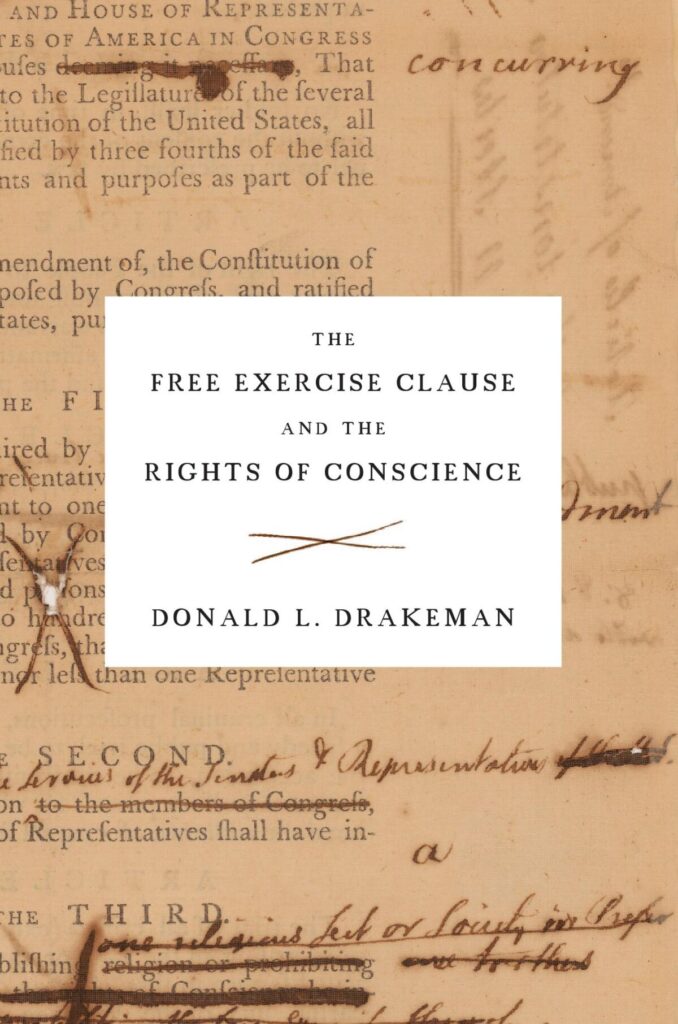
On October 15, Canopy Forum, hosted by the Center for the Study of Law and Religion, held an online book symposium regarding Donald L. Drakeman’s upcoming book, to be published November 2026, titled The Free Exercise Clause and the Rights of Conscience (Harvard University Press, 2026). The following is a review essay of Professor Drakeman’s book written in anticipation of the symposium.
In recent years, the U.S. Supreme Court has increasingly drawn on history and tradition as the touchstone of constitutional interpretation, and Donald Drakeman’s important and timely new book examines where this focus should lead the Court in its Free Exercise Clause jurisprudence. Drakeman was surprised by what he found. The Court’s six conservative justices have been the strongest proponents of a history and tradition approach, and they have also favored expanding constitutional protections for religious exercise. However, the historical meaning of the Free Exercise Clause was, in fact, very narrow. At the time of the founding, the “free exercise of religion” was a term of art with a narrow meaning that remained consistent long before and long after the adoption of the Bill of Rights. It meant the right of religious believers to hold worship services publicly (3, 73, 103-04, 108-09, 129, 149). It did not extend to religious practices more broadly, nor did it entail relief where burdens result from neutral laws not aimed at religion (2-4, 149-51). It was not until the mid-twentieth century, when the Supreme Court broke with history, that the concept of free exercise took on these added dimensions (137-39). The Court returned to a restrictive position regarding religious exemptions in 1990 in its controversial decision in Employment Division v. Smith. While today’s conservative justices have expressed dissatisfaction with Smith, Drakeman argues that Smith was, in fact, right from a historical perspective (156).
Drakeman’s provocative arguments will surely stimulate renewed debate about the meaning of the Free Exercise Clause, but I read Drakeman’s historical sources differently than he does and see within them complexities that challenge his narrow conclusions. The meaning of free exercise was not settled and static in the founding era. It was evolving as the new nation’s commitment to religious liberty was developing under the pressure of its logic and in encounters with new questions and changing circumstances. Nor did nineteenth-century courts only have worship in mind when construing state and federal protections for religious liberty, or simply reject the idea of judicial exemptions from neutral statutes, as Drakeman argues. Some courts did, but the analyses of many others were more nuanced. On the whole, nineteenth-century courts wrestled with the idea of free exercise in light of its justifications and the challenges that shaped various understandings of its limits. The history and tradition of the Free Exercise Clause illustrate the challenges that arise when the meanings of constitutional terms and principles were in flux at the time of their adoption and remained so long after.
The Meaning of Free Exercise of Religion
Drakeman recognizes that eighteenth-century Americans debated about protections for religious liberty that extended far beyond public worship. Religious dissenters opposed religious tests for office holding and religious taxation, even general assessments that allowed believers to direct their taxes to their own congregations (95-97, 145). Quakers opposed oath-taking, and they and other religious pacifists sought exemptions from compulsory military service (74, 95-97, 145). According to Drakeman, these disagreements were not about the free exercise of religion but the rights of conscience, which was a more flexible concept (31, 73-76, 95-98).
However, Drakeman’s sources contain evidence that many founding-era Americans did frame these controversies in terms of the free exercise of religion. Take, for example, opposition to religious taxation in Virginia. In 1785 James Madison’s Memorial and Remonstrance against Virginia’s general assessment bill drew on Article 16 of the Virginia Declaration of Rights, which was written to protect “the free exercise of religion” without a separate reference to the rights of conscience. So did a memorial adopted by a convention of Virginia Presbyterians in opposition to the bill the same year. “[F]arewel to ‘the free exercise of Religion,’” wrote Virginia’s Baptists when the idea of a general assessment was floated in 1776.
These sources describe at least two different ways in which a general assessment would violate the free exercise of religion. The first was an argument made by both Madison and Virginia’s Presbyterians. “Religion is altogether personal, and the right of exercising it unalienable,” stated the Presbyterian memorial, “and it is not, cannot, and ought not to be, resigned to the will of the society at large; and much less to the Legislature.” Madison developed this argument in greater detail. “Religion or the duty which we owe to our Creator and the manner of discharging it, can be directed only by reason and conviction, not by force or violence,” he quoted from the Declaration of Rights, and it follows, as Article 16 concluded, that everyone has a right to exercise their religion as conscience dictates. Madison continued to explain that the personal nature of faith makes this right unalienable as does the fact that the right corresponds to a duty to the Creator. This duty is “precedent, both in order of time and in degree of obligation, to the claims of Civil Society,” and Madison concluded that “no mans right is abridged by the institution of Civil Society and … Religion is wholly exempt from its cognizance.”
Madison’s argument in his Memorial and Remonstrance was that religious taxation, even a general assessment, violates the free exercise of religion because it interferes with what must be entirely free from government involvement. Drakeman argues that Madison did not reason from the right of free exercise to the impropriety of religious taxes; rather, the right of free exercise and the impropriety of religious taxes both spring separately from the government’s lack of authority over religion (91). However, Drakeman has Madison’s argument backwards. For Madison, it was the right of free exercise, and its inalienability, that implied the separation of religion and government and, with it, the impermissibility of religious taxes.
Virginia’s Baptists described the problem with a general assessment slightly differently. Religious taxation violates the free exercise guarantee of the Virginia Declaration of Rights because government money will end up compromising the independence of religious organizations. Those whom the government pays, it has “a Right to regulate and dictate to.” “[F]arewel to the last Article of the Bill of Rights! Farewel to ‘the free exercise of Religion,’ if civil Rulers go so far out of their Sphere as to take the Care and Management of religious Affairs upon them!” the Baptists concluded. The argument here is not that a general assessment violates Article 16’s free exercise guarantee because government lacks all authority over religion. The Baptists’ argument assumes the separation of government and religious spheres. Rather, their argument was that religious taxation violates free exercise because it damages religion and religious institutions. The Baptists drew a principle of church autonomy from the idea of free exercise.
The Presbyterians’ memorial against Virginia’s general assessment bill was just one of the many petitions they authored on the subject of religious freedom in the founding years. Drakeman discusses others, and altogether they provide a good illustration of how the usage of the term was shifting for one group of Americans. In 1774, Virginia’s Presbyterians identified numerous defects with a toleration bill before the Virginia legislature that promised all Protestant dissenters “the full and free Exercise of their Religion.” These complaints, as Drakeman observes, largely focused on public worship, and notably, the Presbyterians did not object to the payment of religious taxes for the established church.
However, in just a few years, in 1777, when these taxes had been suspended and the idea of a general assessment was floated, the Presbytery of Hanover raised the same argument that the Baptists had made four months earlier. A general assessment for religious purposes would endanger the independence of churches. In 1784, in the first of their petitions regarding Virginia’s general assessment proposal, Virginia’s Presbyterians left open the possibility that an assessment would be consistent with the Declaration of Rights if it was done for civic purposes and drafted on a “liberal plan” that avoided settling matters of belief and worship and interfering with church government. However, in less than a year, in their 1785 memorial, the Presbyterians expanded their understanding of free exercise to put religious taxation entirely outside the power of government. As the understanding of religious freedom was quickly expanding in the founding era and Virginia’s Presbyterians confronted the possibility of tax support for their own congregations, they shifted their views about what free exercise required.
Some founding-era Americans, including James Madison, also believed that religious tests for office violated the principle of free exercise. In his first proposal for free exercise protection in the Virginia Declaration of Rights, Madison added a provision to George Mason’s draft that provided: “no man or class of men ought, on account of religion to be invested with peculiar emoluments or privileges; nor subjected to any penalties or disabilities.” Drakeman argues that these additions were distinct from the free exercise guarantee that preceded them (92), but Madison connected them with the words “and therefore.” Thus, these prohibitions read as implications of the concept of free exercise. Virginia’s Revolutionary Convention rejected Madison’s additions and, with them, his position that free exercise precludes privileges and disabilities tied to religion. However, in 1786, after Virginia’s general assessment bill died in committee, Virginia’s legislature adopted Thomas Jefferson’s Bill for Establishing Religious Freedom and with it a similar guarantee that religious belief “shall in no wise diminish, enlarge, or affect the[] civil capacities” of Virginians.
The trajectory in Virginia was clear, as it was in the new nation more broadly. Protections for religious liberty were quickly expanding, and the concept of free exercise was expanding as well. Driving this expansion was the logic of religious freedom. The primary duty of religious believers is to God, and they must follow the dictates of conscience, as Madison and Virginia’s Presbyterians had argued. Their remonstrances against Virginia’s general assessment bill also echoed other rationales for religious freedom that were familiar in the founding era. Pressing conscience stokes resentment and civic unrest, enervating support for government in general. Laws that pressure believers to violate their faith corrupt religion and “beget habits of hypocrisy” when conscience is betrayed, Jefferson argued in his Bill for Establishing Religious Freedom.
These were some of the reasons for allowing all believers to worship freely in public, but the logic of these rationales did not stop there. It extended to freedom from religious taxation for many in the founding era, and these numbers would grow. When the Constitution was adopted, most states had religious tests for office holding, but in the following decade, many would follow Virginia in either abandoning or relaxing them. By the founding, most states had some form of legislative or constitutional protections for Quakers who objected to oath-taking and compulsory military service, and while the First Congress did not include a protection for religious pacificists in the federal Bill of Rights, House members agreed that they should receive accommodation, even if only partial and even if only as a matter of legislative remedy. There was a “liberality of sentiment, which seem[ed] daily to gain ground” in the founding era, Virginia’s Presbyterians wrote in a 1784 memorial, and it was rapidly driving change, including in their own views.
Free Exercise in the Context of the First Amendment
Drakeman argues that the decision of the First Congress to use the term “free exercise of religion” rather than “the rights of conscience” in the Bill of Rights was significant and represented a choice in favor of narrower protections for public worship rather than the more flexible and potentially broader meaning of freedom of conscience (102-03, 145-46). However, a close examination of Drakeman’s sources suggests that the First Amendment’s drafters saw little difference between these two terms.
Madison almost certainly saw no significant difference when, in June of 1789, he introduced a draft of the Bill of Rights in the House in response to concerns voiced by many state ratification conventions. Virginia’s ratification convention had approved the new federal constitution with the understanding that it would not endanger “among other essential rights the liberty of Conscience,” and it proposed a Bill of Rights that included a protection for the “free exercise of religion” very similar to Article 16 of its own Declaration of Rights. The members of Virginia’s ratification convention used these terms interchangeably. Madison did as well the same year when he described Article 16 as an “explicit” protection for the “rights of Conscience” in a letter to Thomas Jefferson. Madison told Jefferson that he did not believe a Bill of Rights was necessary. However, as he wrote to George Eve a few months later, with the Constitution ratified, he believed it ought to be revised with “provisions for all essential rights, particularly the rights of Conscience in the fullest latitude.”
As Drakeman recounts, the religion clauses went through several drafts before Congress settled on the provisions we have today. Madison’s initial proposal for the Bill of Rights included a protection for “the full and equal rights of conscience.” While the House did not adopt this proposal, it did approve several protections for the rights of conscience in August of 1789. A House style committee then formulated a final version that was sent to the Senate. It provided: “Congress shall make no law establishing religion, or prohibiting the free exercise thereof, nor shall the rights of conscience be infringed.” The Senate did not agree on the House version, and it rejected several proposals for the religion clauses from its own members before approving two versions simply barring Congress from “prohibiting the free exercise” of religion without any reference to the rights of conscience. The House rejected the version the Senate sent it, and a joint committee that included Madison drafted the First Amendment we have today. It reads: “Congress shall make no law respecting an establishment of religion, or prohibiting the free exercise thereof.”
While it is possible that the absence of a reference to the rights of conscience in the First Amendment signaled a rejection of a substantively distinct and potentially much broader guarantee, there is no evidence for such a significant change in the congressional debates we have records of. House members of the First Congress quibbled at some length about the language for disestablishment and about whether a protection for conscientious objectors to military service should be included. However, we have no record of any such discussions of the shifting language for the Free Exercise Clause. Madison had committed to a Bill of Rights that protected the rights of conscience, and in the drafting debates, he referred to the concerns of state ratification conventions that Congress might “infringe the rights of conscience” in the absence of a constitutional guarantee. According to Madison, the infringement of these rights and the establishment of a national religion were “the[] effects … the amendment was intended” to prevent. Daniel Carroll described the purpose of the First Amendment in a similar way. “[T]he rights of conscience are, in their nature, of peculiar delicacy, and will little bear the gentlest touch of governmental hand,” he began, and “[h]e would not contend with gentlemen about the phraseology, his object was to secure the substance in such a manner as to satisfy the wishes of the honest part of the community.” While we do not have the full debates from the House and have only minutes from the Senate, it is unlikely that Madison would have been satisfied with a Free Exercise Clause with only the narrow meaning Drakeman sees in it. More likely, the shift in terms was simply a change in phraseology, not a substantive change.
Nuance in Nineteenth-Century Case Law
Drakeman argues that as the nineteenth century progressed, courts construed both the rights of conscience and the free exercise of religion narrowly to cover only belief and worship and that, with one narrow exception, uniformly rejected religious exemptions from neutral, generally applicable laws (106-09). The narrow exception was relief from common law evidentiary rules where Catholic clergy refused to divulge information shared with them during the sacrament of confession (106-07, 128, 133). No court recognized an exemption from statutory rules, leaving those to legislatures (106-07, 133, 142).
In fact, however, the record of nineteenth-century cases is more nuanced, and it reveals courts wrestling with the idea of free exercise, including its reach and limits. In People v. Phillips, an early New York case, the court construed the concept of free exercise broadly and its limits narrowly. Observing that the free exercise guarantee in the state’s constitution was “conceived in a spirit of the most profound wisdom, and the most exalted charity,” the court in Phillips argued that it “ought to receive the most liberal construction.” Consistent with this liberal spirit, the court held that common law evidentiary rules could not be applied to compel a Catholic priest to testify about what he had learned during confession. “It is essential to the free exercise of a religion, that its ordinances should be administered—that its ceremonies as well as its essentials should be protected,” the court explained, and “this important branch of the Roman catholic religion would be … annihilated” were priests forced to disclose the content of confessions. “Every man” would agree “that a decision of [a] court, or a law of the state” that interfered with a Protestant sacrament in this way would violate New York’s constitution. Nothing in its decision indicated that the court would have reached a different result if the legal rule at issue were a matter of statutory rather than common law; in fact, the court expressed the opposite view. Nor was the sacrament at issue a matter of public worship. What mattered to the court was that a fundamental element of the Catholic faith was endangered by a legal rule. The court focused on the effects of the law in light of the tenets of the Catholic faith and how the law operated with respect to its fundamental practices.
New York’s constitution, like many state constitutions, contained a provision limiting its religious liberty guarantee where paramount interests of the state were at stake, and here too the court construed these limits in favor of religious freedom. New York’s constitution provided that “the liberty of conscience, hereby granted, shall not be so construed as to excuse acts of licentiousness, or justify practices inconsistent with the peace or safety of this state.” The court rejected speculative fears of “rare[]” or “extreme cases” and looked for a showing of “offences of a deep dye, and of an extensively injurious nature,” lest “the liberty of conscience [be rendered] a mere illusion.” Behind the court’s liberality were the same rationales for religious freedom that were driving the expansion of the idea of free exercise in eighteenth-century Virginia. “Religion is an affair between God and man, and not between man and man,” the court argued. Where the state meddles with religion, the “calamities” associated with civic division and strife result.
The reasoning and liberal spirit of Phillips were followed in other nineteenth-century cases. In Commonwealth v. Cronin, another case involving the sacrament of confession, a Virginia court drew extensively from the analysis in Phillips, and again the court signaled that an exemption would be required whether it was “a decision of this court, or a law of this State, or a common law rule of evidence” that effectively prohibited an essential element of a faith. What it envisioned was not a narrow exception for a specific common law rule, but relief where the state’s policy effectively “operate[s]” to suppress an “essential and indispensable part of [a] religion.”
In Farnandis v. Henderson, a South Carolina court again drew on Phillips when it recognized the competency of a witness who believed in rewards and punishments in this world, but not in the world to come as the common law had often been understood to require. The court extended the state’s constitutional protection for free exercise beyond direct prohibitions on religious belief and worship to indirect burdens associated with the deprivation of civil rights. “If a man’s religious opinions are made a ground to exclude him from the enjoyment of civil rights, then he does not enjoy the freedom of his religious profession and worship,” the court argued. Exclusion from being a witness, like exclusions from office holding or other civil incapacitations, “is a serious injury” that is “in the very teeth of the Constitution.” The effects of the state’s rules matter, and permitting the state to condition civil rights on religious beliefs would make a “mockery” of religious freedom.
Other nineteenth-century courts construed the concept of religious freedom more narrowly and denied exemptions even as they left open the possibility that other claims might succeed. For example, a number of courts that refused to exempt Saturday Sabbath observers from Sunday blue laws noted that these laws did not compel or prohibit any religious practice. Jews and Christians observing the Sabbath on Saturday were free to worship and rest that day, and no religious tenet required that they work on Sunday. If there were such a requirement, “then indeed there might be a ground to say that the ordinance which requires [them] to desist, during Sunday, from a public business, the sale of goods, was unconstitutional,” a South Carolina court stated in City Council of Charleston v. Benjamin, and the Pennsylvania Supreme Court similarly qualified in Specht v. Commonwealth. However, indirect economic burdens without more would not be a violation of religious liberty.
Other courts that denied religious exemptions challenged the sincerity of religious claimants or second guessed their theological positions. For example, the Pennsylvania Supreme Court described the position of one Jewish claimant who sought relief from the state’s Sunday closing law “mere caprice.” Later in Specht, the same court disputed the claim of a Christian Saturday Sabbath observer on theological grounds: the argument that the decalogue required six days of work “is not rationally its meaning, nor is it that assigned to the word by the ancient people to whom it was originally delivered by the Deity.” Still other courts focused their attention on limits that state constitutions placed on their free exercise protections, but unlike the court in Phillips, they more easily found these limits met.
Drakeman is correct that a number of nineteenth-century courts rejected claims for exemptions altogether, including the Supreme Court in its 1879 decision in Reynolds v. United States. The reasons given by these courts were ones of both principle and practicality. The availability of exemptions will lead to chaos in a nation with so many different faiths, and it will encourage dishonest claims. The rule of law requires uniformity. Courts voiced the speculative fears rejected in Phillips. They also inverted rationales for free exercise in the founding era. Madison had argued that religion is a duty owed to the creator that is precedent to the claims of civil society, but these courts spoke of the primacy of the state’s claims. “[T]here are no duties half so sacred as those which the citizen owes to the laws,” the Pennsylvania Supreme Court wrote in Philips v. Gratz as it rejected the reasoning and result in Phillips and denied a trial continuance to a Jewish plaintiff who could not attend because of his Sabbath.
Few of these courts viewed the potential scope of free exercise or the rights of conscience narrowly in terms of just belief and worship. To the contrary, the breath of religious practice was part of what made judicial exemptions impracticable. For example, in a dissent written three years earlier, the author of Gratz described the rights of conscience to include not only belief and worship but also the “do[ing], or forbear[ing] to do, any act, for conscience sake, the doing or forbearing of which is not prejudicial to the public weal.” Chief Justice Gibson argued that judicial exemptions would endanger the state because “were the laws dispensed with, wherever they happen to be in collision with some supposed religious obligation, government would be perpetually falling short of the exigence.” “There are few things, however simple,” he continued, “that stand indifferent in the view of all the sects into which the Christian world is divided.” When the Supreme Court in Reynolds considered nonChristian sects as well, it conjured up images of human sacrifices and widows burning on the funeral piles of their dead husbands. For the court in Phillips, these and other extremes like incest, a community of wives and the inquisition mark limits to free exercise, not a reason to deny exemptions altogether. However, these courts agreed that the concept of religious freedom includes practices that go beyond belief and public worship even if it does not encompass judicial exemptions.
What emerges from these nineteenth-century cases is not a uniform position with a narrow exception but, rather, a complex and multi-faceted legal tradition in which courts were wrestling with the idea of free exercise and seeking to define its scope and limits in light of its rationales, competing legal principles, and practical challenges. Movements between robust constructions of constitutional commitments and more narrow readings wove in and out of these decisions, shaping their results. For the most part, courts were not looking for the original public meaning of their constitutional texts or for original intent narrowly defined. They were seeking to understand the implications of a concept embedded in constitutional texts but far from fully defined. New conditions like growing religious pluralism were raising new questions or placing old questions in a new light.
History, Tradition and the First Amendment
When the Supreme Court applied the Free Exercise Clause to the states in the mid-twentieth century and construed the protections of the First Amendment robustly, it did not break with this nineteenth-century tradition but, rather, entered into it. In Reynolds, the Court had rejected religious exemptions as dangerous and impracticable. In the mid-twentieth century, the Court reversed course and construed the Free Exercise Clause to afford relief where substantial burdens on religious practice could not be justified as the least restrictive means of achieving a compelling state interest. In doing so, the Court expressly rejected speculative fears of harm unsupported by evidence. It also held that indirect burdens which result from laws that force believers to choose between their faith and receiving public benefits can violate free exercise because the effect of these laws is the same as a fine on religious practice. The Court echoed much that the court in Phillips had said. The effects of legal norms on religious practices matter. Limits on religious freedom should be construed narrowly in light of the importance of the right. Protections for religious exercise should be construed liberally.
In fact, many mid- and late-twentieth century Supreme Court decisions struggled with the scope of free exercise like many nineteenth-century courts did. For example, the Court rejected exemptions where burdens on religious exercise were the result of the way the government managed its internal affairs even if the effect on religious practice was severe. It applied more deferential review in the military and prison contexts. At times, it yielded to speculative fears and to the appeal of administrative uniformity, and the compelling state interest test was often less robust in practice than in theory. Behind these contractions were the practical challenges of recognizing religious exemptions that nineteenth-century courts had also wrestled with. The Court was careful to avoid second-guessing the theological positions of claimants and rarely questioned their sincerity, but it reined in exemptions in other ways.
When the Court reversed course in Smith and rejected most exemptions from neutral, generally applicable laws, the reasoning of the restrictive nineteenth-century cases appeared again as the Court echoed arguments from Reynolds. Applying the compelling state interest test anytime a law substantially infringes religious practice “court[s] anarchy” in a pluralistic nation, the Court argued. We cannot afford its “luxury,” it continued. Exemptions must be left to the political process.
Altogether, the Court’s twentieth-century Free Exercise Clause jurisprudence mirrored nineteenth-century case law in its complexity and its varying, often opposing, strains. No part of it was a break from this tradition. Instead, the Court extended it as it entered into it. This is not surprising. When the Court applied the Free Exercise Clause to the states, the debates that took place in the state courts now took place at the federal level.
The purpose of Drakeman’s book is to examine where the Court’s new focus on history and tradition should take it in its free exercise jurisprudence, but his sources demonstrate that the answers are not straight-forward. The meaning of free exercise was shifting and expanding at the time the First Amendment was drafted and ratified, and it continued to evolve in different directions in nineteenth-century cases. Historical faithfulness in the free exercise context requires examining the historical rationales for protecting free exercise in the founding era and the currents and sentiments that were driving the expansion of this concept. It also includes considering the implications of these rationales and sentiments for today’s conflicts as conditions change and new questions arise. The mid-twentieth century Court recognized, as did the court in Phillips, that the effects of legal rules on religious practice matter even if burdens are unintentional and even where public worship is left intact. Harms to religious believers and the larger society arise either way. Historical faithfulness also requires grappling with the challenges that courts have long struggled with. There will be limits to accommodation, and they must be defined in light of the importance of both religious freedom and essential functions of the state. Protections for religious liberty should be robust and limits circumscribed, but that is just a start. ♦

Kathleen A. Brady is a Senior Fellow and McDonald Distinguished Fellow with the Center for the Study of Law and Religion at Emory University. Her publications focus on the intersection of law and religion, including the First Amendment religion clauses, religion in public life, law and theology, and Catholic social thought, and she has written on the history and interpretation of the Free Exercise Clause in The Distinctiveness of Religion in American Law: Rethinking Religion Clause Jurisprudence (Cambridge University Press).
Recommended Citation
Brady, Kathleen A. “The Meaning of Free Exercise: Historical Complexity and Nuance” Canopy Forum, November 4, 2026. https://canopyforum.org/2026/11/04/the-meaning-of-free-exercise-historical-complexity-and-nuance/
Recent Posts