Was “Free Exercise of Religion” Originally A Term of Art?
Nathan S. Chapman
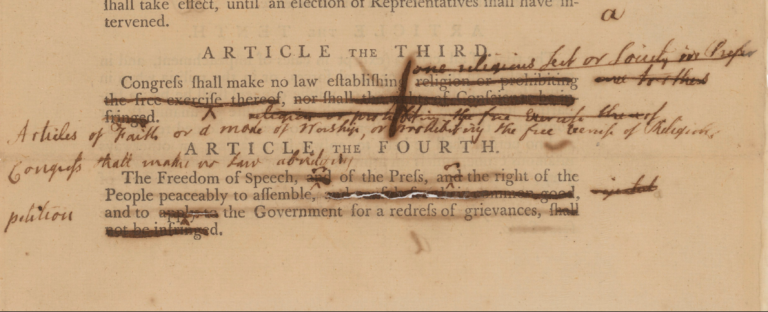
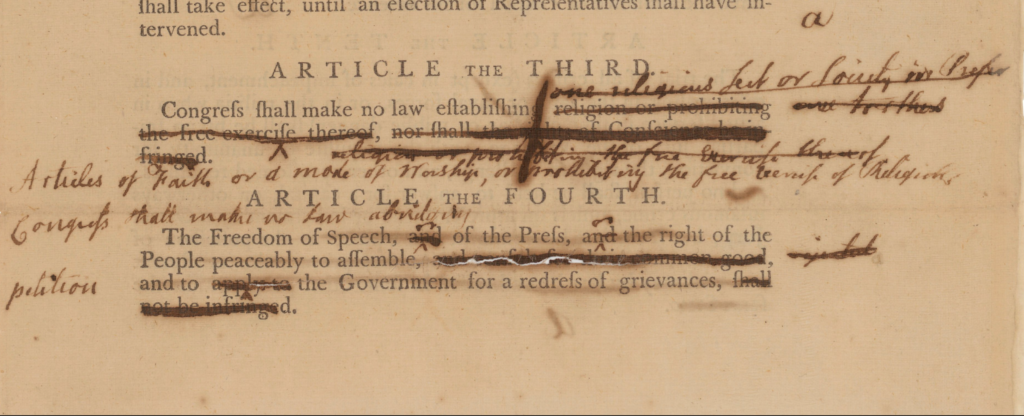
Senate Revisions to House Proposed Amendments to the U.S. Constitution, National Archives (US-PD)
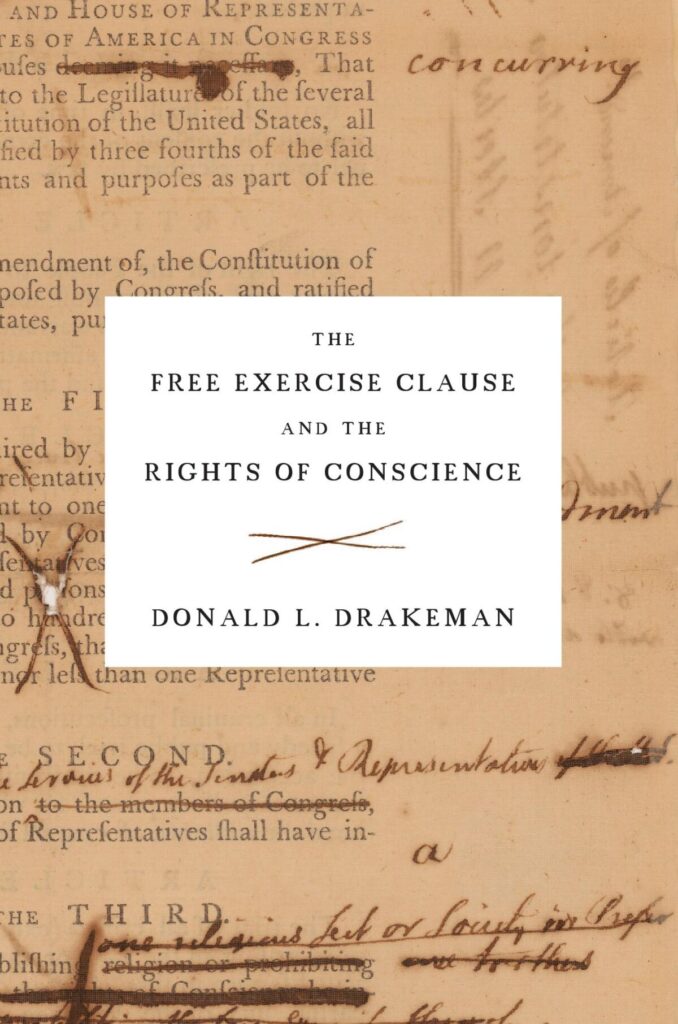
On October 15, Canopy Forum, hosted by the Center for the Study of Law and Religion, held an online book symposium regarding Donald L. Drakeman’s upcoming book, to be published November 2026, titled The Free Exercise Clause and the Rights of Conscience (Harvard University Press, 2026). The following is a review essay of Professor Drakeman’s book written in anticipation of the symposium.
The Free Exercise Clause and the Rights of Conscience, by Donald Drakeman, is perhaps the best volume dedicated to the historical development of the notion of “free exercise of religion.” The writing is clear, the research thorough, the contextual analysis careful. It succeeds in showing that, from late antiquity to the American founding, “free exercise of religion” often referred to the right of dissenters to engage in public worship. It also helpfully distinguishes between the developing concept and theory of the natural right of conscience and the narrower concept of free exercise. The book is a valuable study in the development of religious liberty. Unfortunately, its core thesis is wrong and, if taken up by courts, would be pernicious.
Drakeman’s Term of Art Thesis
When the First Amendment was enacted, the book asserts, “the phrase ‘free exercise of religion’ continued to be a term of art with a well-known meaning at the time the U.S. Constitution was drafted: it meant the ability to hold a worship service in public” (125, also 3, 53, 88, 90, 91, 123).This essay argues that, while the book shows that laws often used the phrase to refer to the right to worship (publicly or privately), it does not provide convincing evidence that Americans considered the phrase to be a term of art restricted to “the ability to hold a worship service in public” (125).
This point may seem pedantic. But the implications of Drakeman’s “term-of-art” thesis are immense and a threat to religious liberty. If the phrase was a term of art, and lawyers are seeking its original meaning, then they should not interpret it according to its plain meaning, but rather according to its artificial legal meaning. If that legal meaning was limited to “the ability to hold a worship service in public,” the original meaning of the Free Exercise Clause is at odds with virtually all of contemporary free exercise doctrine. Under this reading, for instance, the clause would not protect against governmental (1) discrimination on the basis of religion; (2) regulation of minister selection or religious property disputes; (3) compulsory oaths, military service, speech, or conduct contrary to conscience; (4) surveillance, regulation, and punishment of private religious worship; or (5) even incidental prohibition of public worship with laws regulating public gatherings. A but-for premise of all of these doctrines is that the “free exercise of” “religion” can plausibly be read to protect all manner of religiously motivated conduct. Drakeman’s “term of art” thesis would eliminate that premise, dramatically narrowing, and creating new uncertainties, about the free exercise clause’s scope.
Answer: No, It Wasn’t
Readers fretting about yet another originalist revolution in constitutional doctrine can rest easy. Despite its claim, the book presents no evidence that the phrase was a term of art. No lawyer, court, official, treatise, or dictionary ever referred to it as a term of art or suggested that it had a technical meaning unique to the law. No American lawyer appears to have used it as a term of art, either. And American courts never dismissed a free exercise claim in the long nineteenth century on the ground that the conduct was something other than attendance at a public worship service.
In many respects, the book’s evidence is much more historically interesting than its thesis. What Drakeman shows is that the “free exercise of religion” was for centuries part of an ongoing and developing language and set of concepts of religious liberty, alongside conceptions like establishment, freedom of conscience, equal civil rights, and church-state separation. Though “free exercise” of religion usually referred to the freedom of religious worship, it could refer to worship that was either public or private. And what counted as worship? Surely corporate liturgy and religious rites were a focal point for Christians. Drakeman often seems to presume that they were the extent of “worship.” But what of preaching? Catechesis? Bible study? Sacraments administered outside of a worship service? Church discipline? Doctrinal debates? Charitable giving? Mission work? Religious education? Fasting? Pilgrimage? From the beginning, American lawyers and judges adapted the common understanding of the words “exercise of religion” to reach a variety of religiously required conduct. What Drakeman has shown is a common usage, not a term of art, a usage that was indeterminate enough to leave the door open to applications beyond “public worship services.”
Note that my criticism of Drakeman’s claim about the scope of the clause is conceptually distinct from his separate thesis that the phrase was not understood to require exemptions. The issue I focus on here is the scope of activity presumptively safeguarded from at least direct legislative regulation. “Attending public worship services,” he says. To the contrary. Americans believed it went well beyond that.
This essay considers in turn several pieces of evidence Drakeman offers to support his claim. They support a much softer thesis of a common usage of “free exercise of religion” but undermine his assertion that it was a term of art.
Dr. Johnson on Free Exercise
The book presents no evidence of anyone using the phrase “free exercise of religion” as a term of art rather than as a common way to refer to religious worship. No one called it a term of art. The nearest the book comes to claiming that someone expressly referred to it as a term of art is this: “the ‘free exercise of religion’ was a term of art related specifically to, as Samuel Johnson’s Dictionary (1773) put it, ‘act[s] of divine worship’” (52). This assertion is misleading. Johnson did not refer to “free exercise of religion,” or to any of the words in that phrase, as a term of art. This is not because the dictionary did not identify legal terms art: it listed, for example, a definition of “equity” as being “in Law.”
So, what did Johnson say about the exercise of religion? He did say that one definition of “exercise” is an “act of divine worship whether publick or private.” Another, however, is the more generic “[p]ractice; outward performance.” As an example of the latter, he quotes Joseph Addison’s Remarks on Several Parts of Italy 290 (1705): “Lewis [Louis XIV] refused even those of the church of England, who followed their master [James II] to St. Germain’s, the public exercise of their religion.” This quote is especially intriguing for Drakeman’s argument. On the one hand, it perfectly illustrates the consistent usage he identifies: the right of dissenters (in this case, Protestants in Italy) to engage in public worship. On the other hand, it is devastating for his “term of art” thesis: Johnson used the Addison quotation to illustrate not the “divine worship” definition of “exercise,” but the more generic “practice; outward performance,” i.e., acts. That is the meaning of “exercise” that American courts and scholars have always given to “free exercise of religion”—and it is significantly broader in connotation than “divine worship.”
Johnson’s treatment of “exercise” conforms precisely to Drakeman’s evidence, but it undermines his term-of-art thesis. There was a well-known usage of “exercise of religion” to refer to religious worship. But that usage was one of the plain meanings of the phrase, not the only meaning, and not a term of art. Even that usage, though, did not refer exclusively to public worship—it referred to divine worship, “whether publick or private.” And it was underdeterminate. What, precisely, is an “act of divine worship”? “To worship,” Johnson said, meant “to adore; to honour or venerate with religious rites.” What, exactly, counts as an act of divine adoration?
Diversity of Usage in American Constitutions
One of the strengths of Drakeman’s book is its careful reading of specific religious liberty provisions in their historical context. He reads each state constitutional religious liberty provision in the broader context of that state’s other provisions and its history of religious establishment. But if “free exercise of religion” was a term of art for the right to hold public worship services, why did so few of the early state constitutions use that formula?
Only Virginia and Georgia used the phrase, “free exercise of religion.” Pennsylvania, Delaware, and Vermont protected “the rights of conscience in the free exercise of religious worship.” North Carolina: “all persons shall be at liberty to exercise their own mode of worship.” Maryland: all are “equally entitled to protection in their religious liberty,” so “no person ought by any law to be molested . . . on account of his religious persuasion or profession, or for his religious practice.” New York: “the free exercise and enjoyment of religious profession and worship, without discrimination or preference, shall forever hereafter be allowed . . . to all mankind.” Massachusetts: “no subject shall be hurt, molested, or restrained . . . for worshipping God in the manner and season most agreeable to the dictates of his own conscience; or for his religious profession or sentiments.” New Hampshire’s was the same as Massachusetts’s, and additionally acknowledged the “natural and inalienable right to worship God according to the dictates of his own conscience, and reason.”
Three observations follow from this.. The first is that the focus of constitutional freedom in all of these clauses (except perhaps those of Virginia and Georgia) is the right to worship, but the clauses use a variety of phrases to define that right. That is consistent with ordinary language, not a term of art. A term of art has specific, extraordinary substantive meaning. If “free exercise of religion” was understood by lawyers to be a term of art, why would the other state constitutions have used a variety of different permutations to communicate what Drakeman seems to think was more or less the same thing? The second is that the most natural way to make sense of these various permutations is to read the Virginia and Georgia clauses as extending beyond worship, narrowly understood, to any religious exercise. The trend at the time, demonstrated by the other state constitutions, was to specify when the right was limited to public worship, rather than leaving it to customary usage. This strongly implies that the Free Exercise Clause of the U.S. Constitution—drafted and ratified after all of these state provisions—was understood to adopt the broader view.
The third is that none of the state constitutions expressly protect only public worship. As Drakeman shows elsewhere in the book, the difference between a right of public and private worship was immense. One might presume that the right to public worship necessarily includes the “lesser” right of private worship. Not necessarily. The English Toleration Act of 1689, for instance, gave dissenting Trinitarian congregations the right of public worship only. Congregating for private worship—preaching, singing, Bible reading, praying, catechizing, disciplining, and so forth—remained forbidden behind locked doors. Likewise forbidden was worshipping in a place that was not registered, with a minister who had not subscribed to nearly all the Thirty-Nine Articles of Religion. Public worship was allowed but regulated, and private worship was prohibited because it was harder to surveil and therefore harder to control.
Drakeman’s claim that the “free exercise of religion” protected only the right to attend “public worship services” therefore presents a puzzle for early state constitutional provisions. Under his view, either the state freedom of worship clauses protected all manner of worship, both public and private, and therefore provided more freedom than the state and federal “free exercise” clauses (which protected only public worship in his view), or the freedom of worship clauses should also be read as terms of art to refer strictly to “public worship.” Either way, the implication of Drakeman’s claim is that at least some states (Virginia and Georgia) and the federal government, and perhaps all the states, remained free to regulate public worship and to forbid private worship entirely.
Madison’s Use of “Free Exercise of Religion”
What seems more likely is that the different provisions in the state and federal constitutions reflect the ongoing development of a language of religious liberty. This language had various overlapping terms. In context, they could be read as interchangeable ways of stating the same thing. But unless one phrase was a term of art, the different words they deployed had different plain meanings, different connotations, and therefore different plausible uses—as James Madison soon demonstrated.
This is contrary to Drakeman’s claim that the phrase was a “well-settled” term of art that did not change much before the twentieth century. Consider several examples.
The first is James Madison’s Memorial and Remonstrance (1785). The Memorial argues against a Virginia bill that would require taxpayers to pay tithes to their own churches. Scholars have often relied on Madison’s argument to show that Americans believed the U.S. Free Exercise Clause would have been understood to prohibit coerced tithes. This is based on reading the Memorial to argue that the assessment bill was inconsistent with the “free exercise of religion” clause of the Virginia Bill of Rights. Such a usage of “free exercise of religion” would be inconsistent with its usage as a term of art to refer strictly to the right “to attend public worship services.”
So, what does Madison say? His argument starts by quoting Article XVI of the Virginia Declaration of Rights. “Because we hold it for a fundamental and undeniable truth, that Religion or the duty which we owe to our Creator and the manner of discharging it, can be directed only by reason and conviction, not by force or violence.’” The next clause of Article XVI reads: “and therefore all men are equally entitled to the free exercise of religion, according to the dictates of conscience.” The Memorial does not quote this clause verbatim. Instead, it says, “The Religion then of every man must be left to the conviction and conscience of every man; and it is the right of every man to exercise it as these may dictate.” The “right” to “exercise” “religion” according to conscience is “in its nature an unalienable right.” He thus interprets the “free exercise” provision of the Virginia Declaration to implement the natural right of conscience to determine one’s duty to the Creator. Both prohibited coerced tithes.
Note that this is not necessarily inconsistent with the view that “free exercise” referred to a right of worship. The Virginia dissenters believed that tithing was an act of worship and that coerced tithing was not the “free exercise” of religion. But this usage is inconsistent with Drakeman’s narrow thesis that the “exercise of religion” extended only to “public worship services.” Or, if it is consistent because tithing is somehow related to public worship—for instance, because it funds the preacher and the building—then the potential scope of the right to “public worship services” was significantly broader than Drakeman claims.
What does Drakeman say of Madison’s argument? “Madison did not say in the ‘Memorial and Remonstrance’ that the meaning of ‘the free exercise of religion’ expanded beyond its traditional usage. Rather, his point was that all matters related to religion—including both free exercise and the funding of churches—properly lie outside of the legislature’s orthodoxy” (110). By this Drakeman appears to mean that Madison was not basing his argument on the free exercise clause of the Declaration of Rights, but rather on his own view of the proper, broader, scope of religious liberty. This interpretation of Madison’s argument is critical to Drakeman’s claim that an “evolutionary process” in the meaning of “free exercise” “had not yet commenced in the 1790s” (when the Free Exercise Clause was enacted) (112).
While Drakeman’s statement about the Memorial is accurate in a sense, it is beside the point. It is true that Madison did not say that he was “expanding” free exercise “beyond its traditional usage.” Instead, he illustrated through argument that the words “exercise of religion,” whatever their core customary meaning, could plausibly be understood to reach coerced tithing. Madison’s argument presumes that “free exercise of religion” was understood according to its plain meaning, not as a term of art. Madison was marrying an expansive conception of the natural right of conscience to constitutional language that had often been used more narrowly.
Madison and his Memorial’s signatories were not alone. The Memorial of the Hanover Presbytery (1776), which had far more signatories than Madison’s, also asserted that the assessment bill was inconsistent with the government’s duty to “protect [mankind] in the free exercise of religion.” The “evolutionary process” that Drakeman says occurred more than a century later was well under way in 1785-86 (120). The point is not that Madison’s interpretation of the Virginia Bill of Rights is authoritative for the original understanding of the Free Exercise Clause (although it is at least relevant); the point is that the phrase “free exercise of religion” was understood in its plain sense and was therefore subject to ordinary methods of legal interpretation.
Nineteenth-Century Cases
The early judicial opinions in cases arising under state and federal free exercise decisions all bear this out. None of those cases involve a restriction of the right to attend public worship services. And yet none of them dismiss the free exercise claim on the ground that it exceeds the scope of a well-known term of art. The fact that most of the courts denied the requested exemption further supports my case. The clearest path to denying an exemption would have been to declare that the claimant’s conduct was beyond the protection of the free exercise of worship or religion (whichever the state constitution stipulated). None of the courts took that path.
Consider just two examples. In People v. Philips (1813), a court of general sessions held that the New York “free exercise . . . of religious worship” provision protected a Catholic priest from contempt of court for refusing to testify to evidence he received in the confessional booth. Adhering to one’s vows to God would seem to be a powerful example of religiously required actions that are not part of a “public worship service.” The court evaluated the claim through ordinary legal reasoning. It presumed that the free exercise provision would protect the Protestant sacraments of baptism and the Lord’s Supper. By analogy, it ought therefore to extend to Catholic sacraments. The court also emphasized the priest’s absolute religious duty to refuse to divulge the confession. Other courts followed this reading of the free exercise clause by declining to extend the exemption to Protestant ministers because confession was not a Protestant sacrament and Protestant ministers had no divine duty obliged to keep confessions confidential. None of the courts said that Catholic confession amounted to “attending a public worship service.”
Fast-forward to Reynolds v. United States (1879), the first U.S. Supreme Court decision on the scope and application of the Free Exercise Clause of the First Amendment. A polygamy defendant argued that the Free Exercise Clause protected his right to marry multiple women because he genuinely believed he had a “religious duty” to do so. The Court asked, “what is the religious freedom which has been guaranteed”? According to Drakeman, the answer should have been black-letter law: “A right to attend a public worship service.” Because Drakeman says that Reynolds is evidence of his term-of-art thesis, that should have ended the case. But it isn’t what the Court said. It said that laws cannot interfere with “mere religious belief and opinions,” but “they may with practices.” The Court said that to allow “a man [to] excuse his practices to the contrary” of the law “would be to make the professed doctrines of religious belief superior to the law of the land.” This reasoning presumes the plain meaning of “free exercise of religion”—it extends to religious “practices”—but denies the exemption on grounds of policy. Put differently, the presumptive scope of free exercise included any manner of religiously-motivated conduct, but that conduct was subject to regulation for the common good.
The usage of “free exercise” by lawyers in the early republic may explain why Drakeman’s own definition of the “free exercise of religion,” though a “term of art,” is sometimes squishy. In the introduction, he says it was “a term of art with a very specific meaning relating only to public worship” (1). This meaning, he says, “had been unchanged for a very long time” (3, also 48). He then asserts more specifically that “’free exercise of religion’ was a term of art meaning the ability to hold public worship services” (53, also 91), “the well-established definition of being able to hold worship services in public places, such as churches” (125), and that “the phrase ‘free exercise of religion’ continued to be a term of art with a well-known meaning at the time the U.S. Constitution was drafted: it meant the ability to hold a worship service in public” (103).
Drakeman’s Drift
By the end of the book’s discussion of the nineteenth century cases, though, its description of the meaning of “free exercise”—though still a term of art—has subtly become more capacious. It extends to “worship-related actions” (148) or those “specifically related to worship” (152). Gone are the qualifications that the worship must be “public” and part of a worship “service.” In another formula, Drakeman suggests that free exercise includes any “religious sacrament,” such as the “celestial marriage” at issue in Reynolds (154). The sacramental interpretation accounts for the state cases that applied “free exercise” to the confessional, but Drakeman does not explain the relationship of sacrament to “public worship services.” Marriage, confession, and last rites are all sacraments in the Catholic tradition, but none of them are necessarily a part of a public worship service. This definitional drift suggests that even Drakeman cannot make sense of the early American usage of “free exercise of religion” without expanding his own definition of free exercise. The more persuasive account of the book’s evidence is that the phrase was commonly used to refer to the freedom of religious worship, but it quickly came to be understood by many to apply, as Madison had argued, to any conscientious duty to God.
In sum, Drakeman has strong evidence of the common usage through the eighteenth century of “free exercise of religion” to refer to the freedom of religious worship, but it does not show that the phrase was a term of art, much less one that meant specifically the ability to attend public worship services. And Drakeman’s own evidence demonstrates that American lawyers and courts have, from the beginning, deployed it as lawyers generally deploy the plain language of written instruments: as having a focal but indeterminate meaning that may plausibly be construed in multiple ways.♦

Nathan S. Chapman is Associate Dean for Faculty Development and A. Gus Cleveland Distinguished Chair of Law at the University of Georgia School of Law. He is the author, with Michael W. McConnell, of Agreeing to Disagree: How the Establishment Clause Promotes Religious Pluralism and Protects Freedom of Conscience (Oxford University Press, 2023). He extends thanks to Jud Campbell, Doug Laycock, and John Witte, Jr., for helpful comments.
Recommended Citation
Chapman, Nathan S. “Was ‘Free Exercise’ Originally a Term of Art?” Canopy Forum, October 30, 2026. https://canopyforum.org/2026/10/26/was-free-exercise-of-religion-originally-a-term-of-art/.
Recent Posts