When the State Becomes Messiah: The Rise of Jewish Dominionism
J. Shawn Landres
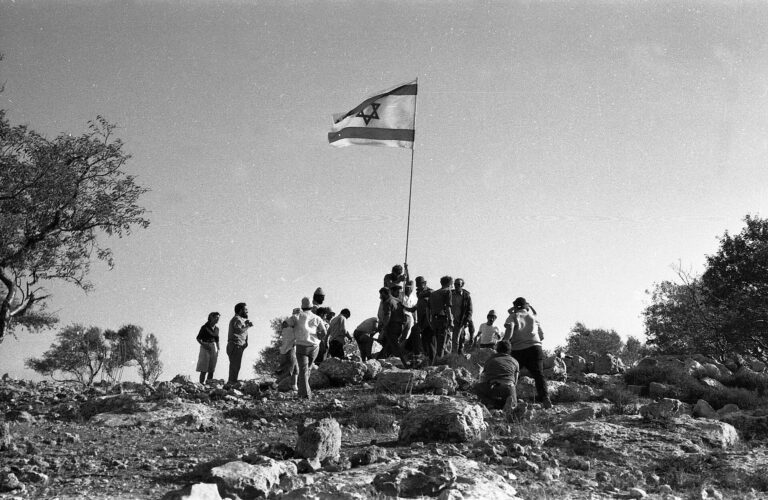
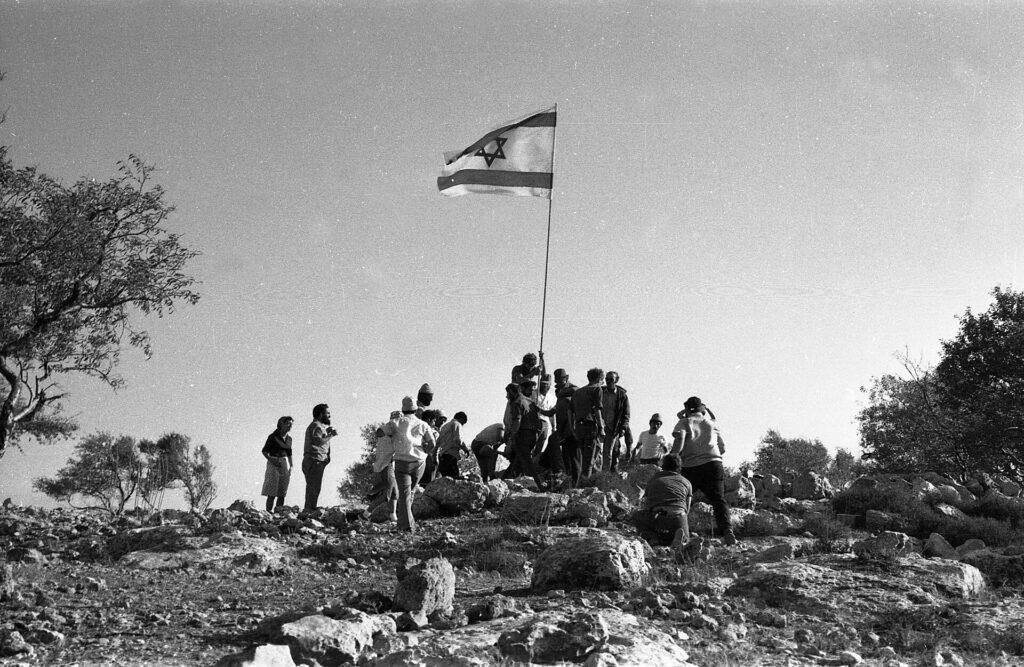
Photo by Asher Koralik, Dan Hadani collection / National Library of Israel / The Pritzker Family National Photography Collection (CC-BY-4.0)
The campaign for the next Israeli Knesset is unfolding in two contexts. One is the shadow of conflict and failure: populist judicial reform that brought hundreds of thousands of protesters into the streets from January to October of 2023, the Hamas attacks of October 7, 2023, and the devastation of Gaza. More recently, there have been two wars with Iran, the second sold as the removal of an existential threat that nevertheless remains intact. Israel barely has any voice in the conduct of the war it helped launch nor in the negotiations to end it. Furious voices from across the political spectrum blame a prime minister who overpromised, an American president who sold out his ally, a hard-right government caught out by events, and even a gullible electorate.
There is a second context, however: the possibility that a sizable element in the Israeli government welcomes disaster as progress rather than defeat. Its leaders sit in the cabinet, direct the Shin Bet counterintelligence agency, and populate the officer corps through its pre-military academies, having advanced over the past two decades through calibrated leverage of the administrative state; political mobilization has delivered access at the highest levels. The ideology has an American counterpart: dominionism, a framework that “made the contemporary Christian Right possible.”
To the dominionist theologian, the nation itself becomes the redemptive instrument, and loyalty to a providentially chosen political order replaces scriptural fidelity as the mark of faith. Religious nationalism can accept worldly defeat without abandoning its faith; dominionism treats worldly triumph as faith fulfilled, and worldly defeat as a stage in the same redemption. Dominionism marries religious authority to political power and displaces democratic accountability with a redemptive claim. Scholars have paired American and Israeli religious radicalisms since the 1990s, as fundamentalisms, as messianisms, and as religious nationalisms. Those pairings follow what the movements believe and await; dominionism follows what they do to the state.
In a world of nation-states, at least forty-three enshrine an official religion; others define nationality in ethnic terms. They cover the full range of regime types. An established church coexists with elected government in liberal democracies like Denmark; Israel, an ethnic-national state, is the only one in its region that the Varieties of Democracy Institute still classifies as an “electoral democracy,” but no longer a “liberal democracy”; at the other end, Iran, Saudi Arabia, and a post-2021 Afghanistan under clerical decree rank among the world’s most autocratic. But whereas religious nationalism valorizes the nation and its people, assigning them a sacred role in history, dominionism makes the institutional state itself the vehicle of its eschatological vision.
From Indicator to Instrument
Just as Christian dominionism has become the loudest voice for American nationalism, Jewish dominionism has claimed the mantle of Zionism, the movement that sought and won a Jewish state on political grounds. The two are not the same, nor is dominionism synonymous with religious Zionism, for which statehood may be an indicator of national redemption but is not its instrument. As Aviezer Ravitzky showed, early religious Zionists like Rabbi Isaac Jacob Reines fused faith and nation but defined Zionism in political rather than redemptive terms. While the pre-state Ashkenazi Chief Rabbi Abraham Isaac Kook saw the secular Zionist return to the land as a leading sign of redemption, his son Zvi Yehuda later read the new State of Israel as its actually enacted next stage.
Jewish dominionism, through Zvi Yehuda Kook’s followers, was born after Israel’s withdrawal from Quneitra in 1974 and emerged as a political force after Israel’s 2005 withdrawal from Gaza and the Gush Katif settlement bloc. Rabbi Avraham Shapira, who headed Rabbi Kook’s yeshiva, condemned it as apostasy, as did Mordechai Eliyahu, a former chief rabbi and eulogist of Meir Kahane, whose Kach movement was barred from the Knesset under a 1985 Basic Law amendment against incitement to racism and outlawed as a terrorist organization after the 1994 Hebron massacre. A religious nationalist can accept defeat, reluctantly—Jewish life and lawful sovereignty weighing more than the land—and hope for a future return, but the dominionist reads the state and its conquests as redemption already underway.
Dominionism interprets upheaval, whether territorial or geopolitical, as a stage in a redemptive process rather than a risk to be managed; catastrophe and progress toward the messianic age are the same program. Its government ministers openly state this messianist reading, and the yeshivas that trained them supply its rationale. The capture inverts political Zionism’s founding order and, by crowning an incomplete messianic redemption, deviates from the religious Zionist concordat with the established state. Premature coronation has a recurring religious history, and the same ending every time: a crushed messianic promise. A false messiah asks the faithful to call an unredeemed world redeemed, to read every outcome, victory or ruin, as redemption both immanent and imminent. Within the dominionist frame, the State of Israel itself has become that false messiah.
The role of the false messiah is so familiar in Jewish history that Jewish scholars codified safeguards against it: Maimonides ruled in the Mishneh Torah, his legal code, that a claimant is presumed the messiah by fidelity to Torah law and by fighting divinely ordained wars but is confirmed only after he builds the Temple and ingathers the dispersed of Israel. Gershom Scholem called Jewish messianism a theory of catastrophe, its disasters built into the idea rather than accidents that befall it; the false messiah fails, and in failing takes his adherents with him.
Viewed through this eschatological lens, the distinctions between religious nationalism and dominionism can be seen to hold across democratic process, the security calculus, and the tradition itself. Religious nationalism degrades the process, tilting law and franchise toward the favored group while still submitting to elections it can lose; dominionism voids it, since a state cast as redemption’s instrument owes voters nothing. Religious nationalism raises the price of every territorial trade; dominionism strikes concession from the ledger and counts escalation as progress. Religious nationalism conscripts the tradition, bending study and symbol toward the flag; dominionism consumes it, leaving the state as the last object of devotion. Loyalty to the idea of Israel becomes the whole of Jewish content, everything else measured against it.
Seizing the State
Dominionism rarely seeks to win through public debate and persuasion. Instead, it quietly captures the institutions that form the next generation. American Christian Reconstructionism has reshaped the evangelical world through curricula, homeschool networks, and credentialing, as Julie Ingersoll has documented; this strategy extends to military chaplaincy and worship services. Weeks after Douglas Wilson, a Christian Reconstructionist pastor and influential leader in dominionist circles, preached at the Pentagon worship service instituted by his congregant, Defense Secretary Pete Hegseth, complaints alleged that “high-ranking officers [were tying the campaign against Iran] to fulfilling a Christian prophecy.”
No less than for its Christian counterpart in the U.S., Israeli Jewish dominionism seeks political and religious power through state capture. Rabbi Zvi Thau, who espouses a neo-Kookist vision of the State of Israel as “God’s throne in the world,” has built a network of seminaries, pre-military academies, and a far-right anti-LGBTQ political party called Noam. Rabbi Yigal Levinstein, with Thau’s student Rabbi Eli Sadan, co-founded the Bnei David pre-military academy, which prepares young orthodox and ultraorthodox men for mandatory national service. The patriarchal parallels follow: Hegseth opposes women in combat; Levinstein calls a woman commanding a company “fit for the madhouse.” After the disillusionment of the 2005 Gaza disengagement, Sadan directed Bnei David devotees to enter the military, the security services, and the police, and in the process populated the officer corps with emergent dominionists. The academies are recognized and funded under the Knesset’s 2008 Mechinot Law through the education and defense ministries, and Bnei David draws that funding; the capture proceeds through public law and public budget. Among Bnei David’s 6,000-plus graduates are IDF generals, including the head of Central Command. David Zini, shaped by Thau’s institutions and Shin Bet director since 2025, retconned Israeli history, telling colleagues that “we are all messianic, like Ben-Gurion and the founding fathers.”
Bezalel Smotrich, Israel’s finance minister, who since February 2023 also has held delegated authority over civilian affairs in the occupied West Bank through a second post in the defense ministry, says the State of Israel will “return to be governed as it was governed in the days of King David and King Solomon by Torah law.” And because dominionists like Smotrich believe regional war advances such redemption, escalation is welcomed. Smotrich himself casts the war as “the process of redemption” and “the conquest of the land.” At Sadan’s academy, Rabbi Eliezer Kashtiel teaches that the greater the destruction, the nearer the footsteps of the Messiah, and cites Abraham Isaac Kook: “When there is a great war in the world, the power of the Messiah awakens.”
Smotrich sits in the cabinet alongside Itamar Ben-Gvir, heir to Kahane’s banned Kach movement and now minister for national security. Their two parties cut a coalition deal, not only with Likud and the nationalist right, which seeks to take control of even more Palestinian land and govern illiberally with as little theology as possible, but also with the Haredi parties, which await the messiah while leveraging the secular state for yeshiva funds, draft exemptions, and religious control. Kahane wrote in 1978 of “Jewish dominion over the Christian holy places” as Kidush Hashem, sanctification of the divine name, dominion defined at the origin as control over the sacred space of religious others. From Kahane comes the sacralization of power; from the Kookists, the capture of institutions; the combination provides leverage and power.
Removing the Brakes
Both Christian and Jewish dominionisms divide the nation into a chosen people and everyone else. The insider-outsider binary identified in American Christian nationalism—the nation belonging to a divinely chosen group while others occupy it on sufferance—operates identically in Israel. Smotrich’s Decisive Plan, grounded in the Book of Joshua, declares that “there is no room for two national movements in the State of Israel” and offers Palestinians one of three choices: residency without citizenship, or subsidized emigration, or force against those who continue armed resistance; all are expected to “[come] to terms with the new reality.” Thau has called them “the biblical Philistines,” with “no self-contained moral, historical or ideal content.” Displaying a map of an imagined Israel that absorbed not only the West Bank but also Jordan, Smotrich has stated the premise outright: there is “no such thing as a Palestinian people.” This was more than an echo of Golda Meir’s oft-summarized (but rarely reproduced in full) 1969 denial of historic Palestinian nationhood; it was an expansion to a biblical vision of manifest destiny that parallels the Puritan erasure of indigenous Americans, most recently visible in Hegseth’s declaration that the twenty Medals of Honor awarded for the 1890 Wounded Knee massacre would stand, overriding a Pentagon review. The nationalist and dominionist forms of this denial rest on different grounds: Meir’s nationalist claim was about history, that any modern Palestinian identity is too recent to outweigh historic Jewish claims; for dominionists it rests on ancient scripture, specifically Joshua, who orders any prior inhabitants to be cleared from the promised land.
Dominionism holds two postures toward the institutions it inhabits: capture and repurpose, or reject and replace. Just as Christian dominionism makes room for multiple paths to shared ends, the Jewish form accommodates both those who leverage existing institutions to build an illiberal populist “democracy” and those who truly reject those institutions from the antidemocratic theocratic ultranationalist Right. Dominionism advances by dissolving protective legal norms. It partners with ultranationalism to take Palestinian land by removing the state’s nominal institutional brakes and by arming, accompanying, and shielding from prosecution the settler squads on whose violence the state has come to rely; it is hard to miss the parallel to the pardoning of American January 6 defendants, many of whom were organized in part through spiritual-warfare networks. Israeli settler emergency squads and regional defense units carry army-issued weapons; their members often police the areas where they live.
The UN Commission of Inquiry in 2026 called the fusion “a de facto collapse of the distinction between settlers and soldiers.” The distinction between crime and enforcement has blurred as well: Yesh Din long has documented that 93.6 percent of police investigations into ideologically motivated crimes by Israelis against Palestinians close without indictment, a systemic non-enforcement the International Court of Justice in 2024 found inconsistent with Israel’s obligations as the occupying power. Settler violence through the spring and summer of 2026 has reached the highest pace tracked by United Nations monitors—an average of six attacks a day, more than a thousand by mid-June across more than two hundred and thirty Palestinian communities, from destroyed farms to the forcible displacement and emptying of whole West Bank communities. Under dominionist pressure, the state has erased even its own line between legal and illegal growth: settlement expansion is now at its fastest since the United Nations began tracking in 2017, with dozens of once-unauthorized outposts retroactively legalized, several of 2025’s fastest-growing settlements among them. Since the 2005 disengagement, and sharply since 2023, the enterprise has been rewritten in redemptive terms and hastened accordingly; in an April 2024 cabinet meeting Smotrich named three Gaza towns for “total annihilation,” citing the commandment to blot out the remembrance of Amalek.
Modern security cordons and political borders give way to biblical mandates. Joshua supplies the command: land the chosen are ordered to take is empty by definition and to be cleared of prior claim, whether to property or even life itself. The explicit biblical mandate is not unique to Israel: in 2025 the U.S. Department of Homeland Security set recruitment videos for its immigration raids to Proverbs and Isaiah, government speech affixing scripture to the state’s police power.
Contesting Zion
The widening gap between Zionism in principle and Zionism in practice, as Jay Michaelson puts it, tests whether an ethnonationalist state can deliver equal justice. What erodes a liberal democracy is the exclusion of a permanent resident population from the demos—a spectrum that spans from Estonia, which in 2025 amended its constitution to strip non-citizen residents, chiefly Russian-speakers, of the local vote, to Myanmar’s denationalized Rohingya and the non-citizen Palestinians under open-ended Israeli military rule and settler violence. Israel’s Declaration of Independence promised complete equality of social and political rights to all its inhabitants, irrespective of religion, race, or sex, a promise Israeli courts read as interpretive rather than binding. From the start, the Israeli government not only has granted Jews a privileged status but also has declined, for nearly eight decades, to codify that equality for its non-Jewish citizens, and has imposed martial inequality on those living outside of its de jure boundaries. Its 2018 Nation-State Law gave that asymmetry constitutional form, declaring national self-determination in Israel “unique to the Jewish people,” with no accompanying guarantee of equality for anyone else. A March 2026 law made death the default sentence in military courts for Palestinians convicted of deadly terror attacks; Israeli citizens, tried in civilian courts, are exempt.
Under pressure from all sides, the terminology of “Zionism” itself, so critical to Israeli self-identity, no longer may hold stable content. In 2004, fourteen months before Israel dismantled its settlements in Gaza, the movement’s official platform added, for the first time, “settling the country as an expression of practical Zionism.” In the years that followed, dominionism, which brooks no compromise, has seized on the ambiguity, offering certainty. Since then the word has been weaponized by right and left, each for its own ends, and Israel’s small-d democrats and their supporters are caught between a right that brands them traitors and a left that brands them collaborators. The dominionist right wields it against Jews who will not pay fealty, insisting that whoever or whatever will not call itself Zionist can only be understood as an enemy: when the state itself is sacred, every opposing position reads as blasphemy. Antizionism is glad to agree with the premise: a Zionism that means only conquest and redemption is the easiest thing to oppose. Likely casualties: security-minded liberalism, democratic-camp politics, diaspora Jews who reject the word but not the state, shared-society movements that reimagine the meaning of Jewish national sovereignty without the triggering baggage of the term.
Whichever coalition emerges in government after October, the assignments of delegated West Bank authorities, the police ministry, and the military courts will show whether the capture consolidates or recedes. The stakes could not be higher, as Zionism continues to be pressed by a right that finds it insufficiently redemptive and a left that finds it insufficiently just. Underneath lies a decades-old fault line: whether the Israeli state—and any possibility for a coexistent Israel and Palestine—is a contestable political object or a sacred instrument of eschatology. The false messiah is dominionism and the state it sacralizes, and neither religious nor secular Zionism; each of those positions can oppose dominionism without renouncing Jewish statehood. But like every false messiah before it, Jewish dominionism has gathered genuine devotion, made ever-increasing demands on that devotion, and now risks the same collapse that ended every predecessor. ♦

J. Shawn Landres holds a doctorate in religious studies from UCSB, where he designed and taught a Law & Society course on religion, policy, and the public sphere, and a master’s in social anthropology from Oxford. Among other volumes, he has co-edited After The Passion is Gone: American Religious Consequences (AltaMira 2004) and Religion, Violence, Memory, and Place (Indiana UP 2006). He wrote a chapter on Jewish communities for the Oxford Handbook of Global Religions (Oxford UP 2006).
Recommended Citation
Landres, J. Shawn. “When the State Becomes Messiah: The Rise of Jewish Dominionism.” Canopy Forum, August 13, 2026. https://canopyforum.org/2026/08/13/when-the-state-becomes-messiah-the-rise-of-jewish-dominionism/.
Recent Posts