Christianity and Constitutionalism at the American Founding: An Introduction
Nathan S. Chapman
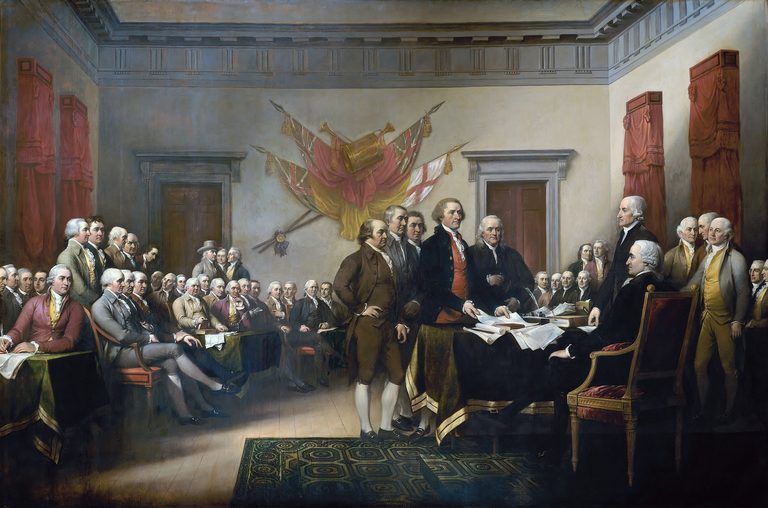
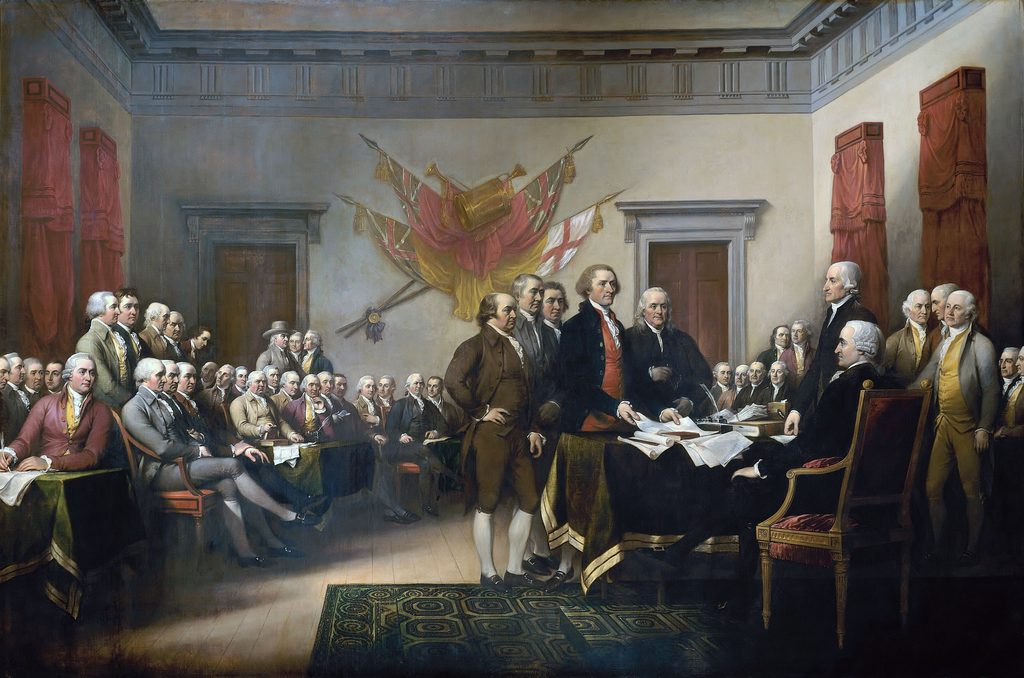
Declaration of Independence by John Trumbull, Wikimedia Commons (PD-US).
This article is part of our series on the 250th Anniversary of the Declaration of Independence.
Americans approaching the religiosity of the founding must begin by resisting the temptation to read our present cultural and political disputes, so often draped in claims about national identity, onto the intellectual influences and motivations of the founders. Those hunting for evidence of “common good constitutionalism,” a “godless Constitution,” a “Christian founding,” “providential republicanism,” a “high and impregnable wall” separating church and state, or “white Christian nationalism” can find it. But none of our ideas were theirs—at least not exactly. Most historians now agree that Protestantism was among an array of intellectual streams that fed the river of early American political thought. Yet the influence of Christianity on American constitutionalism, in particular, remains contested, misunderstood, and underexplored.
This essay briefly explores three facets of the relationship between Christianity and early American constitutionalism. The first is that the prevalent religious beliefs and practices of American Patriots offered powerful theological and anthropological support for popular sovereignty and republicanism. The second is that Americans often integrated constitutional arguments from divine and natural law with liberalism, republicanism, and the English customary constitution. This makes it difficult, and in some cases anachronistic, to assign different constitutional ideas to different intellectual influences. The third is that Protestant thought had a limited direct influence on written constitutions. Some states softly established Protestantism or Christianity. Ironically for those pining for a more expressly Christian America, though, Christianity’s most enduring influence on the U.S. Constitution has been the provision of equal religious liberty for all.
Protestant Belief and Practice at the Founding
Most late eighteenth-century Americans did not clearly distinguish Christian and “secular” political beliefs. Despite doctrinal and ecclesiological diversity among Protestant groups, Americans shared theological commitments and denominational practices that mutually reinforced a distinctly American version of liberal republicanism.
Central to American Protestant theology was an emphasis on personal responsibility for salvation. Consistent with their Calvinist roots and concentrated by waves of local religious revivals, Americans of the late eighteenth century increasingly agreed that salvation depended upon a personal response to the gospel based on hearing the preaching of the Word and searching the Scriptures. Common sense morality buttressed the priority of personal religious interpretation.
This evangelical soteriology had several important corollaries for political theology. The emphasis on personal responsibility supported the ecclesiastical influence of laymen, even for Congregational churches in New England that had historically been dominated by clergy. Historians disagree about rates of church membership and adherence, but it is fair to say that by the time of the Revolution, most Americans had been shaped by a religious culture that emphasized democratic control of church structure and doctrine. Their theology and ecclesiological experiences dovetailed with republican self-governance and liberal individual rights.
American evangelical notions of salvation also formed the basis for the American understanding of the natural right of conscience, which itself formed the principal theoretical foundation for religious liberty. Following John Locke’s case for toleration, many Americans rooted their claim for religious liberty in the natural and divine duty to obey God according to personal conviction. The corollary of that duty was a natural and divine right to worship God according to conscience. As Connecticut minister Elisha Williams put it, the “natural right of judging . . . in matters of religion” arises from “an indispensable obligation to search the scripture” “to make the best use of it” for one’s “own information in the will of God, the nature and duties of Christianity.” “A Christian is to receive his Christianity from Christ alone,” Williams argued, because “Christ be the Lord of the conscience, the sole King in his own kingdom.” This right was limited by the natural rights of others and the demands of public peace, but for Americans it would eventually foreclose one of the central features of western constitutionalism: an establishment of religion.
Though they emphasized the natural right of conscience, Americans believed deeply in the providence of God over the affairs of nations. New Englanders had inherited a constitutional tradition of covenantalism—the belief that political authority arises from covenants among the people, the civil magistrate, and God. That legacy has clear resonances with popular sovereignty and written constitutionalism. But providentialism had another implication for American constitutionalism. It demanded public piety, at least in the form of official declarations of thanksgivings, confessions, and petitions for divine favor, all of which were common among the states and federal government during the early republic. These were not seen as infringing the private rights of conscience, but as discharging the community’s natural and divine duty to recognize the sovereignty of God.
The American Paradigm of Constitutional Thought
Protestant political theology fed into a paradigm of constitutional thought that also included, among other things, Lockean liberalism, civic republicanism, and English customary constitutionalism. In many early American constitutional arguments and instruments, the four are difficult to disentangle. Election day sermons read the Scriptures in light of Lockean social contract theory, representative committees adopted constitutional statements that married Scripture and republicanism, and state constitutional provisions presumed, and sometimes expressly noted, the importance of Christian formation for the success of a republican form of government.
Many American constitutional thinkers blended liberalism, republicanism, the English constitution, and Christianity. Consider examples from different states, one before and one after the Revolution. The Boston Committee of Correspondence’s 1772 The Rights of the Colonists was drafted by Samuel Adams, Joseph Warren, and Benjamin Church; was presented to the Boston public by James Otis; and was republished by Benjamin Franklin. The pamphlet’s argument had three parts. The first, “Natural Rights of the Colonists as Men,” included the rights to life, liberty, and property, along with the right to support and defend them. All of these derived from “the duty of self-preservation, commonly called the first law of nature.” People retain all the natural rights they had “not expressly given up, or from the nature of a social compact, necessarily ceded.” These rights include the “right peaceably and quietly to worship God according to the dictates of . . . conscience.” To support the natural right of conscience, the pamphlet claimed that “it is now generally agreed among Christians that this spirit of toleration, in the fullest extent consistent with the being of civil society, is the chief characteristical [sic] mark of the Church.” This was Lockean natural rights for a Protestant political community.
Under the heading “The Rights of the Colonists as Christians,” the pamphlet argued for the right of conscience on the basis of both Holy Scripture and the English customary constitution, from the Magna Carta of 1215 to the Toleration Act of 1688. The final section, “The Rights of the Colonists as Subjects,” asserted a variety of rights under the customary constitution as understood by Whig ideology, especially the rights to self-determination and to actual representation for consent to taxation.
Consider next the post-revolutionary Virginia Act for Establishing Religious Liberty. Drafted by Thomas Jefferson and championed by James Madison, the Act clarified that “the natural rights of mankind” prohibited mandatory attendance or “support” for “any religious worship, place or ministry.” The preamble rooted the prohibition in Protestant soteriology and epistemology. “Almighty God hath created the mind free [and] all attempts to influence it by temporal punishments or burthens, or by civil incapacitations, tend only to beget habits of hypocrisy and meanness, and are a departure from the plan of the Holy Author of our religion, who, being Lord both of body and mind, yet chose not to propagate it by coercions on either, as was in his Almighty power to do.” The Act also sounds in the equality of citizenship, asserting that mandatory tithes “deprive [citizens] injuriously of those privileges and advantages to which in common with [] fellow citizens [they] have a natural right.” American constitutional reasoning throughout the early republic wove together Protestant beliefs with republicanism, liberalism, and English constitutionalism.
State and Federal Constitutions
American revolutionary arguments gave birth to written state and federal constitutions. American Protestant commitments to personal responsibility and self-government were reflected in the processes of state constitution creation. The electors in each state, through representative assemblies, debated and enacted their own constitutions and, eventually, ratified the United States Constitution.
Many state constitutions illustrated the Protestantism of the people. Several of them merge Christian providentialism and republicanism by expressing gratitude to God for allowing them to voluntarily enter into a constitutional compact. The Preamble of the Constitution of Pennsylvania (1776), for instance, “confess[es] the goodness of the great Governor of the universe (who alone knows to what degree of earthly happiness mankind may attain, by perfecting the arts of government) in permitting the people of this State, by common consent, and without violence, deliberately to form for themselves such just rules as they shall think best, for governing their future society.”
States also sought to secure what they perceived as the benefits of Christianity. The New England states asserted that religion or religious liberty was necessary to promote civic virtue (see the Vermont Constitution, Section XLI (1777) and the Massachusetts Constitution, Article III (1780)). The federal Northwest Ordinance (1787), too, provided that “religion, morality, and knowledge, being necessary to good government and the happiness of mankind, schools and the means of education shall forever be encouraged.” The Delaware (1776), South Carolina (1778), Vermont (1777), and Georgia (1777) constitutions also restricted public office to those of a particular religion; six constitutions guaranteed equal rights only to those with Protestant or Christian religious beliefs; and South Carolina’s went so far as to declare the “Christian Protestant religion” “the established religion of [the] state” (Art. XXXVIII, 1778).
The U.S. Constitution, by contrast, is less overtly Christian than the early state constitutions. The drafters followed the dating convention of the day by signing it “the Seventeenth Day of September in the Year of our Lord one thousand seven hundred and Eighty seven.” The legislative procedures, too, assume that America would be a Christian society by exempting Sundays from the “ten Days” for the President to veto a bill. Otherwise, the U.S. Constitution does not expressly mention or even allude to Christianity, God, or Providence. Some Americans, including some New England Presbyterians, objected to the Constitution’s lack of “explicit acknowledgment of the only true God and Jesus Christ whom he hath sent.”
Yet the U.S. Constitution certainly reflects the influence of Christianity on American notions of natural rights, popular sovereignty, and republicanism. The Preamble declares the intention of “We the people” to “secure the Blessings of Liberty to ourselves and our Posterity.” In light of the preamble to the Declaration of Independence and similar provisions in state constitutions, this would have been understood by most Americans to refer to the divine and natural rights of life, liberty, and property. The Constitution goes on to specify the republican, liberal, and customary mechanisms that would channel national sentiment into a form of limited self-government. In particular, the Constitution reflected a capacious view of religious liberty. Unlike most state constitutions, it forbade religious tests for “any Office or public Trust under the United States.” It also accommodated officeholders who were conscientiously scrupulous of oaths by permitting them to express their support for the Constitution by affirmation.
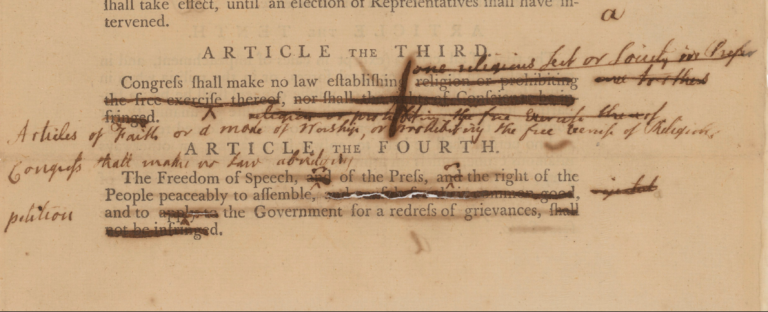
The Establishment and Free Exercise Clauses of the First Amendment further guaranteed that the federal government would make no law “respecting” an establishment of religion or prohibiting its free exercise. The Constitution had not expressly given the federal government the power to make either sort of law, of course, but the First Amendment clarified that it could not do so through the incidental use of one of its enumerated powers. Altogether, the Constitution secured against the federal government the “civil and religious liberty” demanded by American Patriots.
Over time, Americans came to agree that an establishment of religion by a state, too, was inconsistent with the natural and divine rights of conscience. States accordingly abandoned religious tests and civil and religious privileges for Christians, Protestants, and theists. The Supreme Court in the mid-twentieth century interpreted the Fourteenth Amendment of the U.S. Constitution to apply both of the Religion Clauses of the First Amendment to the states, further guaranteeing the rights of conscience against them.
Conclusion
Christianity organically and dynamically shaped early American constitutionalism, from the Revolution to state constitutions to the U.S. Constitution. But its ultimate effect was neither to ensconce Christian piety in American constitutional law nor to privilege Christianity in American society. Instead, it inspired constitutions that emphasized personal responsibility, civic virtue, and popular sovereignty over ancient privileges of political and ecclesiastical class. It also secured religious liberty over conformity to the government’s preferred religion. This has provided a framework for centuries of political, cultural, and constitutional battles over secularization, separation of church and state, and the influence of Christianity on public policy. Justice Douglas’s assertion in Zorach v. Clauson, though written in 1952, accurately captures the founders’ understanding: “We are a religious people whose institutions presuppose a Supreme Being. . . . We sponsor an attitude on the part of government that shows no partiality to any one group and that lets each flourish according to the zeal of its adherents and the appeal of its dogma.”

Nathan S. Chapman is Associate Dean for Faculty Development and A. Gus Cleveland Distinguished Chair of Law at the University of Georgia School of Law. He is the author, with Michael W. McConnell, of Agreeing to Disagree: How the Establishment Clause Promotes Religious Pluralism and Protects Freedom of Conscience (Oxford University Press, 2023).
Recommended Citation
Chapman, Nathan S. “Christianity and Constitutionalism at the American Founding: An Introduction.” Canopy Forum, October 16, 2026. https://canopyforum.org/2026/10/16/christianity-and-constitutionalism-at-the-american-founding-an-introduction/.
Recent Posts