Building a Mountain Too Steep to Climb
Steven T. Collis
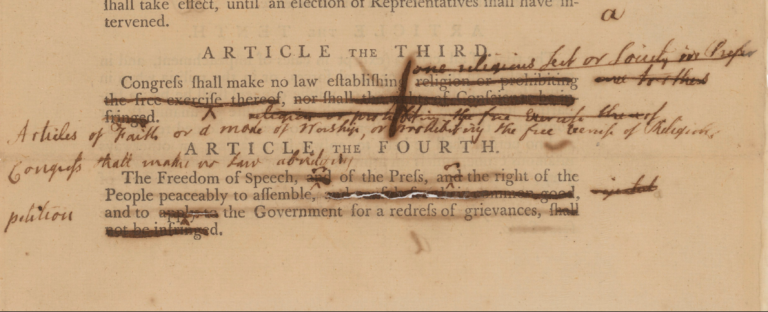
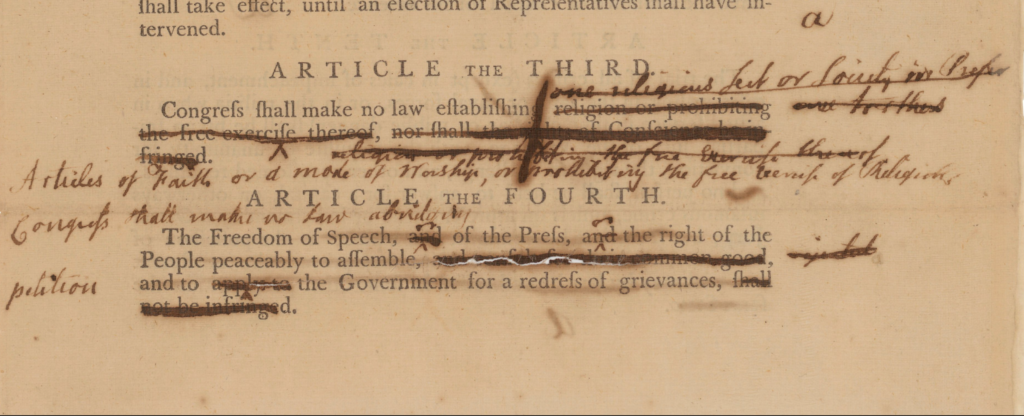
Senate Revisions to House Proposed Amendments to the U.S. Constitution, National Archives (US-PD)
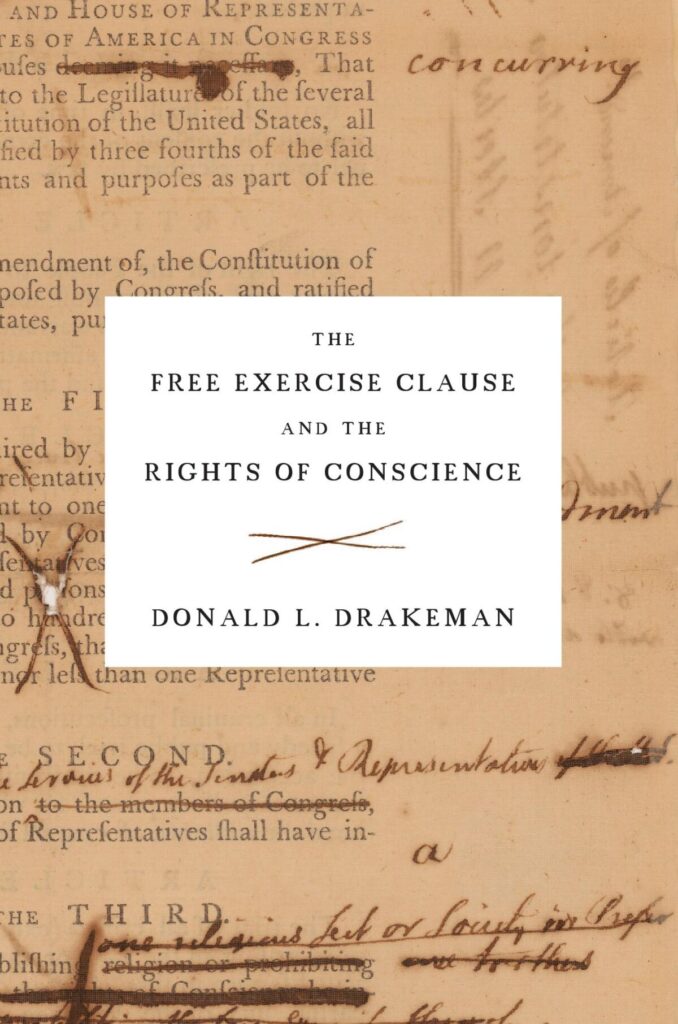
On October 15, Canopy Forum, hosted by the Center for the Study of Law and Religion, held an online book symposium regarding Donald L. Drakeman’s upcoming book, to be published November 2026, titled The Free Exercise Clause and the Rights of Conscience (Harvard University Press, 2026). The following is a review essay of Professor Drakeman’s book written in anticipation of the symposium.
I read Donald Drakeman’s The Free Exercise Clause and the Rights of Conscience with great interest, in part because his central claim is so provocative. Because this is an essay for an online roundtable with strict word limits, I will not provide a summary of the book here. I also cannot come close to presenting my many thoughts and feelings about its subparts. Given the constraints of the forum, this essay is more an impression than a review.
Drakeman’s primary claim is a bold one: that newly discovered historical documents prove the phrase “free exercise of religion” is a term of art meaning only public worship (2). According to Drakeman, no other original meaning is possible and this meaning did not change from antiquity to the end of the long nineteenth century (105). Drakeman’s claim is massive, spanning one and a half millennia, and thus the magnitude of the evidentiary burden he must overcome is equally immense. For me, he has not met it.
I welcome bold claims, and I appreciate Drakeman for not shying away from making one. It motivated me to dive into his book like an explorer on a treasure hunt. I was thrilled at the prospect of discovering new sources, persuasive new perspectives on what the “free exercise” of religion in the First Amendment means. I sought after this persuasive new evidence on each page, in each new chapter, with every turn.
What I found was disappointing. I am grateful for Drakeman’s intellectual honesty and his efforts “not to arrive at a predetermined interpretive goal” that aligns with his “own religious liberty policy preferences” (19). We need more of that attitude in the legal academy, but he did not provide the evidence I needed to reach the same conclusion he did. In fact, in many instances, the evidence he proffered seemed to persuade me of the opposite.
From Antiquity to the Founding: Religion and Regulation
What I was expecting after reading his introduction was a torrent of new cases and documents that state explicitly what Drakeman claims as his central thesis. What he provided were a few sources I had not seen before and an ocean of documents familiar to every scholar in the field that are, at best, unclear. At no point did I find any direct evidence that the phrase “free exercise of religion” was a term of art that concerns public worship only. Given the confidence of his claim, I would have expected clear and direct evidence of the founders or early judges agreeing on the term.
Instead, he first provides various phrases and comments, themselves translations from other languages, to try to prove his point (15-16, 45-57). His argument is that these phrases from antiquity to the founding prove free exercise always means public worship, in part because people were concerned about the suppression of public worship. I have no doubt that worship was a type of religious exercise that faced oppression, but that does not mean it was the only type that would have been protected.
As has been pointed out by other scholars, such as Douglas Laycock in his article “Free Exercise and the Religious Freedom Restoration Act,” the government at the founding and before did not regulate society nearly as much as it does today (884). It may well have been the case that one of the only forms of religious exercise facing regulation was worship because regulations did not extend much into other aspects of religious life. I am also skeptical about attributing to translations of ancient texts only one, definitive meaning. If we cannot agree on what a phrase meant in English roughly two hundred years ago, I am skeptical that we can be confident about the meaning of a translation from over one thousand, five hundred years ago.
Parsing the Terms: Differences of Interpretation
In many places, his evidence seems to contradict his thesis. Indeed, I read many of the passages he quotes very differently than he does. Again, because of space constraints, just one example will have to suffice. He cites the familiar Toleration Act of 1649 adopted in Maryland (64–65). He notes its declaration that no one who “believe[s] in Jesus Christ shall . . . [be] troubled, Molested, or discountenanced . . . in respect of his or her religion nor in the free exercise thereof” unless they “conspire against the civil Government.” Drakeman’s conclusion from this text is that the first dependent clause “in respect of his or her religion” means “liberty of conscience” and the second “nor in the free exercise thereof” means “public worship services” (65). Yet he provides no evidence of that conclusion other than to state it. It is just as plausible that the first clause bans discrimination based on religious status, and the second forbids interfering with various kinds of religious exercise.
Similarly, he reads much into the word “worship,” as if it was universally and always understood to be something that only happens in a church as a group. Yet much of the language he cites, such as the The New England Primer, explicitly notes that worship can be acts done both in private and public (12). Notice the very language Drakeman relies on: “The Sabbath is to be sanctified by . . . spending the whole Time in public and private Exercises of God’s Worship” (12).
Drakeman repeatedly places too much weight on various clauses that use the word “exercise” or “conscience” but that never actually make the distinction he suggests they make. Indeed, much of his evidence seems to blatantly contradict his fundamental premise that “free exercise” and “liberty of conscience” had distinct meanings among all people across wide swaths of time. Consider the New York Constitution of 1777: Drakeman cites it as proof of his thesis (86), but the text itself seems to treat “free exercise” and “liberty of conscience” as one and the same. Article 38 protects “the free exercise and enjoyment of religious profession and worship” but then warns, “the liberty of conscience, hereby granted, shall not be so construed as to excuse acts of licentiousness, or justify practices inconsistent with the peace or safety of this State.” In that provision, “liberty of conscience” refers back to “the free exercise and enjoyment of religious profession and worship.” It treats them as identical. Note also that “free exercise” applies to two objects: “profession” and “worship.” This suggests “free exercise” is more than public worship, yet Drakeman does not acknowledge any of this.
Conscience and Religion: Undefined, but Not Interchangeable
Consider also the debates over what is now the Second Amendment. Drakeman claims “conscience” not “religion” was called upon to refer to religious acts outside the worship context, but that was not true for the Second Amendment debates. I do not have the space to delve deeply into that topic here, but on June 8, 1789, James Madison proposed drafting language that stated: the “right of the people to keep and bear arms shall not be infringed; a well armed and well regulated militia being the best security of a free country: but no person religiously scrupulous of bearing arms shall be compelled to render military service in person” (451). The inclusion of the accommodation for religion triggered debate about how much to protect religion. This had nothing to do with public worship. It seems that if Drakeman is correct, Madison would have used the term “conscience” in the protections he tried to include instead.
In contrast to Drakeman’s conclusion, one point his evidence does suggest is that the “free exercise of religion,” “worship,” and “liberty of conscience” have always been used in undefined ways; sometimes as interchangeable terms, sometimes not. This undermines his most fundamental claim that the phrases are terms of art with clearly distinct and unchanging meanings. In example after example in his book, authors over the centuries seem to have used the terms in vague, unspecified ways, often referring back to one another, or sometimes implying meanings altogether different; no author provides the clear meaning Drakeman’s claim needs (12, 28–29, 45, 47–48, 49, 53, 55–56, 57–58, 59–60, 63–64, 65, 73).
On a related note, I also quibble with his claim that religious liberty scholars universally assume that the two terms hold the same meaning (21–22, 31, 33). My experience in the academic literature is that the difference between “conscience” and “religious exercise” has been debated for decades, and scholars often do not assume the terms share the same meaning. I note at least three distinct groups. Drakeman, creating his own group, argues that “free exercise” appears to mean only “religious worship services” while “conscience” means something else (102–03). In contrast, scholars such as Nelson Tebbe (280), Cecil Laborde, and Lawrence Sager argue that “rights of conscience” appear to include any acts or omissions stemming from any ethically salient deeply held belief, including many that most people would not consider “religious.” Others argue that the decision to leave “conscience” out of the Free Exercise Clause suggests that the clause should apply only to religion (12), not to a broader group of deeply held philosophical beliefs. Both of those latter groups see “conscience” as a broader category than “religion,” neither assumes they are the same, and neither agrees with Drakeman’s reading.
Drakeman’s Contribution
Once he reaches post-founding cases, Drakeman makes a semi-persuasive point that courts rarely protected religious exercise outside the sacrament of confession, but even that does not get him to his destination (109-12). First, the Catholic confessional cases involve what the judges called “sacraments,” not public worship. These cases do not support Drakeman’s thesis that the “free exercise of religion” means only public worship. Second, not one of those cases rests on the meaning of “free exercise of religion” that Drakeman gives it. The judges used all sorts of language to articulate their worries about granting religious exemptions, including the language of their state constitutions, but they did not base their rulings in Drakeman’s claimed definition.
Drakeman has persuaded me that, at times, the distinction between private and public worship seemed a paramount religious liberty concern. I am grateful for his deep dive into that issue and the unique sources he has drawn on to highlight it. His book will be a useful resource in that regard in the years to come, as will some of the sources to which he has drawn my attention.
Though he failed to persuade me of his central thesis, he has provided new resources, including methodological tools, that will contribute to scholarly and judicial efforts to determine the original meaning of the Free Exercise Clause. As I have said in other writings, I am not yet an originalist, so I do not feel bound by original meaning the way some principled originalists might. Nevertheless, I do believe that efforts to understand the original meaning are critical. Drakeman has provided a new and interesting way of considering it, which should prove fruitful in the years to come.
Conclusion
I appreciate Drakeman’s contribution to the literature and my thinking. However, in the end, the boldness and clarity of his thesis prevents me from joining him. If we cannot agree on what a single clause in the First Amendment meant at the time of its adoption roughly 230 years ago, it seems highly unlikely we can reach a consensus that other phrases, across multiple languages, from differing cultures, spanning centuries, all shared one, and only one, meaning. That is Drakeman’s claim. Its audaciousness is its undoing. ♦

Steven T. Collis is a Professor of Law, First Amendment Jurisprudence, and Civic Leadership (by courtesy) at the University of Texas at Austin. He is the founding faculty director of Texas’s Bech-Loughlin First Amendment Center.
Recommended Citation
Collis, Steven T. “Building a Mountain Too Steep To Climb” Canopy Forum, October 21, 2026. https://canopyforum.org/2026/10/21/building-a-mountain-too-steep-to-climb/.
Recent Posts