The Free Exercise Cat is Out of the Bag: Can History and Tradition Lure It Back In?
Whittney Barth
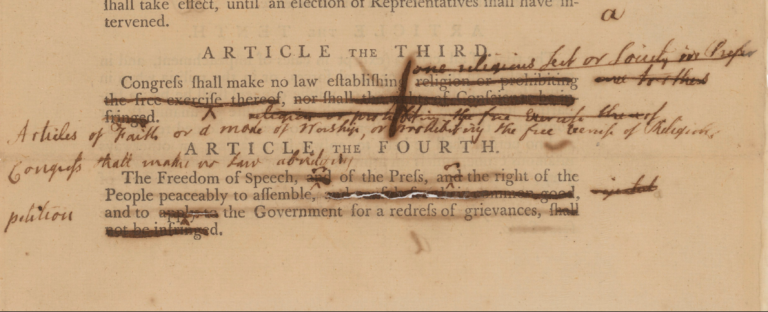
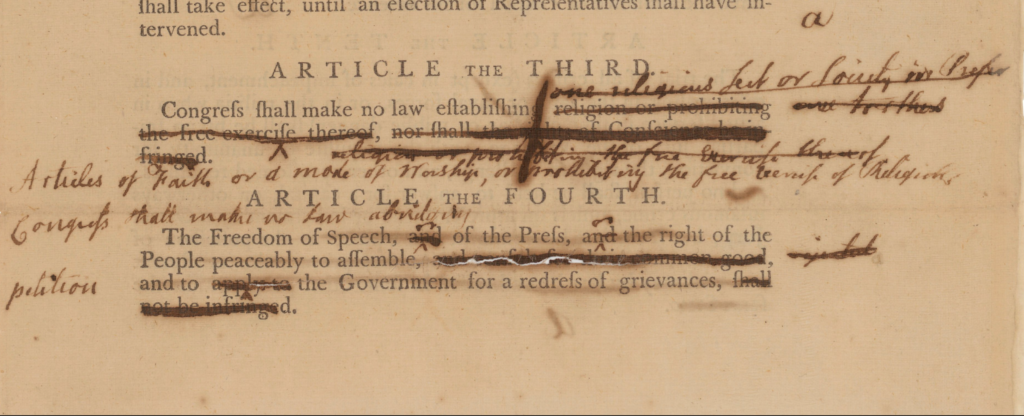
Senate Revisions to House Proposed Amendments to the U.S. Constitution, National Archives (US-PD)
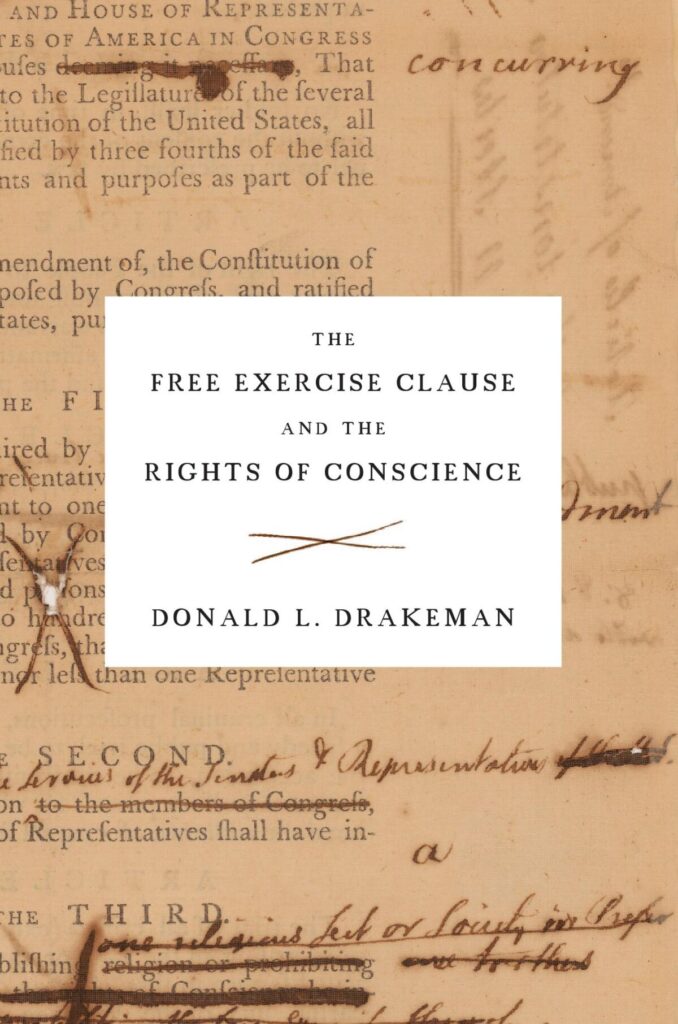
On October 15, Canopy Forum, hosted by the Center for the Study of Law and Religion, will be organizing an online book symposium regarding Donald L. Drakeman’s upcoming book, to be published November 2026, titled The Free Exercise Clause and the Rights of Conscience (Harvard University Press, 2026). The following is a review essay of Professor Drakeman’s book in anticipation of the symposium.
Donald Drakeman’s The Free Exercise and the Rights of Conscience is provocative and refreshing. It is provocative because it challenges much of the prevailing wisdom on the scope of the Free Exercise Clause, both within the courts and within scholarly debates. It is refreshing in its earnest attempt to grapple with history and tradition, even when the evidence may lead to policy outcomes the author himself may not embrace (19). Indeed, Drakeman’s “surprise” at his study’s findings comes through at different turns, belying a serious scholarly curiosity that is open to where the historical evidence leads.
Drakeman’s core argument, based on extensive historical evidence, is that “free exercise” was a term of art understood by the Founding generation to mean public worship and that meaning remained largely unchanged until the mid-twentieth century (20). But even for those who may view this argument as a historically sound way to reign in the excesses of modern Free Exercise doctrine, definitional and normative challenges loom. This essay raises three: First, if Congress and state legislatures relied on an understanding of the Free Exercise Clause that Drakeman now refutes to pass and to interpret statutes, how might these statutes be affected by these remarkable findings? Second, if an originalist understanding of “public worship” were to be adopted, would some religious groups fall permanently outside of free exercise protection based on whether eighteenth- and nineteenth-century jurists or lawmakers would view their practices as worship? And finally, would the specificity of “public worship” not only replicate but exacerbate courts’ entanglement in theological questions? This essay takes up these questions in turn.
First Amendment Foundations of Statutory Protections
Still wanting to protect a robust understanding of free exercise, Drakeman emphasizes the important place of the Religious Freedom Restoration Act (RFRA) in a future free exercise landscape. He not only concludes that RFRA would still apply but that he also argues that the Court could overrule City of Boerne v. Flores (1997) and bring strict scrutiny back to controversies involving states (156). In his telling, the Court would not have to grapple with Founding Era history because RFRA was enacted in 1993 and it “would be appropriate for it to look to the meaning of ‘religious exercise’ as that term was understood by Congress when it enacted RFRA in 1993” (156). This conclusion, however, underappreciates the foundational role a particular understanding of Free Exercise has played in several statutory schemes involving religion.
Like the generation that drafted what would become the First Amendment, the Congress that enacted RFRA was not operating from a blank slate. RFRA’s proponents embraced a particular understanding of the First Amendment’s Free Exercise Clause, one that is captured in a report from the Committee on the Judiciary to the House and urging the passage of RFRA. Report 103–88 explains the need for the statute by positing that the “clarity” of the Free Exercise Clause of the First Amendment “has not prevented government from burdening religiously inspired action” and pointing out that it was not until Sherbert v. Verner’s adoption of “the compelling interest test in the free exercise context [that] decisions more protective of religious liberty evolve[d].” The Report implicitly, if not explicitly, adopts a view of the Free Exercise Clause that Drakeman’s research calls into serious question. If the underlying premise of the statute is faulty, why should Congress or the courts allow it to remain good law?
Furthermore, the Court in City of Boerne held that Congress had exceeded its enforcement authority under Section 5 of the Fourteenth Amendment. RFRA was seen as too blunt an instrument to wield against states since Congress could point to no specific constitutional violation it was seeking to remedy or prevent with RFRA’s passage. If Drakeman’s understanding of the Free Exercise Clause limiting that Clause’s protection to public worship was adopted, why would the Court be any less critical of a second attempt by Congress to expand not only the relevant standard for adjudicating free exercise disputes but also the scope of free exercise itself?
As someone whose scholarship in law and religion spans both private and public law, I also found myself pondering what Drakeman’s work means for religion-related workplace protections. On the one hand, perhaps not much. Religion has been a protected class in the federal government’s antidiscrimination efforts since the 1940s and it is included in Title VII of the landmark Civil Rights Act of 1964. Those protections, which include religion among other protected classes, do not directly rely on the Free Exercise Clause for their existence. Yet, when it comes to religious accommodations in the workplace, should private employers be held to a higher standard than the state? After all, what are religious accommodations but exemptions to workplace policies and procedures that are often neutral and generally applicable.
Whose Public Worship?
Drakeman asserts that the Court’s decision in Employment Division v. Smith (1990), in which it held that neutral and generally applicable law that infringed upon religious practices did not violate the Free Exercise Clause, is much more closely aligned with history and tradition than the compelling interest-least restrictive means approach the Court had adopted mid-century (147). Yet he also notes that the controversy at the heart of Smith—the sacramental use of peyote—would be a “classic” Free Exercise challenge if we “return[ed] to the original meaning, history, and tradition of the Free Exercise Clause . . . ” because of its connection to worship (154). There are tensions here.
Applying a “history and tradition” approach, would a case involving indigenous religious expression—even when communal and within a ritual context that arguably looks a lot like public worship—have come within the purview of the Free Exercise Clause? That result would likely have been surprising to many eighteenth- and nineteenth-century lawmakers and jurists. One need only to look to historical accounts of government efforts to stamp out the Ghost Dance movement of the late nineteenth century to see how the public worship of some may be viewed as threatening to the state.
This, of course, leads to a broader question: How can or should a history and tradition approach account for the controversies that arise in an increasingly diverse society? One might turn in such instances to the Establishment Clause but, in an earlier work (discussed briefly in Chapter 6), Drakeman argues that historical evidence supports a narrower scope to the Establishment Clause, too. That clause, he argues, was limited to concerns about Congress setting up a “formal ‘Church of the United States’” (164). With both clauses so narrowly construed, Drakeman anticipates a potential “de-escalat[ion in] the First Amendment arms race” (164). But current controversies such as efforts to introduce a Protestant version of the Ten Commandments in public schools or anti-Sharia bills begin with the legislature–not with litigation in the courts. Rather than bring down the temperature on the arms race, narrowly interpreting the Religion Clauses might just as easily lead an equally divisive race to flourish, one that, in theory, may result in less protections for religious minorities.
Definitions and Theological Entanglements
Related definitional questions flow from both the above concerns. Since the nineteenth century, the Court has recognized that civil courts face unique challenges when adjudicating disputes involving religious actors, specifically when it comes to weighing in on theological matters or defining terms such as “religion” or, in the case of more recent ministerial exception cases, “minister.” Yet, definitions become necessary for agencies charged with enforcing the law and courts with adjudicating it. The Court of late has been sympathetic to corporate religious actors’ own conception of what constitutes religion. For example, in Catholic Charities Bureau v. Wisconsin Labor & Industry Review Commission (2025) a unanimous Court held that a state’s denial of benefits to a religious non-profit violated the First Amendment because the denial was based on the state’s view that operating “primarily for religious purposes” required proselytization or limitation of charitable services to fellow Catholics. Both requirements ran afoul of the group’s own theological commitments.
While courts and agencies aim to take a hands-off approach to deciding matters of theology, there are times when it must be determined whether a person’s actions count as “religion” or whether they qualify as a “minister,” because the answer to those questions has legal ramifications. And the guideposts agencies and courts have devised to determine these questions also have been influenced by the Court’s First Amendment-related jurisprudence, even in private law matters.
For example, just as Congress relied on the U.S. Supreme Court’s First Amendment jurisprudence in its passage of RFRA, so, too, have agencies like the Equal Employment Opportunity Commission (EEOC). The EEOC is the agency responsible for enforcing Title VII, a major antidiscrimination statute that includes religion as a protected class for the purposes of employment discrimination. The EEOC has adopted an intentionally broad definition of religion that takes guidance from the Court’s religion-related jurisprudence, even as the Court itself has not definitively ruled on what constitutes “religion” for the purposes of the First Amendment or for Title VII. For example, the EEOC highlights the Court’s broad construal of the “belief in a Supreme Being” requirement in U.S. v. Seeger (1965), a case involving a challenge to the denial of a statutory exemption for military service. The EEOC also points to Thomas v. Review Board (1981), a case in which the Court held that a Jehovah’s Witness could not be denied unemployment benefits for quitting a machine shop that had transitioned to only making weapons, work that violated his religion. The Court held that it did not matter that other Jehovah’s Witnesses worked at the shop without incident or that Thomas had difficulty articulating his beliefs.
Drakeman explains that, if his findings were adopted, the denial of unemployment benefits would no longer fall within the scope of free exercise (155). But his approach raises an even broader question for non-First Amendment cases: Would the underlying objection to manufacturing weapons even register as religion in the first place? If the phrase “free exercise of religion” is a term of art synonymous with public worship, there seems to be little room for acts of individual devotion or theologically-motivated abstention within First Amendment jurisprudence. But what about where private law applies? A narrowing of the Free Exercise Clause arguably would lead to a narrowing of the scope of Title VII’s protections, too. This may lead agencies and courts closer to adopting a conception of religion that is only (or at least most) cognizable when it is communal, as Mark Movsesian has advocated.
*****
This book is courageous and compelling. Recognizing that does not make its implications any less difficult, even for those of us who do not subscribe to a strict originalist approach to constitutional interpretation. Drakeman explains that one of the goals of the book was, post-Dobbs v. Jackson Women’s Health Organization, to employ “the same kind of ‘history and tradition’ analysis to the Free Exercise Clause” as the Court applied in Dobbs, a decision that invalidated the constitutional right to an abortion and returned the matter to the states (149). As with Dobbs, there no doubt will be costs if the Court were to take him up on his offer. The question remains: Are we willing to bear them? ♦

Whittney Barth is an associate teaching professor at Emory Law School and executive director and Charlotte McDaniel Scholar at the Center for the Study of Law and Religion at Emory University. She holds a JD from the University of Chicago Law School, MDiv from Harvard Divinity School, and BA from Miami University. Views expressed are the author’s own and do not necessarily reflect those of CSLR.
Recommended Citation
Barth, Whittney. “The Free Exercise Cat is Out of the Bag: Can History and Tradition Lure It Back In?” Canopy Forum, September 30, 2026. https://canopyforum.org/2026/09/30/the-free-exercise-cat-is-out-of-the-bag-can-history-and-tradition-lure-it-back-in/.
Recent Posts